
October 1641–February 1642
Part One ended with Domhnall Óg Ó Maol Phádraig of Aghakillymaud and his son Bryan Óg among the men associated with Rory Maguire in southern Fermanagh on 23 October 1641. The next stage of the story moves toward Cavan, where the surviving evidence becomes much more concentrated around the O’Reillys and, in particular, around one man: Philip mac Hugh O’Reilly of Ballynacargy.
Philip was not simply another local rebel leader. He was one of the most important Catholic landholders in County Cavan, a man who had worked within the Stuart political system before turning against it, and someone whose family stood near the centre of O’Reilly power. By the winter of 1641–42, Bryan Óg Ó Maol Phádraig and a substantial body of men bearing the same surname were operating within the same military sphere.
The relationship was not created at Belturbet. Ó Maol Phádraig connections with O’Reilly leaders can be followed backwards for decades, including one particularly interesting connection with Philip’s own Ballynacargy branch. In 1641 an old political association entered a very different phase as rebellion spread through Fermanagh and Cavan.
Philip mac Hugh O’Reilly of Ballynacargy
Philip mac Hugh O’Reilly was born in 1599, the son of Hugh O’Reilly of Ballynacargy and Katherine MacMahon. His father belonged to one of the important surviving branches of the O’Reilly dynasty after the collapse of the old East Bréifne lordship and the reorganisation of Cavan under English administration. Philip grew up in the generation immediately after the Nine Years’ War, when the old Gaelic political order had been badly weakened but many of its leading families were still wealthy, influential and deeply rooted in the local population.
Ballynacargy remained central to his identity. His father was one of the native Irish landholders who retained a substantial position under the Plantation settlement, and Philip eventually inherited the family lands. His early adult life was spent largely within the institutions established by the Crown rather than in opposition to them.
Contemporary sources described Philip as a lawyer, although no record survives of formal training at an English inn of court. He may have received legal training on the Continent and is also reported to have held a military command in France before returning to Ireland.
After his return he entered county government. Philip was a commissioner of the peace in 1625, sheriff of Cavan in 1629, and in 1640 was elected MP for County Cavan in the Irish parliament. He sat on the parliamentary committee that prepared accusations against senior government officials, including the lord chancellor, Sir Richard Bolton. Long before taking up arms, he therefore understood the machinery of law, parliament and county administration from the inside.
His marriage extended his network still further. Philip married Róisín, or Rose, O’Neill, sister of Owen Roe O’Neill, the experienced continental soldier who returned to Ireland in 1642 and became commander of the Confederate Ulster army. Philip was consequently connected not only to the O’Reilly gentry of Cavan but to one of the most important military families in Ulster.
By 1641 he stood at the intersection of the O’Reilly landed interest in Cavan, the surviving Gaelic aristocratic world and a much wider Catholic political and military network.
An O’Reilly family already known to Ó Maol Phádraig
The association between Ó Maol Phádraig and the Ballynacargy O’Reillys appears to pre-date Philip mac Hugh himself.
In 1593, six years before Philip was born, a pardon was headed by another Philip O’Reilly of Bellanacargy, esquire. That older Philip was a major figure within the O’Reilly dynasty and a son of Aodh Conallach O’Reilly, lord of East Bréifne from 1565 until 1583. Among the people named in the same pardon was Muircheartach Ó Maol Phádraig of Creeny.
The older Philip should not be confused with Philip mac Hugh of 1641. He belonged to an earlier generation and died in 1596. He had represented Cavan in the parliament of 1585, endured imprisonment and political conflict with the English administration, and became involved in the struggles for leadership within the O’Reilly dynasty during the years preceding the Nine Years’ War.
Muircheartach’s appearance in that 1593 pardon places an Ó Maol Phádraig man from the Creeny–Drumlane/Annagh country within the political environment of the Ballynacargy branch almost fifty years before Bryan Óg appears around Philip mac Hugh’s force.
No hereditary military relationship can be reconstructed from that record alone, and nothing yet establishes Bryan as a descendant of Muircheartach. The useful point is narrower: the Ballynacargy O’Reilly political circle already included an Ó Maol Phádraig man by the 1590s.
The pattern continues. In 1602 Conchobhar Ó Maol Phádraig, described as “Chief of His Name,” appears in a pardon involving Owen O’Reilly, likewise styled Chief of His Name. In 1604 Cowconaught, Domhnall Óg, David and Cormac mac Seán Ó Maol Phádraig of Dowra occur in a pardon headed by Maol Muire O’Reilly.
These records concern different men and different branches and should not be compressed into one family tree. Together they reveal a recurring political association between Ó Maol Phádraig households and O’Reilly leaders that was already several generations old by 1641.
Why Philip rebelled
Philip mac Hugh had much to lose in 1641. He owned land, held public office and represented Cavan in parliament. His participation in the rising came after years spent operating within the existing political order.
During 1641 he became involved in the conspiracy against the Dublin administration through Rory O’More, Owen Roe O’Neill and the wider Catholic political network surrounding them. The conspirators hoped that the crisis affecting Charles I in England and Scotland would allow Irish Catholics to secure substantial political and religious concessions and, for some, the recovery of lands lost through the Plantation.
When the rebellion began in October, Philip and his nephew Mulmore O’Reilly, then sheriff of Cavan, emerged as central figures among the Cavan insurgents. Philip was expelled from parliament. The Cavan leadership also produced a remonstrance setting out its grievances while continuing to profess loyalty to Charles I.
Versions of that language appear much farther down the local hierarchy in the depositions involving Ó Maol Phádraig.
8 January 1642: the same language among Ó Maol Phádraig
William Raicye’s deposition, taken on 8 January 1642, provides one of the clearest examples.
Raicye was a yeoman with interests in Galloon parish in Fermanagh and in Annagh, County Cavan. He described the seizure of his property by forces he associated with MacMahons and O’Reillys and reported words attributed to Breartagh Ó Maol Phádraig, a gentleman of Annagh parish.
According to Raicye, Breartagh claimed that the insurgents could show authority from the king and that a priest had instructed them that they might take the clothing and goods of Protestant settlers but were not to take their lives.
The statement attempted to place confiscation within an authorised political action while drawing a line at killing. That distinction would become increasingly difficult to maintain as the rebellion developed, but it was still being expressed in early January.
On the same day William Hoe of Kilconny in Drumlane named Hugh Ó Maol Phádraig alongside Shane Mulmore O’Reilly of Dromher, Shane O’Reilly of Carleconne and other local men in connection with his losses.
Here Ó Maol Phádraig and O’Reilly were not distant political allies acting through senior commanders. They were men from the same neighbourhood appearing in the same local force.
Thomas Ó Maol Phádraig of Corryvony and Hugh O’Reilly
The deposition of Frances and Thomas Lovett, taken on 26 January 1642, pushes that cooperation back to the opening days of the rising.
The Lovetts of Clonamery in Drumlane claimed that around 24 October 1641, only a day after the events at Aghakillymaud described in Part One, their property was taken by the servants of Thomas Ó Maol Phádraig of Corryvony acting with Hugh O’Reilly.
The servants reportedly said that the goods would be held while events developed. If peace returned the property could be restored; if it did not, they argued that it was preferable for them to take the goods rather than leave them for others. They too invoked the king’s authority.
The deposition does not place Thomas personally at the seizure. It places his servants or dependants in a joint action with an O’Reilly almost immediately after the rising reached the district.
Within the first days of the rebellion, the older political association between the families was already visible at neighbourhood level.
Philip’s Cavan force gathers
Philip’s military importance grew rapidly. His forces secured important positions in Cavan and moved southward as the rebellion expanded. On 29 November 1641 the northern insurgents won a major victory over a government force at Julianstown, after which much of the Catholic Pale leadership moved toward cooperation with the rebels. Philip subsequently participated in operations around Drogheda before later joining the Confederate military structure.
The Ó Maol Phádraig story remained concentrated around Cavan and the Upper Erne.
In Fermanagh, Domhnall Óg and Bryan Óg had appeared within Rory Maguire’s following. In Drumlane and Annagh, other Ó Maol Phádraig men were already acting beside O’Reillys.
Bryan Óg is the man who connects those two parts of the story.
Bryan Óg moves into Philip O’Reilly’s sphere
The Bryan Óg introduced in Part One was identified through his father: Bryan Óg, son of Domhnall Óg of Aghakillymaud. Later depositions describe men called Bryan at Derriglush, Polenemadre and Belturbet and identify them variously as gentleman, captain, commander and yeoman. The records require some care because more than one Bryan may be represented.
The Bryan Óg associated with Domhnall Óg nevertheless emerges within the military sphere controlled by Philip mac Hugh O’Reilly. A man first encountered within Rory Maguire’s Fermanagh following is subsequently found farther south around occupied Belturbet.
The geography presents no difficulty. Kinawley, Knockninny, Drumlane, Annagh and Belturbet belonged to an interconnected Upper Erne corridor rather than isolated communities. Aghakillymaud itself was not immediately beside the Cavan border, and Bryan’s later movements show how readily men could move through this wider Fermanagh–Cavan region.
Nor is there reason to imagine that Bryan’s connection with the O’Reilly political world first began after October 1641. The 1593 Muircheartach record, the later pardons and the opening events in Drumlane and Annagh all place Ó Maol Phádraig beside O’Reilly long before Bryan appears as a commander at Belturbet.
The seizure of Belturbet
Belturbet was a strategic Plantation town on the River Erne. British merchants and tradesmen had settled there, while much of the surrounding countryside remained Irish. The town sat close to Drumlane and Annagh and controlled an important route between Cavan and Fermanagh.
Thomas Smith, a gunsmith, and Joane Killin later described Philip mac Hugh O’Reilly and other Cavan gentry assembling with soldiers within about half a mile of Belturbet. They demanded the inhabitants’ arms and ammunition while promising protection for their lives and goods.
According to their testimony, the townspeople agreed and a written instrument was signed.
The insurgents then entered Belturbet. Guards were placed over houses and shops, and property was divided among members of the occupying force.
The later violence therefore followed a surrender in which the inhabitants believed that their lives and possessions had been guaranteed. In the depositions, that earlier agreement remained part of the witnesses’ memory of what happened next.
The chronology is not exact. Joane Woods placed the occupation and plundering at about 20 January 1641/42. William Gibbs placed the major drowning around the end of January. Smith and Killin remembered it as occurring in February. Richard Bennett, deposing later, gave an even later recollection.
The numbers of victims also vary considerably.
Those differences prevent the surviving testimony from being turned into a precise day-by-day reconstruction. The depositions nevertheless agree on the central event: Protestant captives were taken to the bridge at Belturbet, forced or thrown into the River Erne, and drowned, while James Carr and Timothy Dickenson were separately hanged.
Bryan Óg as commander
William Gibbs, a butcher in Belturbet, provides the strongest surviving account of Bryan’s military position.
Gibbs said that at the end of January Bryan Óg Ó Maol Phádraig of Derriglush and Domhnall Óg, whom he described as Bryan’s brother, entered his house with soldiers. Both were called commanders. They removed goods, provisions and clothing but retained Gibbs because his trade was useful to the occupying force.
A military occupation required food, and cattle had to be slaughtered and distributed. Gibbs said that he and his family were kept under guard so that he could continue butchering livestock. They remained in captivity until June 1643. Three of the couple’s four children died during that period.
Bryan was therefore not simply one armed man among many. Gibbs saw him exercising command over soldiers and controlling civilian labour needed to support the occupying force.
His position had changed considerably since his first appearance in October.
“A great number” of Mulpatricks
Gibbs’s deposition gives one of the clearest indications of the scale of Ó Maol Phádraig participation at Belturbet.
He said that Conchobhar Óg O’Reilly of County Fermanagh came to Belturbet and joined Bryan Óg and “a great number” of the Mulpatricks, together with other insurgents.
For the Ó Maol Phádraig story, the important part of the statement is its scale. Bryan was not operating with one or two relatives. Gibbs remembered a substantial body of men identified by the surname.
Other depositions allow some of those men to be named.
Joane Woods identified Bryan Óg, Hugh Reagh, Thomas mac Domhnall Buí, Philip mac Domhnall Buí, Conchobhar Óg, Edmund of Quivvy and Domhnall Buí among the Ó Maol Phádraig around Belturbet. Other evidence adds Farrell, Cormac, Philip Mothlach, Bryan Reagh and several further men from Drumlane, Annagh, Quivvy and the surrounding countryside.
Some relationships are explicit. Domhnall Buí appears with his sons Thomas and Philip. Cormac and Philip Mothlach were brothers. Hugh mac Farrell and Bryan mac Farrell form another sibling pair.
The force therefore drew not simply on isolated individuals but on family groups.
The older title “Chief of His Name” from 1602 also gains some context here. Forty years earlier an Ó Maol Phádraig leader had been recognised under a title implying a corporate kindred. By 1641–42, the depositions show numerous members of the surname operating together in armed groups.
The surviving records probably name only part of the contingent Gibbs remembered.
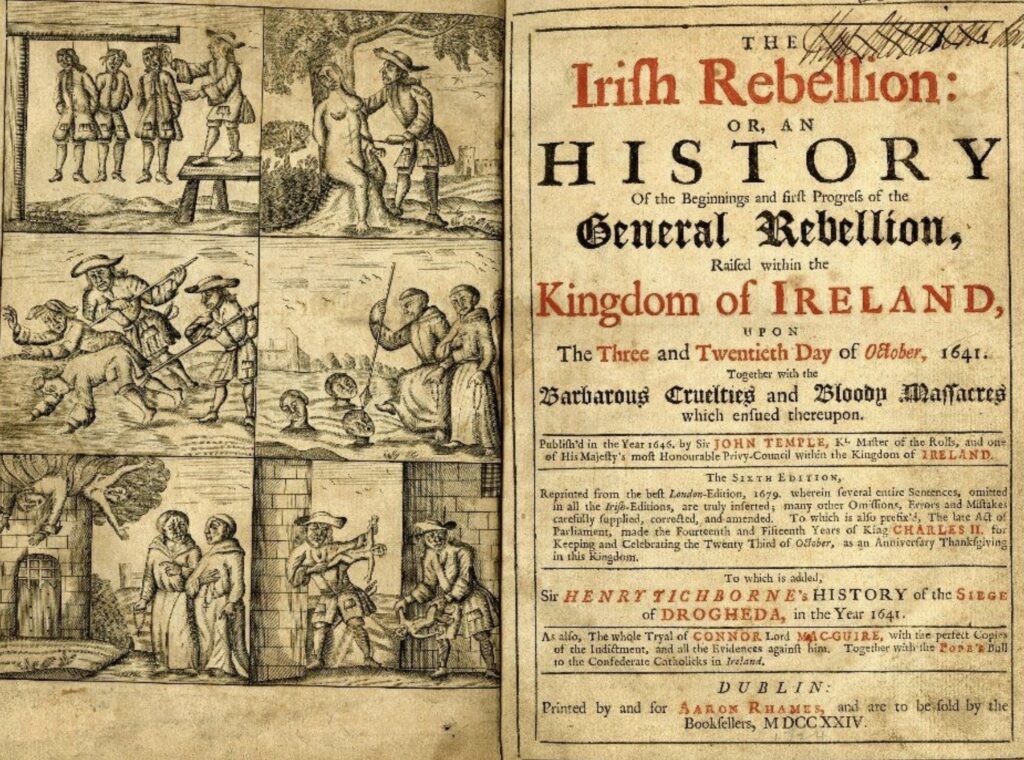
The drownings at Belturbet
The drownings are among the darkest episodes in the Belturbet testimony and they require more than a passing reference.
Smith and Killin said that after the town had surrendered there remained between sixty and eighty British Protestants in Belturbet under assurances of safety. According to their account, fifty-eight of those people were later taken to the bridge.
They described the captives being thrown into the river. Those who managed to swim or attempted to reach safety were, they said, driven back with long pikes and held beneath the water until they drowned.
Other witnesses remembered smaller numbers. Gibbs spoke of approximately thirty-four people. Richard Bennett recalled thirty-two English people and one Scottish woman. Peter Rickebee later remembered approximately thirty-seven. Other versions give figures around forty.
The disagreement over numbers is substantial and should not be hidden. None of the surviving depositions provides a reliable basis for deciding that one total is exact.
The agreement over the character of the event is much stronger. Multiple witnesses independently remembered a group of Protestant captives being taken to the Belturbet bridge and deliberately drowned in the river.
The differences in testimony may partly reflect the circumstances under which people witnessed the event. Some were prisoners in the town, some observed only portions of what occurred, and several gave their accounts years later. The victims may also have been moved in more than one group, although the surviving evidence does not allow that to be established with certainty.
The surrender agreement described by Smith and Killin gives the episode an additional dimension. The inhabitants had surrendered their weapons after receiving assurances that their lives and goods would be protected. The later killing of captives was therefore remembered by the survivors not simply as another act of wartime violence but as a breach of the terms under which Belturbet had been yielded.
The men accused of carrying out the killings
Smith and Killin did more than describe the drownings. They named a smaller group whom they said carried them out.
Among them were Farrell Ó Maol Phádraig, Hugh Reagh Ó Maol Phádraig, Cormac Ó Maol Phádraig and Philip Mothlach Ó Maol Phádraig, whom they described as Cormac’s brother. They also named Conchobhar Óg O’Reilly, his uncle Gillese Óg O’Reilly, Rory O’Togher and others whom they could no longer remember.
Their evidence differs from the much broader lists of people simply described elsewhere as being “in rebellion.” Here specific individuals were attached to a specific act.
Smith had been forcibly retained in Belturbet because he was a gunsmith and remained useful to the occupying force. Killin was also present in the town. Both therefore claimed close proximity to the events and the people involved.
Their deposition was taken on 8 February 1644, approximately two years after the killings. Memory, repetition of stories within the captive community and the political purpose for which depositions were collected all require caution. The accusation against these named men is nevertheless considerably more specific than a general statement that they belonged to the rebel force.
Smith and Killin also named substantially the same group in connection with the hanging of James Carr and Timothy Dickenson.
The two men were apparently taken separately from the bridge victims and hanged. Their names recur in several later accounts of the Belturbet violence, making their deaths among the most consistently remembered individual killings in the depositions.
Bryan Óg and the killings
Bryan’s position needs to be kept separate from the smaller group specifically named by Smith and Killin.
Gibbs associated Bryan with the large body of Mulpatricks present at Belturbet and with the wider force involved during the period in which the drownings occurred. Bryan was one of the commanders of the occupying force and therefore belonged to the military structure controlling the town.
Smith and Killin, however, did not include Bryan in their smaller list of men whom they directly accused of throwing or forcing the captives into the river.
Joane Woods likewise placed Bryan among the Ó Maol Phádraig involved in the occupation, plundering and wider violence in Belturbet, and she separately accused Bryan and Conchobhar Óg Ó Maol Phádraig of taking her cattle, goods and two boats. Her testimony does not provide the same narrow identification of Bryan as one of the men physically carrying out the bridge killings.
A much later examination complicates the picture further. In 1654 Peter Rickebee, a Belturbet smith, named Bryan Óg, Cahir Óg Mór, Conchobhar Óg, Bryan Reagh, Farrell mac Bryan Reagh and others in his account of the movement of prisoners toward the gallows and bridge. He said that he saw Carr and Dickenson hanged and later watched a group of captives forced toward the river.
Rickebee’s testimony contains claimed eyewitness detail, but it was recorded more than twelve years after the events and in a Commonwealth investigative setting when authorities were seeking people who might be prosecuted.
Taken together, the evidence places Bryan firmly within the command structure of the occupied town and among the Ó Maol Phádraig force present during the killings. The strongest contemporary-style identification of the men who physically carried out the drownings, however, names Farrell, Hugh Reagh, Cormac and Philip Mothlach rather than Bryan.
Military command, presence in the force and direct participation in a particular killing remain separate questions.
Philip’s position in the Belturbet violence
The same distinction applies to Philip mac Hugh O’Reilly.
Philip was the senior political and military figure around whom the Cavan force was organised, but the depositions do not provide a simple account in which every killing at Belturbet was personally ordered by him.
Smith and Killin said that Philip appeared highly displeased with the men responsible for the drownings. Their account then adds a difficult detail: within about a month he received those same men back into his company.
Joane Killin reported something still more serious. She said that she later heard Conchobhar Óg O’Reilly and the others involved in the killings claim that they had acted under a warrant from Philip mac Hugh O’Reilly and would not otherwise have undertaken such acts.
That is reported speech. No written warrant from Philip authorising the Belturbet killings survives, and Killin was recounting what she said the accused men themselves later claimed.
The deposition therefore leaves two strands of evidence sitting beside one another. Philip was reportedly angered by the killings, yet the men accused of them subsequently returned to his company. Those same men were also said to have claimed his authority for what they had done.
The surviving evidence cannot resolve that contradiction.
Philip’s responsibility as a senior commander can be established much more securely than his personal role in ordering the individual killings.
An old connection becomes a wartime alliance
Philip’s family background gives the Belturbet episode a much longer history than the few months between October 1641 and February 1642.
The 1593 pardon involving the older Philip O’Reilly of Ballynacargy and Muircheartach Ó Maol Phádraig of Creeny provides the clearest earlier link. It does not establish that a hereditary military relationship passed directly from one generation to the next, but it shows that the Ballynacargy branch and an Ó Maol Phádraig man from the Drumlane–Annagh country were already appearing together decades before the rebellion.
By October 1641 that older political association had become local armed cooperation. Thomas Ó Maol Phádraig’s servants acted with Hugh O’Reilly in Drumlane. Hugh Ó Maol Phádraig appeared in a neighbourhood group containing O’Reilly men. Breartagh Ó Maol Phádraig articulated the same language of claimed royal authority being used within the wider insurgent movement.
Then Bryan Óg entered Philip’s military sphere.
His path from Rory Maguire’s following at Aghakillymaud into the O’Reilly-controlled force at Belturbet joined the Fermanagh and Cavan parts of the story. By the winter of 1641–42, men called Ó Maol Phádraig were no longer simply appearing beside O’Reillys in pardon lists or local political records. They were serving with them in an organised armed force, and some had risen to command.
Gibbs’s description of “a great number” of Mulpatricks gives some indication of how substantial their participation had become. The other depositions reveal family groups within that larger body: fathers and sons, brothers, gentlemen, yeomen and commanders drawn from communities extending across the Cavan–Fermanagh borderlands.
The Belturbet evidence also shows how quickly the character of the rising changed. In the opening weeks some participants were still speaking of royal authority, the taking of property and a prohibition on killing. Within a few months, witnesses were describing prisoners being taken to a bridge, thrown into the Erne and prevented from escaping.
For the Ó Maol Phádraig, the surviving records preserve both sides of that transition. They reveal a family with an old place inside the O’Reilly political world, and they also place named members of that family inside one of the most violent episodes recorded in the Cavan depositions.
Sources and Further Reading
Trinity College Dublin, 1641 Depositions, MS 835, fols. 222r–223v. Thomas Seman, 6 June 1642.
Trinity College Dublin, 1641 Depositions, MS 834, fols. 137r–137v. William Raicye, 8 January 1642.
Trinity College Dublin, 1641 Depositions, MS 833, fols. 011r–011v. William Hoe, 8 January 1642.
Trinity College Dublin, 1641 Depositions, MS 833, fols. 024r–025v. Frances and Thomas Lovett, 26 January 1642.
Trinity College Dublin, 1641 Depositions, MS 833, fols. 109r–109v. William Bloxam, 28 November 1642.
Trinity College Dublin, 1641 Depositions, MS 833, fols. 249r–250v. William Gibbs, 31 January 1644.
Trinity College Dublin, 1641 Depositions, MS 833, fols. 265r–266v. Thomas Smith and Joane Killin, 8 February 1644.
Trinity College Dublin, 1641 Depositions, MS 833, fols. 220r–220v. Richard Bennett, 4 August 1644.
Trinity College Dublin, 1641 Depositions, MS 833, fols. 295r–296v. Peter Rickebee, 1 April 1654.
Ireland Public Record Office. Sixteenth Report of the Deputy Keeper of the Public Records in Ireland. Dublin, 1884. Fiant 5792, p. 222.
Ireland Public Record Office. Eighteenth Report of the Deputy Keeper of the Public Records in Ireland. Dublin, 1886, pp. 82–85. Fiant 6657.
Griffith, Margaret C. Irish Patent Rolls of James I. Dublin: Irish Manuscripts Commission, 1966, pp. 43–44.
Ó Siochrú, Micheál. “O’Reilly, Philip MacHugh.” Dictionary of Irish Biography. Royal Irish Academy.
Caball, Marc. “O’Reilly, Philip (Pilib Ó Raghallaigh).” Dictionary of Irish Biography. Royal Irish Academy.
Perceval-Maxwell, M. The Outbreak of the Irish Rebellion of 1641. Montreal and Kingston: McGill-Queen’s University Press, 1994.
Clarke, Aidan. The Old English in Ireland, 1625–42. London: MacGibbon & Kee, 1966.
Ó Siochrú, Micheál. Confederate Ireland, 1642–1649: A Constitutional and Political Analysis. Dublin: Four Courts Press, 1999.
Amazing work! As you suggest, there is an argument to be made that these types of stories became a very popular tool of propaganda for the Loyalists and a way to dehumanize the native Irish population. “One of the most infamous atrocities recorded in the depositions is the mass drowning of Protestant settlers—including women and children—by Irish insurgents at the Portadown Bridge over the River Bann in County Armagh” (1) “Historians debate the literal truth and scale of the events described. While they document intense sectarian violence and real trauma, many accounts involve hearsay, and the numbers killed were often inflated or used later as political propaganda against Irish Catholics.” (2)
It seems not unrelated that it is shortly after this particular period of vilanizing the participants in the rebellion that the Mulpatrick name begins disappearing in available records in favor of the Fitzpatrick name.
1) https://www.bbc.com/news/uk-northern-ireland-11605241
2) https://historyireland.com/dodgy-dossiers-hearsay-and-the-1641-depositions/
Thanks Charlie,
That is why the 1641 Depositions have to be used cautiously. Roughly 8,000 depositions and related statements survive, but the surviving records of the principal High Courts at Dublin and Cork show only 110 defendants actually brought to trial in 1652–54, with 56 convicted.
The depositions record real violence, but they also contain hearsay, inflated numbers and atrocity stories that were later used as propaganda against Irish Catholics. Portadown became one of the most famous examples, even though much of the testimony surrounding it was not based on direct eyewitness evidence.
In that climate, I agree there was a clear incentive for families carrying an unmistakably Gaelic name such as Mulpatrick to use the already established Fitzpatrick form instead. We cannot prove that propaganda alone drove the change, but the increasingly hostile image of the native Irish would certainly have made anglicisation more attractive.