
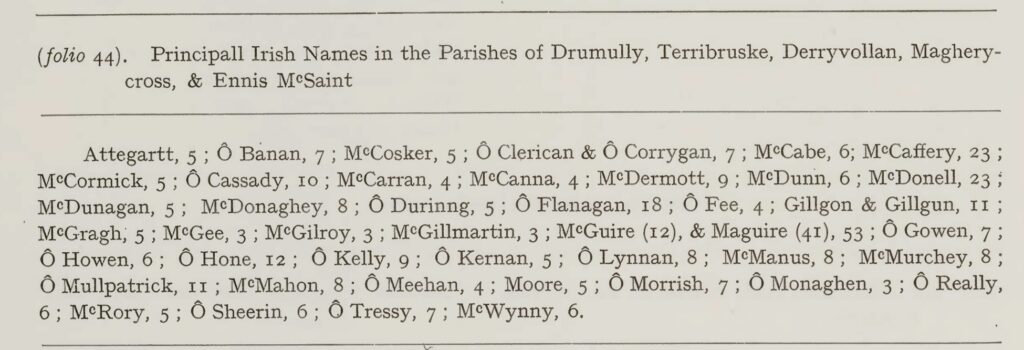
In 1659 the name was still there.
Across the surviving census material and the tax records that followed, families were still being recorded under forms of Ó Maol Phádraig: Mulpatrick, Molpatrick and other attempts to put an Irish surname into English letters. In Fermanagh the 1659 census preserves eleven principal Irish of the name across several parishes. In the 1660s Tirlagh Ó Maol Phádraig and his wife appear in Tyrone, while Bryan Ó Maol Phádraig and Pátraic Óg Ó Maol Phádraig appear in the Monaghan hearth-tax material. These were survivors of war, confiscation, plantation and political collapse. The surname had survived with them.
Yet within little more than a century something extraordinary happened. The people did not disappear, and neither did their descendants. In the regions where Ó Maol Phádraig had been deeply established, Fitzpatricks later appear in abundance. The same transformation occurred far to the south in Cork, where Ó Maol Phádraig had existed independently for centuries. But the ancestral surname itself almost vanished. By the time nineteenth-century records become numerous enough to reveal ordinary rural families on a large scale, Mulpatrick is no longer the normal surname of those communities. Fitzpatrick is.
For a long time I approached this as a problem of records. Perhaps government clerks translated the name. Perhaps landlords standardized it. Perhaps priests copied what appeared in legal documents. Each explanation could account for individual examples, but none could explain the scale of what happened. A large part of the rural population would never have appeared in a surviving seventeenth- or eighteenth-century record at all. Some families could have lived for generations without entering a court, signing a surviving lease, appearing in a tax list or leaving a parish register that we can still consult.
A documentary mechanism could change the name on paper. It could not, by itself, change the name of an entire population.
The missing mechanism was probably much more intimate: the language in which the surname lived was itself changing.
A surname that belonged to a language
Ó Maol Phádraig was never simply a sequence of sounds. The surname carried meaning inside Irish. It identified a person as belonging to the descendants of Maol Phádraig and existed within a world in which kinship, territory, genealogy and language reinforced one another. A man did not need to possess a written pedigree to understand that the surname connected him to other people of the name.
That world was under enormous pressure by the seventeenth century. English government in Ireland had long treated language, law, dress, custom and naming as connected parts of the same political problem. The Statutes of Kilkenny had centuries earlier attempted to prevent the English population in Ireland from adopting Irish language and naming customs. By the later sixteenth and early seventeenth centuries the direction of pressure had shifted. Gaelic Ireland was increasingly being brought within English law, English systems of landholding, English political institutions and an expanding English cultural sphere.
The relationship between names and power was understood explicitly by colonial writers. Edmund Spenser proposed breaking the old sept identities and suppressing the O and Mac forms, which he wished to see “utterly forbidden and extinguished.” His purpose was not orthographic tidiness. He believed that weakening collective names could weaken the social structures behind them and, eventually, the people’s identification with an Irish nation.
Spenser was proposing a programme, not recording a universal Crown order later imposed word for word. Yet his argument exposes the political logic of the period. A Gaelic surname could be regarded as far more than an inconvenience to an English clerk. It could represent allegiance, kinship and the continuing survival of a social order that conquest was attempting to replace.
Arthur Chichester’s discussions of Plantation Ulster likewise show how closely English language and English customs could be tied to the perceived success of colonisation. Policymakers disagreed over whether the native Irish should be transformed, segregated, displaced or economically incorporated, and actual plantation practice was frequently more complicated than official schemes. But language, custom, land and political allegiance were repeatedly treated as parts of the same problem.
Ó Maol Phádraig therefore entered the later seventeenth century carrying something Fitzpatrick did not carry in quite the same way. To an English ear, Mulpatrick still advertised its Gaelic origin. The Maol element had survived in distorted form as Mul, and the underlying Irish structure remained visible.
Fitzpatrick sounded entirely different.
The English name was already waiting
There was already another surname in Ireland built around Patrick.
In 1541 the Mac Giolla Phádraig rulers of Upper Ossory entered the surrender-and-regrant system. Under the conditions imposed upon them they were required to “utterly forsake and refuse” the name MacGilpatrick, and the ruling line adopted Fitzpatrick. By the time the Ó Maol Phádraig surname began its great transformation more than a century later, Fitzpatrick was no improvised spelling. It was an established surname with political recognition, landed associations and a connection to an old Irish ruling dynasty.
That offered an extraordinarily convenient alternative.
The change from Ó Maol Phádraig to Fitzpatrick was not a literal translation. Fitz does not mean Ó, and it certainly does not mean Maol. The ancestral meaning of the surname was altered. What remained immediately recognisable was the central element: Patrick.
That may have reduced the emotional cost of the change. A family adopting Smith, Brown or some completely unrelated English surname would have been unmistakably abandoning its inherited name. Fitzpatrick allowed something subtler. Patrick remained, and the replacement could gradually be understood not as an entirely different surname, but as the English form of the old one.
A father could therefore tell his children something very simple: we are Ó Maol Phádraig in Irish, and Fitzpatrick in English.
No legislation was required for that understanding to move through a community. Children learned it from parents, cousins from cousins, neighbours from neighbours. A farmer could use Fitzpatrick at an English-speaking market while still hearing Ó Maol Phádraig at home. A woman carrying the name into another parish through marriage could use the form recognised in English. A labourer who never signed his name could nevertheless know exactly what surname to give when speaking to an English speaker.
A family whose first surviving written appearance occurs in 1815 could therefore have been using Fitzpatrick for three generations without leaving a single document recording the transition.
That was the weakness in every explanation based primarily on clerks. The name could change in speech long before it became permanently fixed in writing.
The generations that carried two names
The transition probably did not occur in one generation, and complete loss of Irish was not required before the surname could begin to change. For a considerable period the same person could comfortably possess two forms of his identity. The Irish form belonged to one linguistic environment and Fitzpatrick to another.
As English became increasingly necessary in markets, towns, estate business, legal dealings and the institutions of the new political order, Fitzpatrick gained ground without immediately requiring Ó Maol Phádraig to disappear from Irish speech.
Then in 1693 we suddenly see the two worlds on the same line:
Edmund Fitzpatrick alias Mulpatrick.
That entry in the Irish Court of Chancery is among the most revealing records in the entire history of the surname. It shows that Fitzpatrick and Mulpatrick were already recognised as alternative identifiers for the same man. We are probably not witnessing the instant when Edmund changed his surname. We are looking through a narrow documentary window at a broader process already taking place around him.
His family and neighbours may have known perfectly well who Edmund was under either form.
That changes how the eighteenth century should be imagined. Instead of looking for a single document announcing that the Mulpatricks were henceforth Fitzpatricks, we should imagine thousands of smaller accommodations: a surname given differently in English conversation, a son becoming more comfortable with the English form than his father had been, a family moving nearer a market town, a marriage joining households that already used Fitzpatrick publicly, or a priest hearing Fitzpatrick because that was the surname the family itself now supplied when English was being used.
A grandfather might still have been called Ó Maol Phádraig in Irish. His son might answer to both names. His grandson might know that older relatives had once been called Mulpatrick. His great-grandchildren might know only Fitzpatrick.
No document records the moment when that final memory disappeared.
When the office changed the name
Recognising language as the principal mechanism does not remove clerical intervention from the story. It places it where it belongs: as one of several forces reinforcing a transformation already happening in society.
Mike Fitzpatrick uncovered a particularly striking example in County Down. Among the surviving material for the 1803 stock census of Drumee in Maghera parish are two versions of the same return. In one, the surname appears as Fitzpatrick. In the other, the same people are entered under a form representing Mac Giolla Phádraig. Mike reproduced the two records together in his study of the Mac Giolla Phádraig of Leinster and Down.
This gives us something unusually concrete. The family has not moved, its ancestry has not changed, and there is no evidence of a formal legal name change. Yet within the administrative process the Gaelic-derived surname is replaced by Fitzpatrick.
The office has changed the name.
That cannot explain the disappearance of Ó Maol Phádraig by itself, because much of the rural population remained outside such documentation for long periods. But it demonstrates how administrative practice could repeatedly strengthen the English form once Fitzpatrick had become an accepted equivalent. A family might still use a Gaelic form locally while leases, tax returns, rentals or copied official documents increasingly came back bearing Fitzpatrick. The next generation then encountered its own family under that name.
Language could carry the change through the population; administration could help make it permanent.
Pressure from every direction
English increasingly became the language associated with the institutions controlling land, law, commerce and advancement. Gaelic names were routinely distorted in English transcription, sometimes so heavily that their original form became difficult to recognise. Gerard Farrell has shown how this happened to both personal and place names and how English observers could react to Irish names themselves as strange, uncivilised or offensive.
Mulpatrick occupied an uncomfortable position. It was already an anglicised approximation, but it still sounded recognisably Irish. Fitzpatrick did not.
That difference could have practical consequences without any law ordering a change. A man seeking a lease, entering military service, apprenticing a son, conducting business in an English-speaking town or appearing before a court had reasons to use the surname that required no explanation. Once enough relatives did so, consistency itself became another pressure. A man retaining Mulpatrick while brothers, cousins and sons used Fitzpatrick could eventually complicate property, inheritance and family identification.
What began as accommodation could therefore become inheritance.
The state did not have to rename the next generation. The family could do that itself.
Belturbet and the burden carried by Mulpatrick
There was another pressure operating in Cavan that did not exist in the same way in Cork.
The possibility was first raised with me by Charlie Fitzpatrick, who suggested that the reputation attached to the Mulpatrick name after the Belturbet killings might itself have encouraged descendants to abandon it. The idea deserves credit to Charlie. What follows expands that suggestion and places it beside the linguistic and administrative evidence.
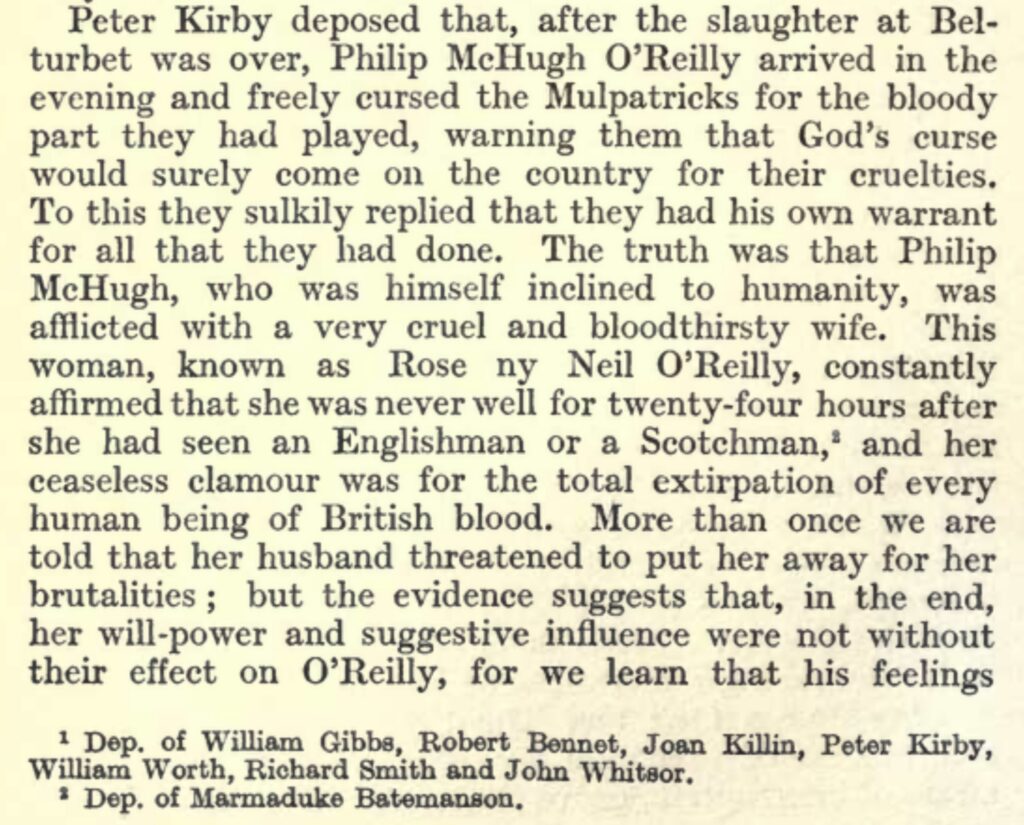
The 1641 Depositions preserve serious allegations against several members of the Ó Maol Phádraig kindred around Belturbet. Some accusations came from eyewitnesses, others from hearsay or later recollection. Different men were accused of different actions, and the sources cannot responsibly be turned into collective guilt for an entire sept.
Later historical writing could nevertheless do exactly that.
By the time Lord Ernest Hamilton published The Irish Rebellion of 1641 in 1920, his narrative repeatedly spoke collectively of “the Mulpatricks.” Individual men and particular allegations had been compressed into a surname group. Hamilton often moved from what specific witnesses had actually said to broader interpretations that appear much less secure when the original depositions are read closely.
The problem was recognised at the time. Hamilton’s contemporaries criticised his handling of the evidence, especially his tendency to blur eyewitness testimony, hearsay and later retelling. A 1921 review by J. W. Williams challenged his use of the depositions and argued that the cumulative picture he constructed was historically unreliable. Modern biographical assessment has similarly noted Hamilton’s tendency to emphasise native Irish brutality while treating settler violence more leniently.
This does not mean that the Belturbet killings were invented or that accusations against particular Ó Maol Phádraig men should be dismissed. Some of the evidence is strong and direct. What it does mean is that Hamilton’s collective “Mulpatricks” should not be confused with the much more complicated human reality preserved in the depositions themselves.
The depositions preserve individuals. Hamilton helped perpetuate a reputation attached to a surname.
That distinction may have had real consequences long before Hamilton wrote.
The descendants living around Cavan in the later seventeenth and eighteenth centuries were far closer to the events of 1641 than he was. They lived among families who remembered the rebellion, the killings, the sieges and the retaliations. In a district where Mulpatrick could carry such historical baggage, an already available English alternative might have been especially attractive.
Charlie Fitzpatrick’s idea therefore fits naturally into the larger mechanism. Belturbet was probably not the reason Ó Maol Phádraig became Fitzpatrick across Ireland, because it cannot explain Cork. But it could have made the northern transition faster and less likely to be resisted.
A family could preserve its Irish identity privately while discarding an English rendering that had become socially dangerous.
Cork shows why there was no single cause
The Cork Ó Maol Phádraig prevent us from explaining everything through Belturbet.
Their surname existed there centuries before the Cavan crisis. Sixteenth- and early seventeenth-century records preserve an established Cork population under Ó Maol Phádraig forms, yet eventually those families too are found under Fitzpatrick.
That points back to language as the broader mechanism.
Cork and Bréifne did not need to coordinate with one another. Both populations could independently adopt Fitzpatrick if it had become the recognised English identity for a Gaelic Patrick surname. Local circumstances then determined how strongly or quickly the change was encouraged.
In Cork, economic, administrative and linguistic pressure may have been dominant. In Cavan those same forces operated alongside the memory of 1641 and the particular stigma attached to Mulpatrick around Belturbet.
Different pressures could therefore produce the same result.
Fitzpatrick offered more than safety
The replacement surname also carried advantages of its own.
By the late seventeenth century Fitzpatrick already had a history. The Mac Giolla Phádraig rulers of Upper Ossory had been using it for more than a century. Their descendants possessed landed, military and political profiles that an English-speaking observer could recognise. Fitzpatrick was not simply an English surname. It was an English-form surname attached to an old Irish dynasty.
For an Ó Maol Phádraig family, that created useful ambiguity.
Once the old surname disappeared, an outsider encountering a Cavan or Cork Fitzpatrick could easily assume a connection with the better-known Fitzpatricks of Ossory. In some cases descendants themselves may eventually have made the same assumption. An Ó Maol Phádraig man did not need to invent a formal pedigree for the surname to imply something about ancestry. If someone assumed an Ossory connection, there was little practical reason to correct him.
Over generations such assumptions could harden into family tradition.
There may also have been an emotional comfort in the choice. Fitzpatrick did not feel like an alien surname imposed from nowhere. It retained Patrick, remained recognisably Irish in association and connected, however inaccurately in genealogical terms, with an established Gaelic-origin dynasty.
That may have made the transition much easier to accept.
The irony is profound. One Gaelic Patrick surname had been compelled to abandon its original form in the sixteenth century. The English surname produced by that earlier transformation then became the form into which another Gaelic Patrick surname could disappear.
The church recorded what families had already become
The appearance of Fitzpatrick in later Catholic registers once seemed difficult to explain if government clerks were driving the change. Under the linguistic model it becomes much easier.
A Catholic priest in a rural parish did not need instructions from Dublin Castle to write Fitzpatrick. By the time many surviving parish registers begin, families could already have used Fitzpatrick in English for decades. The priest was recording the surname supplied by the parents and recognised by the neighbourhood.
Irish might still be spoken in the household, and older people might still remember the Gaelic surname, but a baptism entered in Latin or English could nevertheless record Fitzpatrick because Fitzpatrick had become the public hereditary form.
The church therefore recorded the result of a change that had already penetrated ordinary life. Government records reached only part of the population; the spoken community reached everyone. A child learned his family name before he ever encountered an official record.
What was actually lost
The near disappearance of Mulpatrick can create the illusion that there was little resistance. Yet resistance need not have taken the form of a petition or an open refusal.
Keeping Ó Maol Phádraig alive at home for another generation was itself a form of cultural persistence. So was continuing to understand Fitzpatrick merely as the English version of a deeper family identity. The problem is that such distinctions were carried orally. When Irish receded and the older bilingual generations died, the explanation often died with them.
The descendants inherited Fitzpatrick without necessarily inheriting the story of how they had become Fitzpatricks.
By the nineteenth century, a Cavan child could be baptised Fitzpatrick, marry as Fitzpatrick and die as Fitzpatrick while descending directly from people whom the seventeenth-century world knew as Ó Maol Phádraig. By then no one needed to enforce the transformation. It had become ordinary family inheritance.
That is why treating Mulpatrick, Molpatrick, Mulpadrick and Fitzpatrick as mere spelling variants misses so much. Ó Maol Phádraig belonged to an ancestral language and described a relationship with a kindred. Fitzpatrick belonged to the increasingly dominant English-speaking world through which later descendants had to navigate.
When the language changed, part of the meaning of the surname changed with it.
This occurred within a wider colonial transformation in which Gaelic landholding, political authority, law, language and social structures were subjected to sustained pressure, replacement and destruction. Contemporary writers themselves understood names as one of the structures connecting individuals to sept and nation. Whether the cumulative process is described as anglicisation, cultural destruction or cultural genocide, the disappearance of Ó Maol Phádraig cannot be reduced to clerical convenience.
Nor should the people be portrayed simply as passive victims.
Adopting Fitzpatrick may also have been an act of remarkable adaptability. Families faced war, plantation, confiscation, religious discrimination, economic pressure and profound changes in the language of public life. Protecting children, retaining land, securing employment and maintaining family continuity could carry more immediate weight than defending a particular English rendering of an Irish surname.
Fitzpatrick offered a way through. It preserved Patrick, retained an Irish association, carried the reflected prestige of an old Irish dynasty and functioned easily in the increasingly English-speaking society around them. For the first bilingual generations, using it may not have felt like surrendering an identity. It may simply have felt like carrying that identity into another language.
Only later could descendants discover how much had disappeared along the way.
Standing at 1659
That is why the 1659 census now feels like such a turning point in this history.
We are looking at some of the last generations for whom Ó Maol Phádraig was still plainly visible as a living surname across the northern landscape. Those people could not know that descendants of their kindred would soon be called almost universally by another name.
During the generations that followed, several mechanisms could operate together. English-language speech carried Fitzpatrick into ordinary family life. Clerks and estate offices could standardize it on paper, as the County Down evidence demonstrates. Economic and social pressure made the English form increasingly convenient. Around Belturbet, the historical burden attached to Mulpatrick may have reduced the desire to preserve it. The already established Ossory Fitzpatrick name provided a replacement that was both socially useful and culturally easier to accept.
No single mechanism needs to explain every household.
Language provided the road. Administration reinforced it. Social pressure made the journey easier, and Fitzpatrick offered a destination that did not feel entirely foreign.
The strongest evidence may ultimately be the absence itself. Thousands of people did not suddenly disappear when Mulpatrick vanished from the record. They continued farming, marrying, raising children and moving through the same countryside. What faded was the name by which earlier generations had understood their relationship to one another.
That changes the genealogical search completely.
When we encounter a Fitzpatrick in eighteenth- or nineteenth-century Cavan, Cork, Fermanagh, Leitrim or Monaghan, we cannot automatically ask which Ossory Fitzpatrick brought the surname there. We must also ask whether we are looking at descendants of people who had never been Fitzpatricks in the original Ossory sense at all.
They may be Ó Maol Phádraig people whose language changed.
For descendants today, recovering that history cannot restore everything those generations lost. But it can recover one thing that disappeared with the spoken name: the knowledge that Fitzpatrick was not necessarily where the story began.
For some of us, it began with Ó Maol Phádraig.
After centuries in which that name was pushed out of ordinary speech, removed from family memory and preserved in places where it was sometimes associated more with accusation than ancestry, saying Ó Maol Phádraig again carries an emotion that no database can reproduce.
We are not merely correcting a surname.
We are hearing an ancestor’s name again in the language that gave it meaning.
Sources and Further Reading
Fitzpatrick, Matthew and Fitzpatrick, Mike. 2025. “Ó Maol Phádraig: the Name, the People, and the Clans. Part III.” Journal of the Fitzpatrick Clan Society 6, 27–41.
Fitzpatrick, Mike. 2025. “The Mac Giolla Phádraig Laighean.” Journal of the Fitzpatrick Clan Society 6, 1–26.
Fitzpatrick, Mike and Fitzpatrick, Ian. 2021. “The Similar-Sounding Surnames of Haplogroup R-BY140757.” Journal of the Fitzpatrick Clan Society 2, 1–41.
Farrell, Gerard. The Mere Irish and the Colonisation of Ulster.
Farrell, Gerard. 2022. “The Irish and the Economy of Plantation Ulster.” Proceedings of the Royal Irish Academy 122C.
Spenser, Edmund. A View of the Present State of Ireland. Written 1596.
Hamilton, Lord Ernest. 1920. The Irish Rebellion of 1641: With a History of the Events Which Led Up to and Succeeded It. New York: E. P. Dutton and Company.
Williams, J. W. 1921. Review of Lord Ernest Hamilton, The Irish Rebellion of 1641. The Scottish Historical Review 18.
Dictionary of Irish Biography. “Hamilton, Lord Ernest.”
Pender, Séamus, ed. 1939. A Census of Ireland circa 1659. Dublin: Stationery Office.
National Archives of Ireland. Court of Chancery Bill Books, 1692–1696, vol. 11, p. 70.
Trinity College Dublin. 1641 Depositions, County Cavan and County Fermanagh testimonies relating to Belturbet and the Ó Maol Phádraig.
Public Record Office of Northern Ireland. 1803 Stock Census of Drumee, Maghera Parish, County Down.
State Papers, Henry VIII. 1541 surrender-and-regrant agreement concerning the Mac Giolla Phádraig of Upper Ossory.