
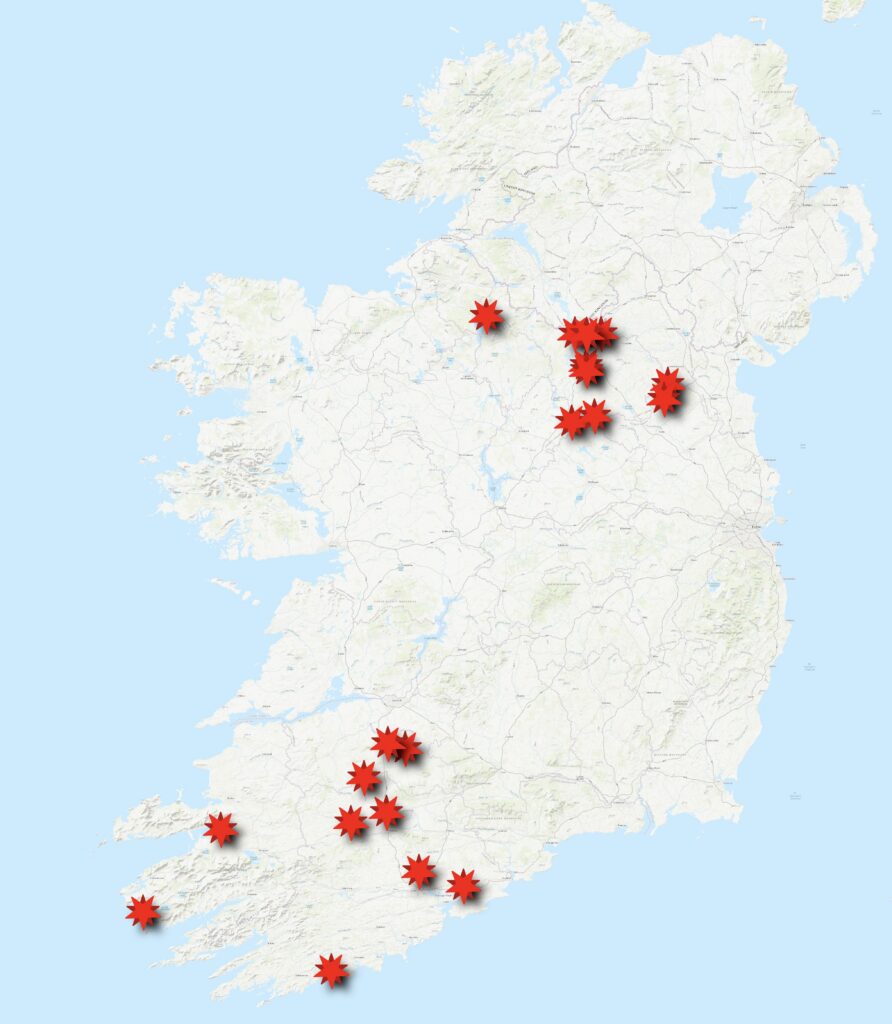
As this research has grown, I have accumulated an enormous amount of material: fiants, patents, pardons, church lands, placenames, occupations, family associations, witnesses, landlords, tenants, military followers and recurring surnames. I am also now putting the known Ó Maol Phádraig locations onto a map so that the geographical pattern can be seen rather than imagined. The obvious question is what any of this is actually useful for when the goal is genealogy.
The answer is that a family tree does not have to stop simply because the direct records stop. Once the surviving baptisms, marriages and wills begin to thin out, the people around an ancestor can become almost as important as the ancestor himself. Instead of asking only who a man’s father was, we can ask where he lived, who owned the land, which families were beside him, which church served the community, who employed him, who appeared with him in legal records, and whether those same names occur again somewhere else. When enough of that information is collected, it can begin to show where the missing generations are most likely to be found.
My own Fitzpatrick line provides a good example of how this works.
On 4 August 1755, John Fitzpatrick married Alice Broughall at Catholic St Catherine’s in Dublin. That is straightforward genealogy: two people, a date, a parish and a marriage.
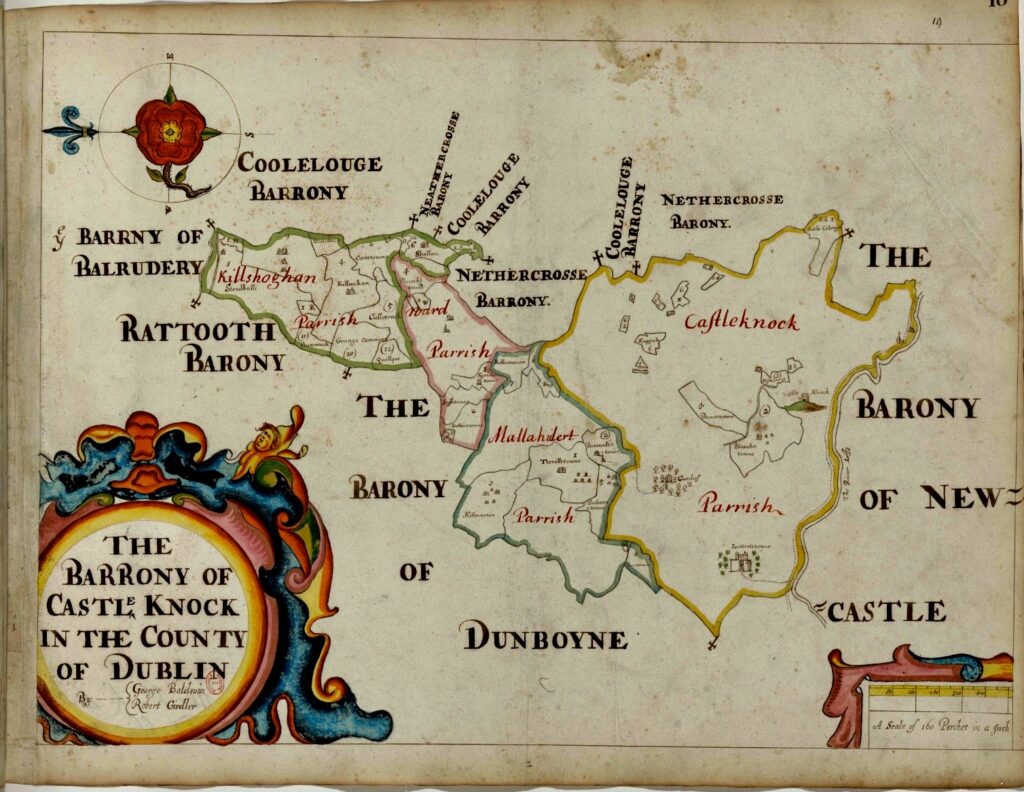
Alice can be followed through a well-established Broughall pedigree back into the Broughall family of Clonsilla and the Grange in Castleknock. The Fitzpatrick side is harder to carry continuously that far back, but there is an important earlier appearance in precisely the same landscape. By 1613, John Fitzpatrick, a farmer of Abbotstown, was the father of James Fitzpatrick, the future Jesuit, who was born there and educated nearby at Mulhuddart.
That immediately gives us something useful. Long before the documented 1755 marriage, the Broughall and Fitzpatrick surnames were already associated with the same small western-Dublin district. At that point, instead of trying to force another generation onto the tree, we can widen the lens.
Look at everyone in the record
One of the best examples comes from the 1540–41 survey associated with the former ecclesiastical estate at Kilmainhamwood in Meath. Nicholas Ó Maol Phádraig and Charles Ó Maol Phádraig of Shancor appear among the probi et legales homines de visneto, the good and lawful men of the neighbourhood who were sworn to assist with the survey. They were recognised local men being used to establish information about land and possession.
The placename evidence also indicates that Shancor itself belonged within the Kilmainhamwood property complex. The earlier material records forms such as Tancore and “Olde Corre,” while the 1619 inquisition into the former manor or preceptory records Tancree alias Oldcar as one of its parcels. That makes the Ó Maol Phádraig presence there more interesting than a family simply living somewhere near a religious house. They appear to have been living on the old ecclesiastical estate itself.
But the real value of the record becomes apparent when we stop reading only the Ó Maol Phádraig names.
The same survey world contains men such as Robert Tyrrell of Rouske, Henry Cruise of Ballycoghill, Lawrence Dowdall, Owen O’Carolan of Shanogher and John Carolan of Rathkenny. Once those names are investigated, the record begins to open outward. Tyrrell has deep historical connections with Castleknock. Cruise had long-standing holdings around Mulhuddart and Cruiserath. Dowdall belongs to the wider Meath Pale world and later appears in the Clonsilla landscape.
The useful information is therefore not simply that two Ó Maol Phádraig men lived at Shancor. It is that they lived there inside a particular network of families, some of whom also operated in the exact western-Dublin district where an early Fitzpatrick household later appears. The map helps here because it makes the geography visible. The points themselves are useful, but the real value lies in seeing which families, estates and institutions sit between them.
Follow an associated family as seriously as your own
The Plunkett evidence shows why this approach can be so productive. In 1599, an Ó Maol Phádraig man appears as a horseboy in a pardon headed by Oliver Plunkett of Gibstown, County Meath. If I were searching only my surname, I might record the Ó Maol Phádraig and move on. Instead, Oliver Plunkett becomes part of the research.
The Plunketts were a major Catholic Meath family, while another branch was firmly established at Dunsoghly beside Mulhuddart, immediately within the Castleknock landscape. The record therefore gives more than the name of an Ó Maol Phádraig horseboy. It shows a direct service relationship with a family whose wider network reaches toward the area where the Abbotstown Fitzpatricks later lived.
The Tyrrell evidence works in the same way. A Tyrrell is already present in the Kilmainhamwood survey environment with Nicholas and Charles Ó Maol Phádraig. Later, Ó Maol Phádraig men repeatedly appear in Richard Tyrrell’s world, including four yeomen at Abbeylara in 1603. The Tyrrell family had an old and substantial connection with Castleknock.
Cruise gives another version of the same pattern. Henry Cruise appears in the Meath survey environment, while his family had been established around Mulhuddart for centuries.
At some point repeated associations become worth treating as a network rather than a succession of coincidences. They still have to be tested individually, but they tell us where to look.
Use context to reject records as well as find them
This kind of research is just as useful for eliminating attractive mistakes.
I ran into a good example with the Fitzpatrick records at St Michan’s in Dublin. A group of seventeenth-century Fitzpatrick baptisms initially looked very promising. The surname was right, the parish was interesting, and the dates were close enough to the period I was trying to understand.
Then I checked the church properly.
Those early records were from St Michan’s Church of Ireland. The later Fitzpatrick line was Catholic. John Fitzpatrick married Alice Broughall in a Catholic church, their children were baptised Catholic, and the family remained strongly Catholic in later generations. Once religion was used as a test, those earlier St Michan Fitzpatricks became poor candidates for the line I was following.
That mistake was useful because it showed how easily a convincing-looking surname match can lead the research in the wrong direction. It also showed that religion can sometimes distinguish two families living in the same city more effectively than the surname itself.
The same principle applies to every new discovery. When something looks promising, the next question should be: what else should be true if this is really the same family? Does the religion fit? Do the ages work? Is the geography believable? Do the associates recur? Can the person be found from another direction?
Some of my best discoveries have come from following things I originally thought were unlikely. Being open-minded is important, but so is trying to break your own theory once you have one. A good lead should survive pressure.
Online family trees show what happens when that step is skipped. Just yesterday I saw someone who had copied people from my tree and ended up with a 76-year-old man having a child with an 86-year-old woman. No complicated historical argument is needed there; the dates destroy the pedigree immediately. Yet once an incorrect connection is added to a large online tree, records and other people’s trees begin accumulating around it, and eventually the mistake can look established simply because it has been copied many times. It can also become a miserable job to undo.
So I try to back-test important discoveries before building too much on top of them. If I think two families were connected through a church, I look for both families in that church’s world. If I think a Meath family had a route into Castleknock, I try to establish the Castleknock side independently. If a man appears with one of the recurring families, I investigate that family rather than assuming the association is meaningless. When two or three different approaches begin pointing to the same place, the lead becomes much stronger.
Then return to the genealogy
This is where all of the apparently disconnected historical material becomes useful.
Alice Broughall can be followed back into the established Broughall family of Clonsilla and the Grange. An earlier Fitzpatrick household is at nearby Abbotstown by 1613. Behind that sits the older Ó Maol Phádraig evidence in Meath, where Nicholas and Charles of Shancor appear on land associated with the Kilmainhamwood ecclesiastical estate and among families such as Tyrrell and Cruise whose own histories connect toward Castleknock and Mulhuddart. Other Ó Maol Phádraig men appear directly within Plunkett and Tyrrell networks.
Then, in 1755, John Fitzpatrick marries Alice Broughall in Catholic Dublin.
I cannot yet draw a straight genealogical line through every generation connecting those earlier Fitzpatricks with John of 1755. But the research has changed the problem completely. Instead of an empty gap between unrelated names, there is now a defined geographical and social landscape in which those missing generations can be searched.
Coventry: following the people around the family
The nineteenth-century move to Coventry gives an especially good example of how this method can produce an unexpected genealogical lead.
When I first searched the 1841 Coventry census, I noticed that Irish-born people were marked with an “I.” As I paged through the surrounding entries, it became obvious that there were very few Irish families in Coventry at that time. My Fitzpatrick family stood out because of it.
Then another Irish family caught my attention: Broughall.
At first, it was simply an interesting surname appearing among a very small Irish population. Following it led first to the discovery of the 1755 Catholic marriage of John Fitzpatrick and Alice Broughall in Dublin. From there, the Broughall line could be traced back into the established family of Clonsilla and the Grange in Castleknock, bringing the Coventry family into the same western-Dublin world already associated with the earlier Fitzpatricks. What began as a surname noticed while paging through a census had opened a much older connection between the two families.
What began as an observation while paging through a census became a serious genealogical connection.
More recently, that connection has been reinforced in two independent ways. There is now a documentary paper trail to a modern Broughall man, and an autosomal DNA match supports the relationship. The significance lies in the fact that the lead did not begin with DNA or with someone else’s family tree. It began by noticing who else was living around the Fitzpatricks and asking whether that other Irish family might be important.
If I had opened the census, copied the Fitzpatrick household and closed the record, I would have missed the Broughalls entirely.
The religious evidence adds another layer. Both the Fitzpatrick and Broughall families had multiple children baptised through the same Catholic community in Coventry. Some Fitzpatrick children born after the family arrived around 1832 were not baptised until years after their births. Coventry still had only a small Irish population and very limited Catholic infrastructure, yet both families maintained their Catholic identity and brought their children into the same Catholic community when the opportunity existed.
That makes Coventry a particularly useful demonstration of how family, religion and social connection can survive migration. The families had moved from Ireland into a completely different industrial city, but the old Catholic connection remained visible.
More importantly for the method behind this research, the Broughall discovery shows why it is worth looking beyond the person you came to find. A census neighbour led back to an eighteenth-century marriage, an older Castleknock connection, a documentary trail to a modern descendant, and supporting autosomal DNA evidence.
That is precisely what all of this historical context is capable of producing.
What the map and the records are really for
This is why I keep collecting the fiants, patents, placenames and associated families.
The purpose is not to turn every historical association into an ancestor. It is to build the environment in which the genealogy can be tested.
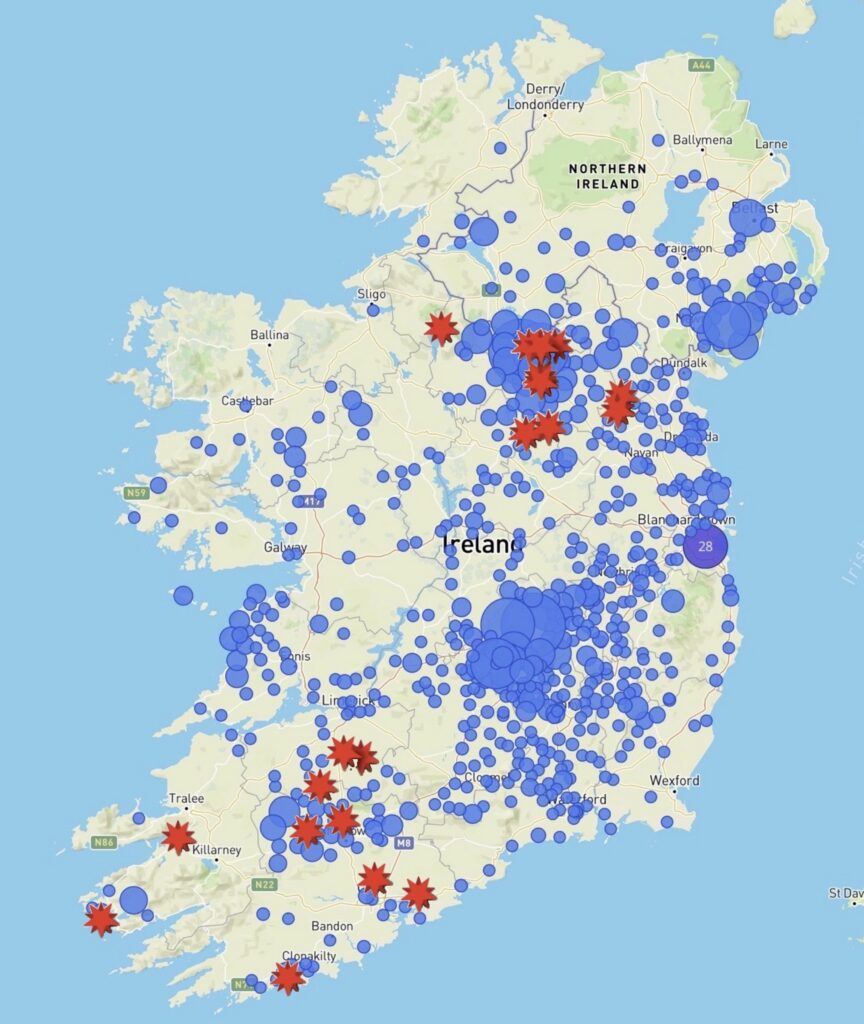
The map of Ó Maol Phádraig locations supports that process. It shows where the family appears, where the concentrations lie, which movements are geographically plausible and which neighbouring families deserve attention. When the same associated surnames begin appearing along those routes, they can be followed. When church estates occur repeatedly, those can be investigated. When a later Fitzpatrick appears in one of those landscapes, the earlier network gives us a reason to look more closely.
As we move into the seventeenth and eighteenth centuries, the records should become increasingly personal: wills, leases, parish registers, baptismal sponsors, marriage witnesses, recusant records, guilds, occupations and addresses. The earlier work tells us which names and places in those records may carry more significance than they first appear to.
That is what can be done with all of this information.
It allows a family history to move beyond a sequence of names and dates. It gives us a way to keep researching when direct pedigrees become difficult, while still testing every step rather than filling the gaps with assumptions.
Sometimes the result will be another generation. Sometimes it will be the discovery that a promising record belongs to the wrong family. Sometimes it will reveal a connection that nobody thought to look for because the clue was sitting beside the ancestor rather than in the ancestor’s own entry.
All three move the research forward.