
The Rise of Loch Cé and the Early Ó Maol Chonaire
The rise of Loch Cé did not begin with the construction of a castle or the foundation of a single monastery. Its importance developed gradually from the geography of the lake and its position within northern Connacht. Loch Cé stood near the meeting point of several regions. To the south lay the central territories of Connacht, to the west the older kingdoms of Tír Oilella and the Moytura landscape, while routes leading north and east connected the lake with Loch Aillionn, the upper Shannon and Bréifne. Its islands provided security, but the lake was not isolated. It stood within a network of waterways and overland routes through which rulers, clergy, scholars and goods could move across northern Connacht.
The early political history of the lake is difficult to reconstruct because the Mac Diarmada did not suddenly arrive and create Moylurg as a new kingdom. Their dynasty emerged from within the wider Uí Briúin Aí world dominated by the Ó Conchobhair kings of Connacht. As the Ó Conchobhair consolidated their provincial authority during the eleventh and twelfth centuries, the Mac Diarmada became the principal regional rulers of Moylurg. They acknowledged the superior kingship of the Ó Conchobhair but governed their own territory, led their own followers and developed an increasingly distinct political centre around Loch Cé.
This relationship suited both families. The Ó Conchobhair needed dependable regional rulers who could secure the northern approaches to the province, while the Mac Diarmada benefited from association with the most powerful dynasty in Connacht. Moylurg occupied an important position between the central province, southern Sligo and Bréifne. Its rulers could guard routes approaching Connacht from the north while also extending their influence through the wooded and lake-filled country surrounding Loch Cé.
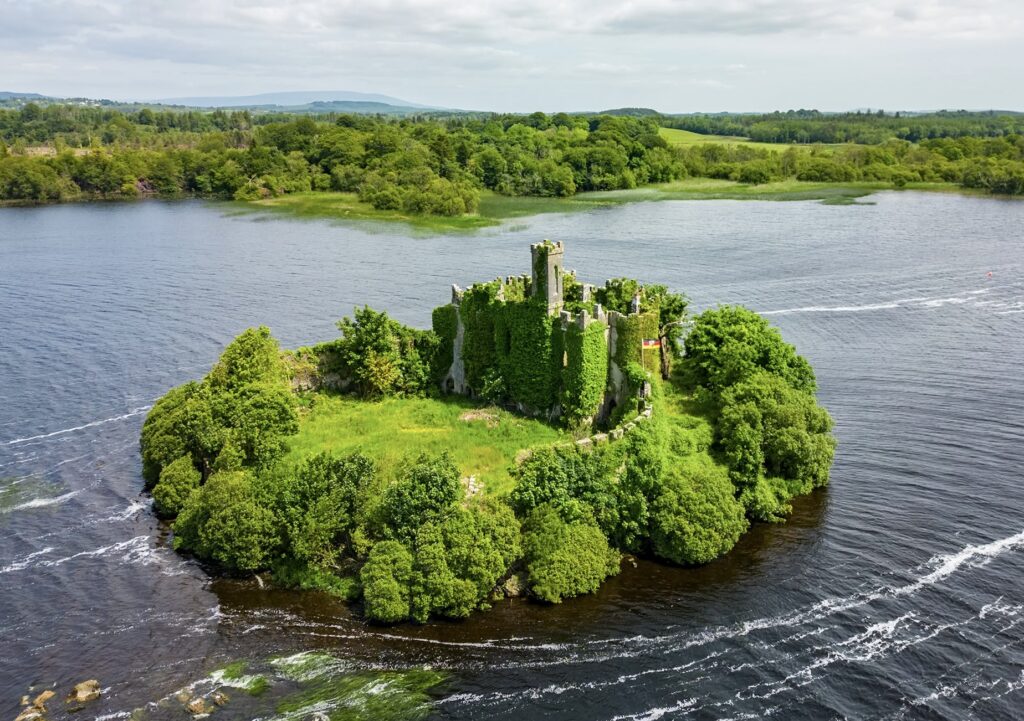
The Mac Diarmada eventually established their principal residence on Carraig Mhic Dhiarmada, later known as MacDermot’s Rock. The island provided a naturally protected setting for the royal household, but its importance should not be understood solely in military terms. A medieval residence was also a centre of hospitality, judgement, tribute and political assembly. Dependants came there to meet the king, disputes were heard, alliances were maintained and resources collected from the surrounding lordship were stored and redistributed. The island residence made Loch Cé the visible centre of Mac Diarmada rule.
The lake’s ecclesiastical importance developed alongside this political growth. The countryside around Loch Cé was already filled with older churches and sacred places before the introduction of the continental religious orders. Ardcarne, the churches of Tír Oilella, the Moytura landscape and the foundations associated with local saints all belonged to an ecclesiastical world that predated the rise of the Mac Diarmada. The new ruling dynasty did not replace these traditions. It inherited a landscape in which churches held land, preserved local memory and maintained hereditary relationships with surrounding families.
During the twelfth century, the reforming religious orders added new institutions to this older church landscape. Boyle Abbey, founded for the Cistercians in 1161, became the largest and most imposing of these houses. Its location near Loch Cé brought one of the most important continental monastic orders directly into the Mac Diarmada and Ó Conchobhair political world. The Cistercians required substantial land, labour and protection, and their survival depended upon the continuing support of Gaelic patrons. Boyle therefore represented both the international reform of the Church and the ability of the local dynasties to direct that reform within their own territories.
Loch Cé itself also contained an important reformed community before the appearance of Clarus Mac Mailín. On Church Island, in the south-western part of the lake, stood Inchmacnerin, or Mainistir Inis Mac nÉirín. Heritage Ireland notes that the site may have had an earlier ecclesiastical history, although the surviving evidence for its beginnings is limited. Between approximately 1140 and 1170, the community adopted the Rule of St Augustine and St Mary’s Priory was established there. Inchmacnerin was therefore present during the same broad period in which the Mac Diarmada were consolidating their rule and Boyle Abbey was becoming established nearby. (Heritage Ireland)
The Augustinian canons occupied a position between the older Irish church communities and the more enclosed monastic life represented by the Cistercians. They lived according to a communal rule but could also undertake pastoral and administrative duties. This made them well suited to a landscape containing older churches, scattered estates and local clergy. From its island setting, Inchmacnerin could maintain relationships with the surrounding countryside while remaining part of the wider reform movement transforming the Irish Church.
By the end of the twelfth century, Loch Cé had therefore acquired several overlapping forms of importance. It was the political centre of the Mac Diarmada, stood near the Cistercian abbey at Boyle and contained an Augustinian priory on Church Island. Older churches remained active around the lake and to the west, while the newly organised Diocese of Elphin provided a larger territorial structure linking them. Thomas Finan has shown that the bishops of Elphin operated within a political world strongly influenced by the Ó Conchobhair and Mac Diarmada. The diocesan system may have been shaped by the reforms of the wider Church, but its success in northern Connacht depended upon cooperation with the ruling dynasties.
The concentration of institutions around Loch Cé made the lake increasingly important beyond the boundaries of Moylurg. A religious house did not consist only of the church and the community living within its walls. It could hold estates, receive rents and maintain dependent churches in other territories. Its canons travelled, dealt with bishops and patrons, and brought clergy and administrative personnel into contact with one another. As the institutions around Loch Cé grew, so did the network of people and properties connected to the lake.
By the early thirteenth century, Loch Cé was becoming the centre of a regional ecclesiastical system as well as a royal lordship. The Mac Diarmada residence represented secular authority, Inchmacnerin represented the Augustinian canonical tradition, Boyle represented the Cistercians, and the Diocese of Elphin connected the region to the wider hierarchy of bishops and archbishops. The older Gaelic churches had not vanished beneath these newer institutions. They remained part of the system, often retaining their traditional lands and the families who had served them for generations.
This was the environment into which the Premonstratensians entered. They were canons regular who, like the Augustinians of Inchmacnerin, followed the Rule of St Augustine, but they belonged to a distinct and more closely organised congregation. Their presence did not introduce canonical religious life to Loch Cé for the first time. Instead, they added another institution to a lake where reformed communities were already established.
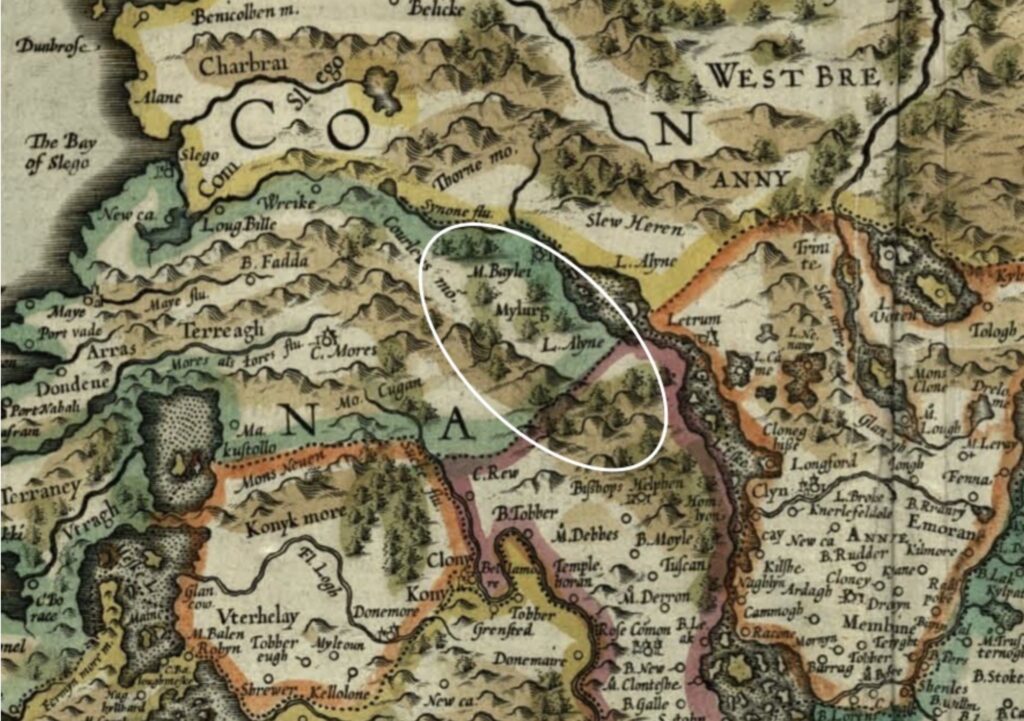
By about 1250, Loch Cé had become one of the most concentrated political and ecclesiastical centres in northern Connacht. The Mac Diarmada ruled from the lake, the Ó Conchobhair remained the dominant dynasty of the province, and the bishop of Elphin exercised authority across a diocese containing several powerful religious houses. Inchmacnerin, Boyle and the emerging Premonstratensian community stood close to older churches extending westward through Tír Oilella and the Moytura country. It was within this setting that the Ó Maol Chonaire family first becomes visible in both learned and ecclesiastical service.
The full extent of the network created around Loch Cé only becomes visible much later. When the religious houses were dissolved and their possessions recorded during the sixteenth century, the lands attached to the Loch Cé foundations stretched across northern Connacht and into Bréifne, from the country around Killala in the west to Loch Uachtair in the east. Together, these holdings amounted to more than 4,000 acres. What had begun as a group of religious communities gathered around one lake had developed into a substantial ecclesiastical estate extending across several kingdoms, dioceses and political frontiers. The sixteenth-century surveys preserve the final outline of a network whose foundations had been laid during the first half of the thirteenth century.
The Early Learned Tradition of the Ó Maol Chonaire
The Ó Maol Chonaire later became one of the most important hereditary learned families in Ireland. Their name is closely associated with the preservation of genealogies, historical texts and annalistic records, particularly for the Ó Conchobhair and the other ruling families of Síl Muireadhaigh. Later members of the family compiled and copied manuscripts that remain essential to the study of medieval Irish history.
Their later fame can make the family appear to have been fully formed as hereditary historians from the beginning. The earlier evidence is more limited. It shows learned individuals bearing the name before the middle of the twelfth century, but it does not reveal the location or organisation of the first family school.
The earliest secure record is the death in 1136 of Neidhe Ua Maelconaire, who was described as in senchaidh, “the historian.” The title distinguishes him from a general scholar or cleric. A senchaidh preserved genealogies, origin traditions and the historical claims of ruling families. This work had direct political importance because ancestry determined succession, social status and rights within a kindred. Neidhe’s title indicates that the family was already associated with specialised historical learning while Tairrdelbach Ua Conchobair was still king of Connacht.
A Tanaidhe Ua Maelconaire has also been associated with the same early period. Poems within the Leabhar Gabhála tradition were attributed to a man of that name, while the Book of Lecan called him Tanaidhe Eólach Ua Maelconaire, or “Tanaidhe the Learned.” The traditional date attached to him is less secure than the record for Neidhe, and it should not be used to construct a definite early family pedigree. It nevertheless reinforces the association between the name and historical or literary learning during the twelfth century.
The learned position of the family becomes clearer in 1231 with the death of Duinnín Ua Maelconaire, ollamh of Síl Muireadhaigh. An ollamh stood at the highest recognised level of a hereditary learned profession. Duinnín’s title connected him directly to the ruling population group that included the Ó Conchobhair and Mac Diarmada. He was therefore not simply a scholar who happened to live in Connacht. He occupied an official position within the political order of the province.
The work of such a family extended beyond recording names in pedigrees. Learned historians preserved accounts of territorial rights, past alliances, royal successions and the relationships between ruling and subordinate families. They could provide the historical arguments upon which claims to kingship or land were based. Their proximity to the great dynasties gave them influence, but it also required them to operate carefully within a political world in which rival branches often disputed the same inheritance.
The later genealogical traditions of the Ó Maol Chonaire placed the family within distinguished lines of descent, but these claims require the same caution applied to the genealogies they produced for others. The family tradition linked them with Maine, brother of Lóegaire, and with the older kingdom of Tethbae. The Book of Ballymote also associated them with the Muintir Maelsinna through a common ancestor. These traditions may preserve elements of genuine family memory, but they may equally reflect the need of a hereditary learned family to express its position through a recognised dynastic pedigree.
Their secure historical importance lies not in proving this remote ancestry but in the offices they held. Neidhe was remembered as a historian, and Duinnín was ollamh of Síl Muireadhaigh. By the early thirteenth century, the Ó Maol Chonaire were already serving the political society from which the Mac Diarmada and Ó Conchobhair drew their authority.
The Ecclesiastical Side of the Family
The early Ó Maol Chonaire should not be understood solely as secular genealogists. Medieval Irish learning remained closely connected to the Church, and the education required of a historian overlapped with that required of clergy and ecclesiastical administrators. Latin literacy, manuscript training, law and knowledge of genealogy could be useful within a royal household, a cathedral or a religious house. Families associated with learned service could therefore produce churchmen as well as professional historians.
An important indication of this ecclesiastical side appears in the record of Magrath Mac Mailín, priest of Kilmactranny, who died in 1236. His death was recorded in the Annals of the Four Masters, an unusual distinction for an otherwise little-known local priest. Eamonn Kelly has suggested that Magrath may have belonged to the same regional family circle as Clarus Mac Mailín Ó Maol Chonaire and may even have been a close relative. The evidence does not establish the precise relationship, and Mac Mailín cannot automatically be treated as a fully transparent hereditary surname in every occurrence. The shared name, period and ecclesiastical setting nevertheless make a connection possible.
Kilmactranny is especially significant because it stood within the compact ecclesiastical landscape west of Loch Cé, close to Moytura, Loch Arbhach, Kilmacallan and Rathmulpatrick. It was not an isolated parish far removed from the suspected early Ó Maol Phádraig setting. Kilmactranny and Rathmulpatrick lay within the same small regional church world, close enough for clergy, learned families and the communities associated with them to know and interact with one another.
Rathmulpatrick remains the strongest surviving place-name connecting the Ó Maol Phádraig name with this early landscape. Kilmactranny, meanwhile, provides a possible early appearance of the Mac Mailín or Ó Maol Chonaire ecclesiastical family. No surviving document places an Ó Maol Phádraig beside Magrath Mac Mailín, and the proximity of the churches cannot prove either common ancestry or formal cooperation. It does establish a genuine opportunity for contact between the two family circles.
That possibility becomes more important when viewed against their later histories. The Ó Maol Chonaire became closely involved in the expansion of reformed ecclesiastical institutions from the western Connacht church landscape towards Loch Cé and eventually into Bréifne. The Ó Maol Phádraig later appeared across several parts of that same broad network. The early proximity of Kilmactranny and Rathmulpatrick suggests that any later relationship between the families need not have begun after one of them reached Loch Cé. They may already have known one another within the older Moytura and Tír Oilella ecclesiastical world.
This remains an interpretation rather than a documented relationship. The available evidence does not permit the two families to be joined through a definite genealogy. What it does show is that an early Mac Mailín churchman served within walking distance of the place most strongly associated with the early Ó Maol Phádraig name. In a society where ecclesiastical service, education and family connections were often passed through generations, that proximity matters.
The learned and ecclesiastical sides of the Ó Maol Chonaire were therefore not separate developments. Neidhe Ua Maelconaire and Duinnín Ua Maelconaire represent the professional historical tradition, while Magrath Mac Mailín points towards a family presence within the regional Church. Together, these records suggest a family already capable of serving both the courts of rulers and the institutions of the Church before its most important thirteenth-century representative entered the historical record.
The Arrival of Clarus
The man who would bring these strands together was Clarus Mac Mailín Ó Maol Chonaire. By the 1230s he had emerged as one of the leading churchmen of northern Connacht. He was associated with the Diocese of Elphin, the Premonstratensian order and the patronage of the Mac Diarmada. His career would connect the older churches west of Loch Cé with the growing religious centre on the lake and eventually extend that network eastward into the Ó Raghallaigh territories around Loch Uachtair.
Clarus did not create the importance of Loch Cé by himself. He entered a lake already occupied by the Mac Diarmada royal residence and the Augustinian priory of Inchmacnerin, with Boyle Abbey nearby and the diocesan administration of Elphin operating across the surrounding region. The political and ecclesiastical foundations were already present. What Clarus brought was the ability to organise them into a wider network supported by powerful rulers in more than one kingdom.
His appearance also reveals that the Ó Maol Chonaire had not yet become defined solely by the hereditary historical profession for which they were later famous. In Clarus, the family appears at the centre of church reform, monastic organisation, landholding and political negotiation. He belonged to the same broad learned world as the early historians of his name, but his authority was exercised through the Church.
The work he began would transform Loch Cé from an important regional centre into the heart of an ecclesiastical network stretching from the churches of Tír Oilella and Moytura to the developing Ó Raghallaigh lordship in East Bréifne. It would also create the first documented institutional connection between the western church landscape in which the Ó Maol Phádraig may have originated and the eastern territories in which the family later appears so frequently.
That story begins with Clarus and belongs in the next post.
Finan, Thomas, ed. Medieval Lough Cé: History, Archaeology and Landscape. Dublin: Four Courts Press, 2010.
Finan, Thomas. “The Medieval Bishops of Elphin and the Lost Church at Kilteasheen.” In Princes, Prelates and Poets in Medieval Ireland: Essays in Honour of Katharine Simms. Dublin: Four Courts Press, 2013.
Gwynn, Aubrey, and R. Neville Hadcock. Medieval Religious Houses: Ireland. London: Longman, 1970.
Kelly, Eamonn P. “Mythology and Landscape of Sligo, Part 2: The Battle of Moytura and Formaoil na Fiann.” Sligo Field Club Journal 7 (2021).
Mac Niocaill, Gearóid. The Medieval Irish Annals. Dublin: Dublin Historical Association, 1975.
O’Dwyer, Brendan. “The Annals of Connacht and Loch Cé and the Monasteries of Boyle and Holy Trinity.”
Ó Muraíle, Nollaig. “The Gaelic Heritage of County Roscommon.”
Freeman, A. Martin, ed. and trans. Annála Connacht: The Annals of Connacht, A.D. 1224–1544. Dublin: Dublin Institute for Advanced Studies, 1944.
Hennessy, William M., ed. and trans. The Annals of Loch Cé: A Chronicle of Irish Affairs from A.D. 1014 to A.D. 1590. 2 vols. London: Longmans, Green, Reader and Dyer, 1871.
O’Donovan, John, ed. and trans. Annala Rioghachta Éireann: Annals of the Kingdom of Ireland by the Four Masters. 7 vols. Dublin: Hodges, Smith and Co., 1848–1851.
The Book of Ballymote.
The Book of Lecan.
Heritage Ireland. Inchmacnerin Augustinian Priory.