
The Rise of the Great Dynasties
By the middle of the twelfth century, the reorganization of the Irish Church was already well underway. The Synod of Ráth Breasail had divided much of the country into territorial dioceses, and the Synod of Kells had placed those dioceses beneath four archbishops whose authority was formally recognized by Rome. The older churches, monastic federations and hereditary ecclesiastical families did not disappear, but they now operated within a wider diocesan structure. Bishops exercised authority across large territories, while disputes over appointments, benefices and church lands could eventually be carried beyond Ireland to the papal court.
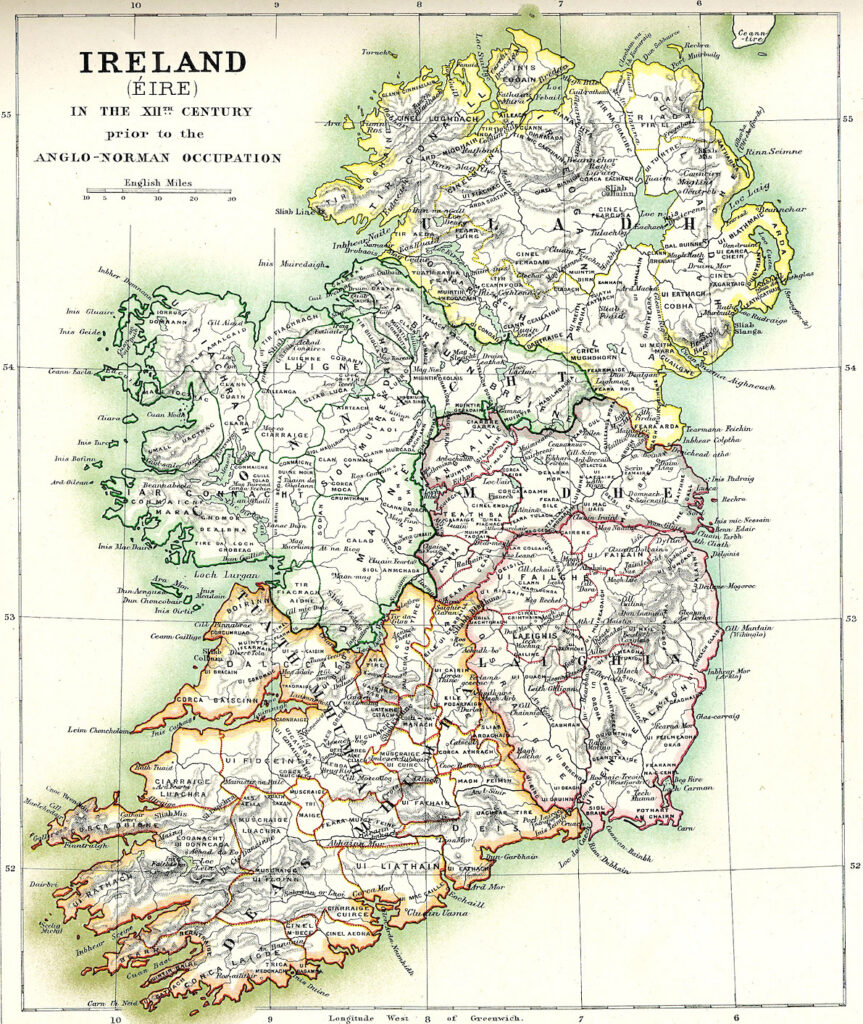
At the same time, political power was becoming concentrated in the hands of a small number of ruling dynasties. The older landscape of numerous small kingdoms remained, but many local rulers now stood beneath more powerful provincial kings and regional lords. Across Connacht and Bréifne, four families became especially important: the Ó Conchobhair, the Mac Diarmada, the Ó Ruairc and the Ó Raghallaigh. Their authority did not rest upon fixed borders or centralized government in the modern sense. It rested upon tribute, military strength, marriage alliances, fosterage, patronage and the ability to place loyal families in positions of influence.
These dynasties did not rule separately from the Church. They endowed monasteries, supported bishops, influenced appointments and granted lands to religious foundations. The bishops, in turn, gave legitimacy to rulers, administered important estates and connected Irish political society to the wider authority of Rome. From this period onward, power in Ireland operated through two overlapping hierarchies. One was headed by kings and regional dynasties. The other was headed by bishops, archbishops and ultimately the Pope. Hereditary church families stood between them, serving both the secular rulers who protected their lands and the ecclesiastical authorities who confirmed their offices.
The greatest political power in the west was the Ó Conchobhair dynasty. Their rise had begun long before the diocesan reforms were complete, but the two developments soon became closely connected. Under Tairrdelbach Ua Conchobair, who ruled Connacht from 1106 until 1156, the kingship of Connacht was transformed into one of the strongest provincial monarchies in Ireland. Tairrdelbach inherited a province divided among powerful regional rulers and spent much of his reign bringing those kingdoms beneath his authority. He campaigned far beyond Connacht, intervened in the affairs of neighbouring provinces and repeatedly placed himself at the centre of the struggle for the high-kingship.
Tairrdelbach did not attempt to remove every local dynasty from power. His success depended upon securing the loyalty of subordinate rulers who could govern their own territories while acknowledging his supremacy. This allowed the kingdom of Connacht to expand without requiring direct administration from one centre. Local kings continued to collect tribute, lead their own followers and maintain their own networks of dependants, but their position increasingly depended upon their relationship with the Ó Conchobhair king.
The Church formed part of this political order. Tairrdelbach supported the reform movement and understood the value of ecclesiastical patronage. A king who founded or endowed a monastery did more than perform an act of devotion. He established a religious centre within his sphere of influence, strengthened his relationship with the clergy and created an institution that could preserve his memory and that of his family. The formation of dioceses also gave rulers new opportunities to influence the government of the Church across much larger areas than the older local foundations had covered.
When Tairrdelbach died in 1156, his son Ruaidrí Ua Conchobair eventually secured the kingship of Connacht and extended the family’s power still further. Ruaidrí became High King of Ireland in 1166, after the fall of Muirchertach Mac Lochlainn. For a brief period, the authority of the Ó Conchobhair reached its greatest extent. Ruaidrí received hostages and tribute from rulers across the island, intervened in disputes between kingdoms and attempted to maintain the political balance that had allowed his father to dominate Irish affairs.
The Anglo-Norman invasion began only a few years later, but it did not immediately end Ó Conchobhair power. Ruaidrí remained king of Connacht, and his descendants continued to rule large parts of the province for generations. The invasion changed the political landscape, particularly in the east and south, yet much of inland Connacht remained under Gaelic authority. In this setting, the relationship between the Ó Conchobhair dynasty and the reformed Church continued to deepen.
The Diocese of Elphin provides one of the clearest examples. Created in the aftermath of the twelfth-century reform synods, Elphin covered a large part of central and northern Connacht. Thomas Finan has shown that the diocese was closely influenced by the Ó Conchobhair and Mac Diarmada dynasties during the twelfth and thirteenth centuries. The first confirmed bishops belonged to the Ua Dubthaig family, but later appointments reveal the growing involvement of the ruling houses themselves.
Tomaltach Ua Conchobair, a grandson of Tairrdelbach Ua Conchobair, became bishop of Elphin in 1172. He was not a distant cleric with only a nominal connection to the ruling family. He belonged to the heart of the dynasty that governed Connacht. His later elevation to the archbishopric of Armagh shows how far the influence of the family could reach through the new ecclesiastical structure. Another Tomaltach Ua Conchobair became bishop of Elphin in the thirteenth century and was later raised to the archbishopric of Tuam. These appointments demonstrate that the division between secular and ecclesiastical authority was never absolute. Members of ruling dynasties could move directly into the highest offices of the Church, carrying their family connections with them.
The Ó Conchobhair did not govern every part of Connacht directly. Their authority depended upon powerful subordinate families, and none became more important to the history of the region around Loch Cé than the Mac Diarmada of Moylurg. Their lordship lay between the central plains of Connacht and the approaches to Bréifne, with Loch Cé at its centre. This was a strategically important landscape of lakes, woods, fertile lowlands and routes linking the upper Shannon with the wider province.
The Mac Diarmada had emerged as a distinct ruling dynasty by the twelfth century. They acknowledged the supremacy of the Ó Conchobhair kings, but within Moylurg they exercised authority in their own right. Their rise illustrates how the provincial kingship of Connacht operated. The Ó Conchobhair depended upon strong regional allies who could secure important territories, provide military support and maintain order on the edges of the kingdom. In return, families such as the Mac Diarmada gained protection, status and opportunities to extend their own influence.
Loch Cé became the political heart of the Mac Diarmada lordship. Its islands provided secure places for residences, churches and religious communities, while the surrounding country connected Moylurg with Sligo, Roscommon, Bréifne and the upper Shannon. Control of this region gave the Mac Diarmada an influence greater than the size of Moylurg alone might suggest. They stood between the kings of Connacht to the south and west and the rulers of Bréifne to the north and east. Their ability to work within both worlds would become one of the foundations of their power.
The Mac Diarmada were also deeply involved in the religious changes of the period. They supported churches and religious houses within their territory and established relationships with new continental orders entering Ireland. The monastery at Trinity Island on Loch Cé became especially important. It belonged to the Premonstratensian order, one of the reforming religious communities that spread across Ireland during the twelfth and thirteenth centuries. Its presence within the Mac Diarmada lordship placed Moylurg directly within the wider European reform movement.
The support of such a house gave the Mac Diarmada more than spiritual prestige. Monasteries held lands, managed resources, received grants and maintained connections extending far beyond the territories of their local patrons. They required educated clergy, administrators and families capable of managing estates and preserving records. The rise of the Mac Diarmada therefore created opportunities for hereditary learned and ecclesiastical families whose skills remained essential within the reformed Church.
The connection between Moylurg and the Diocese of Elphin was equally important. As Thomas Finan observed, bishops of Elphin were frequently drawn from families connected with the Ó Conchobhair and Mac Diarmada political order. The diocesan structure may have been designed according to the principles of Roman reform, but its operation in Gaelic Connacht depended upon cooperation with the ruling dynasties. A bishop without local support would have struggled to exercise authority, collect revenues or defend church property. A king or regional lord, however powerful, also benefited from the recognition and administrative reach of the diocesan Church.
By the beginning of the thirteenth century, the lands around Loch Cé had become a meeting place of these forms of authority. The Ó Conchobhair stood above the province as kings of Connacht. The Mac Diarmada ruled Moylurg and protected the churches within their lordship. The bishop of Elphin exercised ecclesiastical authority across a territory extending beyond the lands of any one local ruler. Religious houses such as Trinity Island maintained their own estates and communities while remaining dependent upon both episcopal oversight and secular protection.
It was within this political and ecclesiastical setting that the Ó Maol Chonaire family rose to prominence. Their later association with the Mac Diarmada did not begin in an isolated school of poetry or history. It developed within a lordship that stood at the centre of the new order taking shape around Loch Cé, where the ambitions of powerful dynasties, the authority of bishops and the service of hereditary learned families had become closely connected.
The Ó Ruairc and the Rise of the Ó Raghallaigh
The kingdom of Bréifne had already emerged as a recognised political territory by the end of the eighth century, but its early rulers cannot be fitted securely into the later genealogies of the families who eventually dominated it. The annals record kings of Bréifne in 792 and again in 805, yet these men do not sit comfortably within the later pedigree of the Uí Ruairc. The most likely explanation is that early Bréifne was assembled from several older territories and population groups whose rulers competed for supremacy before one dynasty established a lasting hold upon the kingship. Later genealogists preserved the ancestry of the successful ruling line more carefully than those of the families it displaced or absorbed.
Medieval genealogies placed the future Ó Ruairc and Ó Raghallaigh dynasties within the Uí Briúin Bréifne, a branch of the wider Uí Briúin population of Connacht. The genealogy linked them to the same prestigious ancestry as the Ó Conchobhair and Mac Diarmada, although through a different branch. Such pedigrees expressed political relationships as much as biological descent. They placed the ruling families of Bréifne within the Connacht dynastic world and gave them a recognised position among the descendants of Brión. Eamonn Kelly describes the Ó Ruairc and Ó Raghallaigh as the principal dynasties of Uí Briúin Bréifne, alongside the Uí Briúin Aí lines represented by the Ó Conchobhair, Mac Diarmada and Mac Donnchadha.
The surname Ó Ruairc developed from a ruling line already becoming prominent during the ninth and tenth centuries. Their rise was closely connected with the geography of western Bréifne. The country around Loch Aillionn, the upper Shannon and southern Leitrim commanded movement between central Connacht and the northern midlands. From this western base, rulers could reach eastward through the passes and waterways of Bréifne towards western Cavan and Loch Uachtair, while the routes north opened towards Fermanagh and the lands beyond. Control of these approaches did not produce a compact kingdom with fixed borders. It gave the ruling dynasty the ability to draw a collection of older territories beneath its overlordship.
The Ó Ruairc kings therefore ruled a varied political landscape rather than a single homogeneous population. Bréifne included districts associated with Conmaicne Réin, Cenél Luacháin, Dartraige, Callraige and other older communities whose identities survived beneath the expanding kingdom. The authority of the king rested upon the submission of local rulers, the payment of tribute, the exchange of hostages and the ability to call subordinate kindreds into military service. The strength of Bréifne depended upon holding these relationships together across difficult country divided by lakes, bogs, woods, mountains and narrow passages.
By the eleventh century the Ó Ruairc had become the recognised royal dynasty of Bréifne, although their position was repeatedly challenged from within the family and by neighbouring powers. They were closely involved in the wider struggles among the kings of Connacht, Meath and the northern dynasties. At different times they allied with the Ó Conchobhair or resisted them, depending upon the ambitions of the men involved. Bréifne stood between larger powers and could rarely remain outside their conflicts.
The greatest figure produced by the dynasty was Tigernán Mór Ó Ruairc, whose long career dominated Bréifne during the middle decades of the twelfth century. His exact accession is difficult to reduce to a single uncontested date because his rule was interrupted by rivals, but his political importance is clear from the 1120s until his death in 1172. Under Tigernán, Bréifne reached the greatest extent associated with the Ó Ruairc kingship. Paul MacCotter describes the kingdom at its height as extending across most of the country later divided between Cavan and Leitrim, with influence reaching into adjoining districts of Meath, Fermanagh and Sligo.
Tigernán’s power was built partly through his long and difficult relationship with Tairrdelbach Ua Conchobair. The king of Connacht needed Bréifne to secure the northern and eastern approaches to his province, while Tigernán benefited from the support of the strongest provincial king in Ireland. Their alliance was never free of tension. Each understood that the other was using the relationship to extend his own authority, and Tigernán was at times driven from Bréifne when the political balance turned against him. He nevertheless returned repeatedly and survived long enough to become one of the most experienced rulers of his generation.
His marriage to Derbforgaill, daughter of the king of Meath, drew him still more deeply into the politics of the midlands. Her removal by Diarmait Mac Murchada in 1152 later became one of the best-known episodes in medieval Irish history, although the story was greatly simplified by later writers. Whatever the personal circumstances, the affair formed part of a larger political struggle involving Bréifne, Meath, Leinster and Connacht. Tigernán’s hostility towards Diarmait Mac Murchada did not begin with one private grievance, nor can the subsequent Anglo-Norman intervention be explained solely through the story of Derbforgaill. The conflict belonged to decades of rivalry among powerful kings seeking control of the Irish midlands.
The arrival of Anglo-Norman forces after 1169 placed Bréifne in immediate danger. Their advance into Meath brought a new military power directly against Tigernán’s eastern frontier. He was already an elderly ruler, but he remained active in the struggle. In 1172 he was killed at Tlachtgha near Athboy during negotiations with Hugh de Lacy and other Anglo-Norman leaders. The accounts differ in detail, but the political consequence is unmistakable. His death removed the one ruler who had possessed the experience and authority to hold the greater kingdom of Bréifne together.
The Ó Ruairc did not disappear after Tigernán’s death. They continued to claim the kingship of Bréifne, and their descendants remained the dominant rulers of its western territories. What they lost was the ability to impose stable authority across the whole kingdom. Rival branches of the family competed for succession, the kings of Connacht intervened repeatedly, and the Anglo-Norman lordship of Meath pressed against Bréifne from the east. The weakening of the central kingship allowed one of Bréifne’s subordinate dynasties to consolidate a power of its own.
The Ó Raghallaigh were not newcomers who suddenly entered eastern Bréifne during the thirteenth century. They were an established kindred within the kingdom long before they became independent kings. Medieval genealogies linked them with the Ó Ruairc through the Uí Briúin Bréifne, and although the literal accuracy of the pedigree cannot be assumed, it reflects their shared membership in the same political society. The rise of the Ó Raghallaigh was an internal change within Bréifne, not the conquest of its eastern lands by an outside people.
Their family name derived from Raghallach, an ancestor placed several generations before the surname became hereditary. By the first half of the twelfth century the annals and other records begin to show members of the family as lords of Muintir Raghallaigh. Their territory lay in eastern Bréifne, within the country later associated especially with central and eastern Cavan. They remained subordinate to the Ó Ruairc king, but they were already developing the territorial and military strength that would later support an independent lordship.
The reign of Tigernán Mór held this eastern power within the larger Bréifne kingdom. His death changed the relationship. During the decades after 1172, rival Ó Ruairc claimants were occupied by succession struggles in the west, while Anglo-Norman pressure from Meath threatened the eastern districts more directly. The Ó Raghallaigh were therefore forced to act with increasing independence. They defended their own lands, built alliances and extended their authority over neighbouring communities that could no longer depend upon the protection of a single king of Bréifne.
Loch Uachtair became the centre of this developing power. Its connected lakes, islands and waterways offered both protection and movement through the surrounding drumlin country. An island residence could be defended more easily than an exposed settlement, while the lake system provided access to much of central Cavan. By the early thirteenth century the wealth and authority of the leading Ó Raghallaigh rulers were closely associated with Loch Uachtair.
Cathal Ó Raghallaigh was the central figure in this stage of the family’s rise. In 1226 he destroyed an Anglo-Norman castle at Kilmore, demonstrating that the dynasty had become capable of acting as the principal military power in eastern Bréifne. The attack was not an isolated raid by a subordinate family. It formed part of a sustained defence of the eastern lordship against expansion from Meath. By then the Ó Raghallaigh had acquired the strength to challenge fortified Anglo-Norman settlements and to prevent their frontier from advancing securely into central Cavan.
An attack on Cathal’s island residence in 1231 further reveals the position he had attained. Forces from Tír Chonaill reached Loch Uachtair and carried away valuables and supplies from the residence. The incident shows that the lake had become more than a refuge. It was a political centre containing the material wealth of the ruler and his household. The Ó Raghallaigh lordship was taking visible shape around a permanent territorial base.
Two years later, in 1233, Cathal Ó Raghallaigh defeated an invasion led by William Gorm de Lacy. De Lacy was wounded during the campaign and died soon afterwards. The victory established the Ó Raghallaigh as one of the strongest Gaelic powers along the border of the lordship of Meath. Their authority had grown from that of a subordinate eastern kindred into a lordship capable of defeating a major Anglo-Norman force.
This expansion did not yet amount to the formal and permanent division of Bréifne into two separate kingdoms. The Ó Ruairc still claimed supremacy over the whole territory, and the kings of Connacht continued to intervene on behalf of competing rulers. The Ó Raghallaigh, however, were no longer merely local lords waiting upon the decisions of the western king. By the middle of the thirteenth century they possessed their own territorial centre, military following and network of dependent families. East Bréifne already existed in practice even though the struggle over its final political status had not been settled.
The situation around 1250 was therefore very different from that which Tigernán Mór had governed a century earlier. The Ó Ruairc remained kings in the western part of Bréifne, centred upon the upper Shannon and the Leitrim country. The Ó Raghallaigh had established a powerful eastern lordship around Loch Uachtair and the lands of Cavan. Between them lay older territories and families whose loyalties could be drawn in either direction. The Anglo-Norman frontier remained close to the east, while the kings of Connacht continued to exercise influence from the west.
The two dynasties had emerged from the same Bréifne political world, but the events following 1172 placed them on different paths. The Ó Ruairc inherited the ancient kingship and the prestige attached to it. The Ó Raghallaigh built their power within the eastern territories and rose through the gradual weakening of the older centre. By 1250 the division that would later define Bréifne was already clearly visible, even though its most violent confrontation still lay a few years ahead.
References
Bartlett, Thomas. Ireland: A History. Cambridge University Press, 2010.
Byrne, Francis John. Irish Kings and High-Kings. 3rd ed. Four Courts Press, 2001.
Charles-Edwards, T. M. Early Christian Ireland. Cambridge University Press, 2000.
Duffy, Seán, ed. Medieval Ireland: An Encyclopedia. Routledge, 2005.
Etchingham, Colmán. Church Organisation in Ireland AD 650 to 1000. Laigin Publications, 1999.
Finan, Thomas. “The Medieval Bishops of Elphin and the Lost Church at Kilteasheen.” In The Church and the Lordship in Medieval Ireland. Four Courts Press, 2012.
Gwynn, Aubrey, and R. Neville Hadcock. Medieval Religious Houses: Ireland. Longman, 1970.
MacCotter, Paul. Medieval Ireland: Territorial, Political and Economic Divisions. Four Courts Press, 2008.
Martin, F. X., and F. J. Byrne, eds. A New History of Ireland, Volume II: Medieval Ireland 1169–1534. Oxford University Press, 1987.
Moody, T. W., F. X. Martin, and F. J. Byrne, eds. A New History of Ireland, Volume IX: Maps, Genealogies, Lists. Oxford University Press, 1984.
Orpen, Goddard Henry. Ireland under the Normans. 4 vols. Clarendon Press, 1911–1920.
Simms, Katharine. “Frontiers in the Irish Church: Regional and Cultural.” In T. B. Barry, Robin Frame, and Katharine Simms, eds. Colony and Frontier in Medieval Ireland. Hambledon Press, 1995.
Watt, J. A. The Church in Medieval Ireland. Gill and Macmillan, 1972.