
The history of R-BY9001 does not begin with Fitzpatrick, McDermott, Quigley, Gilroy, King, O’Reilly or O’Rourke. All of those names belong to a much later Ireland. BY9001 had already existed for thousands of years before hereditary surnames began to identify the paternal families that now occupy its lower branches. The more useful way to read the tree is therefore from the other direction: begin with the prehistoric paternal population, follow the narrowing of that population through the Y-chromosome tree, and only then ask what happened when its surviving descendants entered the medieval surname world.
That distinction is essential because BY9001 is not simply an old version of one of the families found beneath it. It is a deep paternal lineage whose surviving branches eventually appear under several different Irish surnames. Some of those branches are securely defined by downstream SNP testing, while others are presently visible only through distinctive STR patterns. The evidence is therefore not equal at every point, but when the SNP structure, STR signatures, TMRCA estimates and geography are read together, a remarkably coherent regional picture emerges.
FGC12055 and the First Ancient Evidence
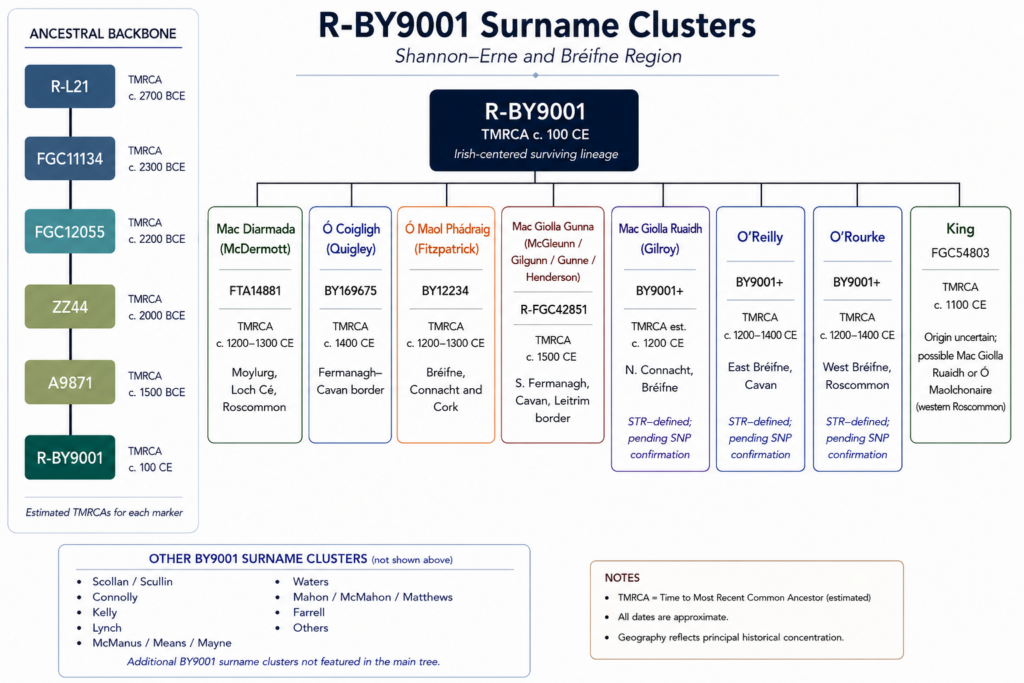
The relevant ancestral path is:
R-L21 → FGC11134 → FGC12055 → ZZ44 → A9871 → BY9001
The estimated formation dates place L21 at approximately 2700 BCE, FGC11134 around 2300 BCE and FGC12055 around 2200 BCE. The sequence leading eventually to BY9001 developed during a period of enormous demographic change associated with the Chalcolithic and Early Bronze Age. The exact places at which each mutation first appeared cannot presently be fixed, because this was also a period of considerable movement between Ireland, Britain and the wider Atlantic world. What can be established more securely is where members of the developing paternal line actually appear in ancient DNA.
The earliest and most important individual is PG911 from Pollnagollum Cave in County Fermanagh, dated to approximately 2349–2135 BCE. Lara Cassidy assigns PG911 to FGC12055. This places an FGC12055 male in Fermanagh extremely early in the history of the branch. Pollnagollum itself was not an ordinary cemetery but a vertical cave and swallowhole in the Fermanagh limestone country where human remains were deposited over a period extending across the Chalcolithic and Early Bronze Age.
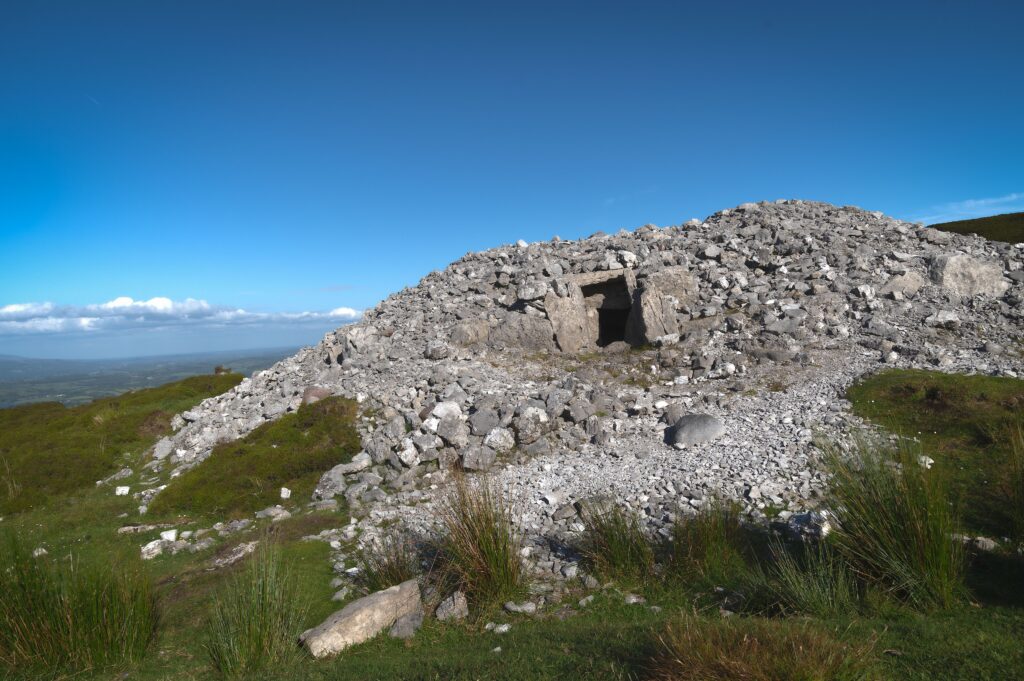
Several centuries later the same paternal lineage appears again in TR116 from Treanmacmurtagh in County Sligo. Cassidy gives PG911 and TR116 the same Y-haplogroup assignment. TR116 was a male child aged approximately ten to twelve years, buried crouched within a short cist beneath a cairn on a mountain ridge near the Carrowkeel complex. A small bowl had been placed in front of the skull; the cist also contained cremated remains of an adult and sherds of another vessel. The unburnt remains produced a radiocarbon date of approximately 2015–1758 BCE, and the left petrous bone was used for the ancient-DNA sample.
The combination of PG911 and TR116 gives the early lineage real geographical depth. We have FGC12055 represented first in Fermanagh near the beginning of the Bronze Age and then several centuries later in Sligo. These were not two individuals from one cemetery or one small community. One came from a cave-deposition complex in Fermanagh, the other from a formal cist burial beneath a cairn in Sligo. Whatever the exact location in which FGC12055 first formed, its paternal population was already established across two parts of the northwestern Irish interior very early in its history.
FGC12055 Was Broader Than BY9001
FGC12055 itself was not yet the narrowly Irish population represented later by BY9001. It belonged to a broader paternal horizon whose descendants spread through different parts of the Atlantic and Irish Sea world. One indication of this is the presence of other branches beneath the same upstream ancestry whose surviving modern distributions differ markedly from the line leading to BY9001.
The tree becomes progressively more informative beneath FGC12055. Under ZZ44, the surviving branches begin to show clearer geographical differentiation, while A9871 becomes more distinctly Irish-centred. That tendency continues into BY9001. The picture is therefore one of gradual narrowing: from the widespread L21 background, through FGC11134 and FGC12055, into a more strongly Irish A9871 population and finally BY9001.
The Iron Age individual WBK106 from Winterborne Kingston in Dorset belongs close to this later branching zone. His available Y-chromosome reads show ancestry very close to A9871 and the wider BY9001 block, demonstrating that related paternal ancestry remained present in southern Britain long after PG911 and TR116. He is useful because he shows that the upstream population remained geographically broader than the surviving BY9001 lineage itself.
By the time we reach BY9001, however, the situation has changed considerably. BY9001 is exclusively Irish in its deepest-rooted surname lines, and its surviving branches are concentrated most strongly in the northwest.
BY9001 and the Northwestern Irish Population
The later branches of BY9001 repeatedly return to the same broad landscape: western Roscommon, Sligo, Leitrim, Cavan and Fermanagh, with extensions into adjoining areas of north Connacht and the later Bréifne world. This is the landscape of Loch Cé, the upper Shannon, Lough Allen, the Erne system and Lough Oughter.
BY9001 is much older than the political divisions later imposed across this region. It predates the medieval kingdom of Bréifne, Mac Diarmada rule in Moylurg, the rise of Ó Raghallaigh in east Bréifne and the hereditary surnames that now identify its surviving branches. The DNA is therefore revealing an older paternal population already present before those later political and family identities developed.
The surname lines below BY9001 represent what happened when descendants of that older population entered the medieval world.
Mac Diarmada
The Mac Diarmada/McDermott branch is particularly important because it demonstrates that a major medieval surname could contain more than one paternal origin. The chiefly Mac Diarmada tradition of Moylurg has been associated with another Y-DNA lineage, while a separate McDermott group sits securely beneath BY9001 under FTA14881.
This indicates that another paternal family became part of the Mac Diarmada surname population. The exact mechanism cannot now be recovered. It could reflect incorporation of an older local family, collateral descent, fosterage, political affiliation or another form of integration into the wider Mac Diarmada kindred.
The geography is particularly striking. Moylurg and Loch Cé lie directly within the western portion of the BY9001 landscape. The appearance of a deep BY9001 Mac Diarmada line therefore places one of its medieval surname branches precisely where the wider paternal pattern already points.
Ó Coigligh — Quigley
The Ó Coigligh/Quigley line forms another important branch. Its genetic depth reaches back into the medieval surname period, while the historical family belongs firmly within the Fermanagh–Cavan border country.
A 1609 inquisition records O Quigley as duoghasa of Clontivrin in the parish of Clones, indicating hereditary possession associated with church land, while Corraquigley in Killinagh parish preserves the surname within the local landscape. Here the genetic and documentary evidence meet especially well: an old BY9001 paternal line carrying a historically appropriate surname in the Fermanagh–Cavan frontier region.
Ó Maol Phádraig and BY12234
The most important branch for the present project is Ó Maol Phádraig, represented by BY12234. BY12234 has an estimated TMRCA around the high medieval period and is overwhelmingly represented today by Fitzpatrick descendants. Its many downstream branches show that this was already a substantial paternal family before the surname later fragmented and was almost entirely anglicised.
The historical genealogies are particularly interesting. The Great Book of Irish Genealogies and the Book of Fenagh place an Ó Maol Phádraig family within Cenél Luacháin, deriving the surname from Máel Pátraic son of Maolgeann. Medieval genealogies cannot simply be treated as literal Y-DNA pedigrees, but the geographical agreement is striking. Cenél Luacháin falls directly within the Leitrim–Bréifne portion of the broader BY9001 region.
The later history of BY12234 extends beyond one small locality. The surviving Ó Maol Phádraig paternal population appears across Bréifne, Connacht and Cork, reflecting the widening distribution of different branches of the family before and during the early modern period.
Mac Giolla Gunna
The Mac Giolla Gunna line is genetically well defined beneath R-FGC42851. Modern surname forms include McElgunn, Gilgunn and Gunne, with Henderson also appearing within the same paternal group. The surviving cluster has a TMRCA of approximately 1500 CE.
Its geography again returns us to the same northwestern zone, particularly southern Fermanagh and the Cavan–Leitrim borderlands. Mac Giolla Gunna therefore provides another independent surname line emerging from the old BY9001 population within the wider Shannon–Erne region.
Mac Giolla Ruaidh — Gilroy
The proposed Mac Giolla Ruaidh/Gilroy line is different because it remains defined through STR evidence rather than a confirmed downstream SNP branch. The Gilroy cluster carries a pattern strongly compatible with BY9001, and its STR-calculated TMRCA is approximately 1200 CE.
That depth makes the cluster particularly interesting. It places the likely paternal relationship well within the medieval surname era and fits the broader north Connacht–Bréifne geography already associated with BY9001. BigY testing from the appropriate Gilroy line would be needed to establish its exact position on the tree.
The Gilroy cluster becomes especially significant when considered beside the King line.
King
The King line is securely placed at FGC54803, with two tested King men sharing a paternal ancestor at approximately 1100 CE. Their earlier documentary ancestry is presently unknown, so the Gaelic surname from which this King branch developed cannot yet be identified.
Two possibilities are particularly attractive because both Mac Giolla Ruaidh and Ó Maolchonaire were anglicised as King.
A Mac Giolla Ruaidh origin is possible because the Gilroy STR cluster has sufficient depth to be related to the King branch. Future BigY testing of the appropriate Gilroy line could establish whether the two groups are actually close on the tree.
An Ó Maolchonaire origin is equally plausible geographically. Ó Maolchonaire belonged deeply within the learned world of western Roscommon, Loch Cé and Moylurg, placing the family directly inside the western BY9001 landscape.
A separate modern King tester carrying the BY9001-associated DYS449=29 STR signature has a documented paternal ancestor in Roscommon. This reinforces the regional association of King with the wider BY9001 population, but it does not distinguish between Mac Giolla Ruaidh and Ó Maolchonaire. The original Gaelic identity of the FGC54803 King branch therefore remains unresolved.
O’Reilly
The O’Reilly group is presently defined through STR evidence and awaits downstream SNP confirmation. Its geographical placement in east Bréifne and Cavan is entirely consistent with the broader BY9001 distribution.
One O’Reilly STR profile is especially interesting because it moves toward the Fitzpatrick/BY12234 cluster and shares several characteristic values with that group. This raises the possibility that the line could represent an Ó Maol Phádraig paternal family that became incorporated into the Ó Raghallaigh surname.
The historical record gives that hypothesis considerable context. Ó Maol Phádraig repeatedly appears within the Ó Raghallaigh political world in the sixteenth- and early seventeenth-century records. The families occur together in pardons, fiants and patents, while Ó Maol Phádraig men are clearly operating within Ó Raghallaigh society. Fosterage provides one plausible mechanism through which such a paternal line might eventually have become deeply incorporated into another family, although the precise process remains unknown.
Further SNP testing will be needed before the O’Reilly line can be placed securely on the BY9001 tree.
O’Rourke
The O’Rourke cluster is similarly recognised through STR evidence and remains pending SNP confirmation. Its interest lies principally in its position within the west Bréifne and Roscommon environment.
Its presence should not be interpreted as identifying BY9001 as the paternal lineage of the historic ruling Ó Ruairc dynasty. Rather, it illustrates once again how major Gaelic surnames could contain more than one paternal origin. Older regional families could become incorporated into ruling kindreds through political affiliation, fosterage, service or other social relationships.
The O’Rourke cluster adds another branch to the western side of the same regional pattern.
Other BY9001 Surname Clusters
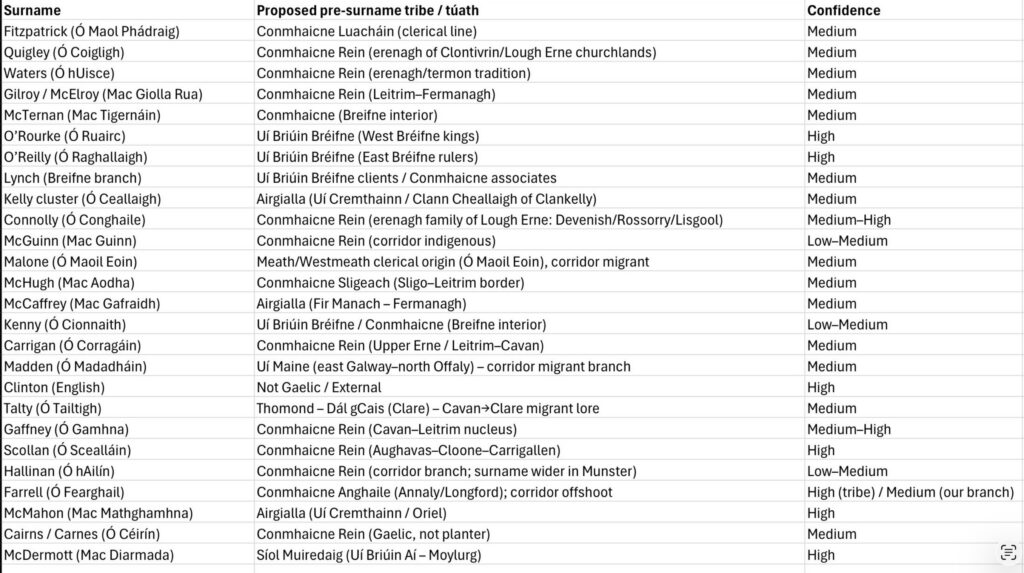
Several additional surname clusters appear within the wider BY9001 population but are not yet developed enough to be treated individually at the same level. These include:
Scollan / Scollin
Connolly
Kelly
Lynch
McManus / Means / Mayne
Waters
Mahon / McMahon / Matthews
Farrell
Some have stronger SNP definition than others, while several remain dependent on STR evidence or contain too few testers to reconstruct their medieval history securely. Their collective importance lies in the same geographical tendency seen among the better-defined branches: the repeated concentration of BY9001-associated paternal lines in north Connacht, Roscommon, Leitrim, Cavan and Fermanagh.
The Geographical Pattern
Viewed individually, the surnames appear diverse. Viewed together geographically, they become much more coherent.
Mac Diarmada takes us to Moylurg and western Roscommon. Quigley takes us to the Fermanagh–Cavan frontier. Mac Giolla Gunna appears in southern Fermanagh and the Cavan–Leitrim borderlands. Ó Maol Phádraig develops across Bréifne, Connacht and later Cork. The Gilroy cluster fits north Connacht and Bréifne. O’Reilly brings us into east Bréifne, while O’Rourke returns us to west Bréifne and Roscommon. The King line remains unidentified by its original Gaelic surname but is equally comfortable within the same western Roscommon–north Connacht environment.
The surname identities are different, but their deeper paternal geography repeatedly overlaps.
The result is a lineage whose prehistoric ancestry can be seen in Fermanagh and Sligo during the Bronze Age and whose deepest surviving surname lines are exclusively Irish, concentrated overwhelmingly within the northwestern interior.
From FGC12055 to the Surname Era
At the prehistoric end of the story, PG911 places FGC12055 in Fermanagh between approximately 2349 and 2135 BCE, followed several centuries later by TR116 in Sligo between approximately 2015 and 1758 BCE. The earlier paternal population remained part of a wider Atlantic and Irish Sea world, but the line narrows progressively through ZZ44 and A9871.
By the time BY9001 emerges, its deepest surviving surname lines are exclusively Irish and concentrated most strongly in the northwest. Around a millennium later those branches begin to acquire the names by which we can recognise them historically: Mac Diarmada, Ó Coigligh, Ó Maol Phádraig, Mac Giolla Gunna and King, together with probable STR-defined Mac Giolla Ruaidh, O’Reilly and O’Rourke lines and a number of smaller surname clusters.
For Ó Maol Phádraig, BY12234 remains the critical medieval paternal branch. What BY9001 provides is the deeper regional ancestry from which that family emerged. The surname itself belongs to the medieval period, but the paternal history behind it extends back thousands of years into the Bronze Age population of northwestern Ireland.
The surname history is medieval.
The paternal history is prehistoric.
References
Cassidy, Lara M. A Genomic Compendium of an Island: Documenting Continuity and Change across Irish Human Prehistory. PhD thesis, Trinity College Dublin.
Cassidy, Lara M., et al. “Neolithic and Bronze Age Migration to Ireland and Establishment of the Insular Atlantic Genome.” Proceedings of the National Academy of Sciences 113, no. 2 (2016): 368–373.
Earley, B., and M. Boyle. “Conflict over the Rectory of Cinel Luachain during the Fifteenth Century.” Breifne 35 (1999).
Fitzpatrick, Mike, et al. “Ó Maol Phádraig — The Name, the People, and the Clans, Part II.” Journal of the Fitzpatrick Clan Society.
Fitzpatrick, Mike, et al. “Ó Maol Phádraig — The Name, the People, and the Clans, Part III.” Journal of the Fitzpatrick Clan Society.
O’Donnell, Katherine. The Affect of Fosterage in Medieval Ireland. Doctoral thesis.
Books of Survey and Distribution, 1636–1703, Vol. I: County Roscommon.
Geinealaighe Fearmanach. 1931.