
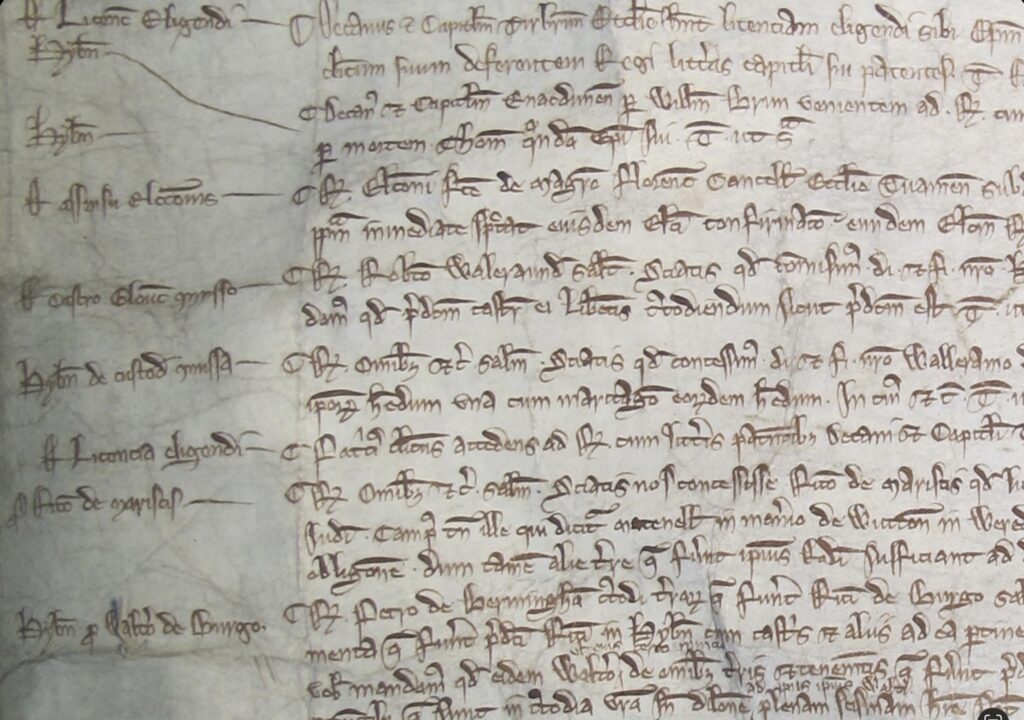
Decanus et Capitulum Tirbrun’ … licenciam eligendi … ecclesiam suam … per cessionem … vacante … Patricium clericum suum … litteras capituli sui patentes …
Word for word:
Decanus — dean
et — and
Capitulum — chapter
Tirbrun’ — of Tír Briúin
licenciam — licence
eligendi — of electing / to elect
ecclesiam suam — their church
per cessionem — through the cession
vacante — being vacant
Patricium — Patrick
clericum suum — their clerk
litteras capituli sui patentes — the letters patent of their chapter
In plain English, the entry records that the dean and chapter of Tír Briúin sought royal licence to elect a bishop after the see became vacant, and that Patrick, their clerk, carried the chapter’s formal letters to the king.
While working on the recently found Mulpatrick Dominican record, I found myself going back through the much earlier clerical references associated with Ó Maol Phádraig. The Dominican record belongs in another post, but it returned me to a question that has followed this research for some time. By the late fourteenth century members of Ó Maol Phádraig were established within important church institutions and were dealing directly with the papal administration. How had they reached that position, and how far back might the family’s association with the Church extend?
The record considered here may offer an earlier glimpse, but I want to place the warning at the beginning rather than repeatedly qualify everything that follows. I am stretching the evidence. The man concerned is not called Ó Maol Phádraig and there is no surviving patronymic or surname with which to identify his family. He may simply have been a man called Patrick. What makes the entry difficult to ignore is the combination of his name, occupation and location. He was a clerk of the chapter of Tír Briúin, the medieval diocese later known as Kilmore, and in 1250 he was entrusted with carrying the chapter’s business to the court of Henry III in England. Medieval Gaelic naming and contemporary Latin usage provide a plausible route by which a man known in Ireland as Máel Pátraic could have appeared in such a record simply as Patricius. That does not make him an Ó Maol Phádraig, but it makes the possibility worth examining.
The Later Clerical Pattern
By the closing years of the fourteenth century there is no uncertainty that Ó Maol Phádraig men were established within the organised medieval Church. On 1 December 1389 Pope Boniface IX made Alan, prior of St Michael’s de Rupe in the diocese of Ardfert, a papal chaplain. The entry did not give Alan a surname, but proceedings in the following year identify the prior of the same house as Alan Omolfading. Another Ó Maol Phádraig, Gilbert, appears among the canons involved in Alan’s postulation, together with Thomas, Ymarus and Malachy Ó Maolchonaire.
This places at least two Ó Maol Phádraig men within the same religious community and also places them beside members of another Gaelic learned and ecclesiastical family. Alan had reached the headship of the house and was recognised personally by the pope. Whatever path had brought these families to St Michael’s, they were operating comfortably inside the administrative world of the Latin Church.
The community at St Michael’s belonged to the Canons Regular of St Augustine. These men were clergy living communally under the Rule of St Augustine, attached to permanent religious houses and involved in worship, pastoral responsibilities and the administration of ecclesiastical property. Their growth in Ireland belonged to the great reform of the Irish Church during the twelfth century, when older ecclesiastical settlements were increasingly incorporated into territorial dioceses and the wider structures of the western Church.
That reform did not remove the older Gaelic system in a single generation. Families that had long occupied and administered church land could remain attached to it under the new arrangements. In Bréifne, church property formally placed under episcopal authority could continue to be occupied by hereditary families whose heads served as erenaghs or coarbs. One of the reformers’ aims was clerical celibacy, yet contemporary practice did not always conform to the new ideal, particularly in Gaelic areas where older forms of hereditary ecclesiastical organisation remained strong.
Alan Ó Maol Phádraig provides a particularly revealing example. The papal proceedings concerning his career record that he was the son of a religious man and an unmarried woman and that he had required a dispensation before advancing in the Church. As an Augustinian canon Alan himself was expected to be celibate, but his very existence shows that clerical family continuity had not disappeared.
The distinction becomes useful when the later Dominican evidence is considered. Dominicans were mendicant friars committed to a religious life that included chastity, preaching, teaching and pastoral ministry. An Ó Maol Phádraig could enter the Dominican Order, but his membership of the order was not something intended to continue through his descendants. In the older Gaelic-Augustinian environment, the individual canon was also officially celibate, but the religious institution could remain surrounded by families whose association with church land, learning and ecclesiastical service continued across generations.
Alan and Gilbert therefore need not represent two men who happened independently to choose religious lives. They may belong to a much older tradition in which members of the family were accustomed to the Church, its learning and its administration.
The earlier Patrick record takes us back almost a century and a half.
The Record of 27 May 1250
On 27 May 1250 Henry III was at Windsor. A royal entry records that the dean and chapter of Tír Briúin were granted licence to elect a new bishop because their church was vacant following the cession of Conoglattus, their bishop. The chapter’s letters patent had been brought to the king by Patrick, their clerk.
The sequence is fairly straightforward. The bishop had left the see. The dean and cathedral chapter now wished to elect his successor. Before doing so they sent formal letters to Henry III seeking the royal licence required for the election. Patrick was the man entrusted with carrying those letters to the king.
The wording identifies him with the chapter itself. He was not an incidental messenger hired somewhere along the road. He was described as their clerk, a man belonging to the literate administrative world of the diocese and trusted to represent its cathedral chapter in a matter concerning the succession to the bishopric.
Tír Briúin, also encountered as Tír Uí Briúin Bréifne or Tír Brun and Latinised as Tirbunensis, was the medieval diocese later known as Kilmore. Kilmore did not formally give its name to the diocese until much later, but the effective ecclesiastical centre had already developed in that area. Patrick was therefore serving the church of Gaelic Bréifne.
For a reader encountering the record for the first time, perhaps the strangest part is not Patrick’s name but the fact that he had to go to an English king at all. Why should the dean and chapter of a Gaelic Irish diocese require Henry III’s permission before electing their own bishop?
The reason was the double character of a medieval bishopric. A bishop held spiritual office, but the bishopric also possessed lands, rents, revenues and other secular property, its temporalities. Within the lordship of Ireland the English Crown claimed rights over those temporalities when a bishopric became vacant. Until a successor had been recognised, the Crown could take custody of the secular property and revenues attached to the see.
The king was therefore not being asked to make Patrick’s bishop for him. The cathedral chapter elected the bishop, while the Church dealt with his spiritual and canonical authority. Henry’s interest lay in the landed and legal estate attached to the office. Before the chapter proceeded with the election it obtained royal licence, and after an election the king’s assent formed part of the process by which the new bishop regained the temporal possessions of the see.
The 1250 entry records Patrick carrying out one stage of that process. Bishop Conoglattus had ceded the see, the diocese needed a replacement, and Patrick was sent to obtain the Crown’s permission for the chapter to proceed.
The surviving record compresses a substantial undertaking into a few words.
From Kilmore to Windsor
Patrick first had to get out of Bréifne.
His exact route is not recorded and should not be reconstructed as though we know it. From the Kilmore region he nevertheless faced a long journey eastward across Ireland before he could reach a port connected with Britain. Dublin was an obvious possibility because of its regular connections with ports on the western side of Britain, although another east-coast departure cannot be excluded.
Travel through Ireland would have been on horseback or on foot. Patrick moved through a landscape of tracks, older routeways and roads of widely varying quality. Rivers had to be crossed, weather could make roads difficult or temporarily unusable, and progress depended upon finding food, lodging and care for a horse. A churchman had one advantage: monasteries, priories, churches and other ecclesiastical establishments formed a network through which hospitality could sometimes be obtained.
He was also carrying something that had to survive the journey. The letters of the dean and chapter established why Patrick was there and on whose authority he acted. They had to remain secure and dry while he travelled across Ireland, waited for a ship and crossed the Irish Sea.
The sea passage was unpredictable. Medieval ships sailed when wind and weather allowed them to sail. Patrick might have arrived at a port and departed quickly, or he might have waited for days. The vessel that eventually carried him was not a passenger ferry but a working ship carrying some combination of merchants, travellers, goods and perhaps animals across the Irish Sea.
Landing in Britain did not end the journey. Windsor lay far to the southeast of the western ports normally used by Irish traffic, leaving Patrick with another long overland journey. Travel continued from town to town and from one night’s lodging to the next, with the pace determined as much by the condition of horses, roads and weather as by distance. Allowing for the Irish journey, waiting for passage, the sea crossing and the journey through England, the mission could readily occupy weeks.
At its end Patrick entered a very different environment. Windsor was one of Henry III’s principal royal residences. The king travelled with a substantial household and administration, and clerks, messengers, petitions and written instruments moved constantly through the royal court. Patrick had come from a Gaelic diocese on the western side of the lordship of Ireland into the documentary world of Plantagenet government.
He was capable of doing that because he too was a clerk.
The business he carried was conducted in Latin. Patrick did not arrive speaking Gaelic to an English chancery clerk who then attempted to work out what his name meant. He belonged to the clerical profession and was operating within the same written Latin culture used by the cathedral chapter and the royal administration. The name that entered the English record therefore reflects a Latin administrative form.
That point changes how the apparently simple name Patrick should be read.
When Máel Pátraic Became Patricius
Patrick is now such a familiar Irish personal name that it is easy to project its later popularity backwards into the Middle Ages. The early evidence shows a very different naming tradition. Among the Gaelic Irish the name of the national saint was generally treated with enough reverence that Pátraic was not commonly used as an ordinary standalone personal name. Instead, devotional names developed around it, particularly Máel Pátraic and Gilla Pátraic.
Máel Pátraic appears in the Irish annals from the ninth century and occurs repeatedly among churchmen. The records include bishops, abbots, lectors and other religious figures carrying the name. One particularly relevant example is Máel Pátraic Ua Scannall, whose ecclesiastical career began almost immediately after Patrick’s appearance at Henry III’s court. Ua Scannall became bishop of Raphoe in 1253 and later archbishop of Armagh.
His name supplies the comparison we need because Latin sources call him Patricius. The Dictionary of Irish Biography identifies him as Máel Pátraic Ó Scanaill (Patricius). Here is a Gaelic churchman, virtually contemporary with Patrick of Tír Briúin, whose Gaelic Máel Pátraic could be represented in Latin simply as Patrick.
He was not an isolated example.
The second bishop of Dublin, who died in 1084, was known in Irish as Gilla Pátraic. In the Latin ecclesiastical world he was Patricius, or Patrick. He had been associated with Worcester and was consecrated bishop by Lanfranc, archbishop of Canterbury. The two forms referred to the same man: Gilla Pátraic in Irish and Patricius in Latin.
We therefore have two different Irish devotional Pátraic-names producing the apparently simple Latin Patrick:
Gilla Pátraic → Patricius
Máel Pátraic → Patricius
There are other examples of the difficulties created when Máel-names cross into Latin. A ninth-century Irish scribe who called himself Máel Pátraic signed in Latin as Calvus Patricii, literally rendering the Máel element as calvus, “bald” or “shorn.” The important point is that medieval writers were not following one fixed modern system for transferring Gaelic names into Latin. Sometimes a Gaelic element could be translated; in other circumstances the saint-name alone could supply the Latin form.
This makes the 1250 Tír Briúin entry rather more intriguing. Patrick was a Gaelic diocesan clerk operating in precisely the Latin clerical environment in which Máel Pátraic Ua Scannall could become Patricius. Only three years separate Patrick’s appearance at Windsor from Ua Scannall’s elevation to the bishopric of Raphoe.
The argument therefore does not depend on imagining that an English clerk heard “Máel Pátraic,” failed to understand the first word and wrote Patrick instead. Patrick of Tír Briúin could himself have used Patricius when conducting Latin business. If his Gaelic name at home was Máel Pátraic, there need have been no mistake at all.
That still leaves a considerable gap between Máel Pátraic and Ó Maol Phádraig.
Máel Pátraic was a personal name and was borne by men belonging to several unrelated families. Finding a Máel Pátraic in Tír Briúin would not by itself establish that he belonged to the lineage later called Ó Maol Phádraig. The royal record gives no Ó, Ua, father’s name or other genealogical clue.
There is, however, a reason this particular possibility catches my attention. Patrick belonged to the chapter of Tír Briúin, within the ecclesiastical landscape where the northern Ó Maol Phádraig later becomes firmly documented. He was not merely a cleric but a trusted diocesan clerk capable of travelling to England and dealing with royal administration. His Latin name can demonstrably represent the kind of Gaelic name from which Ó Maol Phádraig developed. The later genealogical tradition of the Bréifne family itself identifies a Máel Pátraic son of Maolgeann as the figure “from whom are the Uí Mhaol Phádraig.”
Then, by 1389–1390, definite Ó Maol Phádraig men appear in substantial ecclesiastical positions at St Michael’s, one as prior and papal chaplain and another as a canon. Alan’s own parentage demonstrates that the supposedly celibate canonical world could still contain continuing clerical families.
None of those later facts can turn Patrick of 1250 into an Ó Maol Phádraig. There is no missing document that joins the two ends of the story.
What they do is create a plausible historical setting in which the possibility can be taken seriously. In 1250 a clerk whose Latin name was Patrick travelled from the church of Tír Briúin to Windsor carrying the authority of his chapter. Contemporary examples show that a Gaelic Máel Pátraic could be called Patricius in exactly this sort of Latin ecclesiastical environment. A little over a century later, Ó Maol Phádraig churchmen emerge unmistakably within important religious institutions.
Patrick may have been unrelated to them.
For now, the more interesting possibility is simply that he may not have been.
Sources and Further Reading
Calendar of the Patent Rolls, Henry III, 1250.
Calendar of Documents Relating to Ireland, 1171–1251.
Calendar of Papal Registers Relating to Great Britain and Ireland.
Dictionary of Irish Biography. “Ó Scanaill, Máel Pátraic (Patricius).”
Dictionary of Irish Biography. “Patrick (Gilla-Pátraic).”
Earley, Joseph E. Sr., and Leonard E. Boyle, O.P. 1999. “Conflict over the Rectory of Cinel Luachain during the Fifteenth Century.” Breifne 9, no. 35, 103–113.
Fitzpatrick, I., and Fitzpatrick, M. 2023. “Ó Maol Phádraig: the Name, the People, and the Clans. Part I.” Journal of the Fitzpatrick Clan Society 4, 1–10.
Fitzpatrick, M., and Mag Fhionnghaile, P. 2024. “Ó Maol Phádraig: the Name, the People, and the Clans. Part II.” Journal of the Fitzpatrick Clan Society 5, 25–42.
Fitzpatrick, M., and Fitzpatrick, M. 2025. “Ó Maol Phádraig: the Name, the People, and the Clans. Part III.” Journal of the Fitzpatrick Clan Society 6, 27–41.
Mooney, Canice, O.F.M. 1969. The Church in Gaelic Ireland: Thirteenth to Fifteenth Centuries. Dublin: Gill and Macmillan.
Moran, P. 2022. “Latin Grammar Crossing Multilingual Zones: St Gall, Stiftsbibliothek, 904.”
Parker, Ciaran. 1997. “The Diocese of Tir Brun (Kilmore) in the Middle Ages.” Breifne 8, 808–824.