
Ó Maol Phádraig and the Last Years of O’Reilly Cavan
On 30 April 1604, barely a year after the end of the Nine Years’ War, a general pardon was issued under James I to seventy-five people in County Cavan. Among them were five Ó Maol Phádraig men, four explicitly associated with the Dower, or Dowra. They appear among an extraordinary gathering of O’Reillys, Sheridans, Bradys, O’Gowans, Mac Kernans and Mág Samhradháins drawn from widely separated parts of the old O’Reilly country.
The date is important to understanding the document. This was no longer the desperate sequence of wartime pardons that had marked the final years of Elizabeth I. Hugh O’Neill had submitted at Mellifont in March 1603. James I was now king, and the Crown was beginning to confront a different problem: how to govern the Gaelic societies that had survived the war.
Cavan was an especially difficult case. The county might appear on an English administrative map, but underneath that map remained the political structure of East Bréifne. O’Reilly authority had never rested simply upon possession of a castle and a block of privately owned land. It depended upon relationships between different O’Reilly branches, local ruling families, hereditary church and learned families, substantial landholders, service families, tenants and communities bound by customary obligations.
Patent XXXI–41 catches that society while it was still functioning.
Two years later Arthur Chichester would explain very clearly what the government intended to do with it. Writing about Cavan in 1606, he observed that the O’Reillys consisted of several branches, often divided against one another, and that the whole county had formerly depended upon the chief of the family. He saw opportunity in those divisions. Cavan could, he argued, be broken into parcels and distributed among individual freeholders who would “depend immediately upon the King” and consequently cease to fear or obey the Irish lords. The Crown should arrange things so that the people depended as little as possible upon the old O’Reilly leadership.
Patent XXXI–41 predates that statement by two years, but it is difficult to read the pardon now without seeing the society Chichester was preparing to dismantle. The document reaches beneath the O’Reilly leadership and names dozens of the men and families who made the country work. In that sense it provides an unusually detailed view of the world from which the Crown would soon attempt to manufacture its new class of individual freeholders.
And the Ó Maol Phádraig family is unexpectedly prominent within it.
The boy at the head of the pardon
The first man named is Mulmorie O’Relie of Newhengan-magna.
There were several Maol Mórdhas within the enormous O’Reilly family, so the name by itself once caused difficulty. The rest of the pardon now provides a strong clue to his identity. Farther down the same document appears Mulmorie Mc Hugh O’Rely of Lyshavymere. That man can be identified with the older Maol Mórdha mac Aodha Conallaigh O’Reilly, an adult member of an important collateral line and a serious participant in the traditional O’Reilly succession.
The Maol Mórdha at the head therefore appears to be another man. The best fit is young Maol Mórdha O’Reilly, grandson of Sir John O’Reilly and the boy whom the Crown would shortly describe as the “head of the house.”
His position is worth understanding because it tells us a great deal about what the government was trying to do in Cavan.
His grandfather, Sir John O’Reilly, had spent much of his career attempting to negotiate the conversion of O’Reilly authority into a form the Tudor state would accept. Young Maol Mórdha’s father, also Maol Mórdha, had been killed at the Yellow Ford in 1598 while fighting on the government side. His mother, Catherine Butler, connected the boy maternally with the house of Ormond. By 1606 Chichester was consequently concerned that the young representative of the senior O’Reilly line should not emerge from the settlement poorer than supposedly inferior freeholders. He considered giving him lands elsewhere or reserving chief rents from some of those freeholders to support him.
The Crown therefore had not yet decided simply to erase the O’Reilly leadership. It was considering whether a reduced and manageable version of that leadership could be retained.
Young Maol Mórdha was an attractive figure for such an experiment. He had the hereditary name, the descent and the prestige, but he was still a boy. He could represent continuity without possessing the independent political power of the older adult O’Reilly leaders.
This also explains why his position at the head of seventy-five names should not be imagined as command in the modern military sense. The boy did not need personally to have assembled these men. His name could stand at the top because he represented the house around which the Crown hoped some part of the old political structure might be reorganized.
The pardon simultaneously contains the older Maol Mórdha mac Aodha Conallaigh, numerous Munterconnaught O’Reillys, Hugh mac Prior O’Reilly, Belturbet and Loughtee O’Reillys and men from other branches. It is therefore not simply a pardon to one household. It reaches across much of the O’Reilly political family.
The exact identification of Newhengan-magna remains unresolved and is best left that way for now. What can be said is that young Maol Mórdha later received land in Tullygarvey and ultimately became associated with Ballincargy. Under the Plantation he obtained 3,000 acres of his own former lands, but only under the conditions imposed by the new settlement.
That later outcome is almost a preview of what was about to happen to everybody else in this pardon.
Five Ó Maol Phádraig men
Immediately after young Maol Mórdha comes William O’Siridan of the Trougher, and immediately after Sheridan appear:
Cowconaught O’Mulpatrick of the Dower
Donell oge O’Mulpatrick of the same
Two O’Gowan men of Lavey follow, and then:
David O’Mulpatrick of the Dower
Cormack McShane O’Mulpatrick of the same
Later in the pardon appears a fifth man:
Connor O’Mulpatricke
Four members of the family are therefore explicitly associated with Dowra in a single record, while another appears within the wider Cavan group. The published Ó Maol Phádraig study also recognised the importance of this 1604 cluster and its association with the O’Reilly pardon network.
Dowra was not appearing for the first time. Hugh mac Prior O’Reilly, previously associated with Dowra, is also present in this pardon, now described as of Drumhallagh. Hugh belonged to an important collateral O’Reilly line: he was a son of Philip “the Prior,” who was himself a son of Owen of Tullyvin and a relative of Sir John O’Reilly.
The repeated association places the Ó Maol Phádraig men firmly inside the O’Reilly world of northwestern Cavan. Whatever their exact function at Dowra, they were not isolated farmers who happened to share a surname. Four men from the same family appear together there, in a pardon containing the O’Reilly family with whom other records had already connected them.
Only two years earlier, in Fiant 6657, Conchobhar Ó Maol Phádraig had received the striking description “Chief of His Name.”
At first that terminology appears to suggest the familiar picture of a territorial Irish clan headed by its chief. The surrounding evidence increasingly points in another direction.
Sheridan and the strange appearance of “chiefs”
William O’Sheridan is particularly helpful here because the history of his family provides a close comparison.
The Sheridans were an old hereditary family of the Bréifne and Conmaicne church world. Their history is found around ecclesiastical estates and offices rather than in an identifiable independent Sheridan territory. By the late sixteenth century they were also thoroughly embedded in O’Reilly political society.
They appear prominently in this pardon. William O’Sheridan of Togher stands second, between young Maol Mórdha and the first Ó Maol Phádraig men. Elsewhere are Tirlagh Bane O’Sheridan of Trinity Island, Nicholas O’Sheridan of Trinity Island, and Edward mac Gilpatrick O’Sheridan of Coritober.
Trinity Island is especially revealing. These are members of a hereditary family still attached to one of the old ecclesiastical landscapes of Lough Oughter, while simultaneously appearing inside a political pardon headed by O’Reilly.
There is also an unusually large Sheridan group in a separate O’Reilly-led pardon of November 1603. That document contains numerous Sheridans together under Shane O’Reilly of Inshemore. The 1603 and 1604 pardons therefore show the family repeatedly operating within the larger O’Reilly network rather than within an independent Sheridan lordship.
Yet Crown documents begin using language of chiefship for them.
In 1586 Hugh Duff O’Sheridan of Togher was described as “chief of his nation.” A generation later William O’Sheridan would be described under the Plantation settlement as “Chief of his Name.”
There is no comparable medieval sequence presently known of territorial Sheridan chiefs ruling a defined Sheridan country.
That makes the parallel with Ó Maol Phádraig difficult to ignore.
In both families we have an older hereditary line whose history is much easier to understand through church, land, service and wider political relationships than through territorial lordship. Then, during the final decades of Tudor government and the opening years of James I, Crown records begin identifying particular men as “chief of his nation” or “chief of his name.”
The phrase should therefore be used carefully.
The Crown probably was not choosing unknown men and inventing authority for them out of nothing. These families would already have had senior representatives, important branches and men capable of speaking for relatives or dependants. The English administration, however, had strong reasons to formalize that family leadership into something it could recognize.
A government attempting to deal with hundreds of interrelated landholders did not want an amorphous kin network. It wanted a man with a name.
A “chief of his name” could become that man.
This gives the 1602 description of Conchobhar Ó Maol Phádraig a different significance. It remains evidence of considerable standing. It tells us that the Crown recognized someone as the senior representative of the family. What it need not mean is that Conchobhar inherited the throne of an ancient Ó Maol Phádraig territorial lordship.
Sheridan provides the contemporary comparison. The same administrative vocabulary was being applied to another old family whose authority had developed from a very different institutional history.
By 1604 both families were being drawn more tightly into the O’Reilly settlement.
From families to freeholders
Here the later words of Chichester become particularly revealing.
In 1606 he explained that the old dependency of the county upon the O’Reilly chief should be broken apart. The people were to be divided into parcels and made into freeholders who depended directly upon the king. No O’Reilly lord should be allowed to grow powerful enough to dominate the rest. Even the young “head of the house” might have to be supported separately so that he did not become poorer than some of the freeholders being created beneath him.
That is almost a description of the political transformation taking shape around Patent XXXI–41.
The pardon itself is not a Plantation survey, nor is every person named in it necessarily a future freeholder. But the document exposes exactly the level of society the government needed to understand before such a scheme could work.
Who actually held the land?
Which family controlled which polls?
Who represented a local family?
Who owed service to whom?
Which O’Reilly branch had claims over a district?
Which men could identify the boundaries of an old land division?
Who knew which grazing belonged with which settlement, which rights were customary, which church lands were distinct, and which families had occupied them for generations?
Those questions could not be answered from Dublin.
The knowledge existed among the people in records like this one.
For Ó Maol Phádraig, that may have offered a genuine opportunity.
The family had been operating for a long time within precisely the kind of world the Crown was attempting to unravel: church-associated land, O’Reilly relationships, customary holdings and local networks spread across several parts of Bréifne. By 1604 four men were established together at Dowra, another appears elsewhere in the pardon, and a recognised family representative had already been named in 1602.
They would have understood the country in terms that Crown officials were only beginning to translate into individual title.
We should be cautious about assigning a formal office for which no surviving document gives them a title. We do not have a record calling Cowconaught or David Ó Maol Phádraig an estate steward. What we do have is repeated evidence of a family living inside the structures through which land had historically been held and managed. Their usefulness need not have depended upon possessing a vast estate themselves. Knowing the land, the families, the customary divisions and the people who exercised rights over them could itself be valuable.
For a brief period, the Crown still needed men who possessed that knowledge.
The Bradys show how the transition could work
The eleven Brady men in the pardon demonstrate what successful adaptation could look like.
They are spread among Larah, Clenarny, Trimliffe, Din and Tullygarvey and occur in several apparent family branches. This was an old and substantial Cavan family with a deep ecclesiastical history. Brady bishops had occupied the See of Kilmore, and members of the family remained important within the religious and political life of the county.
Yet the Bradys were not trapped inside their older role.
As English administration strengthened, Brady men began appearing in the machinery of the new order. Some were used in surveys. Some became Crown-recognized freeholders. Others entered municipal government. Thomas Brady of Drogheda would even become one of the trustees associated with young Maol Mórdha O’Reilly.
The Plantation records show the family making the transition very clearly. Carew reported Connor Shane Roe McBrady moving to his assigned proportion and Philip McTirlagh Brady preparing to do the same. The same report names senior O’Reillys, Mac Kernan and Mág Samhradháin men undergoing the identical process.
These were exactly the people being detached from the older web of dependency and converted into Crown landholders.
Brady was able to survive that conversion because the family possessed sufficient numbers, status and landed strength to remain visible after the new system was imposed.
That makes its presence beside Ó Maol Phádraig in 1604 especially instructive. Both families had standing within the old society. One would emerge with a recognizable place among the new freeholders. The other appears to have had much less land with which to secure a comparable future.
The O’Gowans and another old layer of Cavan society
The O’Gowan group belongs naturally in the same narrative.
Tirlagh and Chaib O’Gowen of Lavey occur directly between the two pairs of Ó Maol Phádraig men near the beginning of the pardon. Other O’Gowans occur at Tollaghdonell, Lederey and Lawy, with a probable female member of the family at Killinkere.
Ó Gabhann was an old Cavan family whose name ultimately derives from the smith, but by the medieval period its standing reached considerably higher than a simple occupational description would suggest. Domhnall Ó Gabhann had served as Bishop of Bréifne in the fifteenth century, and the family was remembered among the learned surnames associated with the Diocese of Kilmore.
So once again the pardon contains a widely distributed old family whose historical importance came through inherited institutional roles and integration into O’Reilly society rather than through possession of an independent territorial kingdom.
The repetition is now difficult to miss.
Sheridan, Brady, O’Gowan and Ó Maol Phádraig all appear around the O’Reilly structure in 1604. Their histories were not identical, but none needs to be turned into a miniature territorial “clan” to explain why they were important.
They were families embedded in the working institutions of Bréifne.
Dowra and the family that really did rule the territory
The pardon also contains a useful contrast.
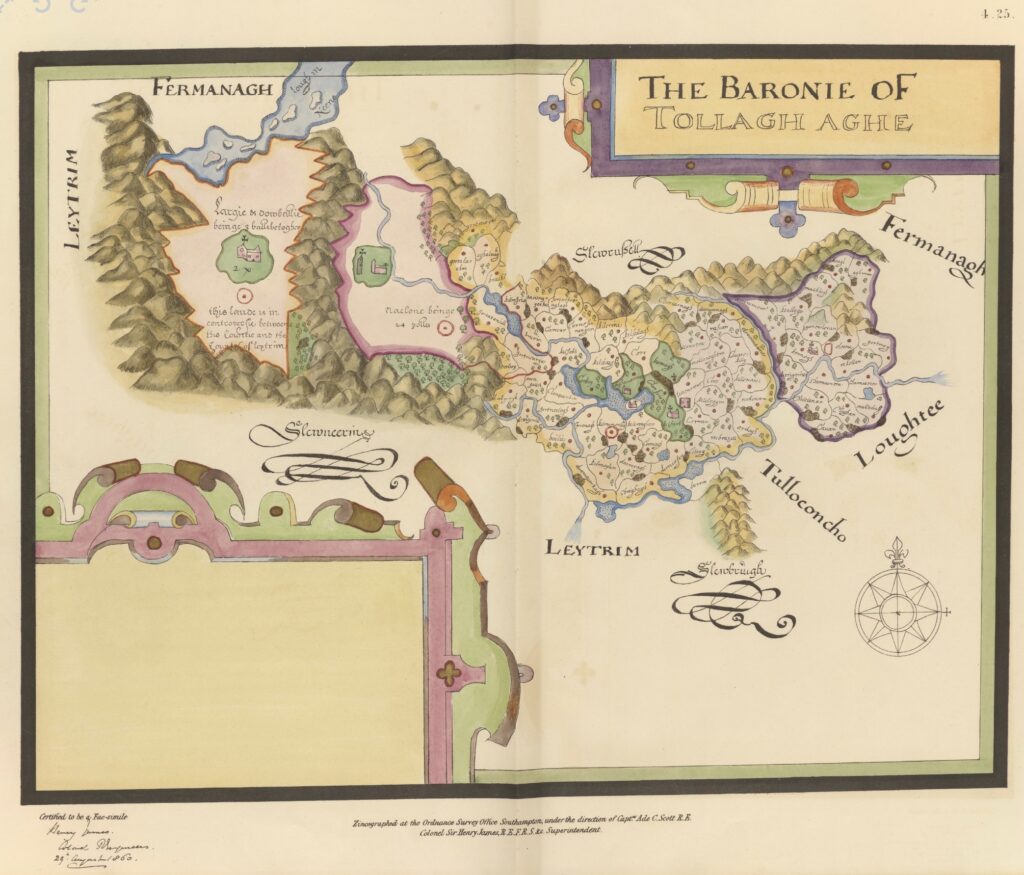
Farther down appears Phelim McGaran of Tolaghagh, followed by Brian McGaran of the same. Phelim can be identified very strongly with Feidhlimidh Mág Samhradháin, the senior representative of the old ruling family of Tullyhaw.
Here we are dealing with a genuine territorial family.
Tullyhaw was Mág Samhradháin country. Their authority over it had deep roots, and the Crown could not simply pretend otherwise when the Plantation settlement was made. Phelim eventually received a substantial native proportion and remained one of the principal indigenous landholders of the barony.
His appearance in the same pardon as the four Dowra Ó Maol Phádraig men therefore helps define the distinction between them.
Mág Samhradháin had a territory.
Ó Maol Phádraig had influence, relationships and a concentrated presence at Dowra, but we have found no equivalent Ó Maol Phádraig territorial lordship.
That difference would become decisive once the Crown began translating the political landscape into surveyed acres and individual patents.
Richard Tyrrell would soon become involved in the same Tullyhaw landscape, acquiring claims and coming into conflict with Mág Samhradháin interests. Tyrrell already had his own connections with Ó Maol Phádraig. The northern part of this story therefore brings together O’Reilly, Mág Samhradháin, Tyrrell and the Dowra Ó Maol Phádraig men at precisely the moment when customary authority was beginning to be converted into written title.
It is difficult to imagine that people established locally, familiar with the land and already trusted within these networks, were irrelevant to that process
What the Crown was actually taking apart
Seen from 1604, the old Cavan order probably still appeared capable of adaptation.
There was still an O’Reilly house. The young Maol Mórdha could be presented as its senior representative. The older O’Reilly branches remained powerful. Mág Samhradháin still held authority in Tullyhaw. Sheridan, Brady and O’Gowan remained substantial families. Ó Maol Phádraig had a recognised family representative and several men established at Dowra.
The Crown initially appears to have thought that much of this society could be reorganized rather than simply destroyed.
The language used around family heads fits that phase very well. A senior Sheridan could be identified as chief of his nation. Conchobhar Ó Maol Phádraig could be called chief of his name. Young Maol Mórdha could be treated as head of the O’Reilly house. Local families could potentially be converted into individual freeholders.
The old structure would remain useful, but the direction of loyalty would be reversed.
That is precisely what Chichester proposed in 1606. Instead of the people depending upon O’Reilly, the freeholders would depend immediately upon the king. The authority running upward through family and lordship was to be broken into individual parcels.
The later Plantation would take the process considerably farther. When the settlement was eventually imposed, the old political relationships were increasingly replaced by property relationships backed by English common law. A modern study of native experience under the Plantation describes precisely this transition: personal ties of loyalty and kinship were displaced by a system in which legally defined property relations predominated.
Patent XXXI–41 stands just before that transformation became irreversible.
Why Ó Maol Phádraig was well placed — and badly placed
This is perhaps the most revealing part of the document for the family history.
Ó Maol Phádraig was well placed because the family understood the old system.
Its members had been moving within the landholding, church and political structures of the region for generations. They knew O’Reilly society. By the opening of the seventeenth century they were present in several parts of the broader Bréifne world and conspicuously established at Dowra. The Crown had even recognized a man as “Chief of His Name.”
For a government beginning to identify freeholders, divide inherited land systems into individual parcels and determine who represented whom, that sort of family could be useful.
But Ó Maol Phádraig was simultaneously badly placed because the new system would ultimately reward something much more concrete.
Land.
Young Maol Mórdha eventually received 3,000 acres in Tullygarvey, although under Plantation conditions.
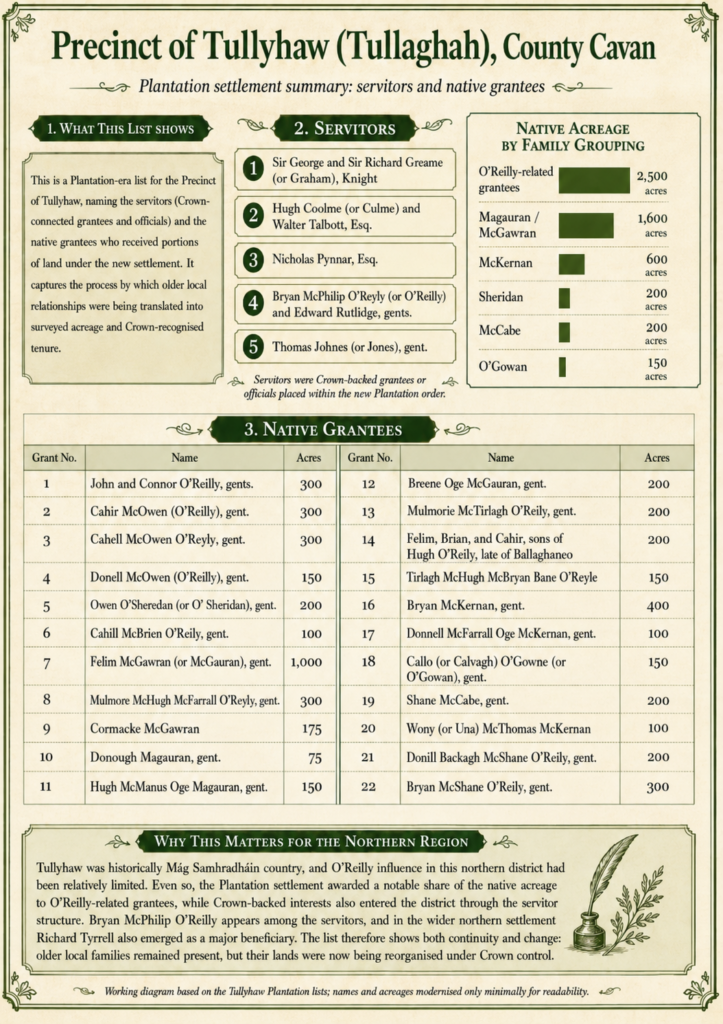
Phelim Mág Samhradháin retained a substantial portion because his family possessed an undeniable territorial position in Tullyhaw.
Mac Kernan representatives retained portions.
Several Brady men entered the new class of native freeholders.
The Plantation account later notes that only fifty-five natives in Cavan received Crown grants and that the surnames occurring most frequently among them included O’Reilly, Mág Samhradháin, Brady and Mac Kernan.
Ó Maol Phádraig is conspicuously absent from that list of families converted into significant Plantation landholders.
This may explain why the family looks so prominent in the records immediately before the Plantation and so much less powerful afterwards.
Their strength had probably never rested primarily upon controlling a great compact territory. It came from their place within a functioning network: land, church associations, service, local knowledge, O’Reilly relationships and the ability of family lines to retain influence across generations.
The Crown briefly offered a world in which that kind of standing might be converted into recognized family leadership and individual freeholding.
For some families it worked.
Brady adapted extraordinarily well.
Sheridan retained recognized leadership and land.
Mág Samhradháin retained a substantial piece of its old territory.
Even the young O’Reilly figurehead was given enough land for the government to preserve something of his social standing.
Ó Maol Phádraig appears to have lacked the acreage necessary to make the same transition securely.
The pardon before the Plantation
This is why Patent XXXI–41 deserves more attention than its bland heading, “General Pardon,” initially suggests.
It is a picture of Cavan before the Crown finished sorting its people into the categories that would define the seventeenth century.
At its head is young Maol Mórdha O’Reilly, the boy through whom the government could imagine retaining a controlled version of the old ruling house. Within the same record are older and competing O’Reilly branches representing the real complexity of that family.
Beside them are the local territorial rulers such as Phelim Mág Samhradháin and members of the Mac Kernan family.
Interwoven with them are Sheridan, Brady and O’Gowan, old families whose importance had grown through church, learned, landholding and service structures and whose members were now being absorbed into Crown administration.
And very near the beginning are four Ó Maol Phádraig men of Dowra.
Two years later Chichester would set out the policy plainly: divide the country, identify its freeholders and make them depend upon the king instead of the Irish lords. The later Plantation would formalize the process, parcel out the land and determine which native families retained enough property to survive as recognised landholders.
In 1604 none of that had quite happened yet.
The old relationships were still visible.
The Crown still needed the people who understood them.
Ó Maol Phádraig was one of those families.
Their appearance here, immediately beneath the senior O’Reilly name and among Sheridans, Bradys, O’Gowans, Mág Samhradháins and numerous O’Reilly branches, suggests a family still possessing useful standing inside the political and landed society of Cavan. The designation “Chief of His Name” two years earlier fits this same transitional moment: a senior representative of a dispersed old family being made intelligible to a government increasingly determined to deal with named individuals rather than inherited networks.
For a while, that offered hope. A family without a great territorial lordship could still possess knowledge, influence, relationships and recognized leadership. If the Crown wanted to tame O’Reilly Cavan by reaching beneath its chiefs and finding the men who actually knew and held the country, Ó Maol Phádraig had every reason to think there might still be a place for them.
The Plantation would expose the weakness in that position.
When influence was finally converted into surveyed acreage and royal patent, knowledge of the old system was no substitute for receiving enough of the land.
Ó Maol Phádraig had survived the old order remarkably well.
What they could not secure was a large enough piece of the new one.
References
Commissioners of Public Records in Ireland. Calendar of the Patent Rolls of the Chancery of Ireland, James I. Patent XXXI–41, General Pardon, 30 April 1604.
Fitzpatrick, M., and Fitzpatrick, I. “Ó Maol Phádraig: the Name, the People, and the Clans, Part III.” Journal of the Fitzpatrick Clan Society, vol. 6, 2025, pp. 27–41.
Hill, George. The Conquest of Ireland: An Historical Account of the Plantation in Ulster at the Commencement of the Seventeenth Century. Belfast, 1877. Extracted Cavan Plantation papers.
Farrell, Gerard. The ‘Mere Irish’ and the Colonisation of Ulster, 1570–1641. Palgrave Macmillan, 2017.
Farrell, Gerard. “Class Divisions and the ‘Mere Irish’ of Colonial Ulster, 1609–1641.” Journal of Postgraduate Research, 2014.