
For the Ó Maol Phádraig family, the years between about 1400 and 1540 remain almost completely hidden. The surname largely disappears from the surviving record after the opening years of the fifteenth century and does not emerge clearly again in Bréifne until the Tudor surveys of 1541. That long silence will have to be examined separately. Before trying to explain it, there is another question to answer: what was happening in the political and ecclesiastical world around the Ó Maol Phádraig during those missing generations?
The answer leads directly to the Ó Raghallaigh, the Church of Kilmore and another Conmaicne family, the Sheridans. During the fifteenth century the Ó Raghallaigh were consolidating their lordship in eastern Bréifne while members of the dynasty occupied increasingly senior positions in the Church. Their influence reached into the Augustinian and Premonstratensian worlds, into cathedral administration, into the episcopacy, and eventually into Cenél Luacháin itself. At the same time, the Sheridans, whose traditional genealogy lies remarkably close to that of the Ó Maol Phádraig, can be followed through rectories, vicarages, religious houses and the cathedral structure of Kilmore.
Taken together, these records show more than a collection of churchmen. They reveal a small number of powerful families occupying the positions through which ecclesiastical authority, land, benefices and local influence were actually exercised.
The Ó Raghallaigh and the Church of Kilmore
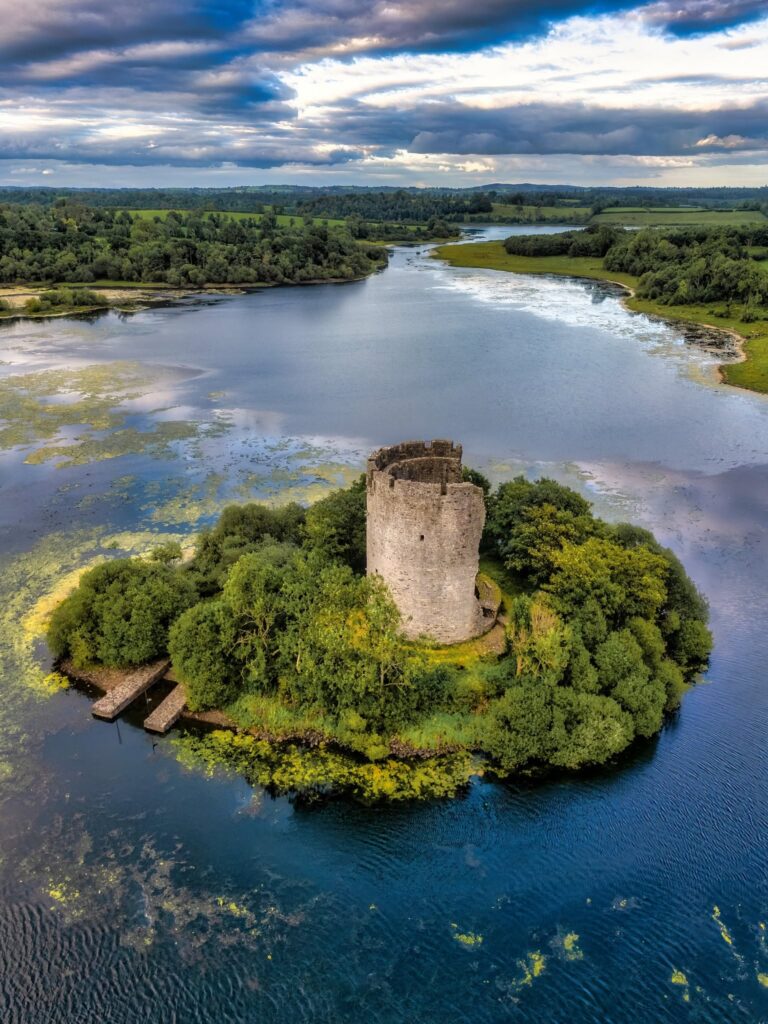
The rise of the Ó Raghallaigh transformed eastern Bréifne during the later Middle Ages. Their principal power developed around Lough Oughter and across much of what became County Cavan, while the older authority of the Ó Ruairc remained strongest farther west. By the fifteenth century the Ó Raghallaigh had become one of the dominant dynasties of the region, but their influence cannot be understood solely through lordship, warfare and territorial expansion. The Church formed part of the same world of authority.
An early example came in 1237, when Cathal Ó Raghallaigh granted Trinity Island in Lough Oughter and associated lands for the establishment of a Premonstratensian house connected with Holy Trinity on Loch Cé. The grant linked the developing Ó Raghallaigh centre around Lough Oughter with the religious network associated with Clarus Mac Mailín Ó Maolchonaire and the Mac Diarmada world farther west. Almost two centuries later that institutional connection was still functioning, with canons moving between Loch Cé and the Lough Oughter house.
Drumlane formed another major part of this ecclesiastical landscape. The ancient church there became a house of Augustinian canons regular and stood within the heart of the later Ó Raghallaigh country. The relationship between the dynasty and Drumlane went beyond external patronage. In 1418 Philip Ó Raghallaigh appears as Dean of Drumlane, placing a member of the ruling family directly within the Augustinian establishment. The later Ó Raghallaigh genealogical tradition also preserved the memory of “Philip the Prior,” whose descendants formed a recognised branch of the family. Ecclesiastical office could therefore become part of dynastic identity rather than remaining separate from it.
The career of John Ó Raghallaigh shows how far this ecclesiastical world extended beyond Bréifne. In 1417 he was a canon of St Mary’s at Killeshin. By the following year he was associated with the house of St Ulrich at Kreuzlingen, close to Constance, at the time when the Council of Constance had drawn churchmen from across Europe into one of the greatest ecclesiastical gatherings of the age. He later returned to Ireland, became abbot of St Mary’s at Kells, held the archdeaconry of Kilmore and in 1465 was provided to the bishopric of Kilmore.
His career shows the scale of Ó Raghallaigh involvement in the Church. A member of the dynasty could move through Irish canonical institutions, enter the continental ecclesiastical world, return to hold an important abbacy and eventually reach the episcopacy of his home diocese. Other members of the family occupied positions lower in the same hierarchy. Terence Ó Raghallaigh was a canon of Kilmore and appears in papal business concerning benefices and cathedral revenues.
By the middle of the fifteenth century Kilmore had become firmly established as the diocesan centre. That placed the cathedral, its offices, its revenues and its benefice system inside the political heartland of the Ó Raghallaigh. The dynasty was therefore operating on both sides of the relationship: as secular rulers and patrons, but also through bishops, canons, abbots, priors and other churchmen who exercised authority from within the institution itself.
This was real power. Bishops could reorganise church property. Canons and cathedral officials could influence benefices and revenues. Priors, deans and abbots controlled major religious houses. Access to these offices brought control over land, patronage and local networks as well as spiritual authority. The Ó Raghallaigh were not standing beside the Church as outside supporters. Members of the dynasty occupied some of the positions from which the Church of eastern Bréifne was actually run.
Their authority soon reached farther west.
From Kilmore into Cenél Luacháin
Cenél Luacháin remained a recognisable ecclesiastical territory throughout the fifteenth century. Papal records use the name for the rectory associated with Drumreilly and Oughteragh, whose churches were traditionally governed together. The older hereditary character of the territory was still visible: the 1479 record concerning Drumreilly stated that the holder of the rectory had, “from time immemorial,” not been required to enter holy orders.
The long history of the Ó Maolmochéirghe in that rectory has already been considered and does not need to be repeated here. Their importance in this article is simply that they demonstrate the continuing value of Cenél Luacháin as an ecclesiastical territory with inherited offices and substantial revenues. During the fifteenth century those offices became increasingly connected with Kilmore rather than remaining confined to Drumreilly and Oughteragh.
That development can be seen most clearly under an Ó Raghallaigh bishop. The poor hospital at Drumreilly carried an obligation to provide hospitality but lacked sufficient revenues to support it. Bishop Seán Ó Raghallaigh united the hospital with the rectory, bringing the two institutions and their revenues together. The later papal record preserves the arrangement as an episcopal act affecting one of the central institutions of Cenél Luacháin.
An Ó Raghallaigh bishop at Kilmore was therefore directly reorganising ecclesiastical property at Drumreilly.
The significance goes beyond one administrative decision. The old church territory of Cenél Luacháin retained its identity and hereditary customs, but decisions concerning its property and offices increasingly passed through a diocesan centre located within the Ó Raghallaigh sphere. By the end of the century, disputes over Drumreilly and Oughteragh could even be tied to the creation of prebends at Kilmore Cathedral.
The political rise of the Ó Raghallaigh and the ecclesiastical development of Kilmore were therefore converging. Cenél Luacháin had not disappeared, but its church structure had been drawn more tightly into a diocesan system centred farther east.
That is especially important for the Ó Maol Phádraig story. The genealogical tradition places their ancestral line within Cenél Luacháin, deriving the family from Máel Pátraic son of Maolgeann and ultimately from Luachán. The documentary disappearance of the surname therefore coincides with a period in which the ecclesiastical territory associated with their genealogy was being pulled increasingly into the orbit of Kilmore and the Ó Raghallaigh.
The Sheridan family provides a second, and very different, connection.
The Sheridans: A Conmaicne Family in the Kilmore World
The Sheridan genealogy brings the family surprisingly close to the Ó Maol Phádraig. In the Book of Fenagh tradition both belong within Conmaicne Réin, and their lines separate at the sons of Onchú. The Sheridan descent runs through Neidhe, while Cenél Luacháin descends through his brother Luachán. From Luachán came the line through which Máel Pátraic son of Maolgeann was remembered as ancestor of the Uí Mhaol Phádraig; from Neidhe came the line leading through Finghin and Maeldabhrach to Sirideán and Muintir Shireadáin.
The genealogy cannot be treated as a modern biological pedigree, but it does show how learned Gaelic tradition understood the two families. Sheridan and Ó Maol Phádraig were remembered as collateral branches lying unusually close to one another inside the wider Conmaicne framework.
The Sheridan presence in Bréifne was old. Gofraid Ua Siridáin was recorded with the army of Bréifne in 1087, before the great expansion of Ó Raghallaigh power. A Sheridan territorial identity later survived within Muintir Máelmórda, the older territorial complex from which the Ó Raghallaigh themselves emerged, with Ballysheridan associated with the northern Kilmore area around Togher.
The later description of the Sheridans as followers of the Ó Raghallaigh therefore hides an earlier history. They appear to have belonged to the regional population before the Ó Raghallaigh lordship reached its mature form, and they were then incorporated into the political and ecclesiastical system that developed around Kilmore.
Their fifteenth-century church records are particularly revealing. In 1407 Thomas Ó Sireadáin held a rectory in the Diocese of Kilmore and proposed to resign it in favour of John Ó Sireadáin, his own son. The papal record explicitly identifies the relationship and notes the dispensation that allowed John, born to Thomas and an unmarried woman, to pursue an ecclesiastical career.
The record shows family continuity operating through church office. Thomas possessed the benefice; his son had been prepared for clerical life and was positioned to succeed him. The canonical machinery of the Church remained necessary, but beneath it is a family plainly capable of preserving access to ecclesiastical position from one generation to the next.
John’s later career widened the picture. By 1411 he was a priest and Premonstratensian canon of Holy Trinity on Loch Cé. He was then provided to Trinity Island in Lough Oughter, the dependent house established through the Ó Raghallaigh grant of 1237. A Sheridan cleric from the Kilmore world had entered a major religious house on Loch Cé and then returned eastward through the institutional network connecting the two foundations.
The family remained active at Kilmore itself. Patrick Ó Sireadáin appears as a clerk of the diocese and received the perpetual vicarage of St Felim’s at Kilmore. In 1461 Cormac Ó Sireadáin appears alongside Terence Ó Raghallaigh in the execution of papal business concerning benefices and cathedral revenues.
That record is especially revealing. An Ó Raghallaigh canon and a Sheridan churchman were working together within the papally directed administration of Kilmore at precisely the time when the cathedral had become established inside the Ó Raghallaigh political heartland.
The Sheridans were therefore doing far more than supplying occasional priests. They held rectories and vicarages, positioned sons for succession, entered major religious orders and participated in the administration of benefices and cathedral revenues. Their members occupied places from which ecclesiastical resources could be directed and protected.
In practical terms, families such as Ó Raghallaigh and Sheridan were among those pulling the administrative strings of the medieval Church in eastern Bréifne. Their influence rested on a combination of kinship, landholding, education, patronage and access to diocesan and papal authority. The Church was not administered by anonymous institutions detached from society. Much of its local operation passed through identifiable families whose members repeatedly occupied the offices through which land, revenues and appointments were managed.
The World During the Silence
By the beginning of the sixteenth century, the church landscape surrounding Cenél Luacháin had changed substantially. The Ó Raghallaigh were the dominant political power of eastern Bréifne, while members of the dynasty held positions at Drumlane, Kilmore, Kells and within the wider European Church. The Premonstratensian connection between Loch Cé and Lough Oughter remained active, and the Augustinian house at Drumlane stood close to the centre of Ó Raghallaigh power.
Farther west, Cenél Luacháin remained recognisable but had become increasingly integrated into the Diocese of Kilmore. An Ó Raghallaigh bishop exercised authority directly over its church property, while disputes and benefices from Drumreilly and Oughteragh were tied into the cathedral system at Kilmore.
The Sheridans show how an older Conmaicne kindred could function within that changing structure without losing its own identity. Members of the family held benefices, produced priests and canons, maintained continuity in ecclesiastical office and worked directly alongside Ó Raghallaigh churchmen.
These were not merely religious families living beside secular rulers. They formed part of the machinery through which estates were administered, benefices distributed, revenues controlled and local authority maintained. In a society where church land represented wealth and influence, the families occupying those positions could exercise substantial power without themselves being territorial kings.
That is the setting in which the Ó Maol Phádraig disappear from the surviving record.
No fifteenth-century document presently identifies an Ó Maol Phádraig as a canon of Kilmore, a rector of Cenél Luacháin or an official at Drumlane or Lough Oughter, and those roles should not be assigned without evidence. The surrounding pattern nevertheless matters. The ecclesiastical territory associated with their genealogy was being absorbed more tightly into the Kilmore system, the Ó Raghallaigh were exercising political and church authority across that world, and another closely associated Conmaicne family was operating inside the same structure at a high level.
The next secure Ó Maol Phádraig records appear in 1541.
For now, that is enough.
When they return to the record, they do so after more than a century in which the families surrounding them had been deeply involved in the management of church lands, benefices and institutions. What the Tudor evidence reveals about the Ó Maol Phádraig place within that world belongs to the next part of the story.
References
Earley, Joseph E., Sr., and Leonard E. Boyle, O.P. “Conflict over the Rectory of Cinel Luachain during the Fifteenth Century.” Breifne 9, no. 35 (1999): 103–113.
Hennessy, W. M., and D. H. Kelly, eds. The Book of Fenagh. Dublin, 1875.
Mac Fhirbhisigh, Dubhaltach. Leabhar Mór na nGenealach: The Great Book of Irish Genealogies. Edited and translated by Nollaig Ó Muraíle. Dublin: De Búrca, 2003–2004.
O’Connell, Philip. The Diocese of Kilmore: Its History and Antiquities. Dublin: Browne and Nolan, 1937.
Parker, Ciaran. “The Diocese of Tir Brun (Kilmore) in the Middle Ages.” Breifne 8 (1997): 808–824.
Twemlow, J. A., ed. Calendar of Entries in the Papal Registers Relating to Great Britain and Ireland: Papal Letters. London: His Majesty’s Stationery Office.
Fitzpatrick, Mike, and Proinsias Mag Fhionnghaile. “Ó Maol Phádraig: the Name, the People, and the Clans. Part II.” Journal of the Fitzpatrick Clan Society 5 (2024): 25–42.