
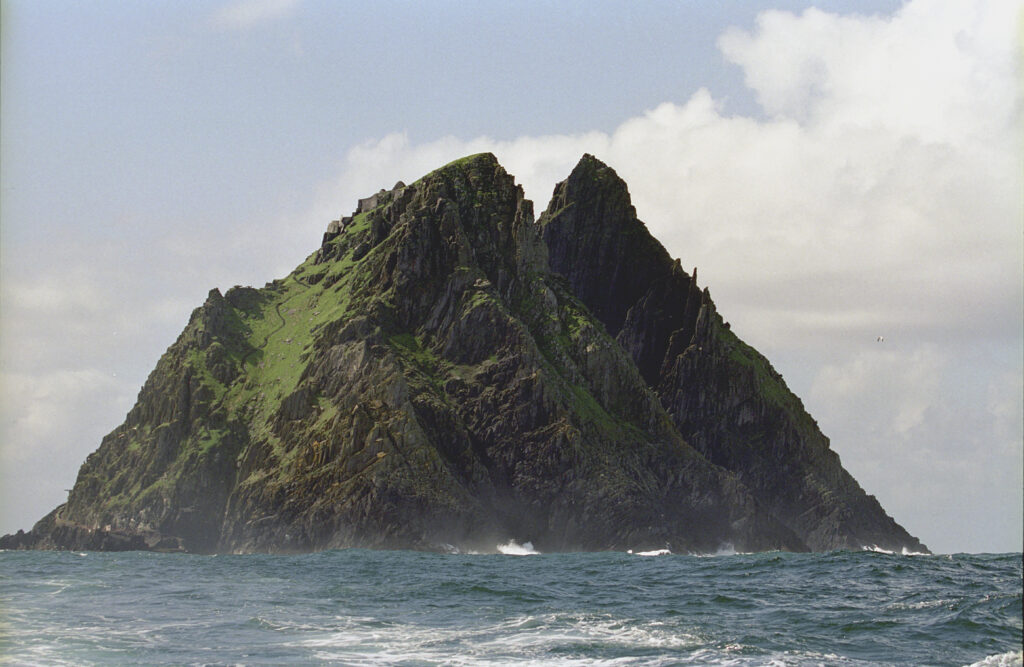
The papal records refer to St Michael’s Mount (de Rupe Beati Michaelis), the Augustinian priory at Ballinskelligs on the mainland opposite Skellig Michael. It is here, at the end of the fourteenth century, that we unexpectedly find members of both the Ó Maol Phádraig and Ó Maolchonaire families serving together.
The reason for this temporary jump is that a remarkable series of papal records from St Michael’s Mount in County Kerry provides one of the clearest examples of how families such as the Ó Maol Phádraig could appear far from any known home territory. These records do not describe the migration of a clan into Kerry. They reveal individual members of two hereditary ecclesiastical families operating inside a connected church network shaped by family influence, religious institutions, regional patronage and papal authority.
That distinction is central to the history that follows.
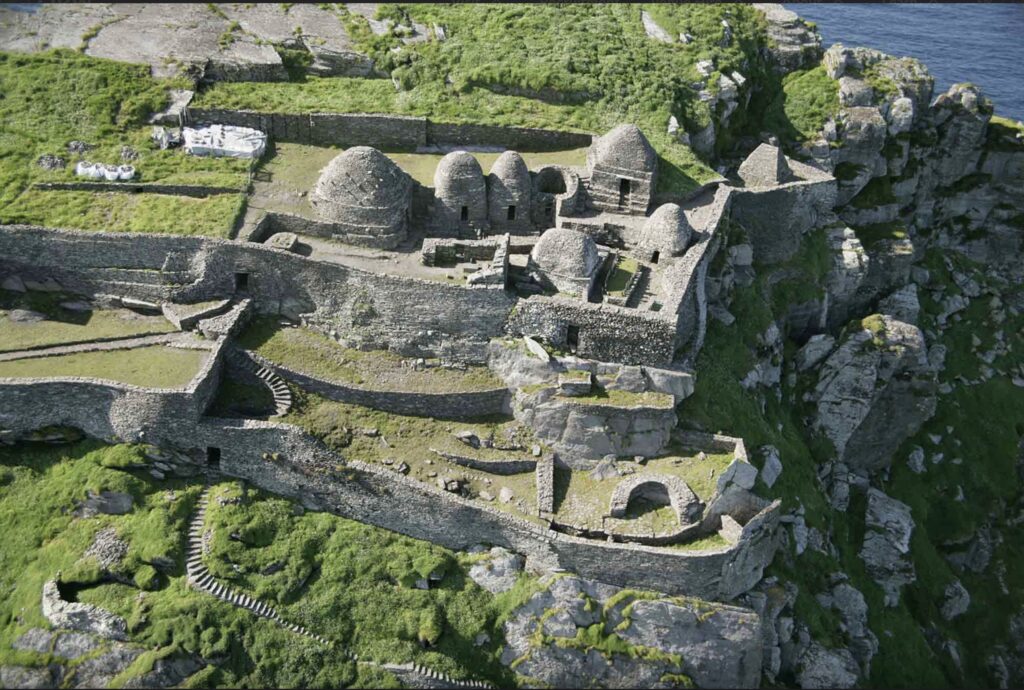
From Skellig Michael to the mainland
A short distance off the coast of the Iveragh Peninsula stand the Skelligs, two steep islands rising almost vertically from the Atlantic. The larger of them, Skellig Michael, became the site of one of Ireland’s most extraordinary early medieval monasteries.
The monastery occupied terraces high above the sea. Its monks constructed stone cells, churches, stairways and retaining walls in a landscape that offered almost no level ground. The isolation was well suited to a religious life centred upon withdrawal, prayer and discipline. It also made the monastery extremely difficult to maintain.
Food, tools and building materials had to be carried by boat across exposed Atlantic waters and then brought up long flights of steep steps. Fresh water depended largely upon rainfall collected in stone cisterns. The community could be cut off from the mainland during storms, and every journey to or from the island carried an element of danger.
The monastery survived in this setting for centuries, but the island was not well suited to the changing needs of the medieval Church. Religious houses were increasingly expected to maintain regular communication with bishops, patrons and other institutions. Their members might administer churches, hold benefices, conduct legal business and participate in diocesan government. These responsibilities were difficult to fulfil from an isolated rock several kilometres offshore.
By the later twelfth or early thirteenth century, the community had moved to the mainland at Ballinskelligs. The exact circumstances of the transfer are not preserved in a single account, but the practical difficulties of island life and the changing organisation of the Church almost certainly contributed.
The new priory retained the identity and dedication of the older foundation. In papal records it appears as St Michael’s Mount, de Rupe Beati Michaelis or Sancti Michaelis de Rupe. The name continued to recall the great rock of Skellig Michael, even though the canons now lived on the mainland.
St Michael’s Mount was therefore more than an ordinary local religious house. It inherited the reputation of one of Ireland’s most striking early monastic sites while becoming part of the regulated and internationally connected Church of the later Middle Ages.
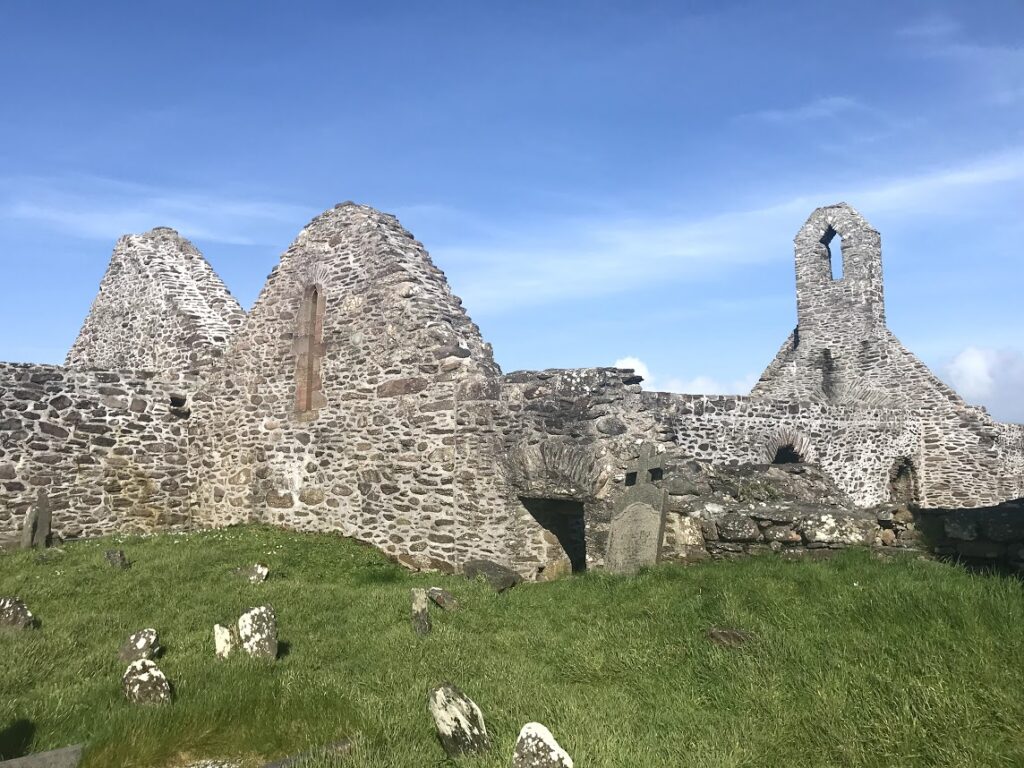
The mainland priory belonged to the Canons Regular of St Augustine and had developed from the Arrouaisian reform tradition. The Arrouaisians had originally represented a stricter form of canonical life, emphasising common property, communal discipline and observance of the Rule of St Augustine. Their members were not enclosed monks removed from the outside world. They were ordained religious clerics who could engage in pastoral work, administration and the management of churches and benefices.
By the late fourteenth century, the distinctive strictness of the original movement may have become less pronounced. The surviving records do not describe daily life within the priory, but they show that St Michael’s Mount was thoroughly integrated into the wider government of the Church. Its prior dealt with Rome, received papal commissions and participated in ecclesiastical business throughout the Diocese of Ardfert.
It was inside this important house that several members of the Ó Maol Phádraig and Ó Maolchonaire families appear together.
Alan Ó Maol Phádraig, Prior of St Michael’s Mount
Alan Ó Maol Phádraig was already Prior of St Michael’s Mount by 1 December 1389, when Pope Boniface IX granted him the dignity of papal chaplain.
That distinction is important. Alan was not simply the head of an isolated coastal monastery. The title associated him with the papal household and reflected recognised standing within the wider Church.
The surviving documents also preserve the names of the canons who supported his position. Letters drawn up by the convent in 1390 record the formal postulation of Alan as prior. The meeting took place in chapter on the north side of the greater church of the monastery.
The participating canons included Thomas Ó Maolchonaire, Ymarus Ó Maolchonaire and Malachy Ó Maolchonaire, together with Gilbert Ó Maol Phádraig and Thady O’Bugeyain.
The concentration of these surnames is immediately striking. Alan was not a lone Ó Maol Phádraig who had somehow reached Kerry by himself. Another member of the family, Gilbert Ó Maol Phádraig, was already a canon of the house. At least three Ó Maolchonaire canons were also involved in its internal government.
Further evidence of Alan’s standing appears in a papal mandate dated 13 May 1396. In a matter concerning Gilbert Ó Sullivan, Archdeacon of Aghadoe, the pope appointed the Bishop of Tuy and the priors of St Michael’s Mount and Inisfallen to carry out the mandate.
Alan’s personal name was not repeated, but he was the serving prior of St Michael’s Mount. He was therefore one of the ecclesiastical officers considered suitable to execute papal instructions within the Diocese of Ardfert. His position brought him into the administrative work of the Church beyond the walls of his own monastery.
On 16 April 1400, Pope Boniface IX confirmed the convent’s earlier postulation of Alan and dispensed him to govern St Michael’s Mount for life.
The confirmation was necessary because Alan was the son of a religious man and an unmarried woman. He had already received permission to take holy orders and hold an office normally served by a canon of the monastery, but his earlier dispensation may not have been broad enough to cover the priorate itself. The papal letter therefore regularised a position he had already held for years.
Alan died later in 1400.
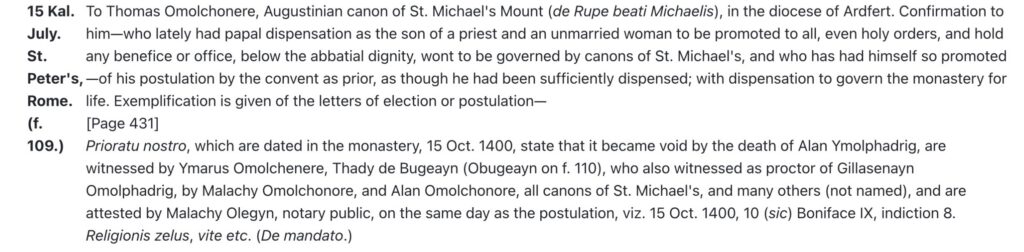
On 15 October of that year, the convent formally postulated Thomas Ó Maolchonaire as his successor. The document states explicitly that the priory had become vacant through the death of Alan Ymolphadrig.
The witnesses again included members of both families. Ymarus, Malachy and Alan Ó Maolchonaire were present, while Thady O’Bugeyain acted as proctor for Gillasenan Ó Maol Phádraig. Other canons were also present but were not individually named.
On 27 June 1401, Pope Boniface IX confirmed Thomas Ó Maolchonaire as prior and dispensed him to govern the monastery for life.
Ten days earlier, Ymarus Ó Maolchonaire had received an unusually wide dispensation. It allowed him to hold benefices, priories, offices and dignities within his own or another approved religious order. He could eventually be elected even to an abbacy, and his illegitimacy would no longer need to be mentioned in future papal grants.
These were clearly men of significant standing. Alan became a papal chaplain, governed an important priory and participated in papal administration. Thomas succeeded him as prior with the support of the convent and the confirmation of Rome. Ymarus received permission to rise to almost any dignity available within the religious orders.
Hereditary church families inside the reformed Church
The family backgrounds of these men are equally revealing.
Alan Ó Maol Phádraig was the son of a religious man and an unmarried woman. Thomas and Ymarus Ó Maolchonaire were sons of priests and unmarried women. Their parentage created canonical obstacles, but it did not exclude them from high office.
Rome repeatedly issued dispensations that allowed these men to receive holy orders, hold benefices and govern religious institutions. It did not remove them from the Church because they came from clerical families. It regularised their status and permitted them to advance.
This is a clear example of how the older hereditary ecclesiastical world survived inside the structures created by church reform.
The Arrouaisian movement had originally sought a stricter and more regulated form of religious life. By about 1400, however, several members of the same Irish clerical families occupied positions within one of its houses. Leadership passed directly from Alan Ó Maol Phádraig to Thomas Ó Maolchonaire, while other members of both families remained among the canons.
This does not establish that the canons themselves ignored their vows or lived without discipline. Their irregular birth arose from the conduct of the previous generation. What the records show is that reform had not destroyed the influence of hereditary clerical families. Those families had adapted to the reformed institutions and learned how to operate successfully within them.
The Church as a network of power and placement
The most important part of the St Michael’s Mount story is not simply that Ó Maol Phádraig and Ó Maolchonaire clerics can be found in Kerry. It is what their presence tells us about the geographical distribution of families such as the Ó Maol Phádraig.
The evidence should not be understood as the movement of an Ó Maol Phádraig clan into the southwest of Ireland.
There is no sign here of a territorial kindred expanding through warfare, marriage or the occupation of neighbouring lands. The men at St Michael’s Mount were members of a religious institution. They had reached Kerry through a system in which clerics, influence and patronage could move across great distances.
The medieval Church was a connected network of monasteries, priories, cathedral chapters, bishops, patrons and learned families. Appointments were shaped by relationships and by power. The resident canons formally selected their prior, but the wider process could also involve regional rulers, bishops, senior members of the order and the papacy.
Families with established ecclesiastical influence could use these networks to educate relatives, secure their admission to religious houses and support their advancement. Once one or two members of a family became established within an institution, they could help create opportunities for others.
This may explain the concentration of Ó Maol Phádraig and Ó Maolchonaire clerics at St Michael’s Mount. It is difficult to believe that so many members of both families independently chose the same remote priory by chance.
They were moving within a structure of influence.
A family did not need to control the territory surrounding a church in order to hold power within it. One relative might serve as a canon in a distant priory, another as a cathedral official, and another in the household of a bishop or regional king. Each appointment extended the family’s network and created relationships that could be used by the next generation.
Individual family members could therefore be moved considerable distances as part of continuing ecclesiastical and political arrangements. They were not moving as a clan. They were being placed as useful and trusted men within a network whose reach extended across Ireland and ultimately to Rome.
This helps explain why the Ó Maol Phádraig surname appears in widely separated places without leaving evidence of a single expanding territory. Their geography may have been created less by the movement of a population across the land than by the movement of clerics through the Church.
St Michael’s Mount provides a particularly clear example. Members of both families had reached a prestigious religious house far from Connacht and Bréifne. They participated in its government, supported one another’s advancement and secured papal approval for their positions.
The Ó Maolchonaire connection is especially important.
Their network did not begin with Clarus Mac Mailín Ó Maolchonaire. Clarus inherited a structure of family influence that had already begun to develop before his lifetime. An earlier Ó Maolchonaire churchman had laid foundations upon which later generations could build. Clarus greatly expanded the family’s standing, but he did not create its ecclesiastical connections from nothing.
When the story returns to Lough Cé, that earlier foundation will need to be examined. It may help explain how the Ó Maolchonaire developed a network capable of carrying family members into important religious institutions far beyond Connacht.
The documents do not state that the Ó Maolchonaire personally brought Alan Ó Maol Phádraig to Kerry. Nor do they identify the particular patron responsible for placing either family within St Michael’s Mount. The precise mechanism remains unknown.
What the records show is the result: several members of both families established together within a powerful religious institution, supporting one another inside its governing community and dealing directly with Rome.
The most likely explanation is that their presence involved a combination of family influence, connections within the Augustinian network, regional patronage and papal approval.
Rome during the Western Schism
These events also took place during the Western Schism, when rival popes claimed authority from Rome and Avignon.
Boniface IX belonged to the Roman line. His authority was recognised in Ireland, but across Europe the unity of the papacy had broken down. Different kingdoms and churchmen supported competing claimants, and the question of who legitimately occupied the papal throne remained unresolved.
The records from St Michael’s Mount show that, despite this wider conflict, the Roman papacy continued to exercise very real authority within Ireland. Alan’s position was confirmed by Boniface IX. Thomas required the same papal intervention before his succession was canonically secure. Ymarus received from Rome the freedom to advance to senior office.
The connection to the pope was therefore not abstract. It affected who could govern the monastery, who could hold benefices and how far individual clerics might rise.
The fact that these cases reached Rome also reflects the influence behind the petitioners. Papal administration was not easily accessible to every minor local cleric. Alan, Thomas and Ymarus belonged to families and institutions capable of bringing their cases before the papal court and obtaining favourable decisions.
Their location in Kerry should therefore not be seen as isolation. St Michael’s Mount was connected to the Diocese of Ardfert, to other religious houses such as Inisfallen, to the wider Augustinian world and to Rome itself.
A lasting Ó Maolchonaire presence
The Ó Maolchonaire connection with St Michael’s Mount did not end with the succession of Thomas in 1400.
Members of the family continued to exercise influence within the church and the wider region into the sixteenth century. Those later records will be discussed separately, because they show that the family’s Kerry presence was not a short episode confined to one group of clerics around the year 1400.
It became a continuing regional connection lasting across generations.
For the moment, the St Michael’s Mount records establish a much broader point about the Ó Maol Phádraig family.
They could appear almost anywhere the connected institutions of the medieval Church could carry them. Their scattered distribution does not need to be explained through the movement of a clan or the expansion of a territorial lordship. Individual family members could be educated, placed and promoted through networks of religious houses, clerical families, patrons and papal authority.
At St Michael’s Mount, the Ó Maol Phádraig appear inside an Ó Maolchonaire-associated ecclesiastical environment far from the places usually connected with either surname. An Ó Maol Phádraig governed the house, an Ó Maolchonaire succeeded him, and members of both families formed part of the same community.
This was not a clan moving south.
It was the medieval Church moving people through a network of power.
References
Bliss, W. H., and J. A. Twemlow, eds. Calendar of Entries in the Papal Registers Relating to Great Britain and Ireland: Papal Letters, Vol. IV: 1362–1404. London: His Majesty’s Stationery Office, 1902.
Bliss, W. H., and J. A. Twemlow, eds. Calendar of Entries in the Papal Registers Relating to Great Britain and Ireland: Papal Letters, Vol. V: 1396–1404. London: His Majesty’s Stationery Office, 1904.
Flanagan, Marie Therese. “St Mary’s Abbey, Louth, and the Introduction of the Arrouaisian Observance into Ireland.” In The Regular Canons in the Medieval British Isles, edited by Janet Burton and Karen Stöber. Turnhout: Brepols, 2011.
Gwynn, Aubrey, and R. Neville Hadcock. Medieval Religious Houses: Ireland. London: Longman, 1970.
Heritage Ireland. Ballinskelligs Augustinian Abbey. Office of Public Works.
UNESCO World Heritage Centre. Sceilg Mhichíl (Skellig Michael).
Fitzpatrick, Matthew, and Mike Fitzpatrick. “Ó Maol Phádraig: The Name, the People, and the Clans, Part III.” Journal of the Fitzpatrick Clan Society 6 (2025).