
Until the early seventeenth century, the surviving documentary record places Ó Maol Phádraig primarily within Bréifne, particularly in Cavan and the adjoining borderlands. There are scattered records elsewhere, but nothing yet found securely places the family as residents of County Fermanagh before the Plantation.
Dr Mike Fitzpatrick and Proinsias Mag Fhionnghaile’s study of the earlier genealogical evidence placed the Bréifne Ó Maol Phádraig within the much older Conmhaicne genealogical tradition. Mac Fhirbhisigh records Máel Pátraic son of Maolgeann as the ancestor “from whom are the Uí Mhaoil Phádraig”, while the Book of Fenagh preserves another version of the same broader association. Whatever weight is ultimately placed on those medieval genealogies, the early modern records show a northern family already established in Bréifne long before the Plantation.
The sixteenth-century records begin to show what that family had become. In 1586 Cathal Bán Ó Maol Phádraig of Dún an Rí in Cavan was specifically described as a husbandman. In 1593 Moriertagh Ó Maol Phádraig of Creeny appeared among the followers of Philip Ó Raghallaigh of Bellanacargy. In 1602 Conchobhar Ó Maol Phádraig, described as “Chief of His Name”, appeared in a pardon headed by Owen Ó Raghallaigh, who was likewise described as “Chief of His Name”.
Matthew Fitzpatrick and Dr Mike Fitzpatrick drew attention in Part III of their study to the concentration of the early modern records in Bréifne and to the close association between the Bréifne Ó Maol Phádraig and the Uí Raghallaigh. Their work provides the foundation for the pattern that becomes much clearer after 1610: the family did not disappear with the destruction of the old political order. It adapted to the new one, and that adaptation appears to have carried some members of the family into Fermanagh
Plantation created a new route north
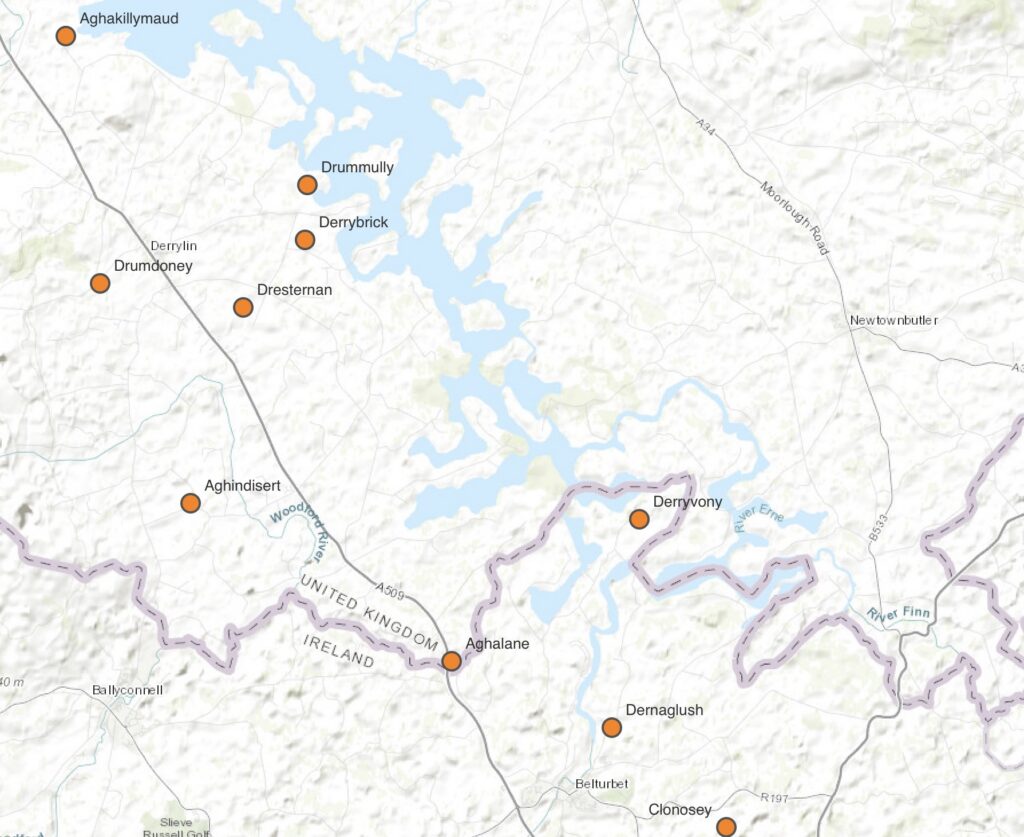
Sir Stephen Butler was one of the English undertakers introduced into Cavan during the Plantation of Ulster. He received a substantial grant at Clonose and land for the development of Belturbet, eventually controlling lands around Dernglush and the Belturbet district. Butler later obtained property across the county boundary in southern Fermanagh.
Ó Maol Phádraig were already present immediately to the south. Creeny, where Moriertagh Ó Maol Phádraig was recorded in 1593, lay in the wider Loughtee and Belturbet region. The new Plantation ownership therefore joined areas of Cavan and Fermanagh that had never represented an impenetrable social boundary in the first place.
For the new landlords the border was administrative. For the people who lived there, travelled there, grazed animals and maintained older family relationships, it was considerably less significant. The Plantation created a new mechanism through which movement could take place, because a landlord could hold estates on both sides of the border and could accept, retain or recruit tenants from the same regional population.
Dresternan
The clearest evidence comes from an inquisition taken at Enniskillen at the end of February 1624, dated February 1623 under the contemporary calendar. Butler was then in possession of the small proportion of Dresternan in the Barony of Knockninny. A small Plantation proportion nominally contained 1,000 acres of profitable land.
The commissioners recorded fifteen Irish tenants living upon the estate. Unfortunately the nineteenth-century editors Charles Russell and John Prendergast did not reproduce the complete list. They wrote that the names of fifteen Irish tenants followed, but printed only the conclusion of the original list. Six names therefore remain hidden in the original State Paper.
The nine whose names survive in the printed calendar were:
Phillip O’Mulpatrick and Brian O’Mulpatrick — Dromdoney and Draychoe
Phillip M’Granell — Doone
Termon Oge M’Caffry — Corclare
Patrick Oge M’Danne — Dresternan
Knogher Duff M’Gilpatrick
Edmun O’Mulpatrick and Brian O’Mulpatrick — Drumully and Dernibrick
Phelim M’Chorrie — one-third of Dromlelan
This is the first presently known concentration of Ó Maol Phádraig within Fermanagh. At least four of Butler’s fifteen recorded Irish tenants were Ó Maol Phádraig. Since six names have not yet been recovered, four is a minimum rather than necessarily the final number.
A request has now been submitted to The National Archives for images of the original State Paper containing the complete Dresternan list. If the omitted six names add anything significant to the pattern, this account can be updated once the manuscript is obtained.
More revealing than the raw count is the way the known tenants occupied the land. Phillip and Brian Ó Maol Phádraig were recorded together in connection with Dromdoney and Draychoe, while Edmund and another Brian Ó Maol Phádraig were associated with Drumully and Derrybrick. The pattern looks much more like Ó Maol Phádraig household or family groups occupying land together than four unrelated men independently obtaining four separate farms.
Fifteen tenants did not mean fifteen equal farms
It would be easy to divide 1,000 acres by fifteen and imagine that each man farmed approximately sixty-five or seventy acres. The survey itself shows that the estate was not organised that neatly.
Land was still structured around older units such as the tate. Some tenants held whole tates, others fractions of tates, and several men could occupy the same holding. Phelim M’Chorrie, for example, held only one-third of Dromlelan.
The commissioners were also not conducting a population census. Their instructions were to identify Irish people inhabiting, residing, manuring, creaghting or depasturing upon the Plantation estates. The inquiry was therefore concerned with people living on the land, cultivating it and grazing livestock, whether or not every person held a formal lease in the modern sense.
Elsewhere in the same Fermanagh survey named tenants had other Irish living beneath them, several men shared the same tate, and some entries refer simply to “divers others” who were never individually named. A named tenant could consequently represent a considerably larger household or working group.
Behind Phillip, Brian, Edmund and the second Brian Ó Maol Phádraig were almost certainly households containing wives, children and perhaps other relatives, labourers or servants. Their total number cannot be reconstructed from this record, but four named tenants should not be understood as four people.
The more interesting possibility is that the record has captured two Ó Maol Phádraig family groups establishing themselves on the same estate. That gives us a much more realistic picture of how expansion into Fermanagh may have taken place.
Dresternan was part of a much larger Irish farming economy
The neighbouring Plantation estates show that Butler’s fifteen Irish occupiers were far from unusual.
David Creighton’s nearby 1,000-acre proportion of Aghalaga contained thirty-seven Irish tenants in the same survey. Their arrangements reveal how complicated the new agricultural economy had become. Some paid rent directly to Creighton or members of his family, while others paid British tenants who themselves stood between the Plantation proprietor and the Irish farmer. Several Irishmen could share a single tate, while other holdings were divided into quarter-tates or smaller parcels.
One tate at Dromborrie was shared by Cale M’Donell O’Reilly, Donogh Maguire, Bryartagh M’Chorrie and Farrall Boy O’Reilly, who paid an English intermediary. Elsewhere James M’Manus and Phillip M’Marten shared a holding, while another entry records two men together with “divers others” occupying two tates.
Balfour’s neighbouring estate provides an even larger example. His great proportion of Bally M’Gillichony contained seventy-four Irish tenants, and the surviving names show similar patterns of shared occupation. Redmond M’Cave and Maghlin Oge M’Corrie appear together at Gortary, groups of Maguires shared other holdings, and at Aghadisart Teige Ó Maol Phádraig occupied land alongside Cormock O’Reilly, Caele Boy O’Reilly and Tirlagh O’Reilly.
Across these three neighbouring properties alone — Dresternan, Aghalaga and Bally M’Gillichony — the commissioners counted at least 126 Irish occupiers, before taking account of unnamed dependants or additional people living beneath them.
There were still more. Immediately after the Dresternan list, the survey records six and a half great tates in Lord Balfour’s possession as “concealments”, upon which lived “divers Irish natives”, their rents unknown. These were lands that had not fitted neatly into the original Plantation allocations and had subsequently come into Balfour’s possession. The published calendar gives neither the names of those inhabitants nor the precise economic arrangements under which they occupied the land.
The southern Fermanagh landscape into which Ó Maol Phádraig moved was therefore still overwhelmingly dependent upon Irish farming labour and tenancy, even though legal ownership had been transferred to Plantation landlords.
Why Ó Maol Phádraig?
The records never state that Butler selected Ó Maol Phádraig because they were good farmers. Agricultural ability, however, provides a convincing explanation for why the family appears in this particular setting.
We already know that at least one member of the family had been explicitly described as a husbandman nearly forty years earlier. That description of Cathal Bán Ó Maol Phádraig in 1586 deserves more attention than it has usually received. A husbandman was not simply an agricultural labourer; he was a man engaged in operating a farm and managing an agricultural holding.
By the early seventeenth century that experience had considerable value. The Plantation scheme was intended to replace much of the native population on undertakers’ lands with British settlers, but the economic reality proved much more difficult. Undertakers repeatedly retained Irish tenants because they needed people who could actually work the land.
Gerard Farrell’s study of the Plantation shows how important this became. Irish tenants could pay rents in money, produce and labour, while some undertakers found them economically more attractive than British settlers. Elsewhere in the same Fermanagh survey tenants supplied landlords with customary work, pigs, butter and meal in addition to rent. The formal intentions of Plantation policy collided repeatedly with the practical requirements of running agricultural estates.
The new landlord might possess the patent, while the Irish tenant possessed something equally useful on the ground: knowledge. He knew the soil, which ground flooded and which drained, where cattle could winter, where oats could be grown, how much stock a particular holding could support and how the old tates functioned as agricultural units.
Ó Maol Phádraig appear to have possessed precisely the sort of practical experience that the Plantation estates required.
Reputation still counted
Skill alone may not explain the concentration. Reputation remained enormously valuable in communities where tenancy, credit, surety and personal recommendation depended heavily upon people knowing one another. A man who had demonstrated that he could manage livestock, maintain a holding and meet his obligations was valuable to a landlord.
A reliable tenant could also open the door for relatives. Once one Ó Maol Phádraig proved capable of managing land, his brother, son, cousin or other relative arrived with something that a stranger did not possess: someone was prepared to stand behind his name.
That offers a plausible explanation for the paired Ó Maol Phádraig holdings at Dresternan. Rather than imagining four men independently arriving in Fermanagh and negotiating separately with Butler, it may be more realistic to imagine one or two established family groups whose agricultural reputation helped other members obtain land nearby.
The movement need not have been organised from above. One tenancy could lead to another, and one successful household could draw another family member across the border. The expansion may have grown through work, reputation and kinship.
The neighbours tell us more
The other families surrounding Ó Maol Phádraig are equally revealing. The MacCorry or M’Chorrie name occurs repeatedly in the Knockninny survey, and the Fermanagh genealogies preserve Sliocht Gothraidh, a branch embedded within the wider Maguire genealogical structure. This makes the MacCorry population part of the old Fermanagh social landscape.
MacManus was another major Maguire-derived family. The MacCabes, represented in the surrounding records by forms such as M’Cave, belonged to the old military world of the Cavan–Fermanagh borderlands. Termon Oge M’Caffry is also significant, because MacCaffrey was deeply established within Fermanagh and closely associated with the Maguire world.
Phillip M’Granell is different. MacGranell belonged particularly to the neighbouring Leitrim and Muintir Eolais region. His presence on Butler’s estate provides another example of movement into southern Fermanagh from the wider Bréifne country.
Dresternan was consequently not populated simply by old Fermanagh families, nor was it a settlement composed entirely of newcomers from Cavan. It was a mixture, with the Plantation landlord at the top while much of the older Gaelic social landscape continued to function beneath him.
There is also an intriguing modern DNA observation involving the name Crayton. A Crayton paternal line appears beneath BY12234 with an estimated common ancestor around 1600. The coincidence with David Creighton’s nearby Plantation estate is worth recording, although at present there is no documentary evidence connecting the DNA line with David Creighton or his family. The timing and geography make it an interesting lead for future work rather than a conclusion. In a period when surnames could change through fosterage, illegitimacy, household affiliation or other social relationships, a non-Ó Maol Phádraig surname emerging beneath BY12234 around this date deserves attention.
Another Ó Maol Phádraig nearby
Butler’s four tenants were not alone. On neighbouring lands belonging to Lord Balfour, Teige O’Mulpatrick was recorded at Aghadisart with Cormock O’Reilly, Caele Boy O’Reilly and Tirlagh O’Reilly.
That detail fits the older pattern extremely well. The earlier Cavan records repeatedly place Ó Maol Phádraig alongside the Uí Raghallaigh. After the old Gaelic landholding system had been replaced by Plantation landlords, an Ó Maol Phádraig was still living alongside three O’Reillys in Fermanagh.
Political authority had changed much more quickly than social relationships. The people beneath the new landlords continued to carry older connections with them, and the Fermanagh expansion may therefore have involved more than isolated individual farmers. Ó Maol Phádraig were moving within a much older Bréifne social network that survived beneath the Plantation.
A second Patrick surname was already in Fermanagh
One man on Butler’s estate presents a separate problem. Knogher Duff M’Gilpatrick appears among the same small group of tenants as the four O’Mulpatricks.
Mac Giolla Phádraig and Ó Maol Phádraig were different surnames. The distinction becomes increasingly important because both could later become Fitzpatrick in English-language records.
There is an old historical tradition that some Fitzpatrick families of Fermanagh descended from Maguire stock, rather than from the famous Mac Giolla Phádraig dynasty of Upper Ossory. There are good reasons to take that tradition seriously.
The personal name Giolla Phádraig occurs repeatedly within the genealogical world of Fermanagh. Maguire and MacManus pedigrees in particular contain numerous men bearing the name. A Fermanagh ancestor called Giolla Phádraig could therefore easily have produced descendants who eventually became known as Mac Giolla Phádraig, without requiring any migration from Ossory.
There is presently no documentary trail connecting Knogher Duff M’Gilpatrick with Upper Ossory. Nothing has yet been found connecting the early Fermanagh Mac Giolla Phádraig with the separate Dál gCais Mac Giolla Phádraig population known from Clare either.
The local explanation is at least as compelling: Fermanagh may have produced a Mac Giolla Phádraig family of its own within, or closely associated with, the Maguire population.
Modern Y-DNA research makes the old tradition even more interesting. A northern Fitzpatrick paternal lineage has been identified with a significant genetic relationship to Maguire families. That cannot identify Knogher Duff individually, but it shows that the idea of a Fitzpatrick line arising from the Fermanagh Maguire population deserves serious consideration.
For this history it creates an important warning. By the later seventeenth and eighteenth centuries a man recorded simply as Fitzpatrick in Fermanagh might descend from Ó Maol Phádraig, from a local Mac Giolla Phádraig population, or potentially from some other Patrick-derived family. The English surname can conceal very different paternal histories.
The remarkable feature of the Dresternan survey is that we may actually be seeing two of those histories before the distinction disappeared: four O’Mulpatricks and one M’Gilpatrick on the same small estate.
From newcomers to an established Fermanagh population
The 1624 record appears to catch the movement at an early stage. Before the Plantation no secure resident Ó Maol Phádraig has yet been identified in Fermanagh. By 1624 at least four were tenants on Dresternan and another lived on neighbouring Balfour land.
Less than twenty years later the picture is very different. The 1641 Depositions contain the names of approximately thirty Ó Maol Phádraig men associated with Cavan and Fermanagh, with particularly strong concentrations around Drumlane and Kinawley.
The border had effectively become part of one Ó Maol Phádraig landscape. Bryan Óg Ó Maol Phádraig was identified as the son of Domhnall Óg Ó Maol Phádraig of Aghakillymaud in Kinawley, Fermanagh, while Bryan himself was associated at different times with Dernglush, Annagh, Polenemadre near Belturbet and Belturbet itself.
Both father and son were associated with Rory Maguire, while Bryan also appears in connection with Captain Philip mac Hugh Ó Raghallaigh. Kinawley in Fermanagh, Drumlane in Cavan and Belturbet were not separate worlds for these people; families operated across all three.
The administrative line on the map mattered much less than the network of farms, relatives, landlords and older Gaelic associations connecting the countryside.
Farming as a route to survival
The expansion into Fermanagh increasingly looks like another example of Ó Maol Phádraig adapting successfully to enormous political change. They were not arriving as conquerors, they were not receiving major royal grants, and they were not replacing Butler or Balfour as proprietors. Their route into Fermanagh was more practical: they were obtaining farms.
The neighbouring estates make the economic background clearer than Dresternan alone ever could. Butler’s fifteen Irish occupiers were part of a much larger system in which Creighton had thirty-seven Irish tenants, Balfour had seventy-four, and additional Irish families occupied concealed lands that the commissioners did not even fully enumerate. British proprietors and middle tenants often depended upon experienced native farmers to make their estates productive, and those farmers could pay not only in cash but through produce, livestock and labour.
Their agricultural knowledge gave Ó Maol Phádraig economic value, while reputation could help secure tenancies and kinship could enable successful tenants to bring other family members with them. Older relationships with families such as the Uí Raghallaigh also continued to operate beneath the new Plantation ownership, giving the family access to social networks that had survived the change in political authority.
The Plantation removed much of the old Gaelic elite from control of the land, but it could not function without people capable of making that land productive. Ó Maol Phádraig appear to have understood that reality quickly. By taking land under the new landlords, they found a way not only to remain within the agricultural economy of the region but to expand into territory where they had not previously been recorded.
The Dresternan inquisition may therefore preserve something larger than four men farming in southern Fermanagh. It may record the early stages of a wider family movement in which an established Bréifne farming population turned agricultural skill, reputation and family connections into a new foothold north of the Cavan border. Within a generation, that foothold had become a substantial Ó Maol Phádraig presence in Fermanagh.
References
Fitzpatrick, M. and Mag Fhionnghaile, P. 2024. “Ó Maol Phádraig: the Name, the People, and the Clans. Part II.” Journal of the Fitzpatrick Clan Society 5, 25–42.
Fitzpatrick, M. and Fitzpatrick, M. 2025. “Ó Maol Phádraig: the Name, the People, and the Clans. Part III.” Journal of the Fitzpatrick Clan Society 6, 27–41.
Russell, C. W. and Prendergast, J. P. 1880. Calendar of the State Papers Relating to Ireland, of the Reign of James I, 1615–1625. London: Longman & Co., pp. 465–466.
Farrell, G. The Mere Irish and the Colonisation of Ulster, 1570–1641.
Ó Scea, C. “Erenachs, Erenachships and Church Landholding in Gaelic Fermanagh, 1270–1609.”
Ó Muraíle, N., ed. 2003. Leabhar Mór na nGenealach: The Great Book of Irish Genealogies. Dublin: De Búrca.
Geinealaighe Fearmanach. 1931.