
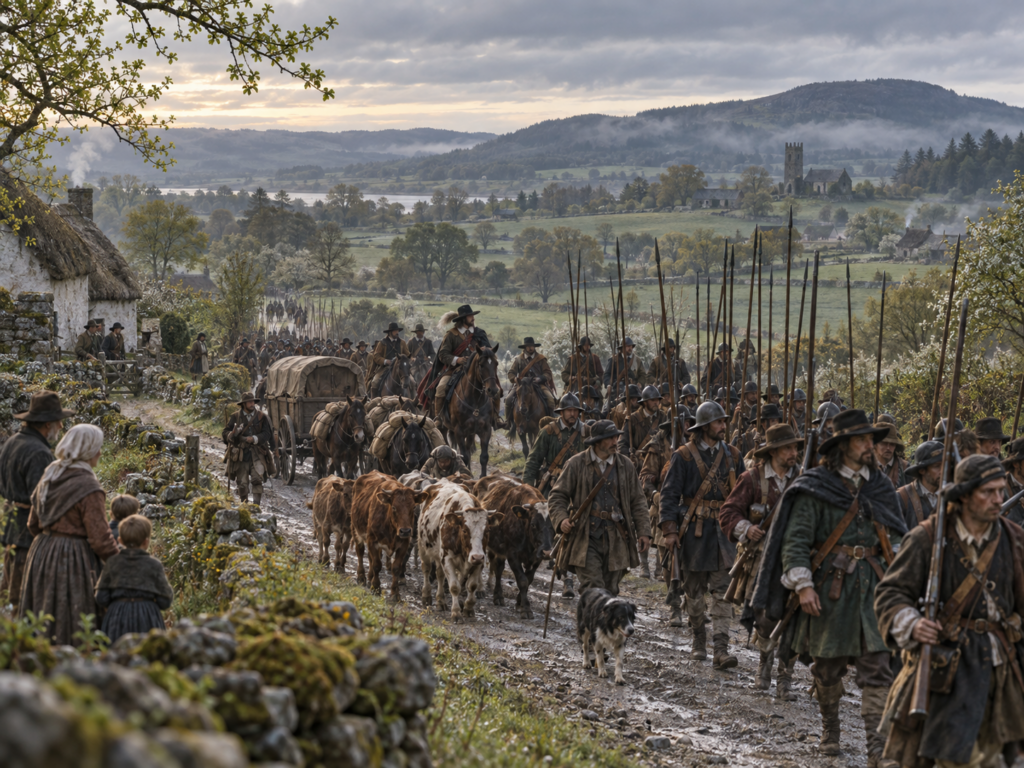
When Owen Roe O’Neill landed in Donegal on 8 July 1642, he brought with him a kind of military experience that few of the men then fighting in Ulster possessed. He had left Ireland in 1605 and spent most of the next thirty-seven years in Spanish service in the Low Countries. He began as a captain in Henry O’Neill’s Irish regiment in Flanders, later became its sergeant-major, and spent decades in the practical world of campaigning, training, supply and siege warfare.
By the 1630s Owen Roe was commanding his own Irish regiment in Spanish service. In 1640 he was appointed military governor of Arras as a large French army closed around the city. After a prolonged defence against superior forces, he surrendered in August on terms that allowed the garrison to march out with its colours. He later returned to service, and by 1642 was in Brussels while news reached the Continent of the rebellion that had begun in Ulster the previous October.
The possibility that experienced Irish officers might return from Spanish service alarmed the English authorities, who attempted to prevent their departure. Owen Roe nevertheless left from Ostend with a group of officers and soldiers and reached Doe Castle in northern Donegal. He returned to an Ulster transformed by Plantation, confiscation and eight months of war. The forces he found there had been raised locally, commanded by county leaders and organised through existing households, territories and family followings. Owen Roe now had to turn those bodies of armed men into an army capable of remaining in the field for years rather than weeks.
From local followings to regiments
In Cavan, Philip mac Hugh O’Reilly had already emerged as one of the principal leaders of the rising. Across the Fermanagh border, Rory Maguire occupied a comparable position. Their forces had been assembled through relationships that existed before October 1641: kinship, tenancy, household service, territorial allegiance and the authority of local gentlemen.
The Ó Maol Phádraig were already inside both networks. Bryan Óg’s family had first appeared among Rory Maguire’s followers in Fermanagh, while later testimony placed Bryan at Belturbet as a captain or commander. William Gibbs described Bryan Óg and Domhnall Óg as commanders with soldiers under them and associated Bryan with Conchobhar Óg O’Reilly and “a great number of the sept of the Mulpatricks.” William Bloxam similarly described a Bryan Ó Maol Phádraig as a captain “now of Belturbet.”
After Owen Roe’s arrival, Philip O’Reilly became a colonel within the developing Ulster army. Rory Maguire also became a colonel. The two commanders with whom the northern Ó Maol Phádraig had been associated in the opening phase of the rebellion were therefore drawn into the new military structure. The surviving records do not tell us whether Bryan Óg entered one of their regiments, remained with a garrison or disappeared from service altogether. His individual trail becomes faint just as the organisation around him becomes clearer.
Owen Roe did not instantly replace the old local structure with a continental army. The men continued to come from particular counties and communities, often under leaders they already knew. His task was to place more discipline, training and coordination over forces that remained deeply regional.
What the remaining depositions add
Several of the later depositions extend the Ó Maol Phádraig story beyond the opening months at Belturbet without returning to the events already covered in the previous post.
Francis Wilson, deposing in September 1642, named Bryan Óg, Thomas Ó Maol Phádraig, Thomas’s brother Cohannat and Edmund of Quivvy among those responsible for his losses. His testimony also preserves disagreement within the insurgent population over the treatment of English inhabitants. Some of the Irish criticised an O’Reilly for helping English people, evidence that the rising did not proceed under one universally accepted understanding of how neighbours, prisoners and property were to be treated.
William Bloxam’s deposition of November 1642 captures the mixture of civilian and military roles still found within the family. Philip mac Shane Ó Maol Phádraig was associated with Derrycark, Turlogh of Derrycark was a husbandman, Bryan of Polenemadre a yeoman, while another Bryan was a captain at Belturbet. The family remained rooted in farms and townlands even while some of its members had acquired military rank.
The 1643 evidence increasingly reflects the redistribution of property produced by war. Nathaniel Clark accused Thomas Buí of Drumlane, described as a farmer, of taking possession of his house and goods. Daniel Morris named Domhnall Buí of Galloon, Hugh mac Farrell of Quivvy and John Reagh of Knockninny in connection with Quivvy and Corragh. Men who had entered the records through farms and local residence were now appearing in a countryside where houses, cattle, land and leases had changed hands under wartime conditions.
William Gibbs’s later deposition gives a different view of military occupation. He said that he and his family were retained because he was a butcher and could slaughter cattle for those controlling Belturbet. The detail is easily overlooked, yet it shows how an armed occupation had to function once the first seizure was over. Cattle had to be gathered, slaughtered and distributed; boats and crossings had to be controlled; weapons and tools required repair; horses needed fodder and care. The people useful to an army included far more than the men carrying swords, muskets or pikes.
Richard Bennett’s deposition of 1644 used broader language when he described the violence at Belturbet as the work of the “septs of the Relys and the Mulpatricks.” He did not identify individual Ó Maol Phádraig men, but his wording shows that the family was still recognised as a collective kindred operating alongside the O’Reillys.
Peter Rickebee’s examination belongs to a later setting. Taken in 1654 during the Commonwealth investigations, it came more than twelve years after the events. Rickebee remembered Bryan Óg, Cahir Óg Mór, Conchobhar Óg, Bryan Reagh, Farrell mac Bryan Reagh and another son of Bryan Reagh among the Ó Maol Phádraig associated with Belturbet. The long interval requires caution, but his evidence preserves family groupings that were still remembered after the war had ended.
Across the full set of depositions, the northern Ó Maol Phádraig emerge as a substantial regional population rather than a handful of isolated individuals. Farmers, yeomen, gentlemen, craftsmen and commanders appear across Cavan and Fermanagh. Some remained closely attached to particular townlands while others had become part of the armed forces operating around them.
1643: Clones and the rebuilding of the army
Owen Roe spent the months after his arrival trying to strengthen the northern forces and impose a more dependable command structure. His experienced officers understood continental drill and the demands of prolonged campaigning, but much of the rank and file had entered service through the local rising and had little experience of fighting as part of a disciplined field army.
On 13 June 1643 that army suffered a serious defeat at Clones. Sir Robert Stewart’s forces broke Owen Roe’s army, experienced officers were lost or captured and many of the troops scattered. Owen Roe withdrew south-westward, regrouping through the country toward Longford and Leitrim before assembling another force.
Clones altered the character of his campaigning. Owen Roe became more reluctant to commit the army to battle unless circumstances favoured him, concentrating instead on preserving his experienced officers, recruiting replacements and keeping enough food and ammunition available to remain in the field. The Cavan-Leitrim-Fermanagh country offered room in which the army could withdraw, recover and later move north again.
The terrain also shaped the war. Lakes, rivers, bogs, narrow roads and cattle country restricted the movement of large forces and gave an advantage to those who knew the local routes. The northern army depended heavily upon the people who could move cattle, locate supplies and guide men through country that was difficult for outsiders to use efficiently.
The same regional circle
One final pattern becomes clear when the 1641 evidence is placed beside the earlier fiants and pardons. The Ó Maol Phádraig are again surrounded by many of the same regional families that had appeared with them in the records of the late sixteenth and early seventeenth centuries.
Those earlier documents and the 1641 depositions were created for entirely different purposes and were separated by several decades. They cannot be used to construct an unbroken alliance or to assume that the individuals named in one generation were directly connected with particular soldiers in another. What they do preserve is the same broad social landscape. Families that had repeatedly appeared beside Ó Maol Phádraig in Cavan, Leitrim, Monaghan and Fermanagh were again present among the men who joined the rising and later supplied the forces from which Owen Roe built his northern army.
The strongest continuity remained with the O’Reillys, but the wider pattern is equally clear. The 1641 records mirror the same regional circle that had surrounded Ó Maol Phádraig in the earlier fiants. By the 1640s, many of those old associations were being expressed through armed service rather than through pardons, tenancy or local lordship.
1644: keeping an army in existence
The campaigning of 1644 was dominated by movement, supply and the attempt to preserve the northern army against stronger or better-equipped opponents. Scottish forces could penetrate deeply into Confederate territory, while Owen Roe still lacked the money and matériel required to challenge them whenever they advanced.
An army of several thousand men consumed enormous quantities of food and fodder. Cattle had to be collected and driven, grain obtained, horses maintained and ammunition preserved. The creaghts, mobile cattle-owning communities that accompanied or supported military forces, became increasingly important to the northern war. Their herds represented food, wealth and mobility at the same time.
The deposition evidence from the earlier phase now fits into a larger military economy. Gibbs being retained as a butcher, the repeated seizure of cattle, the control of boats and crossings, and the continued importance of farmers and craftsmen were local examples of the same problems Owen Roe faced on a much larger scale. Maintaining an army required a supporting population capable of feeding, repairing, transporting and guiding it.
Cavan occupied a useful position within that system. It lay between the northern campaigning grounds and the more defensible country toward Leitrim and the Midlands. Men could move through it, cattle could be gathered there, and the army could withdraw toward it when pressure in Ulster became too strong.
1645: back to Belturbet
By 1645 Owen Roe was again operating in the country familiar from the earlier Ó Maol Phádraig records. A near-contemporary account places him first at Carrickmacross and then at Belturbet while he attempted to raise money and sustain his forces.
Belturbet had therefore acquired another military role. In 1641–42 it had been a captured Plantation town associated with Philip O’Reilly, Bryan Óg and a large body of Mulpatricks. By 1645 it formed part of the operating landscape of Owen Roe’s Ulster army. Its location close to the Erne and the routes between Cavan, Fermanagh and Monaghan made it useful for the movement of men, cattle and information.
Later that year the arrival of the papal nuncio, GianBattista Rinuccini, brought additional money and military supplies into the Confederate war. Owen Roe did not receive everything he wanted, but the assistance gave him resources that had been scarce throughout the previous campaigns. Pay, weapons and equipment could now be improved at the same time as the army benefited from several years of accumulated experience.
The contrast with October 1641 was considerable. The first Cavan forces had been assembled rapidly through local leadership and existing followings. By the end of 1645 many of the surviving soldiers had spent years campaigning, while officers with continental experience had trained and reorganised them.
Winter 1645–46 in Cavan
Owen Roe’s army spent the winter of 1645–46 in Cavan. That brought a substantial field force into the same region from which much of the original rising had been raised. The county had already endured confiscation, flight, occupation and repeated military demands, yet it now had to support soldiers and horses preparing for another campaign.
Quartering an army required grain, cattle, fodder, carts, horses, shelter and repair work. Local knowledge was equally valuable. Officers needed dependable information about roads, crossings and enemy movements, while the army required people who knew where supplies could be gathered and how quickly men could travel through particular districts.
The Ó Maol Phádraig concentrations around Drumlane, Annagh, Belturbet and the Fermanagh border lay within this military landscape. Philip O’Reilly remained a senior Cavan commander and Rory Maguire was still active within the Ulster army. Around them were men drawn from the same regional communities that had supplied the first rising.
The surviving records do not tell us which of the named Ó Maol Phádraig were still serving by that winter. Bryan Óg may have survived into this phase, but there is no document yet found that places him there. The same uncertainty applies to Domhnall Óg, Hugh Reagh, Cormac, Philip Mothlach and the other men whose names appear around Belturbet.
What can be followed securely is the structure around them. The local forces under O’Reilly and Maguire had become part of Owen Roe’s army, and that army was now quartered in the country from which those forces had first been raised.
Spring 1646
During the spring Owen Roe travelled south to Kilkenny and secured authority and funding to raise a renewed northern army. By May, contemporary accounts describe a force of several thousand men, including a substantial body of cavalry. It was larger and better supplied than the army that had broken at Clones three years earlier.
Philip mac Hugh O’Reilly remained among its senior Cavan officers, while Rory Maguire continued within the Ulster command. The army then began moving north from Cavan through Monaghan toward Tyrone, passing through country whose families and local relationships had been appearing throughout the Ó Maol Phádraig story for generations.
Robert Monro and the Scottish army were moving to meet them. Another Scottish force was approaching from the north, creating the danger that Owen Roe could be trapped between the two. He had spent several years avoiding a battle under poor conditions, but the army he commanded in June 1646 was not the force that had scattered at Clones.
Ahead lay the River Blackwater and the country around Benburb.
The next post begins there.
Sources and Further Reading
Trinity College Dublin. 1641 Depositions, Cavan and Fermanagh manuscripts, including the depositions and examinations of Thomas Seman, William Bloxam, Francis Wilson, Nathaniel Clark, Daniel Morris, William Gibbs, Richard Bennett and Peter Rickebee, together with the other Ó Maol Phádraig records used in Parts One and Two.
Fitzpatrick, M. and Fitzpatrick, M. 2025. “Ó Maol Phádraig: the Name, the People, and the Clans. Part III.” Journal of the Fitzpatrick Clan Society 6, 27–41.
Ireland Public Record Office. Reports of the Deputy Keeper of the Public Records in Ireland. Fiants and early Stuart pardons relating to Ó Maol Phádraig and associated families of the Bréifne region.
Ó Siochrú, Micheál. “O’Neill, Owen Roe (Ó Néill, Eoghan Rua).” Dictionary of Irish Biography.
Ó Siochrú, Micheál. “O’Reilly, Philip MacHugh.” Dictionary of Irish Biography.
“Maguire, Rory (Roger).” Dictionary of Irish Biography.
An Impartial Relation of the Most Memorable Transactions of General Owen O’Neill and His Party, from the Year 1641 to the Year 1650.
Farrell, Gerard. The “Mere Irish” and the Colonisation of Ulster, 1570–1641.