
19 February 1599
It had been eight years since the Ó Maol Phádraig name had last appeared in Cork.
In 1591 Thomas Ó Maol Phádraig had been recorded at Dunbulloge in Muskerry, following the earlier appearances of the family among the MacCarthy, Barry and Condon networks of the Desmond period. Since then, the surviving records had taken the story north again. Philip Ó Maol Phádraig appeared in the MacMahon country of Dartree in 1591, and Muircheartach Ó Maol Phádraig followed in Philip Ó Raghallaigh’s Cavan pardon of 1593.
During those eight years, however, Ireland had changed dramatically.
What became known as the Nine Years’ War had developed from the Crown’s increasingly aggressive intervention in Ulster and the struggle surrounding Hugh O’Neill’s position in Tír Eoghain. By the middle of the 1590s O’Neill had moved from an increasingly uneasy relationship with the Crown into open resistance, working with Hugh Roe O’Donnell and other Gaelic lords. What began primarily as an Ulster conflict gradually became something far larger, drawing together regional grievances, resistance to Crown expansion and opposition to the political and religious direction of Elizabethan government.
For several years the principal fighting remained concentrated in Ulster and along the routes leading into it. Crown armies attempted repeatedly to penetrate O’Neill’s country, while O’Neill developed a military organization capable of meeting them with disciplined infantry, firearms and cavalry.
Then came the Battle of the Yellow Ford on 14 August 1598.
The defeat of the Crown army outside Armagh was catastrophic. More importantly, it demonstrated that O’Neill’s forces could defeat a major English army in the field. The political consequences were immediate. Rebellion spread beyond Ulster, the Munster plantation began to unravel, and men who had previously accommodated themselves to the Crown began reconsidering where their loyalties lay.
That point is particularly important for the Ó Maol Phádraig story.
The Cork families among whom the Ó Maol Phádraig had appeared during and after the Desmond rebellions had not disappeared from politics during those eight silent years. Patrick Condon and Donnchadh mac Cormac Mac Donagh had belonged to the political world surrounding the earlier southern Ó Maol Phádraig records, and both the MacCarthy and Condon networks would again become entangled in the Nine Years’ War. The later Cork records of 1601 would place Ó Maol Phádraig men among people caught up directly in that southern phase of the conflict.
But in February 1599 the record had not yet returned to Cork.
The war had reached the Ó Maol Phádraig story somewhere else.
After Yellow Ford, instability spread through Leinster and increasingly threatened the Pale itself. Kildare was particularly unsettled. Geraldines, Eustaces and their associates moved through the countryside while government forces struggled to contain them. The distinction between active rebel, supporter, intermediary and frightened local inhabitant was not always clear.
It is into that confused political landscape that Fiant 6271 belongs.
The pardon is surprisingly small. At its head is Oliver Plunkett of Gibstown, County Meath, gentleman. Peter Carroll is explicitly described as his servant. Also included are Richard Boylan of Naas, yeoman; William Ashe of Naas, apprentice; William Eustace fitz Walter; Giles Cann alias Lockwood of Philipstown; Christopher Eustace and Eleanor his wife; and one Ó Maol Phádraig man:
Owen Ó Maol Phádraig of Ross, County Meath — horseboy.
The geography of the pardon is unusual. Owen came from Ross in the Lough Sheelin and Fore country of north-western Meath. Oliver Plunkett belonged to Gibstown farther east. Boylan and Ashe were from Naas, while the Eustace names lead into Kildare and Cann came from Philipstown in King’s County.
Why people living so far apart were combined in one small pardon is not clearly understood.
There are several possible explanations. They may have shared a patron or intermediary, been connected through service or household relationships, entered a common submission, or simply have been assembled administratively when their pardons were processed. The surviving record does not tell us enough to choose between those possibilities.
Oliver Plunkett’s presence is nevertheless worth noting in the context of the earlier northern records. The Gibstown Plunketts were already connected to the Ó Raghallaigh population of the Kells and Bréifne-facing country. Earlier sixteenth-century pardons place Ó Raghallaigh men in the service of the Gibstown Plunketts, including household servants and men associated with mounted service. That does not explain the whole of Fiant 6271, but it does mean that Oliver Plunkett was not operating in a social world separate from the Ó Raghallaigh networks in which Ó Maol Phádraig had repeatedly appeared.
In that limited sense, Fiant 6271 can also be seen as another Ó Raghallaigh-connected pardon. The connection is not direct through an Ó Raghallaigh named in the 1599 record itself, but through the established relationships surrounding the Plunkett household and the north-Meath frontier world from which Owen came.
There is also reason to think that at least part of the group belonged close to the Geraldine rebellion in Kildare. When Edmund Hogan later examined the contemporary description of Kildare and the associated pardon records, he singled out Christopher Eustace and Eleanor, together with Carroll, Boylan and Ashe of Naas, as people he presumed had assisted the Geraldines. This was Hogan’s interpretation rather than a contemporary accusation and should be treated as such.
Yet his suspicion was not without foundation. Christopher Eustace later reappeared in 1599 in the great pardon headed by James Fitz Piers Fitzgerald, one of the principal Geraldine rebels. William Eustace fitz Walter also appears later that year in another major wartime pardon associated with Viscount Mountgarret.
So Fiant 6271 is not simply a pardon that happens to carry a wartime date. At least some of the people standing beside Owen can be followed directly into the troubled political world of the Nine Years’ War.
But for the Ó Maol Phádraig story, the most intriguing part of the record may be the apparently simplest detail.
Owen was a horseboy.
That description deserves more attention than it normally receives.
Almost sixty years earlier, in May 1541, Nicholas and Charles Ó Maol Phádraig of Shancor had appeared as jurors in the Crown survey of the Preceptory Manor of Kilmainhamwood, former property of the Knights Hospitaller. The manor stood on the very edge of Meath, between the Ó Raghallaigh country of Bréifne and the MacMahon country of Farney.
That record has already raised the possibility that at least some Ó Maol Phádraig families lived and worked within the world of ecclesiastical estates before the Dissolution.
What those families actually did there is unknown.
There is no record saying Nicholas or Charles bred horses, and there is no evidence proving that horse husbandry was a hereditary Ó Maol Phádraig occupation. But large ecclesiastical estates were agricultural enterprises as well as religious institutions. They required people who knew how to manage land, crops and livestock, and horses were among the most valuable and useful animals in medieval and early modern Ireland.
For a family living on or around church land, knowledge of horses would have been an exceptionally valuable practical skill.
The Dissolution could abolish a religious house and transfer ownership of its land, but it did not remove the people who lived there or erase what they knew. Families who had worked ecclesiastical estates could continue as tenants, husbandmen, servants or retainers under new landlords. Skills developed under the old system could remain useful long after the institution itself disappeared.
And few skills would have remained more useful than the ability to rear, handle and care for horses.
Horses were essential to everyday life. They moved people and goods, carried messages, supported agriculture and allowed landed households to function across widely dispersed estates. In warfare they became even more important. Cavalry, scouts, messengers and mounted gentlemen depended not simply upon owning horses but upon people who knew how to keep those animals healthy, fed, controlled and ready to travel.
Seen in that light, horseboy begins to look less like a menial description and more like evidence of a useful specialization.
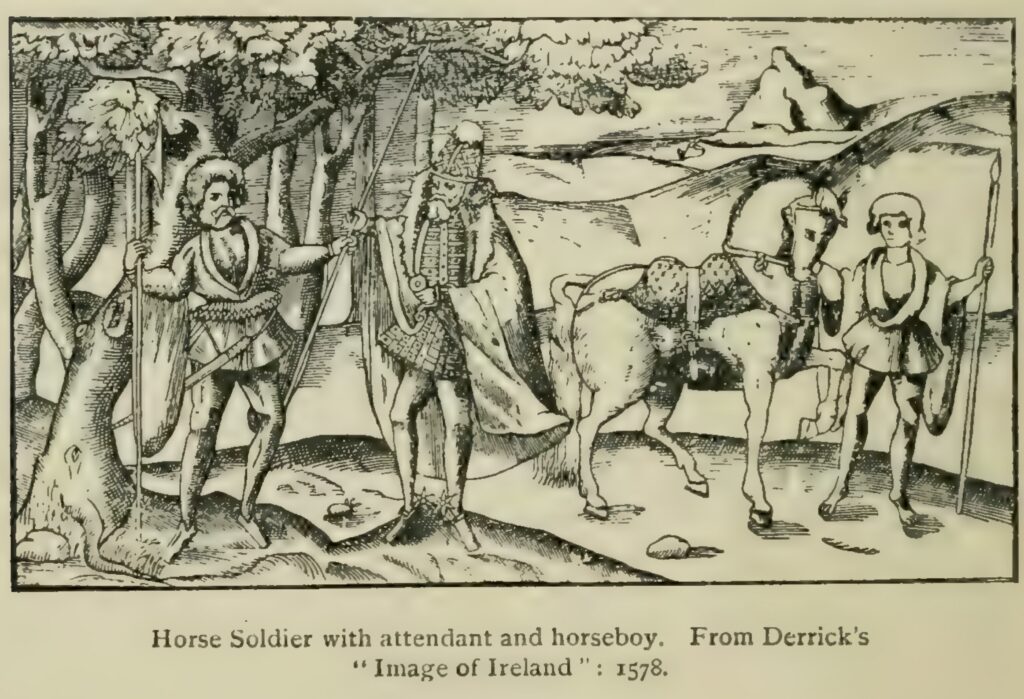
Contemporary evidence shows horseboys accompanying mounted soldiers and their attendants in the field. John Derricke’s The Image of Irelande of 1578 depicts a horse soldier with both an attendant and a horseboy beside him, placing the horseboy within the working entourage of the mounted man rather than back at some distant stable. Owen’s occupation therefore fits naturally within the mobile world of gentlemen, mounted retainers and military households in late sixteenth-century Ireland.
The fiant does not tell us whose horse Owen tended. Peter Carroll is explicitly called Oliver Plunkett’s servant, while Owen is simply described as a horseboy. He may have served Oliver, one of the Eustaces or another mounted man associated with the group.
That uncertainty should remain.
But the occupation itself opens an intriguing possibility.
If some Ó Maol Phádraig families had spent generations living and working around ecclesiastical estates, perhaps practical skills acquired in that environment survived the Dissolution and became part of the way those families adapted to the new political order. Horse rearing and horse management would have been particularly transferable. The same knowledge could serve a religious estate in one generation, a landed household in another, and a military retinue in another.
That remains a hypothesis, not a demonstrated family occupation.
Yet it fits something already visible in the records. Nicholas and Charles Ó Maol Phádraig appear within a former Hospitaller estate in 1541. Cathal Bán Ó Maol Phádraig later appears as a husbandman at Dunaree, only a short distance from the old Kilmainhamwood and Shancor landscape. Then, in 1599, Owen Ó Maol Phádraig appears in Meath with a very specific practical occupation involving one of the most valuable commodities in Irish society.
Perhaps those records have nothing more in common than geography and surname.
But perhaps they preserve glimpses of how a family once associated with church-land communities continued to make itself useful after the institutions around it had disappeared.
Fiant 6271 cannot prove that.
What it does give us is something unusually tangible.
For the first time in these records, an Ó Maol Phádraig man is identified not simply by where he lived or whose pardon contained him, but by a skill.
And that skill placed him in exactly the kind of mobile world becoming increasingly important as the Nine Years’ War spread across Ireland.
The identity of the men around Owen and the reason they were pardoned together remain partly unresolved. The connection to the Geraldine rebellion is suggestive and, in Christopher Eustace’s case, becomes considerably stronger when the later records are followed. The relationship between the distant Meath and Kildare elements of the pardon is still unclear.
But Owen’s occupation gives Fiant 6271 a different kind of importance.
In 1541 the Ó Maol Phádraig story had shown men standing on former church land as the old ecclesiastical order was being dismantled.
Nearly sixty years later, in the middle of a national war, another Ó Maol Phádraig appears caring for horses.
Whether those two worlds were connected cannot yet be proven.
But in sixteenth-century Ireland, knowing horses was knowledge worth carrying forward.
References
Fitzpatrick, Mike, and Mike Fitzpatrick. “Ó Maol Phádraig: the Name, the People, and the Clans. Part III.” Journal of the Fitzpatrick Clan Society, vol. 6, 2025, pp. 27–41.
White, Newport B., ed. Extents of Irish Monastic Possessions, 1540–1541. Irish Manuscripts Commission.
Ireland Public Record Office. Seventeenth Report of the Deputy Keeper of the Public Records in Ireland. Dublin, 1885. Fiant 6271.
Hogan, Edmund. The Description of Ireland and the State Thereof as It Is at This Present in Anno 1598. Dublin, 1878.
Derricke, John. The Image of Irelande. 1578.
Atkinson, Ernest George, ed. Calendar of the State Papers Relating to Ireland, 1598–1599. London: Her Majesty’s Stationery Office, 1895.