
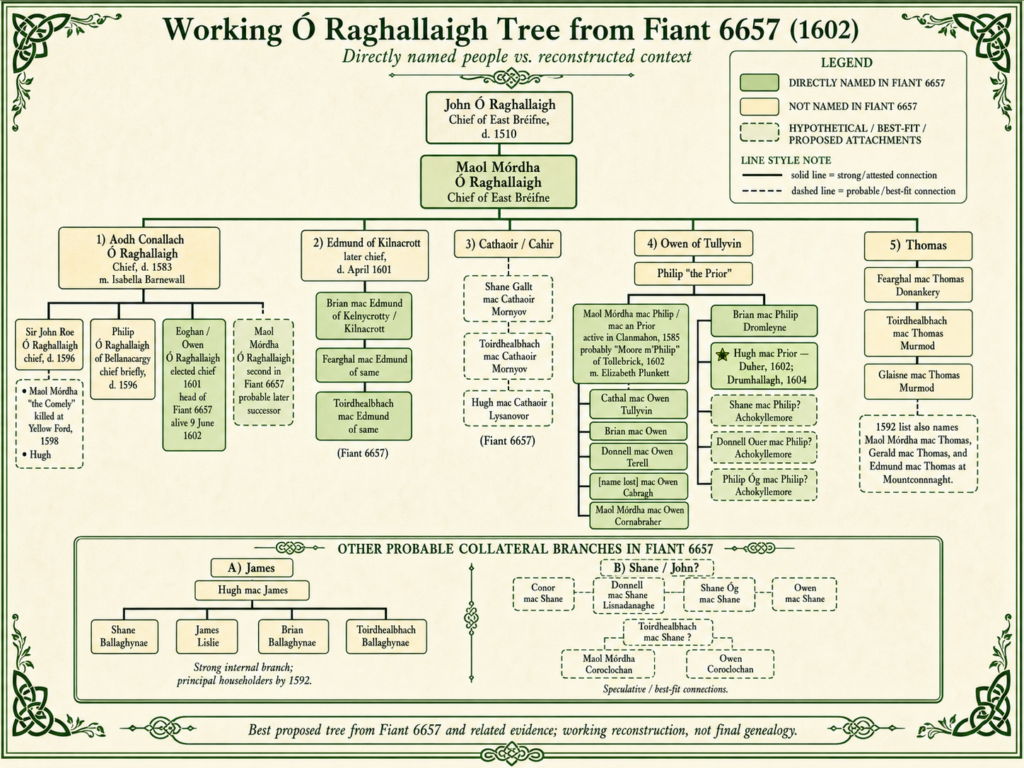
By June 1602 East Bréifne had been at war, internally divided and under increasing Crown pressure for almost a generation. The old Ó Raghallaigh lordship still existed, but the family at its head had been repeatedly fractured by disputes over succession, competing territorial branches and the intervention of Dublin government. The Nine Years’ War had intensified all of those divisions.
Sir John Roe Ó Raghallaigh died in 1596. Philip Ó Raghallaigh of Bellanacargy, his brother and rival, briefly succeeded him and died in the same year. Edmund of Kilnacrott later emerged as chief but died in April 1601. By the following year Eoghan Ó Raghallaigh had been accepted as chief. His authority rested over a family which was anything but a single household. The Ó Raghallaigh had spread through the baronies and estates of Cavan in numerous powerful branches, each with its own lands, dependants and political interests.
Fiant 6657 brings a remarkable number of those branches together.
The enrolled date of the pardon has been lost, but the Lord Deputy’s warrant survives, dated 9 June 1602. It opens with:
“Owen O Reyly, of Cavan, chief of his name.”
Close examination of the patronymics makes it possible to reconstruct a considerable portion of the ruling family. Not every connection can be made with certainty, but enough can be established to reveal the character of the gathering. These were not simply miscellaneous O’Reillys from around County Cavan.
The family of Edmund of Kilnacrott, chief until his death the previous year, appears to be represented by Brian, Fearghal and Toirdhealbhach mac Edmund, all associated with the same Kilnacrott residence. Another group belongs to the family of Owen of Tullyvin, an important older branch of the ruling dynasty. Around Tullyvin itself are Cathal mac Owen and several probable brothers, with nearby residences at Cabragh and Cornabraher. Philip “the Prior,” son of Owen and uncle of Sir John Roe, produced another powerful line, represented in or closely connected with the pardon by Maol Mórdha mac Philip, Brian mac Philip and Hugh mac Prior.
Other identifiable families occur farther east and south. Fearghal mac Thomas appears at Donankery, while Toirdhealbhach and Glaisne mac Thomas are at Murmod in the Castlerahan area. Their identity as substantial householders is independently supported by records from 1592. The Ballaghanea branch, descended through James and Hugh, also reappears in the fiant and had likewise been recorded among principal householders before the war.
Farther north and east the pardon reaches into Clankee, while the Tullyvin, Cabragh and Cornabraher group belongs in Tullygarvey. Murmod, Dunancory and Ballaghanea draw another concentration into Castlerahan. Kilnacrott represents another great branch. Other Ó Raghallaigh appear across the county and beyond it.
The picture is therefore not of one local military company. It is closer to a political cross-section of East Bréifne itself, with the reigning chief surrounded by men from many of the principal houses which had divided the Ó Raghallaigh lordship among themselves.
That becomes important when another chief appears in the middle of the record.
The Ó Raghallaigh gathering
The scale of these families becomes even clearer when the settlement that followed the war is considered.
Within a few years the Crown would destroy the old legal basis of Ó Raghallaigh lordship and reorganize Cavan through the Plantation. Yet it did not eliminate the native ruling family. Selected Ó Raghallaigh were brought back into the new system as Crown grantees.
Among the grants subsequently made to native Ó Raghallaigh proprietors were approximately:
1,000 acres in Tullygarvey to Maol Mórdha mac Philip Ó Raghallaigh;
3,000 acres in Tullygarvey to another Maol Mórdha Ó Raghallaigh;
900 acres in Castlerahan to Shane mac Philip Ó Raghallaigh;
2,000 acres in Clanmahon to Maol Mórdha mac Hugh Ó Raghallaigh;
300 acres in Clanmahon to Philip mac Toirdhealbhach Ó Raghallaigh.
Together these particular grants amount to about 7,200 Plantation acres.
They should not be confused with a restoration of the old Ó Raghallaigh kingdom. The Crown had transformed the legal basis upon which the land was held. But the scale is revealing. Men belonging to the same broad political society visible in Fiant 6657 remained substantial landholders after the war, spread through Tullygarvey, Castlerahan and Clanmahon.
Those estates also required people.
Thousands of acres could not be worked by the grantee and his immediate family. There had to be farmers, graziers, herdsmen, labourers, household servants and smaller tenants beneath them. Yet the names of those people are precisely what the surviving records so often fail to preserve. Later Plantation observers complained that some native proprietors had made no formal estates to their tenants, while others continued with much less formal arrangements. The older economic relationships between lord and dependent population did not disappear simply because a Crown patent had replaced Gaelic title.
This documentary silence is particularly important for the Ó Maol Phádraig. If families of that name occupied small farms on Ó Raghallaigh land, most would have had no reason to appear in the surviving grant itself. The record preserves the man holding a thousand acres while remaining silent about the many households actually making their lives upon it.
There is therefore a population beneath the Ó Raghallaigh names in Fiant 6657 that we can reasonably assume existed but cannot enumerate.
And then, among the men who are named, appears:
“Conor O Molpatrick, chief of his name.”
Part III already recognized the importance of this wording and treated it as evidence for a distinct Bréifne clann Uí Mhaol Phádraig closely associated with the Ó Raghallaigh. The deeper examination of the fiant now sharpens that observation considerably, because we can see much more clearly the company in which Conchobhar was being recorded.
He was standing inside the political world of the ruling family of East Bréifne.
A note on Hugh mac Prior and “Duher”
Fiant 6657 records Hugh mac Prior Ó Raghallaigh “of Duher.” Part III identified this place with An Damhshraith, Dowra, but that now looks less certain than it first appeared. The spelling is not especially close, and the Ó Raghallaigh are not otherwise strongly associated with Dowra in the records being followed here.
There is also a useful later reference to the same man. In 1604 Hugh mac Prior Ó Raghallaigh appears at Drumhallagh, in the Crosserlough/Castlerahan area. That does not prove that Duher was somewhere nearby, nor does it rule out his having held land elsewhere, but it is enough to make a firm identification with Dowra uncomfortable.
The fiants contain many place-names of this sort: local or descriptive names such as “the Derry,” “the parish,” and other labels whose exact modern location is difficult or impossible to recover. Duher may belong to that same category. It is therefore better left unidentified for now rather than treated as secure evidence for an Ó Raghallaigh presence at Dowra.
This does not affect the later Ó Maol Phádraig evidence for “The Dower,” which stands independently. The point is simply that Hugh mac Prior should not be used to strengthen that identification unless another record eventually connects his Duher with Dowra.
What kind of chief was Conchobhar?
There is no evidence that Conchobhar Ó Maol Phádraig ruled an independent territory comparable with those of the great Gaelic dynasties. No Ó Maol Phádraig castle has emerged from the record, no defined Cavan lordship can be assigned to the family, and nothing in Fiant 6657 requires one.
The phrase “chief of his name” says something different.
The government clerk understood Conchobhar to be the recognized head of a group bearing the Ó Maol Phádraig name. It identifies him through the people he represented rather than through an occupation. For the designation to have practical meaning there had to be a recognizable body of Ó Maol Phádraig among whom one man could stand as the senior representative.
How large that body was cannot be recovered.
It almost certainly was not enormous. There is no plausible demographic model in which a thousand Ó Maol Phádraig fighting men were living in Cavan around 1600. Such a population would imply several thousand members of the family and would have made them one of the overwhelmingly dominant populations of the county. Their documentary footprint would be entirely different.
At the other extreme, Conchobhar need not have represented only a handful of families.
A working model of perhaps forty to sixty households demonstrates the scale required. At perhaps five or six people in a household, that could mean roughly two hundred to three hundred people, with perhaps fifty to one hundred adult men scattered among several Ó Raghallaigh estates. These are not historical counts and should never be presented as such. They are a plausibility test.
The test works.
Such a population could be spread across thousands of acres of Ó Raghallaigh land without occupying more than a modest proportion of the available farms. It would be large enough for the surname-group to be visible socially but small enough for most of its members to vanish completely from the surviving administrative records.
The later demographic evidence points in the same direction without proving continuity household by household. By 1901 there were about 1,200 Fitzpatricks in County Cavan, placing the surname among the substantial native surname populations of the county. The increase required to get from a few hundred people around 1600 to that nineteenth-century population is entirely unremarkable over three centuries, particularly after allowing for migration and emigration.
The numbers therefore neither prove nor strain the model. They simply show that a modest but significant Ó Maol Phádraig population in 1602 is perfectly compatible with what is seen later.
Conchobhar could consequently have been chief of a group which was numerically useful without being territorially dominant.
That distinction may explain his position remarkably well.
A different Ó Maol Phádraig world
There is no need in this post to go back through the full medieval history of the family. By 1602 something much more immediate can be seen.
The northern Ó Maol Phádraig of the later sixteenth century were already appearing within the political networks surrounding the Ó Raghallaigh. Fiant 4908 places Cathal Bán Ó Maol Phádraig, a husbandman of Dunaree, among followers of an Ó Raghallaigh gentleman. In 1593 Muircheartach Ó Maol Phádraig appears in the pardon headed by Philip Ó Raghallaigh of Bellanacargy. Part III places An Críonach, his residence, in either Drumlane or Annagh in Loughtee.
By 1602 the relationship appears more developed. Conchobhar is no longer identified as merely another follower. He has a standing of his own.
This may represent a profound change in the way the family functioned.
Earlier generations of Ó Maol Phádraig had existed in a world in which church lands, ecclesiastical institutions and hereditary service relationships provided much of the framework through which families could possess status and employment. By the end of the sixteenth century that framework had been battered by the Dissolution, the redistribution of church property and decades of political upheaval.
The Ó Maol Phádraig did not disappear with it.
Instead, the surviving northern family increasingly appears inside the secular lordship of the Ó Raghallaigh: farming their land, serving among their followers, moving through their political networks and sharing their wars.
Fiant 6657 may be the record in which that transformation finally becomes visible in the terminology used for the family itself.
Conchobhar is chief of his name.
The designation may have formalized something that had previously needed no such expression. A family whose older cohesion could be maintained through church, land and hereditary service now existed within another political structure. Recognition of a senior Ó Maol Phádraig gave that population a voice within the larger Ó Raghallaigh world.
Conchobhar may have been the man through whom the chief dealt with them.
His own residence is frustratingly absent. Somewhere around the political centre of the Ó Raghallaigh lordship — perhaps in the broad Cavan town, Loughtee and Drumlane country — remains an attractive possibility, particularly given the later distribution of the family and the earlier Loughtee connection. It cannot presently be proved. Nor can the size or nature of his holding.
Yet someone carrying this title among these men was unlikely to be socially insignificant. A substantial customary tenancy, responsibility for other households, estate service or simply seniority within a respected local line would all fit the evidence.
There was also a harder edge to such relationships in 1602. The Ó Raghallaigh did not merely require rents and cattle from the populations beneath them. For decades they had required men.
The fiants of the Nine Years’ War repeatedly show how Gaelic power was assembled: major lords at the top, lesser families and principal householders beneath them, and then the tenants, horsemen, kern and followers who could be called when political loyalty became military service. Fifty adult men belonging to one dependent surname-group would not constitute an army, but they would certainly constitute something worth keeping loyal.
Conchobhar may therefore have represented more than family prestige. He may have represented capacity.
He knew the Ó Maol Phádraig households. He stood among the Ó Raghallaigh. If obligations had to be collected, disputes carried upward, loyalty maintained or men gathered, a recognized senior representative offered an obvious point through which those relationships could operate.
That interpretation cannot be read directly from the wording of the fiant, but neither does it require an invented Ó Maol Phádraig kingdom. It grows naturally from the political society visible in the record.
What Fiant 6657 may be showing
The striking feature of this pardon is not simply that two men are called chiefs.
It is the contrast between them.
Eoghan Ó Raghallaigh stood at the head of one of Ireland’s great surviving Gaelic dynasties. Around him were the Kilnacrott family, the Tullyvin and mac an Prior lines, substantial Castlerahan houses and numerous other Ó Raghallaigh whose families held land across Cavan. The years immediately following the war would leave selected members of that same society holding more than 7,000 acres of newly defined Crown grants in just the group examined here. Their political system had been defeated, but the people and much of the social structure beneath it remained.
Conchobhar Ó Maol Phádraig belonged to another scale of society altogether. Nothing suggests that he possessed an equivalent territory or wealth. Yet the record chooses to describe him using the same concept of corporate kinship: chief of his name.
Perhaps that is precisely the point.
The Ó Maol Phádraig no longer appear here primarily as a family defined by an attachment to the church. The institutions that had once provided a natural home for learned and service families were disappearing or had already been transformed. In East Bréifne the Ó Maol Phádraig had instead become firmly bound into the Ó Raghallaigh world.
They had farms to maintain, patrons to follow, families to protect and, during the years of war, men who could be called upon.
How many cannot be known. Their landlords frequently left exactly the sort of tenant population we would most like to identify outside the written record, and the later Plantation documentation often records the proprietor while passing almost silently over the Irish households beneath him. The absence of a long list of Ó Maol Phádraig farmers should therefore not be mistaken for their absence from the land.
Fiant 6657 allows one of those otherwise obscure populations to surface for a moment through the man who represented it.
Conchobhar need not have been chief of every Ó Maol Phádraig in Ireland, nor even necessarily of every branch carrying the name in Bréifne. The record does not tell us the limits of his authority. What it does tell us is that in the political world surrounding the chief of East Bréifne there existed a recognized clann Uí Mhaol Phádraig, and Conchobhar stood at its head.
A century earlier the family may have required no such secular representative to explain its place in society. In 1602 it apparently did.
The transition is difficult to document because most of the people involved were precisely the sort whom Tudor and early Stuart records rarely named. Fiant 6657 happens to catch their senior man at the top rather than their farmers at the bottom. For a family whose later history in Cavan would be dominated by small holdings and tenancy, that brief appearance is unusually revealing.
By the end of the Nine Years’ War the Ó Maol Phádraig of East Bréifne were no longer simply remnants of an older church-associated service family. They had become a clan within the Ó Raghallaigh order, sufficiently coherent to possess a recognized chief and sufficiently numerous to have weight within that society. In the violent political world of 1602, they were very likely numerous enough to supply useful men when the Ó Raghallaigh required them.
Conchobhar stood where those two worlds met: the senior man of his own name and a recognized figure within the political order of East Bréifne.
Fiant 6657 is the moment the surviving record allows us to see him there.
References
Ireland Public Record Office. Eighteenth Report of the Deputy Keeper of the Public Records in Ireland. Dublin: Queen’s Printing Office, 1886, pp. 82–85. Fiant 6657.
Ireland Public Record Office. Fifteenth Report of the Deputy Keeper of the Public Records in Ireland. Dublin: Her Majesty’s Printing Office, 1883. Fiant 4908.
Ireland Public Record Office. Sixteenth Report of the Deputy Keeper of the Public Records in Ireland. Dublin: Her Majesty’s Printing Office, 1884. Fiant 5792.
Fitzpatrick, M. and Fitzpatrick, M. “Ó Maol Phádraig: the Name, the People, and the Clans, Part III.” The Journal of the Fitzpatrick Clan Society 6, 2025, 27–41.
O’Donovan, John. “The O’Reillys at Home and Abroad.” Hibernian Magazine 2, 1861, 37–42.
Farrell, Gerard. The ‘Mere Irish’ and the Colonisation of Ulster, 1570–1641. 2017.