
6 May 1601
Some records reveal their importance immediately. Others only begin to make sense after months of work elsewhere. Fiant 6505 was one of those records. On the first reading it looked almost hopelessly broad, an enormous pardon headed by John Bourke of Brittas, County Limerick, followed by a long procession of people scattered across Limerick and beyond. Gentlemen, yeomen, husbandmen, widows, smiths, surgeons and others appear from Brittas, Ballinard, Askeaton, Ardagh, Any, Bruff, Knocklong, Adare, Bruree, Doon and numerous smaller places. Buried among them is one Ó Maol Phádraig: Teige mac Diarmaid Ó Maol Phádraig of Bruff, husbandman, immediately followed by Donogh O’Flynn and William Óg Nash, also of Bruff.
There was little about that entry that initially demanded attention. Bruff meant little to me at the time and, in a pardon containing so many people and places, Teige looked like another isolated Ó Maol Phádraig occurrence to add to the growing list. That is where returning to records becomes important. Months of working through the fiants, papal registers, church histories, genealogies and place-names changes the way the same document reads. A surname that passed unnoticed six months earlier may now be recognizable as a hereditary learned family. A townland that looked insignificant may suddenly sit beside a medieval monastery or manor already encountered elsewhere. Families that originally seemed unrelated begin appearing repeatedly in one another’s company. There is a real advantage in occasionally starting again and reading the same material from the beginning, because the third, fourth or fifth pass through a record set can be far more productive than the first. The document has not changed; the accumulated research has changed what can be recognized.
Fiant 6505 is a good example. While putting this post together and reviewing earlier notes, I also followed a habit that has occasionally paid off: read the patent immediately before the one being studied. Sometimes there is no connection at all. This time there was something difficult to overlook. Fiant 6504, dated 5 May 1601, contains “Moilen O Mulconnerie, cronickler” — Maoilín Ó Maolchonaire. That one line changed the direction of the investigation.
The scale of Fiant 6505 makes more sense when placed in May 1601. Munster was in the final phase of the Nine Years’ War, and Crown government was trying to restore control, detach people from remaining rebel networks and regularize large numbers who had become caught up in years of rebellion and political disorder. Fiant 6505 therefore looks less like the pardon of one coherent company than part of the wider machinery of submission and pacification. John Bourke of Brittas heads the document, but the patent ranges too widely geographically and socially to make every person who follows one of his retainers. What is more useful are the smaller local groups preserved within it, and the Bruff entry is one of those. The wording places Teige Ó Maol Phádraig, Donogh O’Flynn and William Óg Nash together at Bruff, giving us a genuine local cluster inside the much larger pardon.
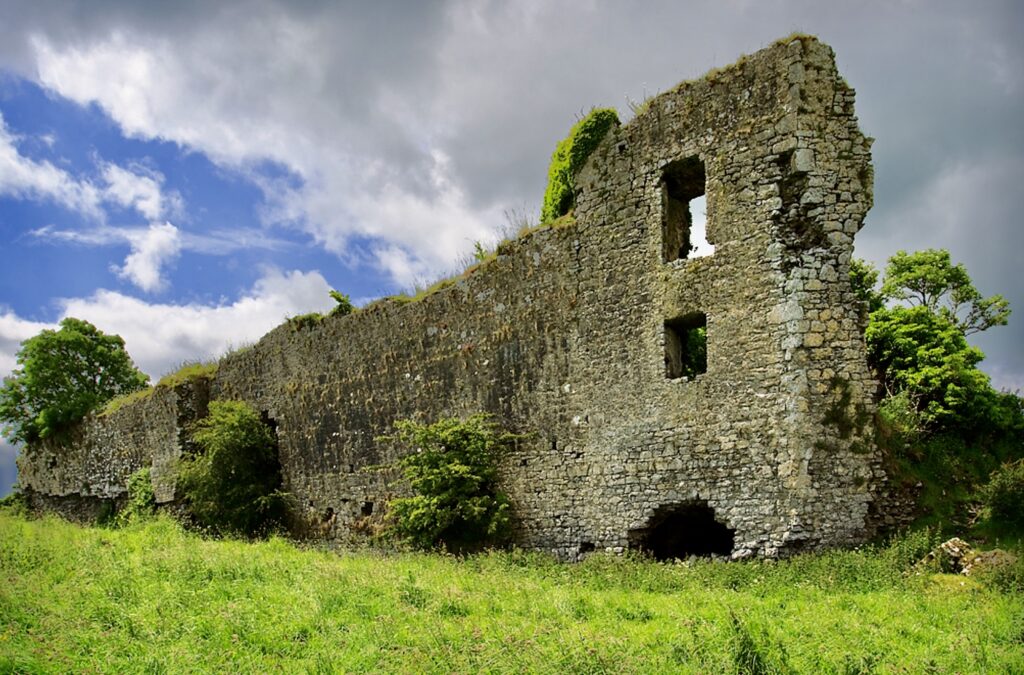
Once Bruff itself was investigated, the entry became much more interesting. Bruff stood within an unusually dense medieval ecclesiastical and manorial landscape. Its own church belonged to the orbit of the Hospitaller establishment at Any, or modern Hospital, but nearby churches followed entirely different lines of patronage. Within a relatively small area were Dromin, Athlacca, Glenogra, Uregare, Tullabracky, Camus and several smaller ecclesiastical sites, involving the Earl of Kildare, the Augustinian Canons of Athassel, Monasteranenagh, the cathedral chapter of Limerick and other institutions. The most interesting place proved to be Glenogra, only a few miles from Bruff. Glenogra had been a substantial FitzGerald manor and administrative centre. The Desmond FitzGeralds held it within the wider Kildare FitzGerald manorial structure centred on Athlacca, while its rectory belonged to Athassel Priory and the Canons Regular of St Augustine. In one small district, therefore, FitzGerald secular lordship and Augustinian ecclesiastical administration overlapped.
Bruff added another layer through the de Lacy family. Piers de Lacy appears in the Tudor records as a gentleman of Bruff and became deeply involved in the warfare engulfing Munster at the end of Elizabeth’s reign. The de Lacy presence at Bruff belonged to the wider Desmond political world, so Teige Ó Maol Phádraig was living directly inside the remains of an older FitzGerald, de Lacy and ecclesiastical landscape.
Maoilín Ó Maolchonaire in Fiant 6504 cannot be placed at Bruff because his residence is omitted, but he occurs in the Limerick section of the pardon, among identifiable places including Carrigogunnell and Ballingarry. The two records therefore give us neighbouring rather than identical Limerick groups: Maoilín Ó Maolchonaire in Fiant 6504 on 5 May 1601, followed the next day by Teige mac Diarmaid Ó Maol Phádraig at Bruff in Fiant 6505. The principal identifiable concentrations lie roughly 20–25 kilometres apart, with parts of the two geographical spreads closer still, while Bruff itself lies only a few miles from Glenogra and Athlacca. The value of the preceding patent is therefore not that it places Maoilín and Teige together, but that it shows an Ó Maolchonaire learned man active in the neighbouring Limerick world at virtually the same moment.
That becomes much more interesting once the history of Ó Maolchonaire is brought back into the picture. One earlier member of the family provides a particularly useful comparison. Maoilín mac Torna Ó Maolchonaire, who died in 1519, was an ollamh, the highest professional grade within the learned order, and the annalistic tradition says that the Geraldines had selected him as their ollamh. That gives the Ó Maolchonaire–Geraldine relationship real depth.
There is also a revealing episode much closer to 1601. In 1589, Conaire Ó Maolchonaire of Ardkyle in Thomond complained to Donough O’Brien after being arrested and forced to seek a pardon, arguing in effect that the English administration did not properly understand the family’s profession. His defence emphasized that the Ó Maolchonaire occupation was one of chronicling and historical learning, not simply the suspect activity of wandering poets and rhymers. Only twelve years later, the clerk responsible for Fiant 6504 describes Maoilín in the simplest possible English term: “cronickler.” That description is therefore not incidental. It identifies him as a surviving practitioner of the hereditary profession the family had been defending only a few years earlier.
The southern history of the family goes back considerably further. The 2012 Archaeological Survey of Ballinskelligs Abbey and Graveyard, prepared for Kerry County Council by Daire and Laurence Dunne, summarizes a remarkable episode in the history of the Augustinian house there. Drawing on earlier work by Hayward and Barrington, the survey states that the Ó Maolchonaire of Connacht had been brought south as bards for the MacCarthys. They did not remain simply visiting scholars. Alan Ó Maolchonaire was prior of Ballinskelligs in 1411; Maurice Ó Maolchonaire was sent by the priory to Oxford to study Canon Law in 1455; John Ó Maolchonaire later held the priorship; and the family subsequently recovered the office after difficulties surrounding his tenure. The survey describes them as effectively dynastic priors for almost the entire fifteenth century, with Thaddeus Ó Maolchonaire appointed prior in 1506. Ballinskelligs itself belonged to the Arroasian branch of the Canons Regular of St Augustine, and the community was still functioning there in 1555.
This provides something extremely valuable for understanding the later records because it demonstrates an actual mechanism. A hereditary learned family originating in Connacht could be brought into Munster through MacCarthy patronage, establish itself permanently in the south and become deeply embedded within an Augustinian religious institution. This was not a theoretical possibility inferred from the Tudor fiants; it actually happened.
The same archaeological survey recorded the later burial population of Ballinskelligs Abbey and graveyard. Among the named burials are MacCarthy, Barry and Fitzpatrick, while ten separate headstones carry the surname King. The concentration of King burials is particularly intriguing because of the long medieval Ó Maolchonaire presence at the site. The possibility that at least some of those Kings represent descendants of the old Ó Maolchonaire population remains a working hypothesis, but it becomes harder to dismiss when considered alongside the rest of the burial population. The old institution had disappeared, yet MacCarthy, Barry and Fitzpatrick remained in the graveyard, and the family that had virtually dominated the medieval priorship may also have remained under a changed surname form.
Seen against Ballinskelligs, the Tudor records begin to form a recognizable southern pattern. In Cork and Kerry the recurring sequence is Ó Maol Phádraig → Ó Maolchonaire → MacCarthy → Barry. Ballinskelligs supplies the older background: Ó Maolchonaire brought south through MacCarthy patronage and established within an Augustinian institution. Later Tudor records place Ó Maol Phádraig directly within the MacCarthy world and subsequently within the Barry–Condon network. Limerick presents another version of the same pattern: Ó Maolchonaire → FitzGerald/Desmond → Glenogra and its Augustinian setting → de Lacy/Bruff → Ó Maol Phádraig. Again, Ó Maolchonaire sits close to the centre of the pattern.
This is particularly interesting because the FitzGerald connection does not have to be inferred from Fiant 6504. The earlier Maoilín Ó Maolchonaire had actually been chosen as an ollamh by the Geraldines, while other members of the family preserved the history and genealogy of the Earls of Desmond. Glenogra therefore belonged directly inside a lordship whose history Ó Maolchonaire specialists were professionally employed to remember, and Bruff lay only a few miles away.
That may be where the real significance of Fiants 6504 and 6505 lies. Before the Dissolution, Munster was supported by overlapping networks of monasteries, parish benefices, aristocratic lordships and hereditary professional families. Ballinskelligs shows how thoroughly a learned family could become woven into such a structure. By 1601 much of that institutional world had been dismantled. The monasteries had been dissolved, the Desmond lordship destroyed, church lands redistributed and the Nine Years’ War was tearing apart what remained of the old political order. Yet the people and families produced by that world were still there.
Maoilín Ó Maolchonaire appears in the records carrying a professional identity that reached back through generations of his family. The following day Teige Ó Maol Phádraig appears at Bruff, living among the remnants of another old FitzGerald and ecclesiastical landscape. Perhaps that is what these pardons preserve: not the institutions themselves, but some of the families that once operated within them. Ó Maolchonaire provides the clearest example because we know what their function had been. The much harder question is what role Ó Maol Phádraig may once have occupied. By the Tudor period members of the family appear in several lay roles — farming, tenancy, military service and association with different lordships — and it is possible that whatever earlier function bound them to these church and learned-family networks had changed long before English clerks began recording them in detail.
Fiant 6505 certainly did not suggest any of this on the first reading. It took months of research elsewhere before Bruff meant something, before the FitzGerald and Augustinian landscape around Glenogra became recognizable, before Ó Maolchonaire stood out immediately, and before a single description — “cronickler” — carried the historical weight it deserved. Then reading one patent backwards opened the whole thing up.
That is probably the most useful lesson from this record. Genealogical and historical research is cumulative. Returning to material already read is not necessarily repeating old work. Six months later the reader may know hundreds of names, places and relationships that were invisible the first time through. Sometimes the fifth reading is the one that matters.
References
Calendar of the Fiants of the Reign of Queen Elizabeth, Fiants 6504 and 6505.
Dunne, Daire and Laurence Dunne. Archaeological Survey, Ballinskelligs Abbey and Graveyard, Ballinskelligs, Waterville, Co. Kerry. Kerry County Council, 2012.
Begley, John. The Diocese of Limerick, Ancient and Medieval.
Ó Dálaigh, Brian. “The Uí Mhaoilchonaire of Thomond.” Studia Hibernica, no. 35, 2008–2009.
McInerney, Luke. “A Sixteenth-Century Bardic Poem Composed for Seán Mac Conmara, Lord of West Clann Chuiléin.” Seanchas Ard Mhacha.
O’Rahilly, T. F. Irish Poets, Historians, and Judges in English Documents, 1538–1615.
Annals of the Kingdom of Ireland, entry for 1519 concerning Maoilín mac Torna Ó Maolchonaire.
British Library, Additional MS 30512, Ó Maolchonaire and FitzGerald historical material.