
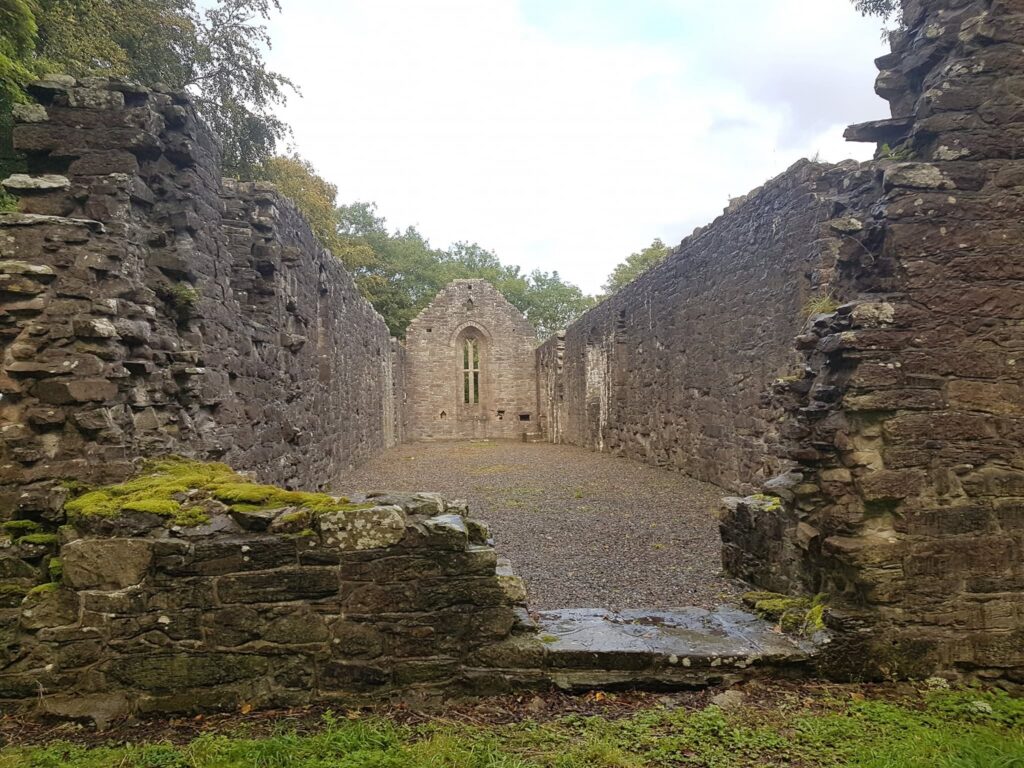
Clarus Mac Mailín Ó Maolchonaire was one of the most powerful Irish churchmen of the thirteenth century. He was Archdeacon of Elphin, a leading figure among the Premonstratensians, a founder of churches and monasteries, a diplomat trusted across political divisions, and a member of one of the principal learned families of medieval Connacht.
His career unfolded during a period of rapid change. The diocesan structure of the Irish Church was still developing after the reform synods of the twelfth century. New religious orders were becoming established. Gaelic dynasties were adapting to Anglo-Norman expansion, while hereditary church and learned families were finding positions within the reformed ecclesiastical system.
Clarus stood at the centre of that transformation. He did not abandon the older Gaelic church world in favour of a foreign institution. He used the new structures of the reformed Church to expand an already established ecclesiastical and learned network.
The system he created reached from southern Tirerrill and Loch Cé westward toward Killala and eastward into Bréifne. It included monasteries, rural cells, parish churches, estates, mills, tithes and dependent communities. It also created routes through which canons, administrators, manuscripts and professional families could move between regions that were politically separate but institutionally connected.
An Ó Maolchonaire of the Mac Mailín line
The records normally call him Clarus Mac Mailín. Modern scholarship identifies him more fully as Clarus Mac Mailín Ó Maolchonaire.
The two names probably described different levels of his identity. Ó Maolchonaire connected him to the wider hereditary learned family. Mac Mailín identified his immediate paternal line or branch within it.
The Ó Maolchonaire were closely associated with the Ó Conchobhair kings of Connacht. Later generations became famous as historians, genealogists and custodians of political memory. They were deeply involved in the traditions preserved in the Annals of Connacht, the Annals of Loch Cé and the Book of Fenagh.
Clarus belonged to that learned world, but his career shows that Ó Maolchonaire activity extended far beyond manuscript production. A member of the family could hold senior diocesan office, manage church property, organize a religious order, negotiate with kings and establish institutions across several lordships.
One account describes Clarus as having been born and raised in the Loch Cé district. His father was reportedly erenagh of a church island there. The father later entered religious life, became abbot of Inis Mac Nerinn and was buried at Holy Trinity on Loch Cé.
If that tradition is accurate, Clarus was raised within an ecclesiastical household. His father’s position as erenagh would have placed the family within the administration and economic support of church land. Clarus did not enter the Church as an outsider. He emerged from a family already connected to religious property, learning and local authority.
A second Mac Mailín appears nearby. Magrath Mac Mailín, priest of Kilmactranny, died in 1236. Eamonn Kelly suggested that Magrath may have been a close relative of Clarus, perhaps even a brother.
The relationship is not proven. The shared name, chronology and geography nevertheless make it plausible. Kilmactranny stood within the same south Sligo and Moytura landscape in which Clarus established some of his earliest foundations.
The Mac Mailín line may therefore have possessed an established clerical base around Kilmactranny before Clarus rose to prominence at Loch Cé.
Archdeacon of Elphin
Clarus was Archdeacon of Elphin. He was not bishop of Kilmore, despite a later claim assigning that title to him.
The office of archdeacon placed him among the senior clergy of the diocese. He was involved in administration, discipline, church property and the supervision of clergy. His influence therefore extended beyond any individual monastery.
Clarus combined his diocesan authority with leadership among the Premonstratensians, or White Canons. The Premonstratensians followed the Rule of St Augustine, but they formed a distinct order of Canons Regular. They should not be confused with every house commonly described as Augustinian.
Their religious life combined communal worship with pastoral and administrative work. They were not enclosed monks separated from the surrounding population. Their houses could manage parishes, estates and dependent churches, while their canons could move between foundations.
That structure suited Clarus. It allowed him to join diocesan authority, landed administration and monastic expansion within one system.
Holy Trinity on Loch Cé
A religious community existed on Trinity Island before Clarus. Later accounts place an earlier foundation there centuries before the Premonstratensian period.
Around 1215, the island was reorganized or refounded as a Premonstratensian house dedicated to the Holy Trinity. Clarus became the principal figure in its development.
Holy Trinity stood beside Carraig Mhic Dhiarmada, the Rock of Loch Cé, which served as the principal stronghold of the Mac Diarmada kings of Magh Luirg. The monastery and the royal residence occupied the same concentrated lake landscape.
The relationship was not accidental. Holy Trinity depended upon Mac Diarmada cooperation and patronage, while the dynasty gained a prestigious religious institution beside its political centre.
In 1237 Donnchad, son of Muirchertach Luathshúileach Mac Diarmada, granted land at Loch Cé to Clarus for the use of the Premonstratensian canons. The community was already active by then, so the grant appears to have strengthened or regularized its landed position rather than marking its absolute beginning.
Holy Trinity became the mother house of the network Clarus was building. Its authority extended through dependent cells and later through the daughter house at Loch Oughter.
It also became a political and literary centre. B. W. O’Dwyer argued that some of the vivid contemporary narratives preserved in the Annals of Connacht may have originated at Holy Trinity.
These narratives contain detailed accounts of campaigns, negotiations, deaths and political reversals. Their geography is concentrated around Elphin, Loch Cé, Moylurg and the routes leading through the Curlew Mountains toward Ballysadare. Clarus appears directly in several of them, and the writer gives unusually full attention to Holy Trinity and the politics of the Elphin bishopric.
O’Dwyer proposed Clarus himself as a possible author. The surviving text does not identify him by name as the writer, so the attribution remains a scholarly hypothesis. A cautious conclusion is that the narratives were produced within the Holy Trinity circle and under Clarus’s influence.
The annalistic tradition may have reached Loch Cé from Boyle after the Cistercian crisis of 1228. Boyle had been drawn into reform measures imposed after the Conspiracy of Mellifont. Its affiliation was changed and outside supervision introduced.
The contemporary shift in the Cottonian annals from Boyle material to a clear Holy Trinity perspective suggests that texts, scribes or literary practices moved between the two houses. The physical transfer of monks has not been proven, but a close cultural relationship is evident.
Holy Trinity became a place where Gaelic historical writing could continue within a reformed canonical order. It preserved native political memory while using Latin script and methods influenced by the wider European Church.
The early foundations in Tirerrill
Clarus was building outside Loch Cé before the major land grants of 1237.
In 1232 he established a Holy Trinity foundation at Áth Moighe, later called Athmoy, Killamoy or Killamoye. The site is identified with the ruined church at Foyoges beside the Feorish River.
Áth Moighe stood at a ford on an important north–south route through south Sligo. Its position allowed the canons to serve travellers and the local population while also controlling movement through a strategically useful crossing.
The house was dependent upon Loch Cé. Sources indicate that canons served there in rotation and otherwise resided at the mother house. It may have begun with a larger canonical community before declining into a smaller rural cell.
A rural cell was not simply a chapel. It could contain accommodation for canons and operate as an administrative centre for land, tenants, tithes and agricultural income. The later Killamoy property included the ruined chapel at Foyoges, several divisions of land, tithes and a watermill.
Local tradition preserved Clarus’s name there. A feature marked as a Bishop’s Grave was associated with a figure remembered as “Saint Claurus O’Melia.” The name is almost certainly a distorted memory of Clarus Mac Mailín.
Clarus was not buried at Foyoges. The annals place his grave at Holy Trinity on Loch Cé. The local story probably attached his famous name to the forgotten burial of an earlier churchman. Even so, the tradition shows how firmly his memory remained connected to the site.
Kilross followed in 1233. It became another dependent Holy Trinity cell within Tirerrill. Its surrounding property included land and islands near Lough Gill and later developed into a parish-centred estate.
Clarus’s foundations in southern Tirerrill were later joined by Holy Trinity properties at Shancough, Killadoon and Ummeryroe. Together they formed a concentrated ecclesiastical and landed presence around Geevagh, Kilmacallan and Rathmulpatrick.
At Shancough, Holy Trinity held land adjoining the church. Killadoon was centred upon another medieval church and became part of the Premonstratensian estate. Ummeryroe lay immediately beside Rathmulpatrick.
These were parts of a connected economic and ecclesiastical hinterland serving the mother house at Loch Cé. Churches, farmland, tithes, mills, tenants and dependent properties were administered within one institutional system.
Rathmulpatrick therefore stood inside the immediate operating landscape of Holy Trinity. Families living there would have been surrounded by monastic land, churches and routes connecting the district with Loch Cé.
This gives the early Ó Maol Phádraig setting greater historical substance. Rathmulpatrick was not merely close to Clarus’s foundations. It stood within a landscape later managed through the Loch Cé network.
Protection during the invasion of Connacht
Clarus’s authority became visible during the Anglo-Norman campaign of 1235.
The English army advanced through Connacht and attacked the Mac Diarmada stronghold on the Rock of Loch Cé. The surrounding country was devastated, and the fortress was eventually forced to surrender.
Holy Trinity was treated differently.
Clarus and the canons received protection. The justiciar and leading English commanders visited Trinity Island and prayed there in honour of the Holy Trinity while their forces were attacking the neighbouring Mac Diarmada stronghold.
The episode shows the degree to which Clarus’s religious authority crossed political divisions. He remained connected to the Mac Diarmada dynasty, yet the army attacking their fortress recognized the monastery as a protected sacred institution.
When Anglo-Norman soldiers were later driven from the Rock, they fled to Trinity Island and placed themselves under Clarus’s protection. He arranged their safe departure.
Clarus was therefore more than a passive beneficiary of religious privilege. He acted as mediator and guarantor. His personal protection could make an agreement credible when ordinary promises were insufficient.
A similar role appears in 1247. After fighting at Feda Conmaicne, a foreign garrison refused to withdraw unless Clarus escorted them across the Shannon. Toirdelbach Ó Conchobair went to Trinity Island to bring him to the scene. Clarus accompanied the men and guaranteed their passage.
Gaelic rulers trusted him to carry out the settlement. The departing garrison trusted him with their lives. His ecclesiastical standing had become a form of political power.
Loch Oughter and the movement into Bréifne
Clarus’s greatest eastward expansion came through Cathal Ó Raghallaigh, king of East Bréifne.
In 1237 Cathal granted Trinity Island in Loch Oughter for the establishment of a Premonstratensian daughter house. Construction appears to have begun at that time, while the organized transfer of canons from Loch Cé was recorded in 1250.
The new house connected the mother house at Loch Cé directly with the Ó Raghallaigh kingdom and the Diocese of Kilmore.
Trinity Island at Loch Oughter remained subordinate to Holy Trinity. Its prior was subject to the abbot of Loch Cé, and its personnel belonged to the same institutional system.
A papal record from 1411 shows how that connection worked in practice.
John Ó Sirideáin belonged to the Loch Oughter community. He travelled west to Holy Trinity at Loch Cé, where he received the training and standing required within the order. He then returned east and became prior of Trinity Island in Loch Oughter.
His career preserves the full route:
Loch Oughter to Loch Cé, and then back to Loch Oughter.
A man from the daughter house could be sent to the mother house for formation, education or advancement and then return to govern the community from which he had come.
This is more than a record of one appointment. It shows that the connection created by Clarus remained active for nearly two centuries. Loch Cé was still supplying training, authority and leadership to the Bréifne house long after his death.
The same route could carry more than professed canons. A functioning monastery required clerics, estate officers, servants, tenants, craftsmen, boatmen and messengers. Only a small part of that movement survives in named records, but the Ó Sirideáin case demonstrates that movement between the two regions was built into the institution itself.
Clarus did not merely establish a monastery in Bréifne. He created a continuing channel between the two regions.
The western reach into Killala
Clarus also founded Killeentrynode, remembered as the “little church of the Trinity,” in the Diocese of Killala.
This foundation extended the Holy Trinity network westward into the Killala and Tirawley region. Clarus was therefore operating in three main directions from Loch Cé: into Tirerrill and Sligo, westward toward Killala, and eastward toward Bréifne.
Killeentrynode placed an Ó Maolchonaire-led Premonstratensian foundation inside one of the oldest ecclesiastical landscapes in Connacht. Killala was associated with early Patrician traditions, hereditary church office and the Uí Fhiachrach and Ó Dubhda political world.
Killeentrynode broadens the interpretation of Clarus’s network. He was not merely extending one monastery toward friendly rulers. He was placing Holy Trinity foundations within several different church cultures and political territories.
At Loch Cé he worked beside Mac Diarmada.
At Loch Oughter he worked with Ó Raghallaigh.
At Killala he entered the Uí Fhiachrach and Ó Dubhda ecclesiastical landscape.
Each foundation created a point through which people, property, prayer, information and professional relationships could move.
The Sligo hospital and the limits of influence
Clarus also attempted to establish a Premonstratensian hospital at Sligo.
The precise chronology varies in the surviving accounts. The project was underway by the 1240s, but in 1245 Maurice fitz Gerald diverted the assembled building materials and used them in the construction of Sligo Castle.
The hospital was probably intended to serve travellers, pilgrims, the poor and the sick near the developing settlement of Sligo. It would have carried the Holy Trinity network into an urban and Anglo-Norman frontier environment.
Its failure reveals the limits of Clarus’s authority. He could obtain land from Gaelic kings and secure protection from an invading army, but he could not prevent the justiciar from taking resources for military construction.
The episode also shows that Clarus’s relationship with Anglo-Norman power was not simple. Maurice fitz Gerald could respect his religious standing in one setting and override his interests in another.
The wider Holy Trinity system
Clarus’s obituary credits him with founding or building several establishments dedicated to the Holy Trinity.
The network included Holy Trinity on Loch Cé, Áth Moighe, Kilross, Killeentrynode, Trinity Island on Loch Oughter and Rinn Dúin on Lough Ree. The attempted hospital at Sligo formed part of the same programme of expansion.
The geographical arrangement was deliberate.
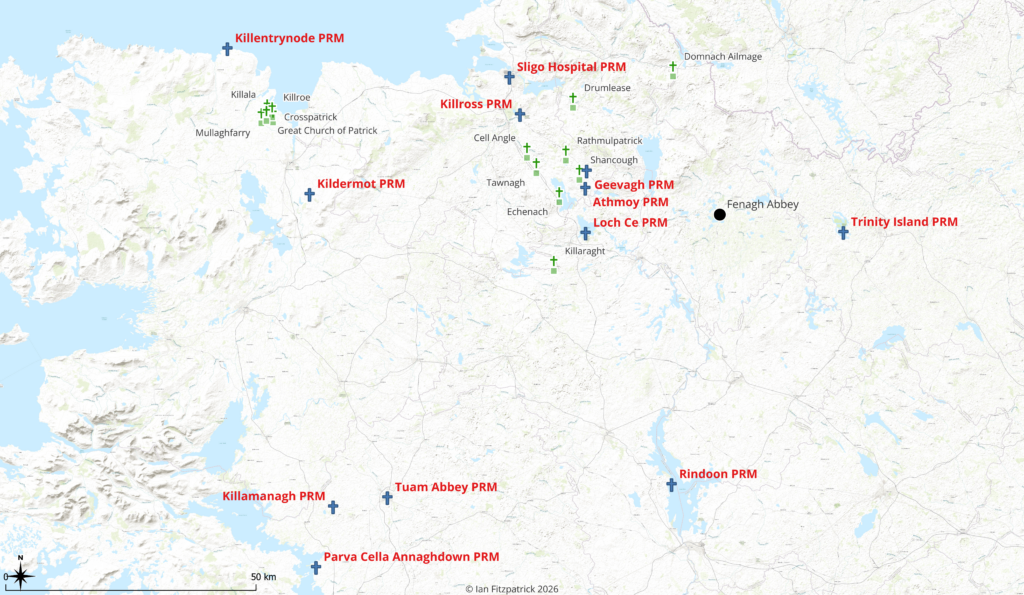
The Premonstratensian churches shown in the southwest of the map, including Tuam Abbey, Killemanagh and Parva Cella Annaghdown, are not attributed to Clarus. They are included to illustrate the wider Premonstratensian presence in Connacht during the same period. It is nevertheless noteworthy that these foundations lay within, or immediately adjacent to, the historic territory of the Conmaicne Mara, highlighting the broader relationship between the White Canons and regions long associated with the Conmaicne peoples.
Loch Cé served as the mother house and institutional centre.
Áth Moighe connected it to the Feorish valley and the routes through southern Tirerrill.
Kilross extended the system toward Lough Gill.
The southern Tirerrill properties connected Holy Trinity to Geevagh, Killadoon, Shancough, Kilmactranny and Rathmulpatrick.
Killeentrynode carried it westward into the Diocese of Killala.
Rinn Dúin placed it on Lough Ree and the Shannon route.
Trinity Island at Loch Oughter carried it eastward into the Ó Raghallaigh kingdom and the Diocese of Kilmore.
The Sligo hospital would have placed it within the growing Anglo-Norman settlement and frontier centre.
These places were joined by waterways, roads, fords, mountain passes and dynastic patronage. The network crossed political frontiers while remaining connected through one religious identity and one institutional centre.
Its mother house supplied authority and personnel. Daughter houses and rural cells extended its reach. Patrons supplied land. Canons administered churches and estates. Routes between the foundations allowed men, messages, manuscripts and resources to circulate.
By the time of Clarus’s death, Holy Trinity had become more than a monastery. It was the centre of a regional religious, economic and political system.
Death and legacy
Clarus died in 1251 at Holy Trinity on Loch Cé. He had chosen the monastery as his burial place.
His obituary is unusually long and reverential. It remembers him as prudent and discerning. It praises his fasting, prayer and patience. It describes him as a defender of the poor and orphans and says that he suffered persecution because of justice or righteousness. The language belongs to the devotional style of a medieval obituary, but its length reflects the stature he had achieved. He was called the venerable founder of monasteries of the Holy Trinity throughout Ireland. That description presents his work as a connected programme rather than a series of unrelated foundations.
His system survived him.
Loch Oughter remained dependent upon Loch Cé. Canons continued to move between the two houses. Mac Diarmada and Mac Donnchadha patrons remained closely associated with Holy Trinity. Rural cells continued to administer lands, churches, mills and tithes.
By the sixteenth century, the temporal estate of Holy Trinity covered roughly 4,000 statute acres. Its wider spiritual estate extended through rectories, vicarages and tithes across a much larger region.
Not every later property belonged to Clarus personally. The estate grew over centuries. The underlying structure, however, had been created during his lifetime.
Clarus and the Ó Maol Phádraig reconstruction
No surviving record names an Ó Maol Phádraig as one of Clarus’s canons. The evidence does not prove that the Ó Maol Phádraig family were Premonstratensians or that Clarus personally transferred them to Loch Oughter.
His importance lies in the institutional setting he created.
Rathmulpatrick stood within the Holy Trinity landscape of southern Tirerrill. The surrounding district contained the dependent properties of Áth Moighe, Shancough, Killadoon and Ummeryroe. A possible Mac Mailín relative served as priest of Kilmactranny. The mother house at Loch Cé controlled a daughter priory in the Ó Raghallaigh kingdom of East Bréifne. A functioning route therefore existed from the Rathmulpatrick and Kilmactranny landscape through the Holy Trinity properties to Loch Cé and onward to Loch Oughter.
The Ó Sirideáin record shows that this route still moved men between the mother and daughter houses two centuries later.
The later appearance of Ó Maol Phádraig in the Kilmore and Ó Raghallaigh world no longer has to be understood as an unexplained movement from a distant homeland. It may reflect participation in an ecclesiastical system that already joined the two regions.
Killeentrynode adds another dimension. Clarus had also carried the Ó Maolchonaire-led network into Killala, where a Máel Pátraic-bearing hereditary church family appears shortly after his death. The significance of that western connection will become clearer later in the wider Ó Maolchonaire and Ó Maol Phádraig story.
The later Ó Maolchonaire and Ó Maol Phádraig overlap at St Michael’s Mount in Kerry occurred within an Augustinian setting rather than a Premonstratensian one. It should not be presented as a direct extension of Clarus’s order.
It does, however, show both families operating within the wider world of Canons Regular, church patronage and long-distance clerical service.
Clarus demonstrates how such movement could happen.
He inherited the standing of a hereditary learned and ecclesiastical family. He entered the reformed Church at its highest regional levels. He secured land from Mac Diarmada and Ó Raghallaigh rulers. He organized canons across several houses. He connected Killala, Tirerrill, Loch Cé, Lough Ree and East Bréifne. He preserved Gaelic historical writing while working inside a continental religious order.
Clarus did not merely found a monastery on Loch Cé.
He built an ecclesiastical world that continued to move people, learning and authority across Connacht and Bréifne long after his death.
References
Primary and medieval sources
Annals of Connacht, edited by A. Martin Freeman. Dublin: Dublin Institute for Advanced Studies.
Annals of Loch Cé, edited by William M. Hennessy. 2 vols. London: Longman, 1871.
Annals of the Kingdom of Ireland by the Four Masters, edited and translated by John O’Donovan. Dublin, 1848–1851.
Calendar of Entries in the Papal Registers Relating to Great Britain and Ireland: Papal Letters. London: His Majesty’s Stationery Office.
Cotton MS Titus A. XXV, British Library. Premonstratensian foundation records relating to Holy Trinity, Loch Cé, Áth Moighe and associated houses.
The Book of Fenagh, edited by W. M. Hennessy and D. H. Kelly. Dublin, 1875.
Modern studies
Clyne, Miriam. “Medieval Loch Cé: Monastery, Landscape and Estate.” Study of Holy Trinity, Loch Cé, its dependent cells, landholdings, rental and regional ecclesiastical network.
Kelly, Eamonn P. “Mythology and Landscape of Sligo, Part 2: The Battle of Moytura and Formaoil na Fiann.” Sligo Field Club Journal 7, 2021.
O’Dwyer, B. W. Study of Clarus Mac Mailín, Holy Trinity at Loch Cé and the origins of the narrative material preserved in the Annals of Connacht.
Ó Scea, Ciaran. “Erenachs, Erenachships and Church Landholding in Gaelic Fermanagh, 1270–1609.” Proceedings of the Royal Irish Academy 112C, 2011, 271–300.
Finan, Thomas. “The Medieval Bishops of Elphin and the Lost Church at Kilteasheen.” In a collection of studies on the medieval Irish Church and Gaelic society.
Earley, Joseph E., and Leonard E. Boyle. “Conflict over the Rectory of Cinel Luachain during the Fifteenth Century.” Breifne 9, no. 35, 1999, 103–113.
Etchingham, Colmán, and Catherine Swift. “Early Irish Church Organisation: The Case of Drumlease and the Book of Armagh.” Breifne 10, no. 37, 2001.
Gwynn, Aubrey, and R. Neville Hadcock. Medieval Religious Houses: Ireland. London: Longman, 1970.
Mooney, Canice. The Church in Gaelic Ireland: Thirteenth to Fifteenth Centuries. Dublin: Gill and Macmillan, 1969.
MacCotter, Paul. Study of the Ó Maolmochéirghe hereditary church family and the rectories of Cenél Luacháin.
Additional regional and genealogical sources
Clyne’s transcription and analysis of the sixteenth-century rental of Holy Trinity, Loch Cé.
The early seventeenth-century inquisitions describing Killamoy, Foyoges, Shancough, Killadoon, Ummeryroe and other former possessions of Holy Trinity.
Extents of Irish Monastic Possessions, 1540–1541.
Mac Fhirbhisigh, Dubhaltach. The Great Book of Irish Genealogies, edited and translated by Nollaig Ó Muraíle. Dublin: De Búrca, 2003–2004.
Fitzpatrick, Ian, and Mike Fitzpatrick. “Ó Maol Phádraig: The Name, the People, and the Clans, Part I.” Journal of the Fitzpatrick Clan Society 4, 2023, 1–10.
Fitzpatrick, Mike, and Proinsias Mag Fhionnghaile. “Ó Maol Phádraig: The Name, the People, and the Clans, Part II.” Journal of the Fitzpatrick Clan Society 5, 2024, 25–42.
Fitzpatrick, Matthew, and Mike Fitzpatrick. “Ó Maol Phádraig: The Name, the People, and the Clans, Part III.” Journal of the Fitzpatrick Clan Society 6, 2025, 27–41.