
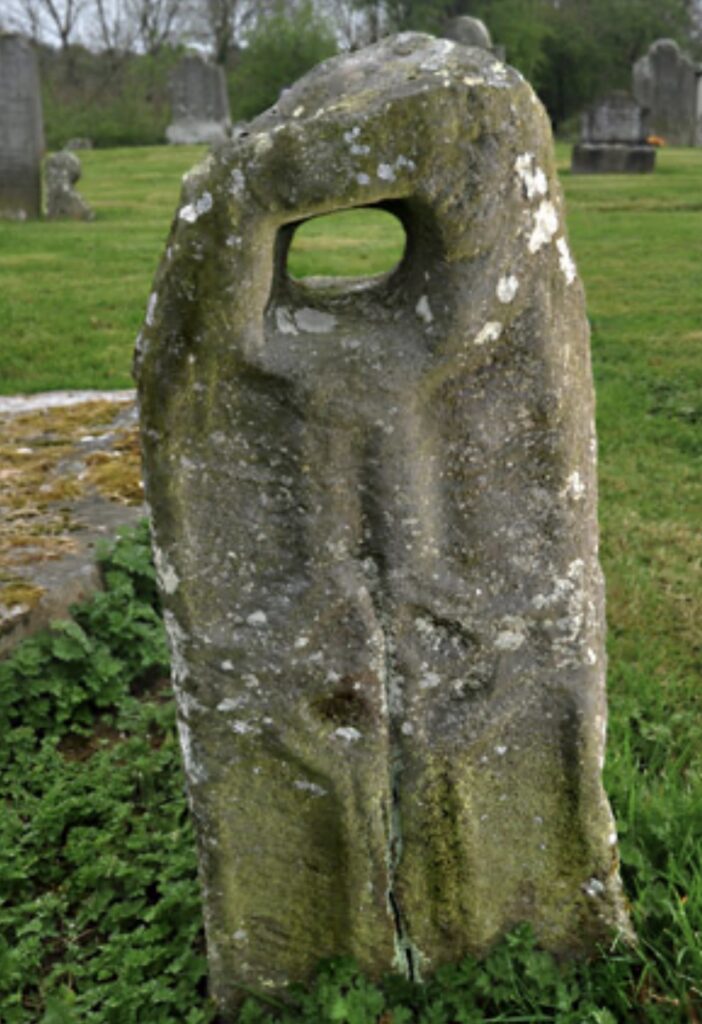
Kilmainhamwood stood in a borderland. Although politically within County Meath, it belonged to the diocese of Kilmore, while the boundary of the old kingdom of Bréifne passed close by. Elizabeth FitzPatrick’s description of such places as borderlands is particularly appropriate here. This was not a clean division between an English Meath on one side and a Gaelic Bréifne on the other. Political authority, ecclesiastical jurisdiction, landholding and family connections overlapped across the boundary.
Elizabeth FitzPatrick’s work on medieval Irish borderlands offers an important way to understand why particular families might be found in places such as Kilmainhamwood. Borderlands were not simply empty buffers between competing lordships. They were active zones in which political authority, ecclesiastical jurisdiction, landholding and service relationships overlapped. Families established in such places could become especially valuable because they possessed knowledge of the people, lands and obligations on both sides of the boundary.
FitzPatrick has also drawn attention to the relationship between hereditary service families and the landscapes in which they were settled. Their position could reflect function as much as ancestry. Families who supplied administrative, legal, military or other specialized services might hold land in places where their knowledge and connections were particularly useful. In that context, the appearance of Nicholas and Charles Ó Maol Phádraig at Shancor should not automatically be treated as an isolated eastern outlier. Their presence in this borderland, followed by their selection as jurors trusted to describe landholding and ecclesiastical property, is consistent with the kind of relationship between family, service and place that FitzPatrick has identified elsewhere. It does not prove that this was the specific role of the Ó Maol Phádraig family, but it provides a historical framework within which their presence makes sense.
The surviving records show how real that overlap was. In July 1366 Archbishop Milo Sweteman proposed meeting Philip Ó Raghallaigh, king of Bréifne, or his representative on the march of his country beyond nearby Kilmainham Beg. Later that same year Sweteman conducted a metropolitan visitation at Kilmainhamwood itself. Richard Ó Raghallaigh, bishop of Kilmore, attended together with Patrick Mac Brádaigh, representing the clergy of Kilmore, and numerous other clerics. The meeting took place in the cemetery beside the church. Kilmainhamwood was therefore already functioning as a point of contact between the ecclesiastical world of Kilmore and the political landscapes of Meath and Bréifne long before the Tudor period.
Kilmainhamwood was also a house of the Knights Hospitaller of St John of Jerusalem. Founded in the thirteenth century, it formed part of the Irish network of Hospitaller preceptories ultimately associated with the great house at Kilmainham in Dublin. These establishments were not simply churches or residences for religious men. They were landed institutions supported by agricultural estates, rents, tithes and other revenues. Their operation depended upon detailed knowledge of landholding, tenants, customary obligations and the value of the resources attached to them.
That world was still functioning when Henry VIII’s break with Rome brought the Dissolution of the religious houses to Ireland. The process moved remarkably quickly. By 1540 and 1541 Crown commissioners were travelling through the country establishing exactly what the suppressed monasteries, priories and religious orders possessed. Lands were measured, buildings valued, rents and tithes recorded, and the rights attached to rectories and other ecclesiastical property set down for the Crown.
These surveys were made at the beginning of the transformation, not generations afterwards. The institutions under examination had not become distant memories. Their estates were still occupied, their rents were still collected and their relationships with bishops, clergy, tenants and neighbouring landholders remained part of everyday life. The Crown was attempting to take possession of an existing Catholic ecclesiastical economy while depending upon the people who already understood how that economy worked.
There was no established Protestant landed class waiting to replace the existing society of northern Meath and the Bréifne borderland. The government therefore had to work through the Old English and Gaelic families already rooted in the district. Men were sworn to identify property, describe tenures, establish values and explain the relationships between the various pieces of an estate. Their usefulness depended upon local knowledge. They had to know not simply where a field or townland lay, but who occupied it, what rights were attached to it, what rents were due, which lands belonged to a rectory or religious house and which obligations had been observed over time.
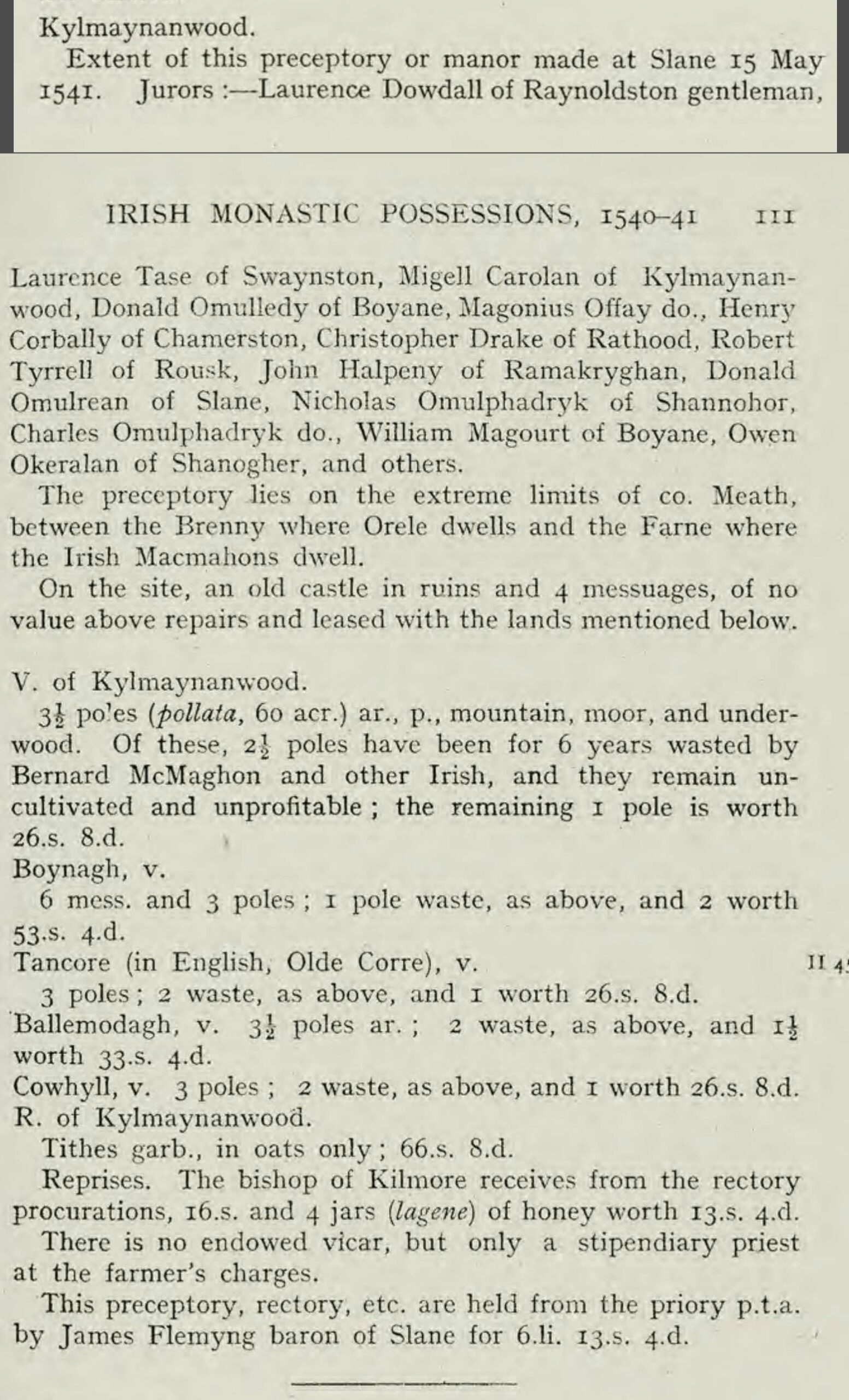
On 15 May 1541, commissioners took the extent of the former Hospitaller preceptory and manor of Kilmainhamwood. Among the jurors were two men whose names are of particular importance to the history of the Ó Maol Phádraig family:
Nicholas Ó Maol Phádraig of Shancor and Charles Ó Maol Phádraig of Shancor.
They were not alone. The panel included Laurence Dowdall of Randalstown, gentleman; Laurence Tase of Swainstown; Migell Carolan of Kilmainhamwood; Donald O’Moledy, Magonus Ossey and William Magourt of Boynagh; Henry Corbally of Chamberstown; Christopher Drake of Rathood; Robert Tyrrell of Rouske; John Halpenny of Ramakryghan; Donald O’Mulrean of Slane; and Owen O’Keralan of Shanogher.
The composition of this group deserves attention. It contained men from established Old English families such as Dowdall, Drake and Tyrrell alongside men bearing unmistakably Gaelic surnames. Several came directly from the property being examined or from its immediate neighbourhood. Three were from Boynagh, itself part of the Hospitaller estate, while Migell Carolan lived at Kilmainhamwood. Others came from surrounding settlements extending toward Shancor, Randalstown, Rathood, Rouske and Slane. The commissioners were drawing upon men embedded in the local landed landscape rather than outsiders unfamiliar with the district.
Their standing was as important as their proximity. Laurence Dowdall was explicitly described as a gentleman, while Drake and Tyrrell belonged to families already established within the landed society of Meath. The later Rathkenny survey describes the recurring body of jurors as the good and lawful men of the neighbourhood, sworn to give evidence. Such men were useful because they possessed the kind of accumulated knowledge that could not easily be obtained from written records alone.
They would have known who occupied particular lands, where one holding ended and another began, what rents and customary payments were due, which lands belonged to a rectory or religious estate and what those properties were actually worth under local conditions. In an age without modern cadastral maps, centralized land registers or comprehensive title records, this collective local knowledge was essential. The Crown could measure land, but it still needed men who understood the web of tenure, custom and obligation that gave those lands their meaning.
Nicholas and Charles Ó Maol Phádraig therefore appear among men whose credibility rested upon both standing and knowledge. Their inclusion suggests familiarity with the ownership, use and obligations attached to land across this eastern borderland. This is particularly notable because Shancor lies far to the east of the areas where later Ó Maol Phádraig records become most conspicuous. Much of the later Tudor evidence draws attention toward Cavan, the northern and western parts of Bréifne, Dowra and other locations farther west. Yet in 1541 two men bearing the surname were already established on the Meath edge and were sufficiently familiar with this landscape to serve among its trusted land jurors.
That should caution against imagining the family as confined to one compact centre from which individuals later dispersed. Whatever the deeper origin of the surname, Nicholas and Charles were already firmly embedded at the far eastern edge of the wider Bréifne world by the opening years of the Dissolution. They were not appearing as newcomers or transient followers. The nature of the duty entrusted to them suggests men who knew the country and were known within it.
One name on the panel deserves to be kept in view. Robert Tyrrell of Rouske sat on the same jury as Nicholas and Charles Ó Maol Phádraig. The significance of that association cannot yet be measured from this record alone, but Tyrrell is not a surname that disappears from the Ó Maol Phádraig story. The two names will appear together repeatedly in later records and in very different settings, eventually as far away as County Cork. Several of the other surnames encountered among these 1541 jurors will also reappear in later Ó Maol Phádraig records far beyond the immediate Kilmainhamwood district. Those connections belong to later stages of the investigation, but their recurrence makes this early jury worth remembering as more than a chance gathering of unrelated local men.
The same point applies to the repeated appearance of Nicholas and Charles themselves. During the same period they were also used in the Crown survey of the rectory of Rathkenny, farther into Meath, where many members of the same wider group of jurors appear again. Their usefulness therefore extended beyond knowledge of one neighbouring Hospitaller estate. They belonged to a regional body of men whose testimony was considered reliable when ecclesiastical property was being identified and valued.
The speed of the transformation becomes particularly clear when Kilmainhamwood is compared with nearby Kilmainham Beg. On 16 May 1541, only one day after the Kilmainhamwood extent, the commissioners moved on to make a separate survey there with a new jury.
Kilmainham Beg had long occupied an equally sensitive position. In 1366 it had served as a reference point for the march of Philip Ó Raghallaigh’s country. By 1568, only twenty-seven years after the survey, the former religious property was being required to support new fortifications intended to strengthen the border against Ó Raghallaigh and Mac Mathghamhna.
The significance lies in the speed of the change. A medieval religious estate standing beside the Bréifne border was surveyed as Crown property in 1541 and, within less than a generation, the same landscape was being incorporated deliberately into a Tudor defensive system. The institution changed, while the strategic importance of the ground remained.
For the men sitting on the Kilmainhamwood jury, these developments could hardly have seemed remote. The ecclesiastical institutions being measured were part of the world in which they had grown up. The rectories, tithes, church lands, payments to bishops and religious estates were familiar components of local society. Yet within their own lifetimes that structure was being transferred into the hands of the Crown and increasingly reshaped for political and military purposes.
The later histories of several of the families represented on the jury make the moment still more striking. The Dowdalls remained closely associated with Catholic religious life. Tyrrell branches later became deeply involved in the Catholic and Gaelic political world. The Cruises, represented in the wider survey network, remained Catholic, while Carolans continued to appear within Catholic religious life. Their later histories show how misleading it would be to read participation in a Crown survey in 1541 as evidence of Protestant conversion.
In 1541 the Crown was still working through the existing Old English and Gaelic society of the district, long before a Protestant landed order had taken firm root there.
Among those men were Nicholas and Charles Ó Maol Phádraig.
Their appearance in 1541 is therefore more revealing than the survival of two names in a land survey might initially suggest. They belonged to the class of men whose local standing and accumulated knowledge allowed the Tudor government to understand the landscape it was taking over. Their presence at both Kilmainhamwood and Rathkenny places them firmly within the functioning landed society of eastern Meath and the Bréifne borderland.
Later Ó Maol Phádraig records would emerge in very different circumstances. The surname would repeatedly appear among Ó Raghallaigh networks, Tudor pardons, patents and the political conflicts that accompanied the extension of Crown power across Bréifne. Those later developments belong to another part of the story.
In 1541, however, the picture is still one of transition. Two Ó Maol Phádraig men stood at the far eastern edge of the family’s later documented Bréifne landscape, trusted to explain an ecclesiastical land system just as that system was beginning to disappear.
References
FitzPatrick, Elizabeth. Studies of medieval Irish borderlands and the interaction of Gaelic and Anglo-Norman landscapes.
Fitzpatrick, Mike, and Fitzpatrick, Mike. Ó Maol Phádraig: the Name, the People, and the Clans, Part III. Journal of the Fitzpatrick Clan Society.
Lawlor, H. J., ed. A Calendar of the Register of Archbishop Milo Sweteman.
Mac Niocaill, Gearóid, ed. Crown Surveys of Lands 1540–1541, with the Kildare Rental Begun in 1518. Dublin: Irish Manuscripts Commission, 1992.
O’Connell, Philip. “Moybolge.” Breifny Antiquarian Society’s Journal, vol. 2.
White, N. B., ed. Extent of Irish Monastic Possessions, 1540–1541. Dublin: Stationery Office, 1943.