The previous Ó Maol Phádraig record from County Cork ended in September 1577 with Domhnall mac Conchobhair Ó Maol Phádraig among the followers of Donnchadha mac Cormaic Mac Donagh, one of the Mac Donagh MacCarthys of Duhallow. On its own, that record offered little indication of whether Domhnall represented an isolated member of the family or part of a larger Cork population.
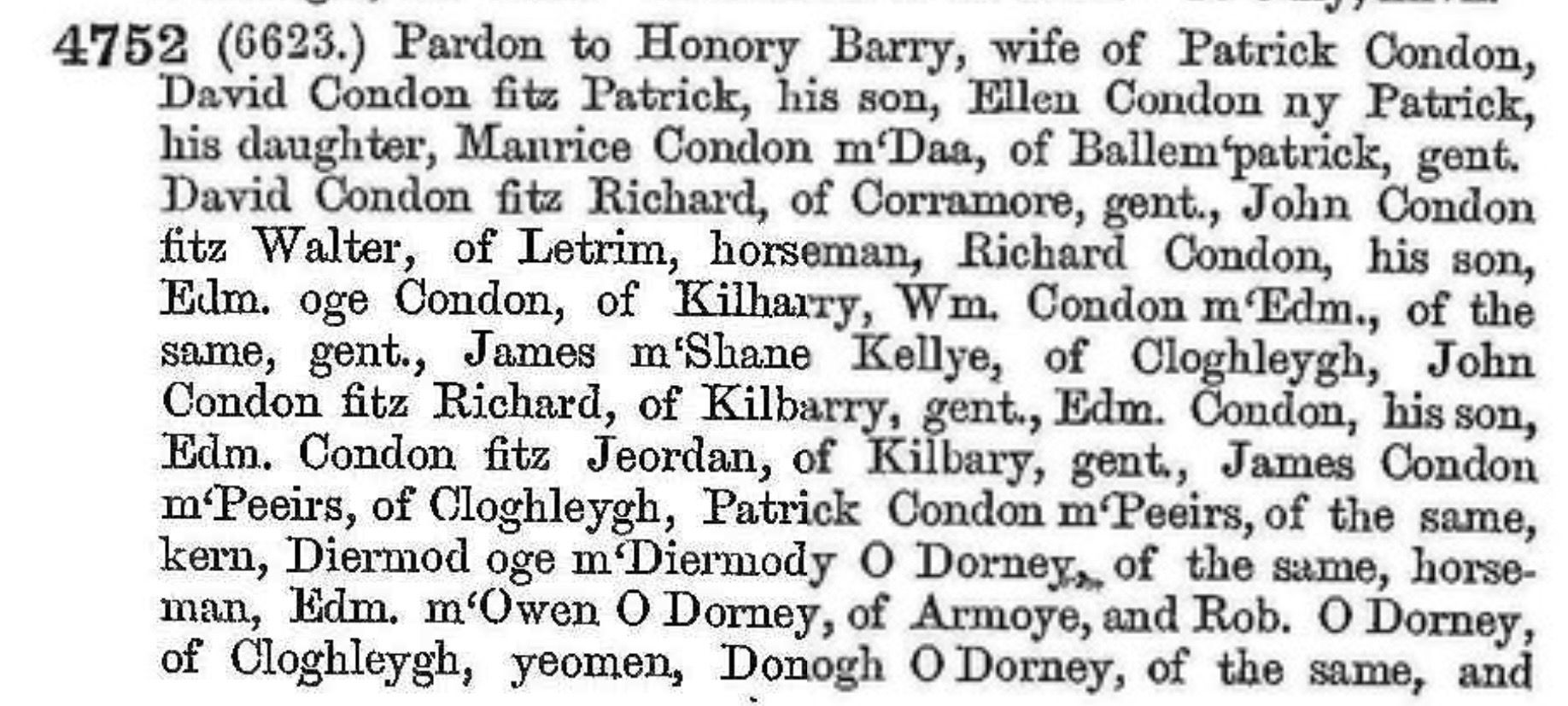
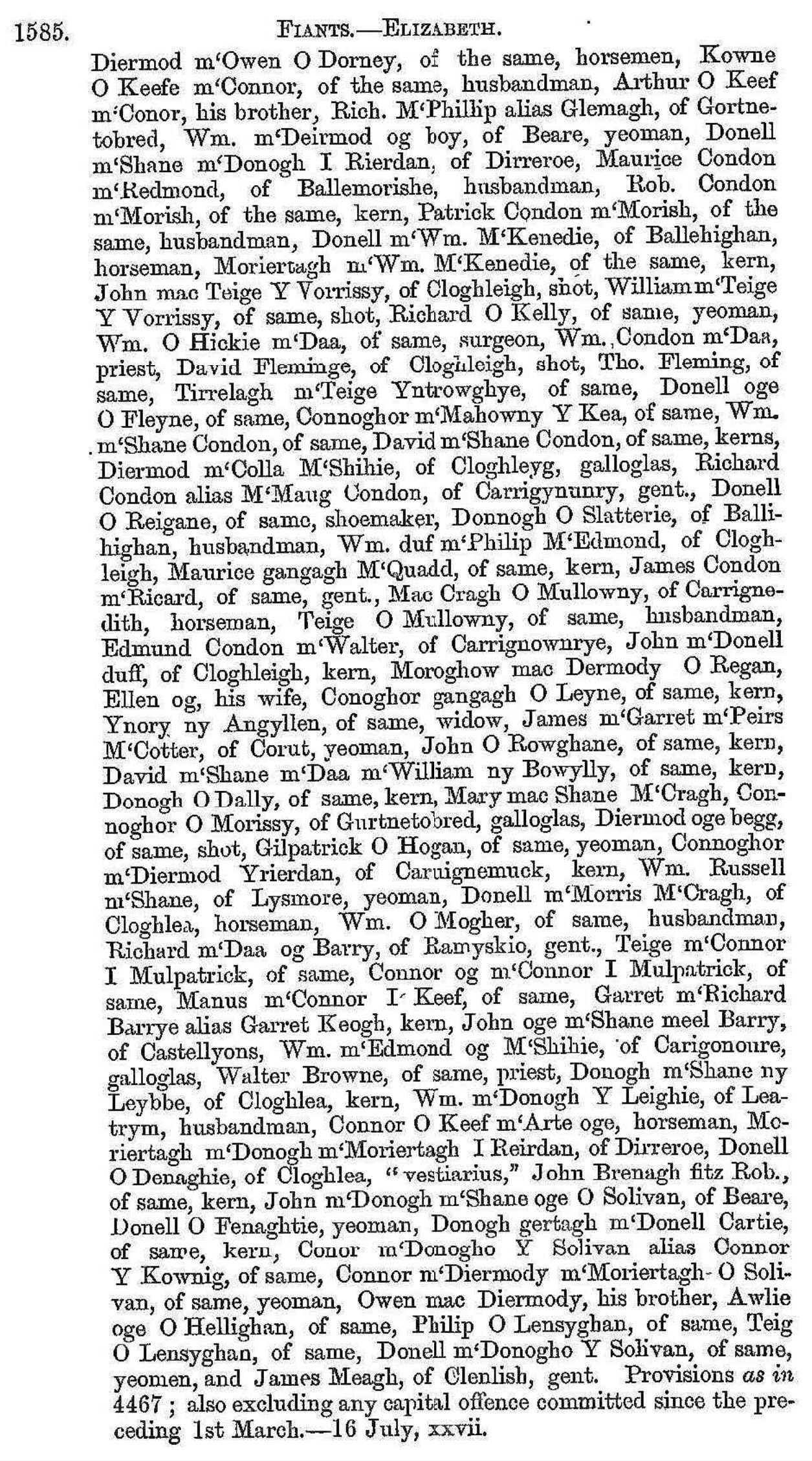
Eight years later, another pardon provides the first substantial clue. Fiant 4752, dated 16 July 1585, is a very large pardon headed by Honora Barry, wife of Patrick Condon, and members of the Condon family. It contains gentlemen, horsemen, kern, galloglass, shot, husbandmen, clergy and others drawn from several parts of County Cork. Among them is a small group attached to a place written in the fiant as Ramyskio:
Richard m’Daa og Barry, of Ramyskio, gent.
Teige m’Connor I Mulpatrick, of same
Connor og m’Connor I Mulpatrick, of same
Manus m’Connor I Keef, of same
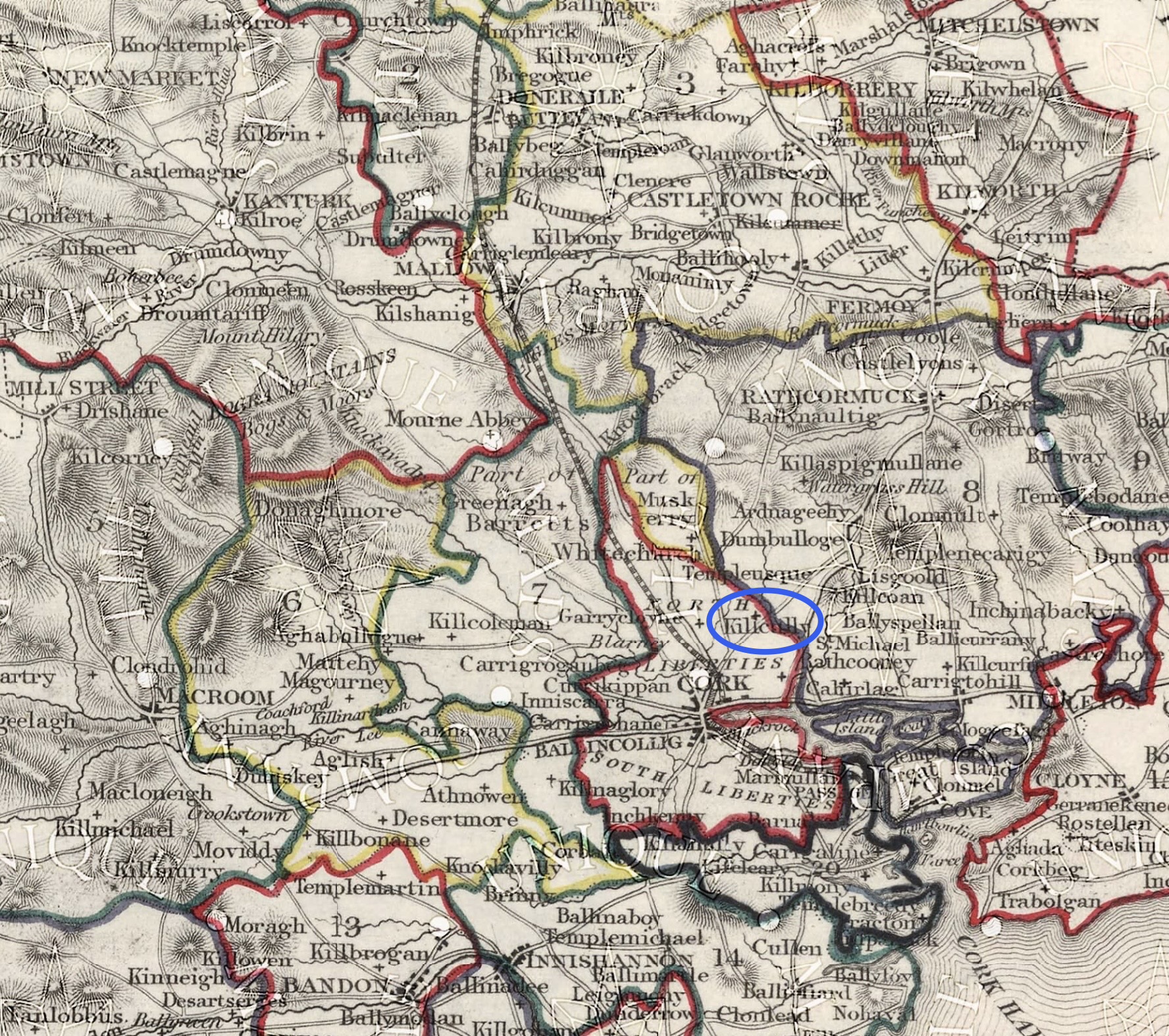
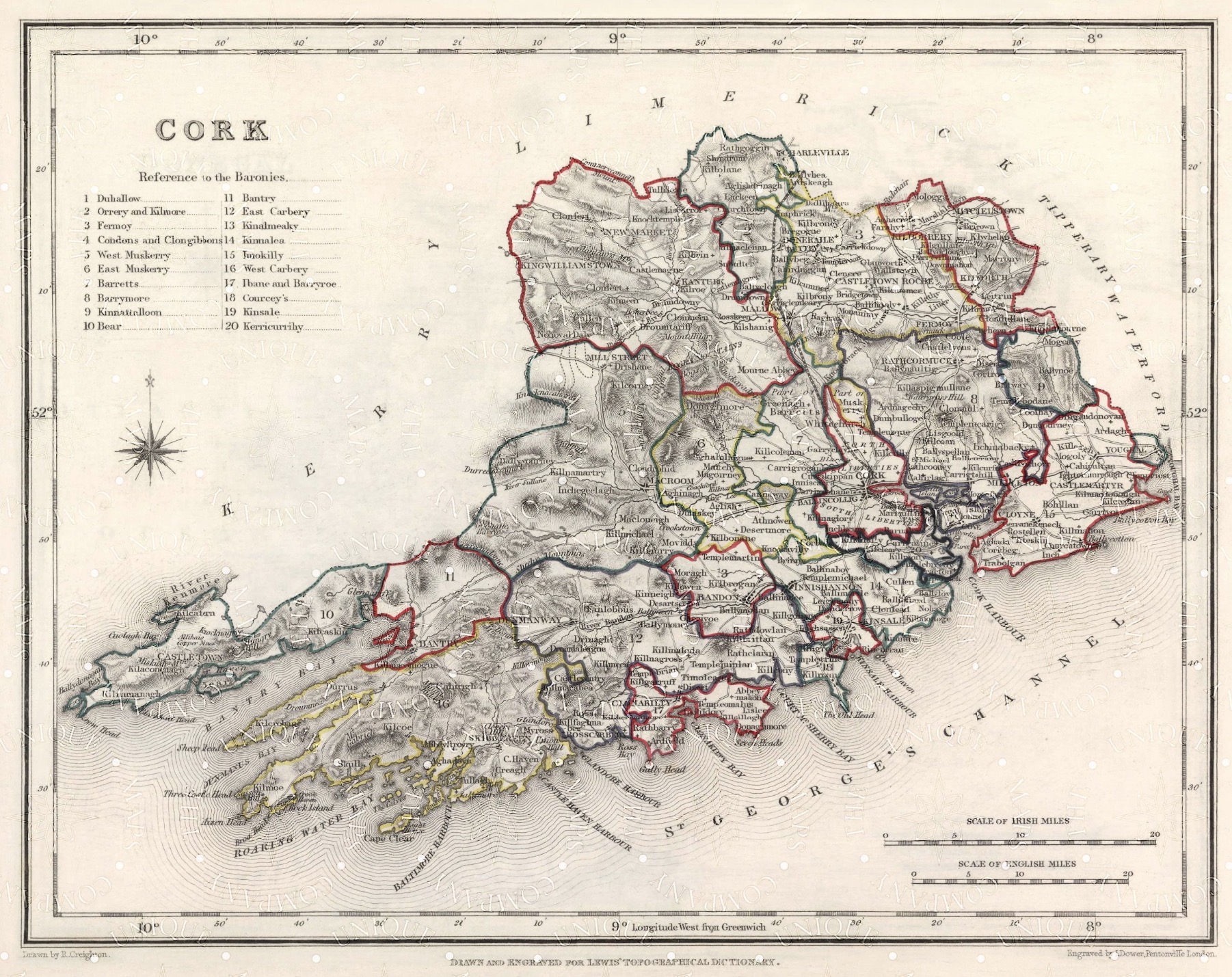
The place can be identified with Rahanisky, north of Cork city. The two Ó Maol Phádraig men were Tadhg mac Conchobhair and Conchobhar Óg mac Conchobhair. Both were therefore sons of a man named Conchobhar, just as Domhnall Ó Maol Phádraig in the 1577 pardon had been.
Matthew and Mike Fitzpatrick have consequently suggested that the three men were probably brothers. The surviving records cannot prove that relationship, since Conchobhar was not an uncommon name, but the possibility becomes considerably more persuasive once the company surrounding them is examined.
Rahanisky
Richard mac Dáibhí Óg Barry was not simply a local gentleman whose name happened to precede the Ó Maol Phádraig men. The history of his branch of the Barry family was reconstructed in considerable detail by Rev. Edmond Barry from fiants, inquisitions, wills and family records.
Richard and his brother Redmond first appear as military retainers of Sir Cormac mac Taidhg MacCarthy, Lord of Muskerry. In 1573 Richard was at Ballygarvan among Sir Cormac’s followers, and in November 1576 he was explicitly described as a horseman in another pardon to the Lord of Muskerry.
That description was significant. Horses were central to warfare and lordly power in sixteenth-century Ireland. Mounted men provided speed, reconnaissance, communication and striking power that infantry could not match, while maintaining them required horses, grazing, fodder, equipment and attendants. A man identified as a horseman therefore belonged to an important and costly part of a lord’s military following.
Richard’s appearance in that role also helps explain his later position. Between November 1576 and September 1577 his family acquired Rahanisky. Edmond Barry believed that Sir Cormac’s regard for Richard was instrumental in securing the estate for Richard’s father, David fitz David Barry. The later tradition described the grant as eight or ten thousand acres, although that figure should be treated as Barry’s reconstruction rather than as a contemporary acreage measurement. Sixteenth-century records instead describe Rahanisky itself as six or eight ploughlands, with additional lands elsewhere.
Whatever its exact acreage, this was a substantial landed establishment. The estate bordered Sir Cormac MacCarthy’s lands and extended to within a short distance of Blarney Castle. Edmond Barry observed that Richard could therefore be readily available to the Lord of Muskerry.
Sir Cormac’s own will confirms the closeness of the relationship. Richard was named among the men chiefly trusted in connection with access to Blarney Castle and the protection of Sir Cormac’s heir. Edmond Barry consequently described Richard as one of Sir Cormac’s most trusted personal partisans.
The Rahanisky estate therefore grew directly out of the political and military world of MacCarthy Muskerry, providing an important setting for the two Ó Maol Phádraig men found there in 1585.
Three followers
Edmond Barry summarized the 1585 fiant as a pardon to Richard mac Dáibhí Óg Barry of Rahanisky, gentleman, “and three of his followers.”
The structure of the original fiant strongly indicates which three men Barry had in mind. Richard is immediately followed by Tadhg mac Conchobhair Ó Maol Phádraig, Conchobhar Óg mac Conchobhair Ó Maol Phádraig and Manus O’Keeffe, each recorded “of same,” meaning Rahanisky. Barry’s abbreviated summary does not identify the three men individually, but the arrangement of the original entry makes the connection persuasive.
The word followers should not be confused with a specific military occupation. Tudor pardons could identify men quite precisely as horsemen, kern, galloglass, shot, priests or husbandmen. Neither of the Ó Maol Phádraig men nor Manus O’Keeffe is given such a designation.
A follower could instead belong to the wider affinity surrounding a lord or substantial gentleman: a client, dependent, tenant, minor landholder, household officer, fighting man or other trusted person owing some form of service or allegiance. This distinction becomes clearer when another Rahanisky pardon is examined.
In June 1584 Richard and his three brothers were pardoned together. Among the other men at Rahanisky were a named horseman, a kern and four husbandmen. The record therefore demonstrates that the Rahanisky household contained people occupying very different positions. A year later, Tadhg and Conchobhar Ó Maol Phádraig and Manus O’Keeffe appear without occupational labels. Whatever their function, the fiant did not identify them as husbandmen or as any of the explicitly named military specialists.
Richard’s earlier description as a horseman nevertheless tells us something important about the world into which they had entered. Rahanisky was headed by a man whose position had been built through mounted military service to one of the most powerful lords in Muskerry. Horses were an essential part of that military world, and sustaining mounted service required land, grazing, fodder, equipment and manpower. That does not tell us what work the Ó Maol Phádraig men themselves performed, but it does help define the kind of lordly household and estate in which they were operating.
Manus O’Keeffe
The third follower provides the strongest bridge back toward the world of Domhnall Ó Maol Phádraig in 1577.
On 5 September 1577, the day before Domhnall’s pardon, a large pardon headed by David Barry of Buttevant included a man recorded as Manus mac Conchobhair mac Donnchadha O’Keeffe. Other members of the same O’Keeffe family group occur beside him.
Eight years later, Manus mac Conchobhair O’Keeffe appears at Rahanisky immediately after the two Ó Maol Phádraig men. The later record omits the grandfather Donnchadh, but the combination of Manus, son of Conchobhar, O’Keeffe, inside two Barry-connected companies makes it very likely that the records refer to the same man.
If so, the sequence is unusually revealing. In 1577 Manus mac Conchobhair mac Donnchadha O’Keeffe belonged to a Barry-led following. On the following day Domhnall mac Conchobhair Ó Maol Phádraig appeared among the followers of the Mac Donagh MacCarthys of Duhallow. By 1585 Manus was at Rahanisky beside two men who were probably Domhnall’s brothers.
The later history of Rahanisky shows that the Barry-O’Keeffe relationship was not fleeting. One of Richard Barry’s daughters subsequently married Danyell O’Keeffe, and their daughter Margaret Ní Danyell O’Keeffe was specifically remembered in the 1627 will of Richard’s son David. The O’Keeffes were therefore eventually connected to the Rahanisky Barry family by marriage as well as by service.
The neighbouring pardons of 1577
Once Fiant 3082 is read beside the other pardons issued in the same September 1577 sequence, further connections appear. Members of the Rahanisky Barry family were already moving through these political circles. On 6 September, the same day as Domhnall Ó Maol Phádraig’s pardon, Redmond mac David Barry of Rahanisky appeared among the followers in another MacCarthy pardon. Six days later David Óg Barry of Rahanisky received a pardon of his own.
Richard’s family was therefore already present in the same administrative and political environment in which Domhnall first appears.
Other surnames recur across the neighbouring pardons: O’Keeffe, Ó Callaghan, Ó Riordáin, Ó Murchadha, Ó hIarlaithe, MacSweeney, Roche, Condon and several branches of the MacCarthys. These were not one single company, but they belonged to overlapping lordships whose members could be connected through land, marriage, military service and political allegiance.
Some individuals can even be followed from one period to another. Richard Mac Mág Condon of Carrignowry appears in the September 1577 pardon sequence and again in the great Condon-Barry pardon of 1585. The recurrence demonstrates that these later pardons were drawing upon a political population already visible eight years earlier.
Domhnall’s appearance in Fiant 3082 therefore belongs to a much larger landscape than a single Mac Donagh household.
More than a military network
Fiant 4752 initially looks overwhelmingly military. Horsemen, kern, galloglass and shot appear repeatedly, and Patrick Condon and the Barrys were clearly capable of maintaining armed followings. That observation remains valid, but it does not fully describe the people involved.
The same pardons contain priests and clerks. Several of the recurring families had substantial ecclesiastical histories of their own. Members of the O’Keeffe family reached senior church office. The MacCarthys and Barrys were major patrons and controllers of religious institutions. Other recurring families likewise supplied clergy or held ecclesiastical interests.
The political and ecclesiastical worlds were not separate systems. This becomes especially apparent in 1577. Within weeks of the September pardons, leading Cork lords were receiving former religious property from the Crown. Sir Cormac MacCarthy received lands and possessions of dissolved religious houses and rectories. The Roches likewise obtained former monastic property.
The old church estates had not vanished from the landscape. Their ownership and legal status were being transferred. For families that had made their living within older ecclesiastical and landed structures, such a transition could have altered their patron without eliminating the need for their services.
What were the Ó Maol Phádraig men doing?
No surviving record identifies Tadhg or Conchobhar as estate managers, stewards, rent collectors or church-land officers. Their precise role at Rahanisky remains unknown. It is nevertheless possible to describe the environment in which they were operating.
Rahanisky was a recently established and politically sensitive estate. Contemporary and later records show a multi-ploughland property accompanied by other holdings, head-rents, mills, mortgages, settlements, tenants and complicated obligations. By the early seventeenth century Richard’s holdings extended through numerous separate denominations, and elaborate deeds of feoffment were required to organize their inheritance.
An estate of that size required more than soldiers and farmers. Someone had to know the tenants, rents, boundaries, customary obligations and relationships between the individual holdings. Someone had to deal with disputes, organize revenues and maintain communication between the estate and the wider political network surrounding it. Livestock also had to be managed, and in a household whose head had risen through mounted military service, horses formed part of a wider economic and military system that depended heavily upon land.
Richard himself had begun his career as a military retainer, but once established at Rahanisky he had become the head of a substantial landed household. That makes an administrative or land-service role for some of his followers entirely plausible, although the records do not allow such a role to be assigned specifically to Tadhg or Conchobhar.
It also provides an interesting comparison with the much earlier Cork record of Robert Ó Maol Phádraig. In 1306 Robert had been summoned as a juror in a dispute involving Philip de Barry. The record does not make Robert a Barry servant or estate official, but it does place an Ó Maol Phádraig man within the legal and landed environment surrounding the Barry family more than two and a half centuries before the Rahanisky pardon.
The recurrence cannot establish an unbroken hereditary Barry-Ó Maol Phádraig relationship. Too much evidence is missing between the two periods. It does, however, raise a reasonable question. If Ó Maol Phádraig originated in or became associated with hereditary ecclesiastical and land-service functions elsewhere in Ireland, could some Cork members of the family have occupied a similar social position within the large estates and lordships of the south?
The Cork evidence does not yet answer that question, but nothing discovered in the 1577 and 1585 pardons contradicts it.
From one probable family to a wider network
The surviving Cork records now permit a tentative reconstruction. In 1577 Domhnall mac Conchobhair Ó Maol Phádraig was among the followers of Donnchadha mac Cormaic Mac Donagh in Duhallow. The day before, a probable later associate, Manus mac Conchobhair mac Donnchadha O’Keeffe, appeared inside a Barry following. During the same pardon sequence, members of the Rahanisky Barry family were already appearing in neighbouring MacCarthy companies.
By 1585 Tadhg and Conchobhar Óg mac Conchobhair Ó Maol Phádraig, probably Domhnall’s brothers, were at Rahanisky with Richard Barry and Manus O’Keeffe. Edmond Barry later described Richard’s 1585 entry as a pardon to him and three of his followers.
Richard himself was no ordinary local landlord. He had spent years in the service of Sir Cormac MacCarthy of Muskerry, had been a horseman in his following, and was later trusted with responsibilities involving Blarney Castle and Sir Cormac’s heir. The Rahanisky estate appears to have been obtained partly through that relationship.
The MacCarthy, Barry and O’Keeffe strands therefore converge at precisely the point where the two Ó Maol Phádraig men enter the record. These occurrences still do not reveal an Ó Maol Phádraig territory in Cork. They instead place members of the family within the political and landed networks of more powerful houses.
A family in service rather than a territorial lordship?
The Cork evidence may ultimately prove to represent a branch whose history differed from the Ó Maol Phádraig families found elsewhere. There is no reason to expect every branch of a medieval surname family to have performed the same function for centuries.
A family originally associated with ecclesiastical land or hereditary service could produce clergy in one place, jurors or estate officials in another, substantial tenants elsewhere and military retainers where political conditions demanded it. That flexibility may account for much of the scattered appearance of Ó Maol Phádraig in the surviving records.
In Cork, the repeated association with MacCarthy and Barry power is now difficult to overlook. Robert Ó Maol Phádraig appears in a Barry legal context in 1306. Domhnall mac Conchobhair appears among the Mac Donagh MacCarthys in 1577. His probable brothers appear at Rahanisky in 1585 in the small group headed by Richard Barry, a man whose own rise had taken place through MacCarthy Muskerry service.
The evidence is not sufficient to assign these men an occupation that the records do not give them. It is sufficient to place them within a durable world of lordship, landed service and political dependency.
For now, that may be the most useful conclusion. The two men at Rahanisky were not simply two isolated Ó Maol Phádraig names in another Tudor pardon. They belonged to a small Rahanisky group headed by Richard Barry, and that group can be connected backward into the same broader MacCarthy-Barry environment in which their probable brother had already appeared.
The precise service they performed remains hidden, but the network around them is becoming much clearer.
References
Barry, Edmond. “Barrymore: Records of the Barrys.” Journal of the Cork Historical and Archaeological Society, Second Series, Vol. VII, No. 50, 1901, pp. 65–80.
Fitzpatrick, Matthew and Mike Fitzpatrick. “Ó Maol Phádraig: the Name, the People, and the Clans, Part III.” Journal of the Fitzpatrick Clan Society, Vol. 6, 2025, pp. 27–41.
Ireland Public Record Office. The Thirteenth Report of the Deputy Keeper of the Public Records in Ireland. Dublin, 1881.
Ireland Public Record Office. The Fifteenth Report of the Deputy Keeper of the Public Records in Ireland. Dublin, 1883. Fiant 4752, pp. 120–121