
Sometimes there is no explanation. A record can show that something was happening without telling us why, and all that can be done is mark the pattern, follow it carefully and hope that another document eventually turns up to explain what was going on.
Fiant 5603 is one of those records. I knew this pardon was coming as I worked through the Tudor fiants chronologically, and I had already spent a considerable amount of time trying to understand it before reaching this point. The difficulty was obvious almost immediately. By now a fairly consistent pattern had begun to emerge around the Ó Maol Phádraig name. The same families appear repeatedly around them, and in many of those records the Ó Raghallaigh name sits at or close to the top of the list.
In those cases the association is not particularly difficult to understand. The setting is Bréifne, the geography is Cavan, the political world is Ó Raghallaigh, and the people appearing around Ó Maol Phádraig are largely people one would expect to find there.
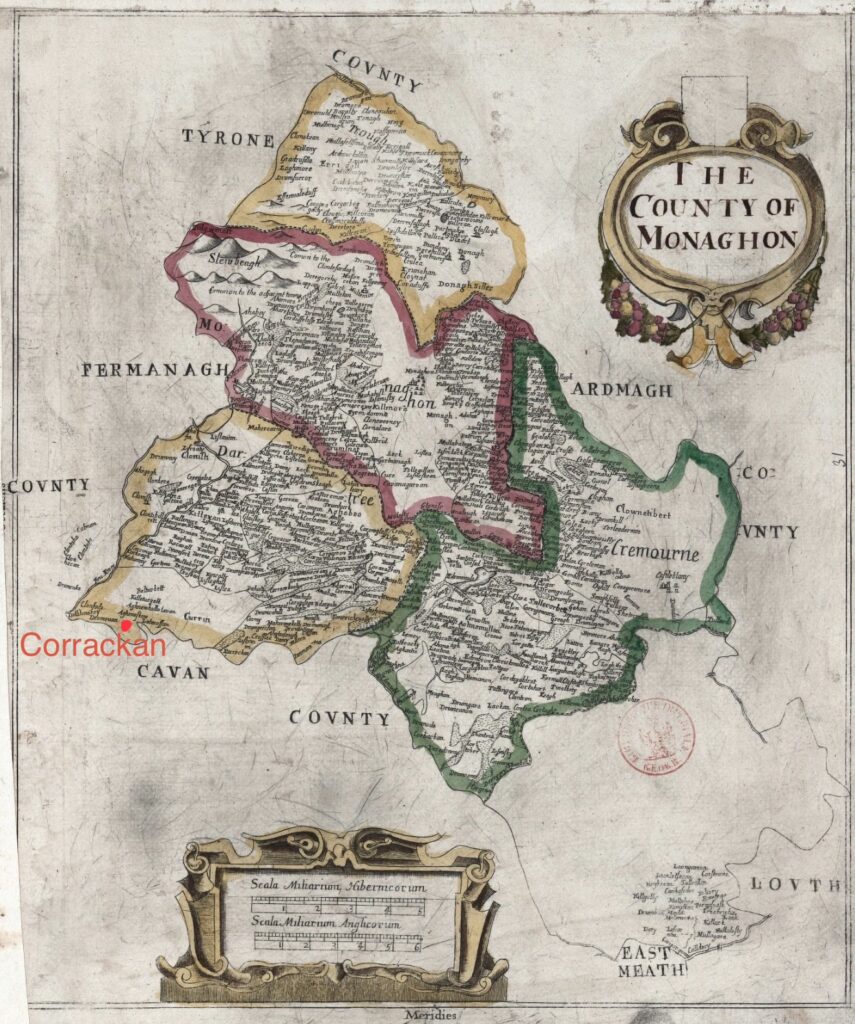
Fiant 5603 is different. This one belongs to County Monaghan. It is MacMahon territory, the world of Clones and Clogher rather than Drumlane and Kilmore. The pardon is headed by Brian mac Hugh Óg MacMahon, and much of the list looks exactly as it should. MacMahons appear everywhere, belonging to several branches of the wider family, along with people who can be recognized as part of the MacMahon political and social structure.
Then, among them, appears Philip Ó Maol Phádraig of Ballyneglogh. That alone would have been enough to make the record interesting, but it is the company around him that makes it difficult to explain.
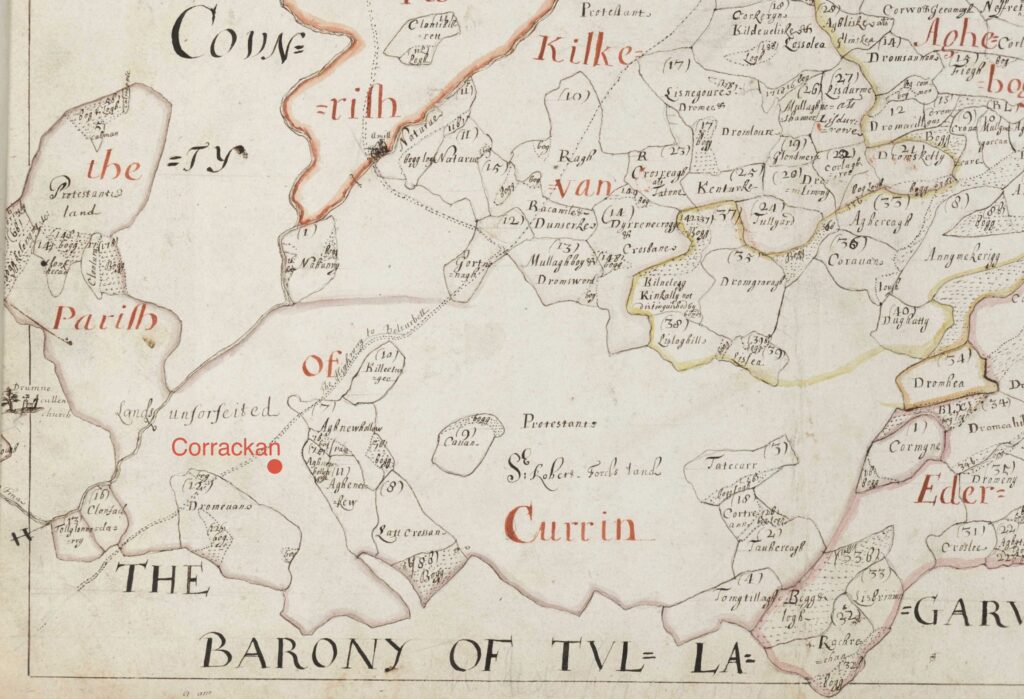
Ballyneglogh
Philip is described as being of Ballyneglogh, in the western part of the MacMahon country close to the Bréifne frontier. The location matters. Ballyneglogh was not somewhere vaguely between Cavan and Monaghan. It belonged to the Dartree landscape and formed part of a MacMahon-controlled estate structure.
A later grant associated with the 1591 settlement identifies the ballybetagh of Ballyneglogh and names the individual tates distributed among members of different MacMahon branches. Among those places are names that can still be followed on the landscape: Aghnaskew, Lattercrossan, Corrackan and others in the Currin area.
The later appearance of Bryan O’Mulpatrick at Corrackan in the 1663 Hearth Money Roll is therefore particularly interesting. Corrackan lay within that old Ballyneglogh grouping. It does not prove that Bryan descended from Philip, nor does it tell us exactly where within Ballyneglogh Philip lived in 1591, but it does show an Ó Maol Phádraig presence continuing within the same small landscape more than seventy years later.
Philip was not simply passing through Monaghan. The family appears to have become established there, and that produces the obvious question: why?
The obvious explanations
If Fiant 5603 contained Philip surrounded entirely by MacMahons and well-known Monaghan families, the simplest explanation would probably be that an Ó Maol Phádraig household had crossed the border and entered MacMahon service.
There would also be another possibility that had to be considered. Perhaps this Philip did not belong to the same Ó Maol Phádraig population appearing elsewhere around Kilmore and the Ó Raghallaigh world at all. The surname was already geographically dispersed by the late sixteenth century, so it is reasonable to ask whether the Ballyneglogh family might represent a separate branch, perhaps one that had been established in Monaghan for some time and had little or no connection with the Bréifne families being followed through the other fiants.
That would solve the problem neatly, but there is presently no evidence for it. Nothing in the record identifies Philip as belonging to a separate Ó Maol Phádraig lineage. No genealogy, land record, ecclesiastical record or later pedigree has emerged that distinguishes the Ballyneglogh family from the wider northern Ó Maol Phádraig population. Nor is there any independent evidence for an older, separate Ó Maol Phádraig settlement in MacMahon territory that would explain his presence there.
More importantly, Philip does not appear in isolation. The same pardon also contains Ó Raghallaigh, Mac Brádaigh, Ó Sheridan, Ó Maolmochéirghe and Mac Diarmada — surnames that recur in the same broader Bréifne and Kilmore environment in which Ó Maol Phádraig appears elsewhere.
That does not prove that Philip belonged to exactly the same branch as the other Ó Maol Phádraig men in the fiants. The records are not capable of showing that. But it makes the idea of a completely unrelated Monaghan Ó Maol Phádraig line less persuasive. To accept that explanation, one would have to suppose that Philip happened to belong to a separate family branch and that, by coincidence, he appears in the same pardon with several of the very surnames repeatedly associated with the Kilmore and Bréifne Ó Maol Phádraig population elsewhere.
There is no evidence that this was the case. The possibility has to remain open, but at present it is only a possibility. The evidence we actually possess points in the other direction: whatever Philip’s precise relationship to the other Ó Maol Phádraig men may have been, Fiant 5603 places him among a familiar cluster of Bréifne-associated families in a location where that cluster is unexpected.
That is what makes the record so difficult to explain.
The people around him
Among the MacMahons and their followers appear Ó Raghallaigh, Mac Brádaigh, Ó Sheridan, Ó Maolmochéirghe, Mac Diarmada and Ó Maol Phádraig.
Most of those names sit very comfortably in the wider Bréifne and Kilmore world already emerging from the other records. Brady and Sheridan were deeply embedded in the ecclesiastical world of Kilmore. Ó Maolmochéirghe was an old Bréifne ecclesiastical family. Ó Raghallaigh hardly requires explanation: it was the ruling dynasty immediately across the frontier and was itself deeply involved in the Kilmore church. Ó Maol Phádraig has already been appearing among precisely this broader population.
Mac Diarmada is a little different. There is a documented Mac Diarmada priest in the diocese of Clogher before 1591, so the surname already has a possible ecclesiastical route into this region. That makes its presence in Fiant 5603 somewhat less surprising than the others. At the same time, Mac Diarmada is the weaker connection in this recurring group. It appears, but it does not appear with the same consistency as Brady, Sheridan, Ó Maolmochéirghe, Ó Raghallaigh and Ó Maol Phádraig.
Mac Diarmada therefore belongs in the discussion, but with a qualification. There may already be a plausible reason for a Mac Diarmada to appear in the Clogher region, while for the others there is presently no comparable explanation. What matters is that, even with Mac Diarmada treated more cautiously, the core pattern remains intact.
That core is Ó Raghallaigh, Mac Brádaigh, Ó Sheridan, Ó Maolmochéirghe and Ó Maol Phádraig.
Yet here they are in a pardon headed by a MacMahon.
At the same time, Fiant 5603 contains families that belong perfectly naturally to the Clones and Clogher ecclesiastical landscape. Mac an Eanaigh was an established hereditary church family associated with Clones. Ó Connallaigh had deep connections with the ecclesiastical community there. Ó Coigligh likewise appears in the church-land landscape of the Clones area.
That distinction is important. Mac an Eanaigh, Ó Connallaigh and Ó Coigligh do not need explaining simply because they appear in this pardon; they belong naturally to the Clones and Clogher world. Brady, Sheridan, Ó Maolmochéirghe, Ó Raghallaigh and Ó Maol Phádraig are harder. They are Bréifne names appearing among them.
Looking for the explanation
I did not arrive at that conclusion quickly. Before accepting that the connection could not presently be explained, I spent a considerable amount of time trying to find even one convincing link between these Bréifne families and the MacMahon structure represented in the pardon.
That meant going much deeper into the MacMahons than I had originally intended. The names themselves are difficult enough to follow. Repeated forms involving Mac Hugh, Mac Owen, Mac Hugh Óg, Mac Owen and several generations carrying the same personal names can become almost impenetrable. Different MacMahon branches were operating in neighbouring territories at the same time, and the 1591 redistribution of lands added another layer of complication.
Sorting them out meant following the different branches, locating their estates, comparing the names in the pardon with the names in the grants and trying to determine who belonged to whom. By the end of it I knew considerably more about the various Mac Owen and Mac Hugh MacMahons than I had ever really cared to know.
But it had to be done. The obvious possibility was that Brady, Sheridan, Ó Maolmochéirghe, Mac Diarmada, Ó Raghallaigh or Ó Maol Phádraig could be connected directly to one of these MacMahon branches through service, landholding, marriage, fosterage or some other recognizable relationship.
I looked for exactly that, and I could not find it.
There are isolated marriages between the great Gaelic families, as one would expect. There were political dealings across the border. People travelled, clerics crossed diocesan boundaries and lords made alliances with one another. But none of that provides a satisfactory explanation for this particular concentration of Bréifne-associated surnames inside a pardon otherwise dominated by MacMahons and identifiable MacMahon followers.
These families are simply not known as MacMahon follower families. That is the difficulty.
The Church remains difficult to ignore
The ecclesiastical pattern is nevertheless impossible to miss. On the Monaghan side we have old Clones church families such as Mac an Eanaigh, Ó Connallaigh and Ó Coigligh. On the Bréifne side we have Brady, Sheridan and Ó Maolmochéirghe, families with substantial associations with Kilmore and the older ecclesiastical structure of Bréifne.
Ó Raghallaigh itself was deeply involved in the Kilmore church, both politically and through members of the dynasty who occupied ecclesiastical office. Then there is Ó Maol Phádraig, whose records repeatedly bring the family into landscapes associated with former church lands, ecclesiastical property and the institutions surrounding the Bréifne church.
Mac Diarmada again has to be treated a little differently. Its documented clerical presence in Clogher before this pardon means that there is already at least one plausible route by which the name could have become established in this ecclesiastical landscape. It is useful evidence that such movement happened, but Mac Diarmada is not carrying the larger argument. The stronger recurring group remains Brady, Sheridan, Ó Maolmochéirghe, Ó Raghallaigh and Ó Maol Phádraig.
It is very tempting to make the Church the explanation. Perhaps church patronage allowed these families to cross the political frontier. Perhaps hereditary ecclesiastical relationships connected Kilmore and Clogher in ways that are largely invisible in the surviving secular records. Perhaps church tenancies or service relationships placed Bréifne families on lands that were politically controlled by MacMahons.
Any of those mechanisms would make sense, but the record does not tell us that. There is no surviving document in hand saying that Ó Maol Phádraig was placed at Ballyneglogh by a bishop, that the family held church land there, that Philip served a rectory, or that these other Bréifne families entered Dartree through an ecclesiastical arrangement.
It would be easy to turn a very suggestive pattern into an explanation simply because it fits. That would be going too far.
Fiant 5603 does not tell us how these people became integrated into this landscape. What it tells us is that they had become integrated into it.
The border does not quite solve it
The western edge of Monaghan was a borderland. Cavan lay only a short distance away, and people certainly moved across such frontiers. That must be part of the background, but it does not entirely answer the problem.
These people were not merely appearing at a market on the frontier or witnessing a document on the Cavan side. They are being recorded inside the MacMahon political structure, living on or around MacMahon estates and receiving a royal pardon under Brian mac Hugh Óg MacMahon.
Philip Ó Maol Phádraig is explicitly of Ballyneglogh. The Ó Raghallaighs are there, the Bradys are there, Sheridan is there, Ó Maolmochéirghe is there and Mac Diarmada is there. Whatever brought them across the frontier, by 1591 the crossing had already happened.
That is what the document proves.
A pattern that becomes harder to dismiss
For the moment, Fiant 5603 has to be allowed to say exactly what it says and no more. A group of families strongly associated elsewhere with Bréifne and Kilmore had become integrated, in some fashion, into the MacMahon landscape of Monaghan. At the same time, old Clones and Clogher church families were present beside them.
There may eventually be another record that explains why. For now, there is only the pattern.
And that pattern matters because these same surnames appear together in other fiants. In those records, however, their presence is much easier to understand because the locations are where one would expect to find them: within the wider Ó Raghallaigh and Bréifne world, around Kilmore, Drumlane and the eastern and northern reaches of Cavan.
Fiant 5603 is different. Here the same cluster appears again, but this time on the wrong side of the line. It is in Monaghan, inside MacMahon territory, among MacMahon kinsmen and known MacMahon followers, in the ecclesiastical world of Clones and Clogher rather than Kilmore.
That makes the recurring pattern harder to dismiss as chance. Ó Raghallaigh, Brady, Sheridan, Ó Maolmochéirghe and Ó Maol Phádraig are not merely a loose collection of familiar surnames appearing in unrelated records. Mac Diarmada strengthens the picture, but more cautiously, because its connection is less consistent and there is already a possible Clogher explanation for its presence.
Fiant 5603 pulls the stronger core group together in a place where several of them do not naturally belong, and in doing so makes the association tighter, more persistent and much more difficult to explain away.
They appear together elsewhere where we would expect them to be. Here, they appear together where we would not.
That is what makes Fiant 5603 so important. It does not explain the relationship.
It makes the relationship harder to deny.
References
- The Sixteenth Report of the Deputy Keeper of the Public Records in Ireland. Dublin: Her Majesty’s Stationery Office, 1884. Fiants 5603 and 5647.
- Fitzpatrick, Mike, and Mike Fitzpatrick. “Ó Maol Phádraig: the Name, the People, and the Clans. Part III.” The Journal of the Fitzpatrick Clan Society 6 (2025).
- Ó Mórdha, P. “The Mac Mahons of Monaghan, 1603–1640.” Clogher Record 2 (1957): 148–169.
- Duffy, Patrick J. “Social and Spatial Order in the MacMahon Lordship of Airghialla.” In Gaelic Ireland, c.1250–c.1650: Land, Lordship and Settlement, edited by Patrick J. Duffy, David Edwards and Elizabeth FitzPatrick. Dublin: Four Courts Press, 2001.
- Schlegel, Donald M. “An Index to the Rebels of 1641 in the County Monaghan Depositions.” Clogher Record 15 (1995): 69–89.
- Ó Scea, Ciarán. “Erenachs, Erenachships and Church Landholding in Gaelic Fermanagh, 1270–1609.”
- Leslie, James B. Clogher Clergy and Parishes. Enniskillen, 1929.
- Calendar of Papal Registers Relating to Great Britain and Ireland. Fifteenth-century volumes relating to the dioceses of Kilmore and Clogher.
- History of Monaghan for Two Hundred Years. Including the 1663 Hearth Money Roll material for Currin parish.