
A Check Against the DNA
Up to this point, the DNA has deliberately been kept out of the historical investigation.
That is important. Genetic genealogy can become misleading when a historical story is first attached to a Y-DNA branch and the documentary record is then searched for evidence that supports it. A Y-DNA tree does not identify medieval kingdoms, clans, occupations or institutions. It records biological relationships between paternal lines. The historical interpretation has to come from somewhere else.
The approach taken here has therefore been to reconstruct the history of the Ó Maol Phádraig family independently. The records have led through the early Patrician landscape, the emergence of the surname, the ecclesiastical world of Connacht and Bréifne, the Ó Maolchonaire and Ó Maolmochéirghe families, Cenél Luacháin, Ballinaglera and finally Dowra. Only now is it useful to return to the genetic evidence and ask a simple question.
Does the DNA support the history that has emerged, does it contradict it, or does it make the picture more complicated?
For the moment, only the earliest branching of the surviving Ó Maol Phádraig paternal line needs to be considered. The individual branches and their later histories will be examined separately in future articles.
What the BY12234 tree actually shows
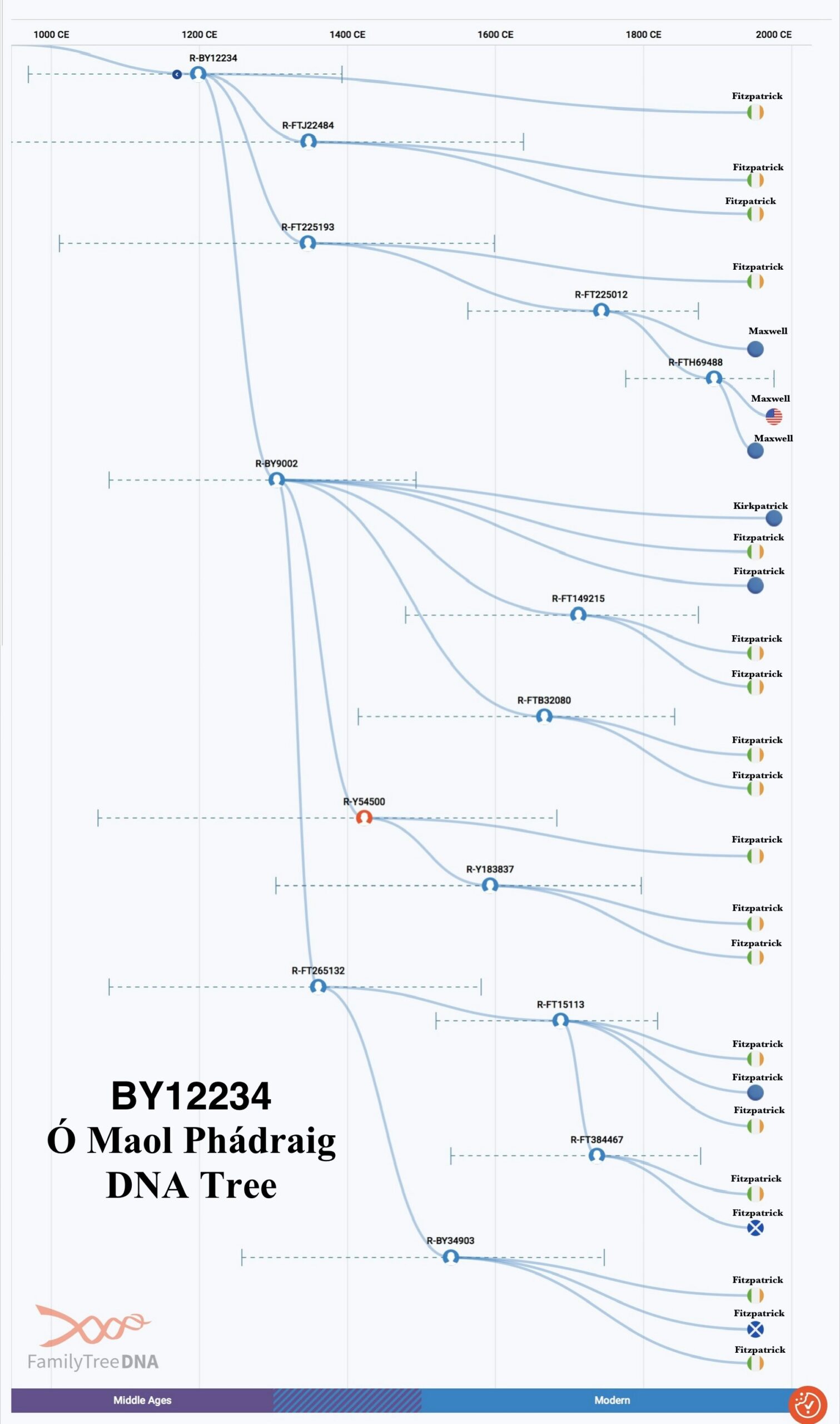
The Y-DNA branch R-BY12234 contains a substantial group of modern men bearing the surname Fitzpatrick and represents the principal surviving paternal lineage being examined in this research.
The most striking feature of the tree is its age.
The present FamilyTreeDNA estimate places the common paternal ancestor of the surviving BY12234 lines at approximately 1200 CE. More importantly, the tree does not remain as a single line for several centuries after that date. A number of major branches separate from BY12234 relatively early.
Among those visible on the present tree are lines leading through R-FTJ22484, R-FT225193, R-BY9002 and R-FT265132, while other surviving lines appear to descend directly from BY12234 itself. BY9002 then undergoes substantial further diversification, producing several branches whose descendants survive today.
The precise dates should not be read as calendar dates for particular births. A label placed near 1200 CE does not mean that a man carrying a particular mutation was born in the year 1200. It represents an estimated period in which the common paternal ancestor of the tested descendants probably lived.
That distinction is essential.
How the dates are estimated
The dating of a Y-DNA branch is based primarily upon mutations in the Y chromosome.
A SNP, or single nucleotide polymorphism, is a change at a particular position on the Y chromosome. Once such a mutation occurs in a man, it can be inherited by his sons and their male-line descendants. When several tested men share the same mutation, they can be placed together on a branch of the paternal tree.
Additional mutations accumulate as descendants separate into different paternal lines.
Consider a simplified example. A medieval man has two sons whose male lines both survive. Over succeeding centuries, mutations accumulate independently in each line. Modern sequencing can identify both the mutations shared by the two descendants and those that developed after their paternal lines separated.
The number and distribution of these mutations provide the basis for estimating how far back their common ancestor probably lived.
The calculation depends upon an estimated mutation rate across the portions of the Y chromosome being examined. Because mutations do not occur according to a perfectly regular clock, the result cannot be an exact date. One generation might produce a mutation while several following generations produce none in the regions being compared. Different tested men may also have slightly different amounts of usable sequence data.
The resulting date is therefore a statistical estimate of the time to the most recent common ancestor, usually abbreviated TMRCA.
This is why the tree includes horizontal dashed ranges around many of the branching points. The central placement represents the estimated date, while the wider range represents the uncertainty surrounding it.
A branch displayed around 1200 CE should consequently be understood as belonging broadly to that historical period, rather than as evidence for an event that occurred in a particular year.
The uncertainty becomes greater as the tree moves farther into the past. Generation lengths must be estimated, mutation rates have statistical variation, and the number of available tested descendants affects the calculation. New Big Y tests can also change the tree. A newly tested man may reveal previously unknown SNPs between two existing branches and refine the estimated age of their common ancestor.
The tree is therefore not fixed forever. It is the best reconstruction possible from the men and mutations currently available.
A useful check on the scale
There is, however, a useful reason for taking the broad chronology seriously.
Two branches within the wider Ó Maol Phádraig dataset can be compared with paternal lines whose documentary genealogies reach back to approximately 1680–1690.
Those known genealogical dates provide a valuable reality check.
The genetic tree does not place their common paternal ancestry hundreds of years away from the period indicated by the documentary records. At the scale being used here, the estimated branching is reasonably consistent with what is independently known from conventional genealogy.
That does not prove that every medieval date on the tree is correct. Two historically documented lines cannot calibrate the entire BY12234 tree, and the further back the reconstruction goes, the greater the uncertainty becomes.
It does show something more modest but useful: the chronological scale of the tree behaves reasonably when it reaches a period for which independent documentary evidence survives.
That gives some confidence in treating the estimate around 1200 CE as a meaningful historical horizon, provided that it is not mistaken for an exact date.
What happened around 1200?
This is where the DNA becomes relevant to the history already examined.
If the present estimate is approximately correct, the paternal ancestor represented by BY12234 lived around the period in which hereditary Irish surnames had become established and during a period of profound ecclesiastical and political change.
His surviving descendants did not remain together genetically for another four or five centuries.
They began separating.
That observation alone has important consequences.
By the Tudor period, the Ó Maol Phádraig found at Dowra were therefore not necessarily members of a recently formed family that had only just begun spreading through Bréifne. The surviving paternal branches had already been developing independently for centuries.
The same applies to the Ó Maol Phádraig found much farther south.
Records eventually place members of the surname in Cork and Kerry, while other records place the family within Bréifne and around Dowra. The genealogical tradition also associates Ó Maol Phádraig with Cenél Luacháin.
The DNA cannot tell us which medieval branch went to which place.
That would be forcing history onto the tree.
But it does tell us that the chronological opportunity for such geographical separation existed remarkably early.
The history now looks different
This is important because the historical research has not uncovered a simple territorial Ó Maol Phádraig lordship from which all of these later families can easily be shown to have migrated.
Instead, the research has uncovered something considerably more complicated.
By the thirteenth century, the ecclesiastical world surrounding the family was highly mobile. Clerics, hereditary church families and religious institutions operated across diocesan and political boundaries.
Loch Cé was becoming a major centre of the White Canons. Clarus Mac Mailín Ó Maolchonaire belonged to a hereditary ecclesiastical family and became one of the important churchmen of that century. From Loch Cé the Premonstratensian network expanded outward, including the establishment associated with Lough Oughter in the 1230s.
The foundation of a religious house involved considerably more than moving several canons. Such institutions possessed lands and livestock and required labour, administration and continuing relationships with the families and rulers surrounding them.
No surviving document states that an Ó Maol Phádraig branch travelled to Lough Oughter with the White Canons. It would therefore be wrong to assign one of the BY12234 branches to that movement.
But the chronology is difficult to ignore.
The DNA indicates that surviving paternal lines were beginning to separate around the same broad period in which these ecclesiastical networks were expanding across the regions that later become important in the Ó Maol Phádraig story.
That gives us a possible historical mechanism without giving us permission to identify the individuals who used it.
Four Possible Historical Settings
The historical evidence now suggests four possible settings in which early Ó Maol Phádraig paternal lines may have become established: Cork, Dowra, the Drumreilly–Oughteragh territory of Cenél Luacháin, and Lough Oughter.
Cork represents the southern branch of the historical record, where the surname appears far from Bréifne.
Dowra provides another concentration, with several Ó Maol Phádraig men recorded in the district by the early seventeenth century.
Drumreilly and Oughteragh belong to the ecclesiastical territory of Cenél Luacháin, where the Ó Maolmochéirghe held hereditary church offices and extensive lands and where the genealogical tradition places the Ó Maol Phádraig.
Lough Oughter provides a fourth possibility. The White Canons established a new religious centre there during the thirteenth century as part of the wider expansion associated with Loch Cé.
These four settings were identified from the historical record before the DNA was considered.
The DNA now contributes something different. It shows that the surviving BY12234 paternal lines were already beginning to separate around 1200 CE.
It cannot tell us which branch belonged to Cork, Dowra, Cenél Luacháin or Lough Oughter. Nor can it explain why particular branches became established in different places.
What it does show is that the chronology allows for that separation to have happened early.
The historical evidence points to more than one possible geographical setting for the family. The DNA independently shows that the surviving paternal line was already dividing at approximately the same broad period.
For now, that is the important comparison. The history provides the possible places; the DNA provides the approximate timetable.
The later articles can return to individual branches and ask whether subsequent testing, documented genealogies and geographical origins allow any of them to be connected more securely with particular parts of the historical landscape.
At this stage, the important result is simpler: the DNA does not force us to rewrite the history uncovered so far. Instead, its earliest branching appears remarkably compatible with it.
References
Annals of Connacht. Edited by A. Martin Freeman. Dublin: Dublin Institute for Advanced Studies.
Annals of Loch Cé. Edited by William M. Hennessy. 2 vols. London: Longman, 1871.
Calendar of Entries in the Papal Registers Relating to Great Britain and Ireland: Papal Letters. London: His Majesty’s Stationery Office.
Clyne, Miriam. “Medieval Loch Cé: Monastery, Landscape and Estate.”
Earley, Joseph E., Sr., and Leonard E. Boyle. “Conflict over the Rectory of Cinel Luachain during the Fifteenth Century.” Bréifne 9, no. 35 (1999): 103–113.
FamilyTreeDNA. Discover Y-DNA Haplotree and Time Tree for R-BY12234 and its downstream branches.
Fitzpatrick, Ian, and Mike Fitzpatrick. “Ó Maol Phádraig: the Name, the People, and the Clans. Part I.” Journal of the Fitzpatrick Clan Society 4 (2023): 1–10.
Fitzpatrick, Mike, and Proinsias Mag Fhionnghaile. “Ó Maol Phádraig: the Name, the People, and the Clans. Part II.” Journal of the Fitzpatrick Clan Society 5 (2024): 25–42.
Fitzpatrick, Matthew, and Mike Fitzpatrick. “Ó Maol Phádraig: the Name, the People, and the Clans. Part III.” Journal of the Fitzpatrick Clan Society 6 (2025): 27–41.
Ó Scea, Ciaran. “Erenachs, Erenachships and Church Landholding in Gaelic Fermanagh, 1270–1609.” Proceedings of the Royal Irish Academy 112C (2011): 271–300.
Placenames Database of Ireland. Entry for Dowra / An Damhshraith.
Twemlow, J. A., ed. Calendar of Entries in the Papal Registers Relating to Great Britain and Ireland: Papal Letters. London: His Majesty’s Stationery Office.