
Two Fitzpatrick families and the survival of an agricultural tradition in nineteenth-century Ireland
By the middle of the nineteenth century, the countryside around Pettigo and Drumkeeran in southwestern Fermanagh was divided among farms, grazing holdings and the estates of families whose ownership of the land extended back through generations. Along the Donegal border, the rural population lived within a network of townlands connected by family relationships, agricultural employment and the movement of livestock between neighbouring holdings.
Among these families were the Fitzpatricks, whose presence in the district can be traced through the surviving land records and their longstanding association with the Acheson family. Two men in particular emerge from the records of the Clonelly estate: Acheson Fitzpatrick, known as Black, and Acheson Fitzpatrick, known as White.
Their unusual shared name provides an immediate indication of an established family network. Their occupations offer something more: a glimpse into the responsibilities held by Fitzpatrick men within the agricultural economy of nineteenth-century Fermanagh.
The Fitzpatricks of Clonelly
The Clonelly estate had belonged to the Barton family since 1754, when Thomas Barton acquired the property. During the following half-century, the family consolidated its position among the landed proprietors of Fermanagh. Around 1805, William Barton built a new country house at Clonelly, establishing a residence that would remain associated with his descendants into the twentieth century.
William’s son, Folliott Warren Barton, served as High Sheriff of Fermanagh in 1834 and inherited Clonelly the following year. The estate comprised approximately 2,660 acres, with holdings extending into the surrounding countryside, including land associated with Clonaweel and Aghahannagh.
The Barton property occupied a landscape where small tenant farms existed alongside larger agricultural holdings. Grazing land, cattle, farm buildings and cultivated fields required constant attention. Much of this work fell to local men whose knowledge of the countryside had developed through generations of farming.
The two Acheson Fitzpatricks appear within this setting in Griffith’s Valuation, compiled for the district during the middle decades of the nineteenth century.
At Clonaweel, Acheson Fitzpatrick (Black) was associated with a caretaker’s house and land, while Acheson Fitzpatrick (White) occupied a herd’s house and land. Both holdings were connected with property under Folliott Warren Barton.
The descriptions distinguish their places within the agricultural workings of the estate. A caretaker was responsible for property entrusted to his care, which could include buildings, land and agricultural facilities. The responsibilities of a herd centred upon livestock, particularly cattle, their grazing arrangements and their protection throughout the year.
Cattle represented a substantial investment. Their welfare depended upon experienced men who understood pasture, seasonal grazing, animal health and the practical difficulties of managing stock across scattered holdings. On larger properties, a herd could be responsible for animals belonging to the landlord or to a principal agricultural tenant.
The caretaker’s position involved a different but related form of responsibility. Estate buildings, occupied holdings and agricultural property required regular supervision, particularly where owners or principal tenants were not continually present.
Both positions depended upon familiarity with the property and the confidence of those responsible for its operation. The houses associated with these occupations also suggest that the work was closely integrated with the occupants’ daily lives.
The valuation records contain a further detail. Both Acheson Fitzpatrick (Black) and Acheson Fitzpatrick (White) appear in the holdings for Aghahannagh as well as Clonaweel.
This gives the two men a wider agricultural presence than their occupational houses alone might suggest. Their names were attached to property in neighbouring townlands, raising the possibility that they combined estate responsibilities with separate agricultural holdings.
Such arrangements were common in rural Ireland. An employee might occupy a house associated with his work while also renting or farming land elsewhere. The acreage and tenure of the individual Fitzpatrick holdings remain to be reconstructed from the original valuation pages and maps, but the double appearance of both men provides an avenue for following their activities beyond a single estate holding.
The records also preserve the distinction between Black and White, a practical form of identification widely used in communities where personal names were repeated. Although such descriptions sometimes arose from differences in complexion or appearance, their precise origins in this case are unknown.
The shared forename Acheson is more revealing of the families’ history.
Acheson was a surname established in northwestern Ulster by the seventeenth century. Members of the family appear around Drumquin by 1631, while the later Acheson family of Pettigo can be traced through a surviving pedigree beginning in 1679.
The name subsequently became established as a forename among the Fitzpatricks of the Pettigo–Drumkeeran district. Its recurrence suggests the influence of marriage and kinship relationships through which maternal surnames were preserved in succeeding generations.
This practice was particularly common among families seeking to retain connections with both sides of their ancestry. A maternal surname might be given to a son, repeated among descendants and eventually become a recognizable marker of a particular family branch.
The Fitzpatrick presence around Aghahannagh, Clonaweel, Killen and the neighbouring townlands belongs to this broader local history. The repeated Acheson name links households whose family relationships had developed within the same agricultural district over many years.
By the time of Griffith’s Valuation, the two Acheson Fitzpatricks were therefore part of an established regional community, with family connections extending beyond the immediate property of the Barton estate.
The surviving records of Clonelly also reveal the tensions surrounding landlord authority during the years of the Great Famine.
On 31 October 1845, Folliott Warren Barton was shot and seriously wounded while returning from a visit to relatives at The Waterfoot. The attack attracted considerable attention, and an investigation followed during the opening months of the famine.
Two Fitzpatrick brothers were arrested on suspicion of involvement. One, James Fitzpatrick, died of fever while imprisoned at Enniskillen. Contemporary newspaper accounts reported that the surviving brother maintained their innocence and that the men had previously been regarded as loyal Protestants. No conviction resulted from the investigation.
The identity of the surviving brother and the relationship of these men to other Fitzpatrick households around Clonelly remain unresolved. The episode nevertheless adds two more Fitzpatrick names to the local history during the same decade in which the Black and White Acheson Fitzpatricks were living in the district.
Later examination of the Barton shooting has also raised questions about the personal circumstances surrounding the attack, including local resentment connected with the landlord’s conduct. The affair unfolded within a community already experiencing the strains of unequal landownership, agricultural insecurity and the first devastating effects of potato failure.
For men employed within the estate system, these tensions formed part of everyday life. Their accommodation, wages and agricultural opportunities could depend upon relationships with landowners and principal tenants, while their families remained closely connected with the wider rural population.
The positions occupied by the two Acheson Fitzpatricks placed them directly within that relationship. They were responsible for aspects of agricultural property in a district where control of land shaped the economic circumstances of almost every household.
Their story also raises a question about the skills and experience that rural families carried through generations. The ability to manage cattle, care for property and maintain agricultural holdings could be learned within families and developed through long familiarity with a particular landscape.
Several hundred kilometres south, in County Cork, another Fitzpatrick family can be followed through a much longer succession of agricultural occupations.
Henry Fitzpatrick and the Estates of Eastern Cork
The countryside of eastern Cork contained some of Ireland’s most productive agricultural land. Across the barony of Barrymore, farms, grazing holdings, country houses and cultivated estates formed a landscape in which generations of families earned their livelihoods through agriculture.
Among the earliest identifiable members of one Fitzpatrick family in this district was Henry Fitzpatrick, born around 1800–1810 and described in the surviving family records as a farmer.
Little has yet been established about the size of Henry’s holding or the terms under which he occupied the land. His identification as a farmer nevertheless places the family within Cork’s agricultural economy during the first half of the nineteenth century, before the Great Famine transformed the lives of rural households across the county.
His son, also named Henry Fitzpatrick, was born around 1826–1830. In 1858, the younger Henry married Jane Goulding at Ballylanders, County Limerick, extending the family’s known connections into another agricultural district.
The younger Henry’s subsequent records provide a particularly useful account of his working life. Family research also identifies a period of service as a policeman, reflecting an occupational path that was not confined to farming. By the late 1860s, however, he was established in agricultural employment in eastern Cork.
In 1869, Henry was described as a land steward at Ballynaclashy, a townland associated with the extensive Smith-Barry properties.
Ballynaclashy was situated within a region dominated by substantial landed interests, including the holdings of the Smith-Barry family. At the time of Griffith’s Valuation in the early 1850s, Ballynaclashy House was occupied by Henry Wilson, who held the property from James Hugh Smith Barry. The house was valued at £10 10s.
Nearby Ballycurrany House was occupied by Joseph Wilson, who likewise held property from James Hugh Smith Barry. By the 1870s, Henry Wilson of Ballynaclashy was recorded as an owner of 83 acres, adding another indication of the substantial agricultural interests associated with the family.
The presence of the Wilsons reveals the layered arrangements common to nineteenth-century estates. A great landowner might hold the superior title to a property while individual farms or houses were occupied by substantial tenants, some of whom maintained their own agricultural employees.
Henry Fitzpatrick’s employment as a land steward places him within this system of agricultural supervision. His immediate employer has not yet been identified, although Henry Wilson and the surrounding Smith-Barry holdings offer promising lines of investigation.
The work of a land steward varied according to the size and character of the property. On a working farm, responsibilities might include organizing labour, supervising cultivation, overseeing livestock, maintaining agricultural buildings and coordinating the seasonal work required to keep the holding productive.
Such employment called for practical knowledge accumulated over time. A successful steward needed to understand the land as well as the people and animals working upon it.
Ballynaclashy provides an especially interesting setting for Henry’s occupation because of its place within the older Barry territories of County Cork.
The Barry Connection
The de Barry family had been established in Munster since the Anglo-Norman settlement of Ireland. Over succeeding generations, branches of the family acquired extensive properties in Cork and became prominent in the political, legal and agricultural life of the county.
Their territories extended across districts where Gaelic and Anglo-Norman families interacted through landholding, legal proceedings, military obligations and local administration. Among the Gaelic surnames appearing in this medieval world was Ó Maol Phádraig.
In 1306, a man recorded as Robert Omolpatrik, or Robert Ó Maol Phádraig, appeared in the Irish justiciary proceedings associated with a dispute involving Eustace le Poer and Philip de Barry of Kilbrin. Robert was named among men summoned for jury service in proceedings connected with the de Barry family.
The entry places an Ó Maol Phádraig within the legal world of medieval Cork more than five centuries before Henry Fitzpatrick’s employment at Ballynaclashy. Jury service was an established part of the administration of justice, drawing upon men whose local presence and knowledge were relevant to the proceedings.
The justiciary records also contain proceedings involving Henry, son of Philip de Barry, providing further detail about the legal affairs of the family during this period.
The association between the Ó Maol Phádraig surname and the landed families of southern Ireland continued to appear in later centuries.
In September 1577, a pardon record included Domhnall mac Conchobhair Ó Maol Phádraig among individuals associated with the Mac Donagh family of Duhallow. Further appearances followed in the Cork pardon records of 1585, including Tadhg mac Conchobhair and Conchobhar Óg mac Conchobhair Ó Maol Phádraig of Rahanisky.
During the final years of the Nine Years’ War, additional members of the family appeared among men associated with the Mac Cárthaigh, Barry and FitzGerald networks of southern Munster. The pardons of 1601 preserve several Ó Maol Phádraig names in these settings, demonstrating the surname’s continuing presence within the complicated political and landed relationships of Cork.
By the nineteenth century, the Smith-Barrys had inherited and consolidated extensive agricultural properties in the same broad region. James Hugh Smith Barry held major estates in Cork during the first half of the century, and the properties subsequently passed to Arthur Hugh Smith Barry in 1856. By the 1870s, the family’s holdings in County Cork amounted to nearly 13,000 acres, with further substantial lands in Tipperary and Louth.
It was within this longstanding Barry landed landscape that Henry Fitzpatrick was employed at Ballynaclashy in 1869.
The medieval and nineteenth-century records are separated by more than 560 years. The extent of Barry landownership across eastern Cork offers a straightforward geographical explanation for Henry’s employment in the district. Whether any memory of the earlier relationships survived among the families is beyond the present evidence.
Nevertheless, Henry’s presence at Ballynaclashy reconnects the Fitzpatrick surname with a landed environment in which an Ó Maol Phádraig had appeared as early as 1306. The record gives the Cork family’s nineteenth-century agricultural history a geographical setting rooted in the medieval development of the region.
Henry’s subsequent movements allow that history to be followed beyond Ballynaclashy.
By 1875, he was described as a farm steward at Ballycrana, another agricultural locality in eastern Cork. The change of location suggests that his experience was useful beyond the property where he had worked in 1869.
The move may eventually be better understood through the estate records of Ballycrana. Identifying the principal occupiers and landowners in the 1870s could establish whether Henry remained within a connected group of employers or moved independently between agricultural properties.
In 1876 and 1877, Henry’s occupation was recorded as gardener at Ballinglanna, another locality within the barony of Barrymore.
The change from farm steward to gardener is particularly interesting when considered in the context of nineteenth-century country estates. Gardening involved considerably more than maintaining ornamental flower beds. Large houses and substantial farms maintained kitchen gardens, orchards, nurseries, cultivated grounds and sometimes glasshouses, providing food and plants for household and agricultural use.
The management of such gardens required an understanding of soils, drainage, planting, propagation, pruning and seasonal cultivation. Experienced gardeners might supervise other workers, organize planting programmes and maintain productive grounds throughout the year.
The precise responsibilities of Henry’s position at Ballinglanna remain to be established, but his earlier employment as a land and farm steward suggests a man whose working experience extended across several forms of skilled agricultural employment.
The Ballinglanna area contained substantial houses and properties associated with established landholding families, including the McCalls, whose interests also extended into neighbouring Glyntown. Estate rentals and employment records may eventually identify the property on which Henry worked and the circumstances that brought him there.
Across the decade from 1869 to 1877, the surviving records place Henry in three agricultural localities, twice with explicit supervisory titles. They provide evidence of sustained involvement in the practical management and cultivation of land during a period when Irish agriculture was changing rapidly.
His descendants continued in related occupations.
Henry’s son John Fitzpatrick was born at Ballynaclashy in 1869, during the period when his father was working there as a land steward. John also became a gardener, carrying the family’s experience in cultivated land into another generation.
John’s son, John George Fitzpatrick, born in 1897, continued the agricultural association. Family records connect him with the country-estate landscape around Old Connaught in County Dublin, where substantial houses and their cultivated grounds provided employment for gardeners and other agricultural workers.
John George subsequently emigrated to Australia, where he worked as a dairyman.
The move to Australia carried the family’s agricultural history into a very different environment. Dairying required practical knowledge of livestock, pasture, feeding and the seasonal routines of farm work. Although the work differed from the stewardship and gardening occupations recorded in Cork, it continued the family’s close association with productive land and animals.
From Henry senior, born near the beginning of the nineteenth century, through Henry junior, John and John George, four generations of the family can be associated with farming or skilled agricultural employment.
Their movements took them from rural Cork into the Dublin area and eventually overseas. The succession of occupations reflects both continuity within the family and the adaptability required of agricultural workers as the Irish economy changed.
The northern Fitzpatricks of Fermanagh and the southern family of Cork were living within different agricultural landscapes, but their surviving records reveal related forms of work. The northern men cared for estate property and livestock, while the Cork family developed a particularly well-documented history of agricultural supervision and cultivation.
These occupations also invite consideration of an older chapter in Fitzpatrick history.
From Gaelic Landholding to the Estate Economy
The nineteenth-century landed estates of Ireland had developed through centuries of political and social transformation.
In medieval Gaelic Ireland, landholding and agricultural production were organized through lordships, kinship groups and local communities whose relationships were shaped by customary obligations. Powerful families depended upon the resources of their territories, including farmland, pasture, livestock and the labour required to maintain them.
The Ó Maol Phádraig family had emerged within this world, particularly in the regions associated with the northern Connacht and Bréifne borderlands. As the surname spread into neighbouring territories, its members entered the political and agricultural networks of other ruling families.
By the sixteenth century, Ó Maol Phádraig men appeared in records involving the Ó Raghallaigh, Tyrrell and other prominent families of the Irish midlands and northwest.
The surviving pardon records provide glimpses of their positions within these households and communities. They include individuals associated with the Ó Raghallaigh territories of Cavan and the Tyrrell interests around Westmeath and neighbouring districts.
One particularly useful group of records belongs to the final years of the Nine Years’ War and the first years of the Stuart monarchy.
In 1603, a pardon associated with the Tyrrell network included several Ó Maol Phádraig men. The following years brought further appearances, including William Ó Maol Phádraig, described as a yeoman, among individuals associated with the Tyrrell household and its connections.
A yeoman occupied a recognizable position within the agricultural society of the period. The designation could encompass men farming land or possessing a degree of economic independence and standing within their communities. The precise circumstances of William’s employment are not recorded, but his identification adds another example of an Ó Maol Phádraig man situated within the agricultural and landed networks of early seventeenth-century Ireland.
Further north, the family appears within the changing estate structures of Fermanagh.
In 1623, Ó Maol Phádraig tenants were recorded on lands associated with the Butler interests at Dresternan. The estate connections reached toward Castle Butler and Belturbet, within a region undergoing the consequences of plantation, redistribution of land and the extension of English-style estate administration.
The Fermanagh record is particularly useful because it places members of the family within an agricultural tenancy system whose basic structure would remain familiar in Ireland for generations.
The families occupying such lands lived through an era in which older forms of Gaelic authority were being displaced by new arrangements of landownership. Tenancy, rent, leases and estate administration increasingly shaped the relationship between rural households and the properties they cultivated.
The changes did not eliminate the need for agricultural knowledge. The management of cattle, pasture, cultivation and farm buildings continued to depend upon practical skills acquired through experience.
Within families, such knowledge could pass from one generation to another. Men who had grown up on farms learned the seasonal routines of cultivation, the care of livestock and the organization of work long before they appeared in surviving records as farmers, herds, gardeners or stewards.
The nineteenth-century occupations of the Fermanagh and Cork Fitzpatricks fit within this longer history of adaptation to changing landholding structures.
By the time the Black and White Acheson Fitzpatricks occupied their holdings at Clonaweel, and Henry Fitzpatrick was employed at Ballynaclashy, the political world of the medieval Ó Maol Phádraig family had disappeared. Landlord estates had replaced the old Gaelic lordships, while the surname itself had largely assumed its anglicized form.
The families remained connected to the agricultural economy, however, through occupations requiring experience with property, crops, pasture and livestock.
The northern records show Fitzpatrick men with responsibilities associated with the care of estate holdings. The southern records reveal a longer succession of individuals who continued in skilled agricultural work across four generations.
The possibility that these occupations reflect skills preserved within particular family traditions offers an intriguing interpretation of the evidence. Such continuity would have operated through everyday family experience rather than through the formal survival of a medieval office or title.
By the nineteenth century, the two families had developed separate histories in distant parts of Ireland. Their documented relationships, employers and local circumstances were distinct, and the surviving paper records offered no clear indication of how far back their shared surname might connect them.
Modern genetic research has now provided an unexpected answer.
The Common Ancestor
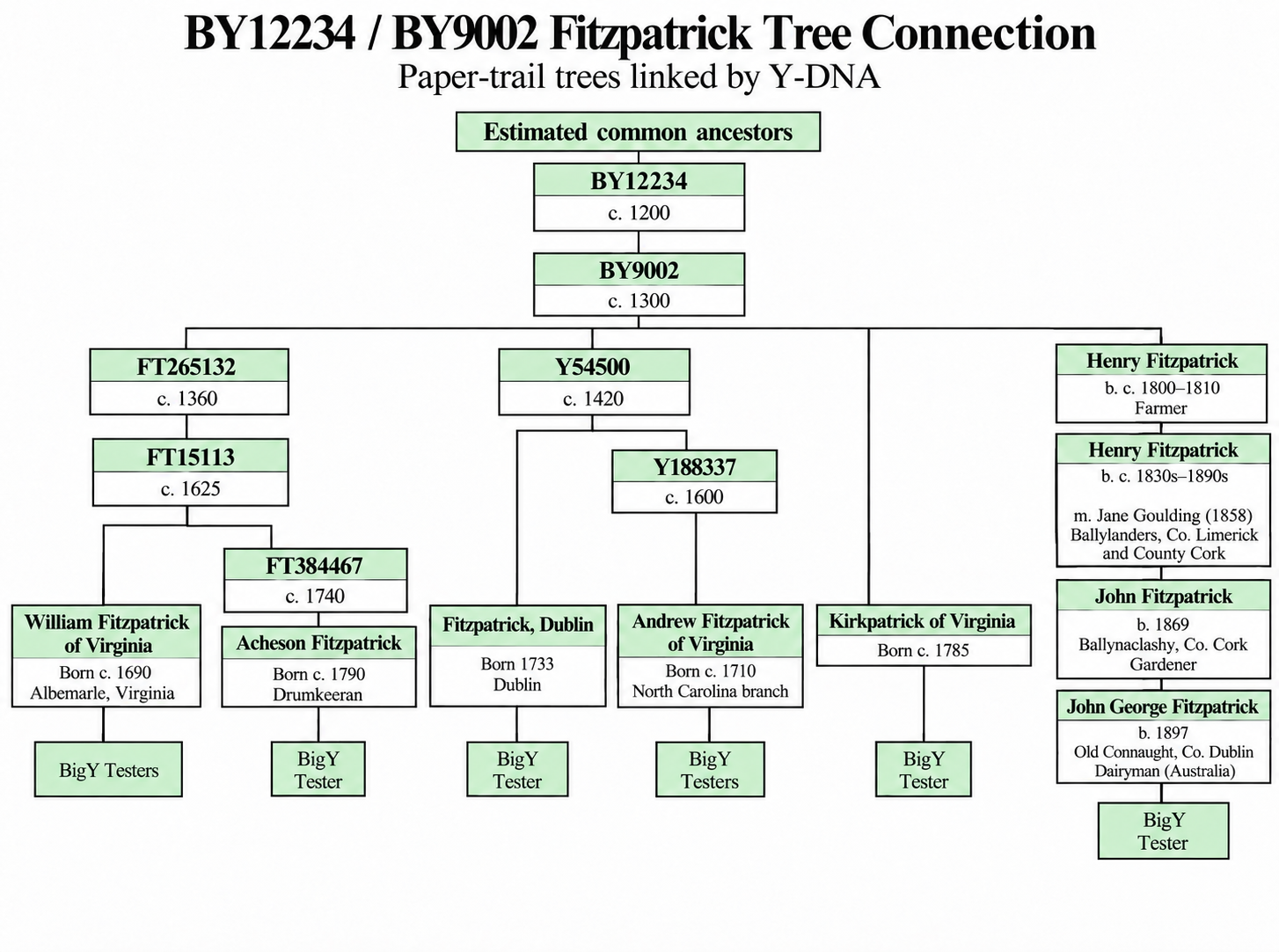
The Acheson Fitzpatrick family of Fermanagh belongs to a paternal lineage identified through Y-chromosome DNA as R-FT15113, a branch whose descendants can be traced through the Pettigo–Drumkeeran district and into colonial Virginia.
The Henry Fitzpatrick family of Cork is also independently represented in Big Y testing. Its paternal lineage belongs to the wider R-BY9002 family, within the genetic ancestry associated with Ó Maol Phádraig.
When the two paternal lines are followed backward, they converge upon the same ancestral branch.
R-BY9002 — an estimated common paternal ancestor around AD 1300.
The two nineteenth-century families were therefore descendants of a shared medieval paternal ancestry, separated by approximately five and a half centuries of family history.
Their records had led in different directions: one through the Acheson families and the estates of Fermanagh, the other through the farmers, stewards and gardeners of eastern Cork. Their shared ancestry had remained hidden until the development of modern Y-DNA research.
The estimated ancestral period takes us back to the generation of the medieval Ó Maol Phádraig family living around the beginning of the fourteenth century, approximately the same era in which Robert Ó Maol Phádraig appeared in the Cork justiciary records of 1306.
The DNA evidence does not identify Robert as their common ancestor, but it reveals that the paternal separation between the northern and southern lines reaches back to the medieval world in which the surname was already established.
The documentary histories provide the occupations, the estates and the generations through which these families can be followed. The genetic evidence establishes the older relationship connecting them.
By the nineteenth century, descendants of that common paternal family were living hundreds of kilometres apart, carrying out related agricultural work within two entirely different estate systems.
What began as a comparison between the caretaker and herd of Clonelly and the stewards and gardeners of Cork ends with the discovery that their families shared an ancestor in medieval Ireland, around the year 1300.
The two histories had followed separate paths for more than five hundred years. Their common origin had survived in the paternal line.
Sources and Further Reading
1. Griffith’s Valuation, Parish of Drumkeeran, County Fermanagh, Clonaweel and Aghahannagh.
2. PRONI, D1028, Barton of Clonelly Estate Papers, 1835–1935.
3. PRONI, D1016/4–5, Clonelly Estate Maps, 1769 and 1826.
4. PRONI, D1390/13 and D1390/21, Barton Estate Papers.
5. National Library of Ireland, Pedigree of the Acheson Family, Pettigoe, Co. Fermanagh, 1679–1904.
6. PRONI, D722, Acheson Family Papers.
7. J. B. Cunningham, “The Investigation into the Attempted Assassination of Folliot Warren Barton near Pettigo, on 31 October 1845,” Clogher Record, 1990, pp. 125–145.
8. Ballyshannon Herald, 1845–1846.
9. Griffith’s Valuation, County Cork, Barony of Barrymore, Ballynaclashy, Ballycurrany, Ballycrana and Ballinglanna.
10. University of Galway, Landed Estates Database, Barry/Smith-Barry Estate, Ballynaclashy House, Ballycurrany House and Ballinglanna.
11. PRONI, T3364, Smith-Barry Estate Papers.
12. Fitzpatrick Family Civil Registration and Genealogical Records, 1858–1877.
13. Henry Fitzpatrick Family Genealogy, County Cork, County Dublin and Australia.
14. James Mills, ed., Calendar of the Justiciary Rolls, or Proceedings in the Court of the Justiciar of Ireland, 1305–1307. Dublin, 1914.
15. Fiants of the Tudor Sovereigns, Irish Pardons, 1577–1605.
16. Irish Patent Rolls, 1623, Fermanagh.
17. Ó Maol Phádraig / Fitzpatrick Y-DNA Research, R-BY12234, R-BY9002 and R-FT15113.
18. Fitzpatrick Family Genealogical and Y-DNA Research, Pettigo–Drumkeeran, County Cork, Colonial Virginia and Australia.