
A Familiar Name in Virginia
In the previous post, I followed William Fitzpatrick from his appearance in colonial Virginia in 1738 back toward a possible homeland in the Pettigo–Drumkeeran district of northwestern Ireland. The investigation brought together William’s Y-DNA, his early land transactions, the families surrounding him in Virginia, and a series of connections pointing toward the Presbyterian communities of Fermanagh and western Tyrone.
One surname in particular continued to attract my attention: Gay, also appearing in Ireland as Guy.
Samuel Gay was closely associated with William Fitzpatrick in Albemarle County. He witnessed William’s will in 1762, and the relationship between the families continued into another generation when Samuel’s daughter Rebecca married a later William Fitzpatrick. The Gay family was therefore more than another surname appearing in the same county. There was a demonstrable personal and marital connection.
But Gay was also a prominent surname among the Presbyterian settlers of Augusta County, where another early Fitzpatrick family had become established. Andrew Fitzpatrick, whose paternal ancestry belongs to a different branch of the same medieval Ó Maol Phádraig population, appears in the Borden Grant settlement during the 1740s. His associations included many of the families familiar from William’s Virginia surroundings.
The repeated Gay surname prompted a wider comparison. Were William and Andrew participating in the same migration movement? Had their families belonged to the same Presbyterian community before leaving Ireland? And if so, might their shared medieval Ó Maol Phádraig ancestry have something to do with it?
The investigation became considerably more interesting when a third paternal line entered the picture. This family had adopted, or at least come to use, the surname Kirkpatrick.
Its modern Y-DNA places it within the same medieval Ó Maol Phádraig paternal population as William and Andrew. The Kirkpatrick family also has a well-established genealogy extending into colonial Virginia, and an examination of its ancestry reveals numerous records and family associations that appear to connect with the earlier Kilpatrick records of Augusta County. These include individuals living among the same Presbyterian families and participating in the same local networks already encountered in the William and Andrew investigations. Although the precise documentary connections between some of these early Kirkpatrick and Kilpatrick individuals remain to be established, the combination of genetic evidence, geographical proximity and recurring family associations makes this third line particularly intriguing. The Kirkpatrick ancestry will certainly be the subject of a more detailed investigation in the future, as there is considerably more to uncover about its early Virginia history and possible origins in northwestern Ulster.
I was now examining three distantly related branches of one Gaelic Irish family, all associated with the Virginia settlement landscape of the eighteenth century. The surrounding surnames were overwhelmingly Scottish or Ulster Presbyterian, and the results of comparing them were remarkable.
Three Branches Separated by Four Centuries
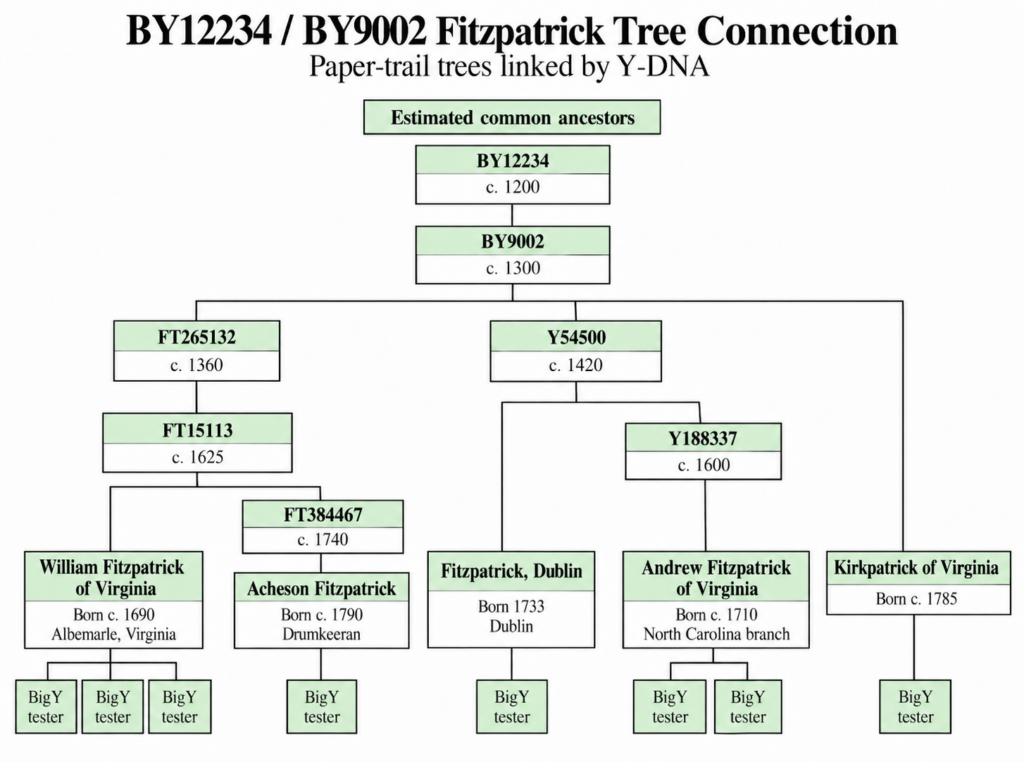
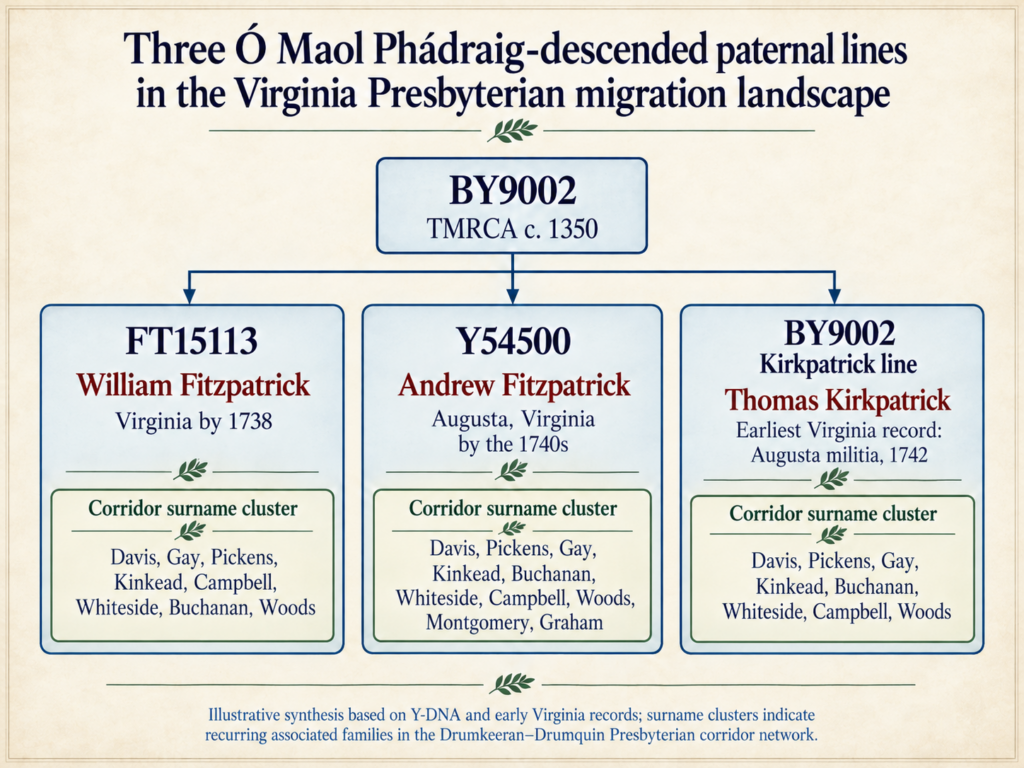
The Y-DNA provides the starting point. All three paternal lines belong beneath R-BY9002, with their shared paternal ancestry estimated around 1300–1350 CE.
William Fitzpatrick belongs to the FT15113 branch. Andrew Fitzpatrick belongs to Y54500, a separate downstream branch. The Kirkpatrick lineage is represented by a tested BY9002 paternal line.
This is not the genetic relationship expected from three brothers, first cousins or even families whose paternal ancestors separated shortly before emigration. Their common ancestor lived approximately four centuries before they appeared in America. By the early eighteenth century, each line could have developed its own family history, geographical associations and social identity.
Yet their descendants appear within the same broad colonial settlement environment.
William was established in Virginia by 1738. Andrew was living in the Borden Grant region by the 1740s. The Kirkpatrick family tree extends into eighteenth-century Virginia, while earlier records establish other Kirkpatrick men in Augusta County by 1742.
The earliest of those records identifies Thomas Kirkpatrick in Captain John Wilson’s militia company. George Kill Patrick and Thomas Killpatrick subsequently appear in the Augusta road orders of 1746. Although those particular men have not been genetically connected to the modern BY9002 Kirkpatrick tester, their appearance provides valuable evidence of the surname within the settlement community under investigation.
There is another important difference between the three paternal lines. William and Andrew retained Fitzpatrick, a surname associated with Gaelic Ireland. The third line appears as Kirkpatrick, a surname readily recognizable within Scottish society.
I have not established when this name change occurred. Nevertheless, the appearance of a genetically Ó Maol Phádraig-descended family under a Scottish-associated surname is entirely compatible with the cultural circumstances of Plantation Ulster.
The three families need not have regarded themselves as close relatives. They may not even have known one another personally in Virginia. What interests me is the possibility that they had already become part of the same wider community before emigrating.
The Names Surrounding William, Andrew and Kirkpatrick
The comparison began with Gay, but it soon became apparent that the overlap extended much further.
Davis, Pickens, Gay, Kinkead, Whiteside, Buchanan, Campbell, Woods, Montgomery and Graham repeatedly appeared in the records of western Virginia. They were not simply scattered surnames collected from unrelated counties. Many occurred together in Presbyterian congregations, land transactions, road-working districts, witness lists and marriage relationships.
Several also had documented associations with the Presbyterian communities of northwestern Ulster, particularly the district extending from Drumkeeran and Pettigo through Drumquin, Castlederg, Ardstraw and Strabane.
The number of records connecting these families is considerable. I have deliberately selected some of the clearest examples rather than attempt to reproduce every deed, church subscription, road order, marriage and probate reference. Such an exercise would quickly overwhelm the purpose of this post.
The important distinction is that many of these connections are personal and documentary, not merely geographical. These were individuals who witnessed one another’s transactions, married into one another’s families, belonged to the same congregations, held neighbouring properties and sometimes moved into new settlements together. The repeated surnames provide the initial clues, but the surviving records establish relationships extending well beyond coincidence of location.
William Fitzpatrick and the Albemarle Families
William’s earliest Virginia history involves Robert Davis, from whom he acquired land in 1738.
The Davis surname recurs throughout the settlement records and was closely associated with the Pickens family in the wider Virginia and Carolina migration. An early Davis–Pickens family tradition places their Irish origins around Drumquin in County Tyrone.
The Gay connection is more personal. Samuel Gay witnessed William Fitzpatrick’s will, and a later marriage between Rebecca Gay and another William Fitzpatrick joined the families directly. This was a relationship extending across generations rather than an isolated appearance in a legal document.
The Kinkead and Whiteside surnames also appear among the Presbyterian families of western Albemarle. The 1747 call to Reverend Samuel Black records numerous families who subsequently appear in the wider Presbyterian settlement history of Virginia.
Taken together, these associations place William within a recognizable social environment rather than among a random collection of colonial landowners. The connections were maintained through ordinary family and community relationships, precisely the sort of associations that could influence where settlers obtained land, whom they married and where their descendants eventually moved.
Andrew Fitzpatrick and the Augusta Congregation
Andrew’s community provides even clearer evidence.
In 1753, Andrew Fitzpatrick joined the subscribers calling Reverend John Brown to serve the New Providence and Timber Ridge Presbyterian congregations. The same document names Samuel Davis, William Davis, Robert Kirkpatrick, Samuel Buchanan, Robert Gamble, John Lowry, Moses and William Whiteside, Alexander Miller and numerous other settlers.
The significance of the document is that these people were participating in the same congregation. They were not merely recorded somewhere within the enormous territory administered as Augusta County. They had joined in a common undertaking to obtain a Presbyterian minister for their community.
Other records reinforce their geographical and personal connections. In 1764, the local land processioning records again place Andrew Fitzpatrick among William Davies, members of the Buchanan family, Samuel Dunlap, Andrew Hays and other neighbouring landholders.
Andrew’s relationships with the Davis family were also personal. Later testimony identifies Mary Davis as his wife and Samuel Davis as his brother-in-law. This is an important distinction because the relationship between Andrew and the Davis family was established through marriage, not simply inferred from adjoining farms or shared participation in Presbyterian affairs.
Here again, a Fitzpatrick family was firmly embedded within a Presbyterian settlement community, maintaining relationships with families already familiar from the wider investigation.
The Kirkpatrick Records
The Kirkpatrick surname appears in precisely this environment.
In 1742, Thomas Kirkpatrick was enrolled in Captain John Wilson’s Augusta militia company, alongside Robert Davis and Morris O’Friel.
An especially revealing record follows in August 1746. Robert Davis was appointed overseer of a road running from North Mountain toward William King’s property. Among the men ordered to maintain it were George Kill Patrick, Samuel Kinkead and Andrew Pickens, together with James Mills, Hugh Young and other neighbours.
Thomas Killpatrick and John Davis were assigned to an adjoining section.
This was a functioning community of neighbouring households, participating in the ordinary obligations of colonial settlement. The association of Killpatrick with Davis, Pickens and Kinkead is particularly striking because these are among the surnames already encountered in the William and Andrew investigations.
A later Presbyterian record, the 1753 call to Reverend John Brown, includes Robert Kirkpatrick alongside Andrew Fitzpatrick.
The modern BY9002 Kirkpatrick paternal lineage has a separate documented family history extending into eighteenth-century Virginia. The earlier Augusta Kirkpatrick men have not yet been individually assigned to that genetic branch, but their records establish that the surname was already present in the same settlement world.
The comparison therefore reveals three Ó Maol Phádraig-descended paternal lines and a substantial recurring network of Presbyterian-associated surnames. The pattern extends across different kinds of historical records, while the Y-DNA reveals a medieval paternal relationship that those records alone could never have identified.
Following the Names Back to Northwestern Ulster
The Irish investigation brought the geographical focus increasingly toward the Drumkeeran–Pettigo–Drumquin district, extending northward through Castlederg, Ardstraw, Strabane and Londonderry.
This was not one continuous river valley or a single parish. It was a connected landscape of settlements, agricultural estates, roads and Presbyterian congregations. Families could maintain relationships across parish and county boundaries through trade, marriage, religious affairs and the ownership or occupation of land.
The Presbyterian administrative records provide a particularly useful framework.
The Strabane Presbytery minutes from 1717 onward identify elders and congregational representatives from communities across western Tyrone and neighbouring districts. Among the names encountered are Kinkead, Lowry, Gray and Woods.
Joseph and Charles Kinkead appear in the Ardstraw Presbyterian records during the early eighteenth century. The 1751 will of Joseph Kinkead of Burnaghs supplies a more substantial family context, identifying children and other relatives or associates.
The Gay surname provides another important connection. Gay and Guy families are documented in the Drumquin district itself, as well as in the surrounding communities. Charles Gay appears at Newtownstewart in a 1753 probate index, while other Gay families are found in the wider Presbyterian world of Londonderry and Donegal.
The Drumquin evidence is particularly relevant because the Gay surname was the observation that originally prompted this investigation. It places a family name closely associated with William Fitzpatrick and recurring in Andrew’s Virginia environment within the Irish geographical district already under consideration.
The Davis–Pickens connection is equally interesting because a later family genealogy explicitly identifies Drumquin as the family’s Irish locality. Although parts of that genealogy remain chronologically uncertain, its geographical tradition closely matches the district under investigation.
Whiteside provides another useful connection. Early eighteenth-century records place Whiteside or Whitsitt families in County Tyrone, while the surname appears prominently among Presbyterians in Albemarle and Augusta. Buchanan, Campbell, Graham and other familiar names likewise appear within the wider Plantation and Presbyterian history of western Tyrone and Fermanagh.
Not every Irish family can yet be connected genealogically to its American namesake. Nevertheless, the repeated combination of surnames, Presbyterian institutions and geographical associations points toward a shared migration environment.
The personal relationships established in America give this comparison greater weight. The Virginia records contain marriages, witness relationships, congregational commitments and adjoining landholdings involving families whose surnames recur within the same Irish geographical network.
The explanation worth pursuing is that the three Ó Maol Phádraig paternal lines had become associated with this northwestern Ulster population before their descendants emigrated.
The relationship need not have involved close family bonds. They might have occupied neighbouring farms, participated in the same estate economy, known members of the same congregations or maintained connections through Scottish families with whom they had developed relationships.
In Virginia, these connections continued through landholding, church membership and local administration. Within another generation, several associated families moved onward into North Carolina, including Fitzpatrick, Davis, Pickens, Gay and other Presbyterian households, carrying many of their existing family and community relationships into new settlements.
Andrew Fitzpatrick’s own movement into the North Carolina settlement world makes this continuation particularly relevant. The Fitzpatrick presence was not merely incidental to the movement of neighbouring families. Descendants of the medieval Ó Maol Phádraig population participated in the same geographical expansion.
The network was therefore not confined to one American county. It formed part of a broader movement from Ulster through the Virginia settlements and into the Carolinas.
Other Researchers Have Described This Migration Mechanism
The movement of interconnected Presbyterian families is well established in historical scholarship.
Patrick Griffin’s The People with No Name examines the development of Ulster-Scots identity and the movement of Presbyterian communities into colonial America. His work places religious affiliation, economic opportunity and social relationships at the centre of the migration experience.
Russell M. Reid’s 1988 study of a Scots-Irish frontier population is particularly relevant. Reid found that migration frequently involved networks of families already related through marriage and common descent. These households moved repeatedly over generations, establishing new communities in which familiar family connections continued to influence marriage and settlement.
Peter Nathaniel Moore’s study of the Waxhaws provides another important comparison. The movement from Virginia into the Carolina settlements involved connected families, churches, neighbourhoods and landholding relationships.
Robert Lee Meriwether’s earlier history of South Carolina’s expansion also identifies named families moving through these settlement networks, including Davis and Pickens households. Such studies reinforce the picture of migration as a social process in which family connections and established relationships helped determine where people settled.
These works describe a migration mechanism consistent with the relationships identified around the Fitzpatrick and Kirkpatrick families. They establish that the movement of associated households through Presbyterian communities was a recognizable feature of eighteenth-century migration.
The particular contribution of this investigation is the identification of three distant Ó Maol Phádraig paternal branches within that environment, and the possibility that their association with it began in the Plantation settlements of northwestern Ulster.
How Unusual Were Gaelic Irish Families in This Migration?
To understand the position of the three Ó Maol Phádraig lines, I examined the surnames appearing in early western Virginia records.
The survey drew upon Augusta militia lists, Orange County importation records, the 1744 Tinkling Spring Presbyterian subscriptions, the 1747 Albemarle Presbyterian call and Reverend John Craig’s baptismal records from the 1740s.
Together, these sources yielded 1,772 recorded entries and baptismal events.
In the portion of the material classified individually, recognizably Gaelic Irish surnames represented approximately 3.6%. Applying that observed proportion to the expanded collection produces an estimate of approximately 63 Gaelic Irish entries among 1,772 recorded appearances.
This was an illustrative surname survey, not a census of individual settlers. Some names occur more than once, baptisms represent events rather than separate families, and the Irish total for the expanded collection is estimated. It nevertheless provides a useful indication of the composition of these particular records.
The striking feature is the overwhelming predominance of surnames associated with Scottish and wider British settlement, alongside a relatively small number that can readily be identified with native Gaelic Irish naming traditions.
There were exceptions. Morris O’Friel appears in the early Augusta records, while names such as O’Docherty, Quinn and Reagh also occur within the wider settlement population. But recognizably Gaelic Irish surnames remained a small minority in the material examined.
The distinction between surname origins and actual ancestry is important. Some settlers with Scottish surnames were born in Ireland, and others may have possessed Gaelic Irish ancestry that is no longer visible in their surnames.
The Kirkpatrick lineage illustrates precisely that difficulty. Without Y-DNA, it would be natural to place this family among the Scottish-origin Kirkpatricks. The genetic evidence instead identifies its paternal ancestry with the medieval Ó Maol Phádraig population.
Among a migration population bearing predominantly Scottish and Ulster Presbyterian surnames, I have identified three distinct paternal branches of one medieval Gaelic Irish family. Their common ancestor had lived centuries earlier, yet their descendants appeared within the same broad settlement environment during the eighteenth century.
That makes their presence particularly intriguing. One Gaelic Irish family entering a predominantly Presbyterian migration movement might be explained through marriage, employment, religious conversion or an individual household’s circumstances. Three separate paternal branches from the same medieval family raise a much larger historical question.
The explanation may lie in a shared geographical and social history that developed before their descendants ever reached America.
The Mystery Begins Before the Emigration
The American evidence identifies the destination. It may not explain the beginning.
For that, the investigation must return to the seventeenth-century Plantation of Ulster.
Earlier Ó Maol Phádraig research has documented families in the Cavan–Leitrim region around 1600 and tenants holding land in Fermanagh by 1623.
The 1623 material places Ó Maol Phádraig men within the agricultural economy that followed the Plantation. It provides a valuable indication that some members of the old Gaelic population were finding positions within a radically transformed landholding system.
The wider historical evidence shows that this was possible.
In 1622, the Abercorn estates around Strabane contained 120 native Irish families. Elsewhere in Fermanagh and Cavan, incoming British settlers complained that Irish tenants were successfully competing with them for available farms.
On Sir Stephen Butler’s Fermanagh estate, Irish tenants were reported to be outbidding British settlers. On Sir Archibald Acheson’s lands in Cavan, some estates were subsequently let to Irish tenants after disputes involving English settlers.
These examples reveal an agricultural world considerably more complicated than a simple division between incoming Scots and displaced Irish. Native families could retain land, obtain new tenancies, work within Plantation estates and develop relationships with landlords who needed productive farms and reliable tenants.
One example from Strabane is especially revealing.
Patrick groome O’Devin, a native Irishman who did not belong to one of the great Gaelic ruling families, appears as a juror in 1611. By 1613–1615 he held substantial lands associated with Sir Claud Hamilton’s estate, eventually obtaining a lease of the Eden–Killeny property for a time.
Here was a Gaelic Irishman who had secured a substantial position within a Scottish-controlled estate through the opportunities available during the earliest Plantation period. His circumstances provide a useful historical parallel for the position that some Ó Maol Phádraig families may have achieved.
An Old Family Strategy in a New Society
Looking back over the history of the Ó Maol Phádraig, the Plantation experience begins to resemble a pattern encountered repeatedly.
The family’s possible early associations with Ó Maol Chonaire and Ó Maol Mocheirghe place it within the wider learned, ecclesiastical and territorial networks of medieval Connacht and Bréifne.
Later records show Ó Maol Phádraig men in the political environment of the Ó Raghallaigh. In Munster, they appear among the followers and associates of the Mac Cárthaigh and Mac Donnchadha families, as well as within the wider Barry-associated world.
The 1603–1605 records again place members of the family among more powerful households, including Tyrrell and Ó Raghallaigh associates, sometimes explicitly designated as yeomen.
These relationships were not identical. Some were political, others territorial or agricultural. Not every association demonstrates direct employment or hereditary service. Nevertheless, a recurring characteristic emerges: the Ó Maol Phádraig repeatedly found a place within societies controlled by more powerful families.
They were rarely the principal rulers of those societies. Their position may instead have depended on practical usefulness, local knowledge, established relationships and an ability to adapt to changing circumstances.
The Plantation introduced a different political and cultural order, but perhaps the underlying problem was familiar.
Scottish and English landlords needed productive farms, reliable tenants, livestock, local knowledge and people capable of working within established agricultural communities. Ó Maol Phádraig families had considerable experience operating within the agricultural and political systems of earlier Gaelic lordships.
Those abilities did not suddenly become worthless when the old ruling families lost their lands. For some descendants, they may have become the very means of obtaining a position within the new society.
The circumstances had changed, but the mechanism through which the family survived may have remained remarkably consistent.
Accepted Without Becoming the Ruling Class
The crucial distinction may have been between belonging to the new ruling elite and becoming an accepted member of the society it controlled.
An Ó Maol Phádraig family did not need to become wealthy Scottish landlords to benefit from the Plantation economy. A substantial tenancy, successful agricultural enterprise, useful estate occupation or established relationship with a landlord could provide standing within the local community.
From there, relationships could develop naturally. Children grew up alongside Scottish neighbours, families conducted business together, and marriages joined households that had already become economically interdependent.
Religious affiliation might change within this process, perhaps first through the Established Church and later through the Presbyterian congregations that became such a prominent part of the region.
The precise religious history of the three Ó Maol Phádraig branches remains unknown. William’s association with Presbyterian families is compatible with integration through marriage, while Andrew’s documented Presbyterian participation in Virginia demonstrates that his family had entered that religious community by the middle of the eighteenth century.
The Kirkpatrick surname suggests another possible expression of cultural adaptation. The family’s Gaelic paternal ancestry survives in its Y-DNA, while its historical surname belongs to a form strongly associated with Scotland.
Whether this represented a deliberate choice, gradual linguistic adaptation or an earlier naming development remains uncertain. The different surnames nevertheless suggest that related paternal branches could follow different paths into the same society.
The larger possibility is that several Ó Maol Phádraig branches had become accepted participants in the Plantation community before the Atlantic migration began.
And they may have adapted together.
Why Three Lines Instead of One?
This is the central historical question.
William, Andrew and the Kirkpatrick lineage were not close paternal relatives. Their branches had separated around 1300–1350 CE. Yet their descendants entered the same broader Presbyterian migration environment, surrounded by recurring families whose histories point toward northwestern Ulster.
One branch might have entered the community independently through marriage or employment. Explaining three lines in this way would require several separate processes to produce broadly similar historical outcomes.
A more coherent possibility is that the families had already become geographically associated during the Plantation period.
Their medieval separation does not mean they had necessarily lived hundreds of miles apart. Branches of the same Gaelic population could remain within adjoining districts, move into one another’s territories, or retain relationships that were no longer close in a genealogical sense.
They could also have been drawn together during the economic upheavals of the seventeenth century.
A successful tenancy might have provided opportunities for relatives or associates. One family could introduce another to a landlord, obtain neighbouring holdings, or provide employment and assistance. Such arrangements would not necessarily leave a surviving written record, particularly where the people involved were ordinary agricultural tenants rather than major landowners.
Their relationships need not have been close enough to appear in surviving documents. Nor must the descendants have known the precise history of their shared ancestry. They may simply have belonged to a familiar regional population whose households had adapted to the same changing circumstances.
The Drumkeeran–Pettigo–Drumquin district is the leading geographical explanation for such a convergence.
The available evidence does not establish a particular townland occupied by all three branches. It does, however, provide a plausible setting in which their common social and economic history could have developed.
By the beginning of the eighteenth century, their descendants may already have been regarded as ordinary members of the local Presbyterian-associated community.
Their migration to Virginia would then represent a continuation of relationships formed in Ireland rather than the beginning of those relationships.
From Plantation Tenants to American Landowners
The American experience fits the longer pattern remarkably well.
William Fitzpatrick established himself as a landholder in Virginia and developed enduring relationships with families such as Davis and Gay. Andrew Fitzpatrick acquired land in the Borden Grant settlement, participated in Presbyterian congregational affairs and maintained relationships with the same wider group of colonial families.
The Kirkpatrick lineage likewise became established in colonial Virginia, bearing a surname culturally at home within the Scottish Presbyterian world.
Once again, descendants of the Ó Maol Phádraig had entered a changing society and found a place within it.
There was, however, an important difference.
In America, these families could acquire land directly and establish new households without necessarily depending upon the patronage of an established Gaelic lord or Plantation landlord.
The ability to maintain relationships, work productively and adapt to new institutions remained valuable, but the opportunities could be considerably greater.
The same family characteristics that may have assisted survival in medieval Bréifne, sixteenth-century Munster and Plantation Ulster were potentially useful again in colonial Virginia.
Within another generation, Fitzpatrick and several associated families continued southward into North Carolina, carrying their Presbyterian institutions, family relationships and settlement practices into another frontier society.
The American colonies were therefore not necessarily a break from the family’s older experience. They may have represented another stage in a long history of adaptation, this time in an environment where agricultural skill and established community relationships could lead to greater independence and opportunities for succeeding generations.
A Question That Takes Us Back to 1600
This investigation began with the Gay surname in William Fitzpatrick’s Virginia records.
That small observation led to Andrew Fitzpatrick, then to the Kirkpatrick paternal line, and eventually to a much larger question about the history of the Ó Maol Phádraig in northwestern Ulster.
The Y-DNA reveals three branches of the same medieval Gaelic family. The American records place their descendants within the wider Presbyterian migration world. The recurring surnames connect that world to a network of congregations and settlements associated with western Tyrone, Fermanagh and adjoining Donegal.
The Plantation records show how native Gaelic Irish families could secure productive tenancies, establish relationships with incoming landlords and become participants in the new agricultural economy.
And the earlier Ó Maol Phádraig records reveal a family whose history repeatedly involved adaptation to more powerful political and social structures.
The leading interpretation is that several distant branches of the Ó Maol Phádraig became established within the same northwestern Ulster Plantation society during the seventeenth century. Their agricultural abilities, relationships and continued family connections may have allowed them to gain a degree of standing among Scottish settlers. Over subsequent generations, their descendants became sufficiently integrated into that community to participate in its Presbyterian migration to America.
The process may have taken only a few generations.
What makes the investigation especially intriguing is that these three paternal branches had been separated for centuries. Their survival within the same migration environment suggests the possibility of enduring or renewed community connections, rather than merely three independent movements into a society where recognizably Gaelic Irish surnames were comparatively uncommon.
The most revealing event, therefore, may not have been the departure of three related paternal lines for Virginia. It may have been their earlier convergence within the changing society of Fermanagh and western Tyrone.
That possibility connects the eighteenth-century emigrants directly to a much older feature of Ó Maol Phádraig history: the ability to find a useful and accepted place within the institutions of others, while maintaining family continuity through successive periods of political, economic and social change.
The American colonists may have been continuing a tradition already centuries old.
References
- Oren F. Morton, A History of Rockbridge County, Virginia (1920), Section XIII, including the 1753 Timber Ridge Presbyterian call, early importation declarations and land processioning records.
- W. W. Scott, A History of Orange County, Virginia (1907), early importation records, 1735–1750.
- Edgar Woods, Albemarle County in Virginia (1901), Fitzpatrick, Gay, Kinkead and related family records; Presbyterian call of 1747.
- Augusta County Road Orders, 1745–1769, particularly 20 August 1746, identifying Robert Davis, George Kill Patrick, Samuel Kinkead, Andrew Pickens and adjoining road workers.
- Howard McKnight Wilson, The Tinkling Spring: Headwater of Freedom (1954), early Presbyterian subscriptions and Reverend John Craig’s baptismal register.
- Patrick Griffin, The People with No Name: Ireland’s Ulster Scots, America’s Scots Irish, and the Creation of a British Atlantic World, 1689–1764 (Princeton University Press, 2001).
- Russell M. Reid, “Church Membership, Consanguineous Marriage, and Migration in a Scotch-Irish Frontier Population,” Journal of Family History 13 (1988), 397–414.
- Robert Lee Meriwether, The Expansion of South Carolina, 1729–1765 (1940).
- Peter Nathaniel Moore, This World of Toil and Strife: Land, Labor, and the Making of an American Community, 1750–1805 (University of Georgia, 2001).
- Alexander G. Lecky, In the Days of the Laggan Presbytery (1908).
- Public Record Office of Northern Ireland, Strabane Presbytery minutes, CR3/26/2/1, 1717–1740.
- Ulster Historical Foundation, “The Irish and the Plantation,” examining native Irish tenancies, the 1622 Abercorn, Butler and Acheson estates, and Patrick groome O’Devin of Strabane.
- Victor Treadwell, ed., The Irish Commission of 1622 (Irish Manuscripts Commission, 2006).
- John Barrett Robb, The Gays of the Little Calfpasture in the Valley of Virginia (2021).
- John H. Gebbie, Ardstraw: Historical Survey of a Parish, 1600–1900 (1968), Ardstraw probate material, including Charles Gay of Newtownstewart, 1753.
- Fitzpatrick Y-DNA research, including the BY9002, FT15113 and Y54500 paternal branches; associated colonial Fitzpatrick and Kirkpatrick genealogies.
- Ó Maol Phádraig research notes, 1603–1605 pardon records and the 1623 Fermanagh tenant material.
- Working surname survey of early western Virginia, 1735–1750: 1,772 recorded entries and events across immigration, militia, subscription and baptismal sources; individually classified base of 755 entries, including 27 recognizably Gaelic Irish names; expanded estimate approximately 63 of 1,772.
Addendum: Documentary Evidence for the Presbyterian Migration Network
The following 85 entries represent a selection of the historical records uncovered during this investigation. They illustrate the remarkable depth of the connections between the Fitzpatrick, Kirkpatrick, Davis, Gay/Guy, Pickens, Kinkead and other families associated with the Presbyterian migration from northwestern Ulster into Virginia and North Carolina.
The records include marriages, wills, land transactions, church memberships, road orders, estate tenancies and Presbyterian congregational proceedings. Many establish direct personal relationships between named individuals, while others document the presence of the same family names within the Irish communities from which this migration movement appears to have originated.
The list is not exhaustive. Considerably more material exists, and the individual records differ in the strength of the genealogical connections they establish. Nevertheless, viewed together, they demonstrate the considerable depth of the historical network surrounding these three distantly related Ó Maol Phádraig paternal lines.
Ó Maol Phádraig and the Presbyterian Migration Network
Selected documentary connections, 1600–1812
1. William Fitzpatrick — Albemarle, Virginia
1738 — William Fitzpatrick and Robert Davis: Land transaction establishing a direct association between the two men in Virginia.
1747 — Albemarle Presbyterian call: Kinkead, Whiteside, Gamble, Woods and other recurring families subscribe to Reverend Samuel Black’s ministry.
1746 — David and Winifred Kinkead: Albemarle court proceedings identify Margaret Gay, establishing an additional Gay–Kinkead association.
1758 — James Gay, John Montgomery and Thomas Buchanan: Court proceedings connect these individuals across the Albemarle and Augusta settlements.
1762 — William Fitzpatrick and Samuel Gay: Gay witnesses William’s will, establishing a direct personal relationship.
1769 — William and Elizabeth Whiteside: Albemarle land transaction witnessed by John Davis and members of the Stockton family.
1793 — Samuel Gay’s will: Identifies Rebecca Fitzpatrick, documenting the continuing marriage connection between the Gay and Fitzpatrick families.
2. Andrew Fitzpatrick — Augusta, Virginia
1740 — James Davis importation declaration: Names Mary, Henry, William and Samuel Davis among those whose importation James proved.
1744 — Tinkling Spring Presbyterian subscriptions: Gay, Gamble, Davison, Campbell and other families appear in the early congregational community.
1753 — Andrew Fitzpatrick and Robert Kirkpatrick: Both sign the Presbyterian call to Reverend John Brown.
1753 — Andrew Fitzpatrick and the Davis family: Samuel and William Davis appear alongside Andrew in the same congregational document.
1753 — Whiteside, Buchanan, Lowry, Gamble and Miller: All appear within Andrew’s Presbyterian congregation.
1756 — William Kinkead and Eleanor Gay: Marriage directly joins two recurring families from the Presbyterian settlement network.
1764 — Andrew Fitzpatrick processioning record: Andrew appears among William Davies, the Buchanan family, Samuel Dunlap and neighbouring landholders.
1765 — Andrew Fitzpatrick land purchase: Andrew acquires 150 acres adjoining Dominick Moren and John Kirk.
1770 — George Campbell and Thomas Kinkead: Land conveyance involving Calfpasture property, with Andrew and Joseph Kinkead as witnesses.
1771 — Andrew Fitzpatrick land sale: Deed to David McNeelley witnessed by James Buchanan, Samuel Lyle and Andrew Campbell.
1811 — Davis–Fitzpatrick testimony: Depositions identify Mary Davis as Andrew Fitzpatrick’s wife and Samuel Davis as his brother-in-law.
3. Kirkpatrick / Killpatrick — Augusta and Prince William, Virginia
1742 — Thomas Kirkpatrick militia record: Appears in Captain John Wilson’s company alongside Robert Davis and Morris O’Friel.
1742 — Thomas Kirkpatrick land record: Acquires 390 acres in the Orange County jurisdiction.
1746 — George Kill Patrick and Robert Davis: George is named among men assigned to a road-working district overseen by Robert Davis.
1746 — George Kill Patrick, Andrew Pickens and Samuel Kinkead: All assigned to the same road section.
1746 — Thomas Killpatrick and John Davis: Assigned to an adjoining road-working section.
1752 — Thomas Kirkpatrick road record: Appears in a road-workers list preserved by Oren F. Morton.
1753 — Robert Kirkpatrick and Andrew Fitzpatrick: Both named in the New Providence–Timber Ridge Presbyterian call.
1762 — John Peery’s will: Leaves money to Thomas Kirkpatrick and appoints John Kirkpatrick among the executors.
1767 — Thomas Kirkpatrick: Appears among Augusta County hemp producers.
1787 — John Kirkpatrick Sr.: Recorded in Prince William County tax records; part of the documented ancestry being investigated for the BY9002 Kirkpatrick line.
The records for Thomas, George and Robert Kirkpatrick establish the earlier surname presence and its Presbyterian connections. Their individual relationship to the tested BY9002 Kirkpatrick lineage remains an area for further investigation.
4. Ireland — Early Plantation and estate connections
1603–1605 — Ó Maol Phádraig and Tyrrell associates: Pardon records place Ó Maol Phádraig yeomen among Tyrrell households and followers.
1604 — Ó Maol Phádraig and Ó Raghallaigh: Cavan pardon records identify Ó Maol Phádraig men within the wider Ó Raghallaigh political and territorial network.
1611–1615 — Patrick groome O’Devin, Strabane: Gaelic Irish juror and tenant obtains substantial interests within Sir Claud Hamilton’s Plantation estate.
1622 — Abercorn estates, Strabane: Plantation survey records approximately 120 native Irish families living on the estates.
1622 — Sir Stephen Butler, Fermanagh: Reports describe Irish tenants successfully competing with incoming British settlers for farmland.
1622 — Sir Archibald Acheson, Cavan: Plantation evidence records Irish tenants obtaining holdings on estates originally associated with British settlers.
1623 — Ó Maol Phádraig, Fermanagh: Plantation tenancy records identify Ó Maol Phádraig men holding agricultural land within the new estate system.
1623 — Robert Buchanan, Ardstraw parish: Early probate-calendar entry places the Buchanan surname within the developing Plantation community.
1699 — James Robinson and James Templeton, Pettigo: Petition Laggan Presbytery for a local Presbyterian congregation.
5. Ireland — Presbyterian families and institutions
1672–1700 — Robert Patrick, Ardstraw: Listed among Presbyterian elders or commissioners; an early Patrick surname occurrence deserving further investigation.
1672–1700 — Robert Gamble, Urney: Appears among Presbyterian congregational representatives.
1672–1700 — John Graham and William Maxwell, Strabane: Named among Presbyterian congregational representatives.
1672–1700 — James Kenny, Alexander Delap and Alexander Taggart: Ardstraw Presbyterian representatives.
1672–1700 — Patrick Caldwell and John Brown, Strabane: Appear within the early Presbyterian congregational network.
1699 — Reverend James Maxwell, Omagh: Ordination involves representatives from several neighbouring Presbyterian congregations.
1699 — William Buchannan, Drumragh: Identified as Presbyterian in a contemporary household register.
1699 — David Aitcheson, Drumragh: Recorded as Presbyterian; relevant to the wider Acheson investigation.
1699 — William Anderson and James Coulter, Drumragh: Named Presbyterian household heads.
1699 — David and Hugh Kennedy, Drumragh: Presbyterian household entries illustrating the established local community.
1699 — John and William Rogers, Drumragh: Named among Presbyterian households.
1699 — Patrick Montgomery, Drumragh: Recorded as Protestant, although not specifically designated Presbyterian.
1703 — John Whitesitte, Clonfeacle: Marriage record establishes the Whiteside/Whitsitt surname in County Tyrone.
1717 — Joseph Kinkead and John Lowry, Donagheady: Named Presbyterian elders in congregational visitation records.
1718 — Joseph Kinkead, Robert Gray and James Woods, Ardstraw: Commissioners requesting the settlement of Reverend Isaac Taylor.
1718 — James Kenny and Thomas Taggart, Ardstraw: Named among congregational commissioners in the same proceedings.
1732 — Joseph and Charles Kinkead, Ardstraw: Appear as congregational commissioners in Strabane Presbytery records.
1733 — Charles Kinkead, Ardstraw: Again appears in Presbyterian proceedings, demonstrating continued family involvement.
1745 — Reverend Patrick Buchanan: Licensed by Strabane Presbytery and described as born near Omagh.
6. Ireland — Wills, probate and family connections
1618 — Lieutenant James Montgomerie, Ardstraw: Early probate entry documenting the Montgomery surname in the parish.
1733 — Samuel Halyday, Altaclady: Probate entry documenting a family surname also encountered within the wider migration population.
1738 — Andrew Galbreath, Ardstraw: Probate record places Galbraith/Galbreath in the western Tyrone district.
1740 — Arthur Graham, Ballyfolliart: Will-calendar entry locating the Graham family in Ardstraw parish.
1744 — John Miller, Grange: Probate-calendar entry identifying a Miller household within the district.
1748 — James Anderson, Killstrol: Probate entry locating another recurring Presbyterian-associated surname.
1751 — Joseph Kinkead, Burnaghs: Will identifies sons Robert, Joseph and Oliver and associations with Oliver Wallace and John Kinkead of Islandnahugh.
1752 — Moses Campbell, Killen: Probate-calendar entry placing the Campbell surname in Ardstraw parish.
1752 — William Patrick, Urney: Early Patrick surname occurrence in the neighbouring Presbyterian district.
1753 — Charles Gay, Newtownstewart: Probate-calendar entry documenting the Gay surname in Ardstraw parish.
1755 — James Caldwell, Drumclamph: Probate-calendar entry identifying a Caldwell family within the district.
1756 — James Miller, Ardstraw: Another probate entry documenting the continued local presence of Miller.
1763 — John Campbell, Urblereagh: Probate-calendar entry identifying another Campbell household.
1782 — John Kinkead, Island McHugh: Later probate record demonstrating the continuing presence of Kinkead in the parish.
1786 — Nathan Patrick, Seen, Urney: Additional Patrick occurrence deserving genealogical examination.
1800 — Samuel Patrick, Lislafferty: Ardstraw probate record providing another potential Patrick surname lead.
1812 — John Picken, Burnaghs: Probate-calendar entry locating the Picken surname in the same townland previously associated with Joseph Kinkead.
7. Ireland — Gay/Guy, Davis–Pickens and the Drumquin connection
Early eighteenth century — Gay/Guy, Drumquin district: Family records document the surname in the Irish geographical area under investigation.
1753 — Charles Gay, Newtownstewart: Probate entry provides a named individual within the Ardstraw–Drumquin settlement environment.
Eighteenth-century family tradition — Robert Davis and Anna Pickens: Later Davis family genealogy identifies Drumquin, County Tyrone, as their Irish place of origin and describes the family’s emigration in the 1730s.
1845 — Matthew Gay and Margaret Gay: Presbyterian marriage identifies two Gay households, their fathers Robert Gay and John Gay, and witnesses Matthew and William Gay.
1860 — Matthew Guy and Susan Sproule: Marriage at Drumquin Presbyterian Church directly connects the Guy and Sproule families; Matthew was associated with Drumlish House and Susan with Drumquin House.
The nineteenth-century Gay/Guy records demonstrate continued surname presence and personal connections in the region. They are useful geographical evidence, although they are later than the migration generation.
8. Virginia to North Carolina — Continuing family connections
1751 — Andrew Pickens, Robert Davies and William Davies: Appear in North Carolina land applications alongside Ramsey, Linn and Moore associates.
1758 — Waxhaw Presbyterian church property: Davies, Pickens, Miller and Dunlap families associated with the developing congregation.
1764 — Samuel Davis migration: Land and family records trace movement from Augusta into the Surry/Townfork settlement.
1770 — Robert Davis, Mecklenburg County: Will identifies sons George, Robert, James, William and Moses.
1773 — Davis–Pickens deed: John and Moses Davis convey Mecklenburg County land, witnessed by John Pickens.
1784 — Samuel Fitzpatrick and William Davis: Witness a land transaction involving Daniel Davis in the Surry/Townfork settlement.
1787 — John Fitzpatrick, Surry County: Appears in a county road order, documenting Fitzpatrick participation in the developing North Carolina community.
Principal Historical Sources
Lyman Chalkley, Chronicles of the Scotch-Irish Settlement in Virginia, volumes I–III.
Oren F. Morton, A History of Rockbridge County, Virginia (1920), Section XIII.
Edgar Woods, Albemarle County in Virginia (1901).
Howard McKnight Wilson, The Tinkling Spring: Headwater of Freedom (1954).
Augusta County Road Orders, 1745–1769.
Public Record Office of Northern Ireland, Strabane Presbytery minutes, CR3/26/2/1, 1717–1740.
Alexander G. Lecky, In the Days of the Laggan Presbytery (1908).
John H. Gebbie, Ardstraw: Historical Survey of a Parish, 1600–1900 (1968), probate calendars.
Drumragh parish household register, 22 June 1699.
Ardstraw, Urney and Strabane Presbyterian congregational records, 1672–1700.
Ulster Historical Foundation, “The Irish and the Plantation.”
Victor Treadwell, ed., The Irish Commission of 1622 (2006).
John Barrett Robb, The Gays of the Little Calfpasture in the Valley of Virginia.
Robert Lee Meriwether, The Expansion of South Carolina, 1729–1765 (1940).
Peter Nathaniel Moore, This World of Toil and Strife (2001).
Davis–Pickens family genealogical research, including the Drumquin origin tradition.
Fitzpatrick Y-DNA research and associated colonial Fitzpatrick and Kirkpatrick genealogies.