One of the central goals of this project has always been to connect modern Fitzpatrick paternal lines, wherever the evidence allows it, with the historical Ó Maol Phádraig families found in the Irish record. That is a much harder task than following the surname Fitzpatrick backward. By the seventeenth century several unrelated Pátraic surnames were being rendered as Fitzpatrick, while Ó Maol Phádraig itself was beginning to disappear from official records. A modern Fitzpatrick therefore cannot be assumed to descend from the Barons of Upper Ossory, from Ó Maol Phádraig, or from any other Pátraic family merely because the surname eventually became the same.
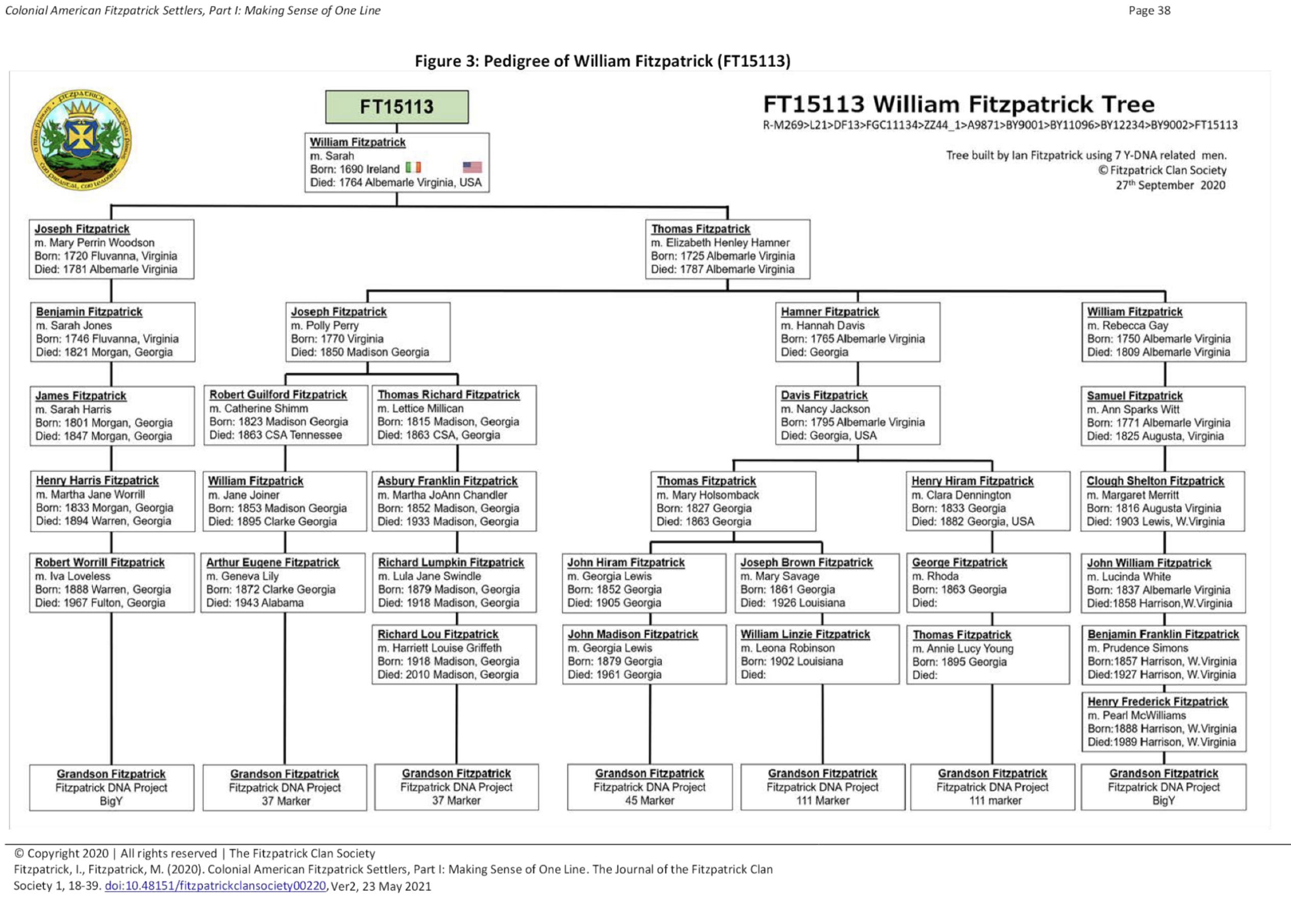
Few early Fitzpatrick families illustrate that problem more clearly than the descendants of William Fitzpatrick of Albemarle County, Virginia. After the Barons of Upper Ossory, William’s family is probably one of the most discussed Fitzpatrick lines in colonial genealogy. When Mike Fitzpatrick and I examined the family in 2020, William was attached to more than 3,000 Ancestry trees through his two sons. His pedigree had become so dominant that other early American Fitzpatrick families were repeatedly grafted onto it, often through little more than shared names, geographical proximity and the attraction of an apparently prestigious Irish ancestry.
The most persistent story made William a descendant of the Fitzpatricks of Upper Ossory.
That story collapsed when the evidence was examined closely. The family tradition connecting William to “Sir John and Lady Ella Fitzpatrick” was chronologically impossible. John Fitzpatrick, later first Earl of Upper Ossory, was born in 1719, decades after William. The equally familiar story that William’s wife Sarah was Sarah Jane Breckenridge, sister of Alexander Breckenridge, and that William travelled from Pennsylvania into Virginia with the Breckenridge family could not be supported by a contemporary record either. Reba Fitzpatrick Lea, whose 1954 work seems to have helped preserve the tradition, had herself cautioned that the Breckenridge identification had not been established.
Once the unsupported parts of the older pedigree were stripped away, the documented beginning of William’s American story became remarkably simple.
William Fitzpatrick in Virginia
William appears securely in the surviving record on 10 November 1738, when he purchased land from Robert Davis in South Garden, then part of Goochland County and later incorporated into Albemarle County. It is the first firm documentary anchor for the man whose descendants would spread through Virginia, Georgia and other parts of the southern United States.
William then becomes strangely difficult to see. His next major surviving record is his will, written in December 1762 and proved in Albemarle in May 1764. It identifies his wife simply as Sarah and names his son Thomas as executor and manager of the estate. Samuel Gay, William Fitzpatrick and John Harris witnessed the document.
Those sparse records are a sharp contrast with the elaborate pedigrees built around him.
The 1738 transaction contains another detail that deserves renewed attention. On the very same day William bought from Robert Davis, Thomas Fitzpatrick purchased 400 acres from the same Robert Davis. The 2020 paper considered this Thomas probably to have been William’s son, largely because William later named a son Thomas and because a Thomas Fitzpatrick appears in later Albemarle records connected with the Hamner family.
The chronology now gives reason for caution. If the later Thomas, husband of Elizabeth Henley Hamner, was born around 1725, he would have been extremely young in 1738. The purchaser may instead have been William’s brother, cousin or another close adult relative. The relationship can remain open without affecting the larger argument. What the paired transactions show securely is that William’s first appearance in Virginia occurred within a small Fitzpatrick group already dealing with Robert Davis.
Joseph Fitzpatrick soon appears in the same general landscape. By the middle of the century William, Thomas and Joseph were associated with lands around the North and South Garden and the branches of the Hardware River. The exact paper relationship between all three men was never entirely secure, although later Y-DNA would clarify that the descendants attributed to William’s family belonged to the same paternal line.
The Virginia family also preserved names in a way that becomes useful later in the story.
Thomas Fitzpatrick married Elizabeth Henley Hamner. One of their sons was named Hamner Fitzpatrick. Hamner Fitzpatrick married Hannah Davis, and the next generation included a son named Davis Fitzpatrick.
The pattern is straightforward. A surname belonging to an important maternal or allied family could be preserved as the given name of a Fitzpatrick son. Hamner entered the Fitzpatrick line as a forename. Davis did the same in the following generation.
That practice seemed like a small genealogical detail until a record in County Fermanagh brought another unusual Fitzpatrick forename into view.
John Fitzpatrick of Drumkeeran
On 23 August 1866, John Fitzpatrick married Eliza Johnston at Drumkeeran, County Fermanagh. The marriage record identifies John’s father as Atcheson Fitzpatrick.
Atcheson, more commonly encountered as Acheson or Aitchison, is not a conventional Irish Christian name. It is a Scottish surname. Its appearance in a Fitzpatrick family living near the Fermanagh–Donegal border immediately raises the possibility that an earlier Acheson connection had been deliberately preserved.
The wider family strengthens that interpretation.
An Acheson Fitzpatrick, born around 1790, sits at the head of the reconstructed Drumkeeran branch. Another Acheson Fitzpatrick, born in 1821, appears in the following generations and married Sarah Johnston. John Fitzpatrick married Eliza Johnston. William Fitzpatrick married Elizabeth J. Johnston. Later still appears Aitchison Fitzpatrick, born in 1859.
The repeated appearance of Acheson or Aitchison is far more suggestive than a single unusual baptismal name. It was being preserved.
The family also reused William with striking persistence. William appears repeatedly in the Irish branch just as it does in the Virginia family. William alone cannot establish a relationship; it was too common throughout Ireland, Scotland and England. Within a known family, however, the repeated use of William helps illustrate a broader naming culture in which some core names survived generation after generation while other names preserved marriage connections.
The three Johnston marriages are equally revealing. These were not isolated encounters between unrelated families. The Drumkeeran Fitzpatricks had become deeply entangled with the Johnston population of the district.
That observation takes the story backward again, because both Acheson and Johnston were already established in western Fermanagh long before the nineteenth-century marriages.
The Achesons of Fermanagh and Pettigo
The Achesons were a Scottish family established in Ulster during the seventeenth century. Different branches appear in Armagh and Fermanagh, and one Fermanagh family can be followed through Skea, Cleenish and the wider Enniskillen world.
A William Atcheson of Skeagh left a will in 1656. Colonel William Acheson of Skea appears in the military history of Enniskillen during the same period. Later members of the family married into established Plantation and landed families including the Nixons and Hassards.
More directly relevant to the Drumkeeran Fitzpatricks is the surviving manuscript pedigree titled “Pedigree of the Acheson family, Pettigoe, Co. Fermanagh, 1679–1904.”
That document takes the Acheson name into precisely the country that interests us.
Pettigo sits on the Fermanagh–Donegal border northwest of Drumkeeran. Historically the border was not a sharp social boundary. Templecarn, Pettigo, Lurg, Lower Lough Erne, Kesh and Drumkeeran formed a connected frontier landscape. Families, tenants, ministers and estate interests crossed county and barony boundaries that appear far more rigid on a modern map than they did in ordinary life.
The 1665–66 Hearth-Money Rolls for the Barony of Lurg bring the seventeenth-century population into focus.
There is no identifiable Fitzpatrick or O’Mulpatrick in the surviving Lurg list. There is, however, a William Atchisson. There are numerous Johnstons. And there is Thomas Davyes.
The Johnstons appear repeatedly across the same broad district in which Fitzpatricks would later marry Johnston women. William Atchisson appears in the Devenish portion of the roll. Thomas Davyes is recorded at Ballymctagart. Grahams, Irvines and other Plantation surnames occur beside Maguires, McDermotts, McCabes, McCaffreys, O’Monaghans and other Gaelic families.
The townland names are just as revealing. Glenagarron, Bannagh Beg, Drumcerin and other places belonging to the later Fitzpatrick landscape are already present in the roll. In 1665 the Fitzpatricks are not yet visible there under that name, but the society into which they would later become embedded is already on the page.
The Acheson connection continues beyond the hearth roll.
In 1685, Ferdinando Davies of Lisgoole became involved in a Chancery dispute concerning lands associated with the Nixon and Hassard families. Those families subsequently became direct Acheson in-laws. Catherine Acheson, daughter of Alexander Acheson of Tonnyheague, married George Nixon, while her sister Mary married William Hassard of Skea.
Ferdinando Davies cannot be turned into a blood relative of the Achesons on the strength of litigation, nor can he be made an ancestor of Robert Davis in Virginia. The record establishes something more restrained and still very useful: Davies, Nixon, Hassard and Acheson were already participating in the same Fermanagh landholding and legal world before the eighteenth century.
That social network had been forming while another family was moving north through Fermanagh.
Ó Maol Phádraig enters Fermanagh
Before the Plantation, the northern Ó Maol Phádraig records belong primarily to the world of Bréifne.
Cathal Bán Ó Maol Phádraig appears at Dunaree in 1586. Muircheartach Ó Maol Phádraig appears at Creeny in 1593. Conor O Molpatrick was described in 1602 as chief of his name. Several Ó Maol Phádraig men appear again in the 1604 Cavan pardon alongside Ó Raghallaigh, Sheridan and other families belonging to the political and social environment of Cavan.
The temptation is to treat their later appearance in Fermanagh as a sudden Plantation-era migration into unfamiliar territory.
Ciarán Ó Scea’s study of medieval and early-modern Fermanagh shows why that interpretation is too simple.
Fermanagh had long been a frontier society populated through repeated inward migration. Ó Scea describes settlement into the lordship from Airghialla, Tyrone and Connacht and shows that many erenach septs later regarded as native to Fermanagh had originally come from elsewhere. Families from Donegal, Monaghan, Tyrone and Sligo entered the lordship, settled for generations and became accepted as part of its native social structure. His study is particularly valuable because it examines these movements as part of the economic and human workings of Fermanagh rather than treating the county’s families as fixed populations.
The county also suffered from chronic underpopulation. Sir John Davies went so far as to observe that Maguire had to hire soldiers from Bréifne. Ó Scea places that remark within a broader demographic picture in which Fermanagh had a much lower density of townlands and population than neighbouring Ulster lordships.
That observation gives the movement of Ó Maol Phádraig into Fermanagh a much deeper context. People from Bréifne were already being drawn into the Maguire world before the Plantation rearranged landownership. Military service, tenancy, learned service, ecclesiastical patronage and marriage could all bring outside families into Fermanagh.
Ó Scea’s study also shows that Fermanagh’s settlement pattern was heavily organized around Lough Erne. Church lands, monasteries, erenachships and older settlements clustered along the lake and its approaches. Devenish and Lisgoole occupied especially influential positions, and medieval church lands extended northward along both sides of Lough Erne to the limits of Devenish parish.
The Erne was therefore not simply a convenient line drawn after the fact. It was one of the organising spines of Fermanagh settlement.
Against that background, the Ó Maol Phádraig movement begins to look far less exceptional.
By the early 1620s members of the family were already living in southern Fermanagh, including men on Butler-associated lands. Philip, Brian, Edmund and another Brian Ó Maol Phádraig appear among tenants there. Other Pátraic surnames were also moving through the Plantation landscape; Seán Mac Giolla Phádraig was associated with the Maguire world in Fermanagh by 1629.
By 1641 Ó Maol Phádraig men appear more deeply embedded in Maguire political and military networks while still belonging to the broader Bréifne world from which they had come.
Then came rebellion, Confederate warfare, Cromwellian conquest, confiscation and another great rearrangement of land and people.
By about 1659, the family had moved farther north.
The census conventionally dated to that year records eleven O’Mullpatricks among the principal Irish names in the combined parishes of Drumully, Derrybrusk, Derryvullan, Magheracross and Inishmacsaint.
The census cannot place each of the eleven individuals in a particular parish. It nevertheless demonstrates that O’Mullpatrick was established through a broad central and northern Fermanagh district extending toward Lower Lough Erne.
That is the direction of Lurg, Drumkeeran and Pettigo.
The other surnames in the same census grouping reinforce the sense of a migrating social environment rather than a solitary family. Ó Raghallaigh, Sheridan, McDermott, McGilroy, Gilgunn, McMahon, McCabe and Maguire occur among the principal Irish names. Graham, Armstrong, Elliott, Johnston, Irwin, Scott, Crozier and other English and Scottish surnames appear in the same broad district.
The older Bréifne world and the newer Plantation society were overlapping.
The Fitzpatrick family that later appears around Drumkeeran belongs to that overlap.
Along the Erne toward Lurg and Pettigo
The surviving evidence now gives the movement a geographical sequence.
Ó Maol Phádraig is firmly established in the Cavan–Bréifne environment at the end of the sixteenth century. The family appears in southern Fermanagh in the early seventeenth century. By the middle of that century O’Mullpatrick is present farther north in the county. The natural continuation of that movement was through the Erne corridor toward Lurg and the Fermanagh–Donegal border.
The 1665 hearth roll provides a useful chronological marker. O’Mulpatrick is not identifiable in the surviving Lurg return, even though the surname was present in the wider Fermanagh population six years earlier.
Several explanations are possible. The relevant household may have lived outside the part of Lurg represented in the surviving list. A family might have fallen beneath the hearth-tax threshold. A clerk may have used an unexpected surname form. The final movement into the Drumkeeran area may also have occurred after 1665.
The last possibility fits the wider evidence particularly well.
During the later seventeenth century the surname itself was changing. Ó Maol Phádraig could become Mulpatrick, Mullpatrick or eventually Fitzpatrick in English-language records. An individual later recorded as Fitzpatrick alias Mulpatrick shows directly that the two surname forms could refer to the same person.
The documentary problem is therefore exactly what we would expect. The family moves north at roughly the same time that the older surname begins disappearing from administrative records.
When Fitzpatricks later emerge around Drumkeeran, they are not strangers dropped suddenly into the landscape. Their appearance is consistent with the continuation of a movement that can already be followed from Bréifne into southern and then central Fermanagh.
And by then they were becoming part of the mixed society already visible in the hearth roll.
Acheson, Johnston, Hamner, Davis and William
The naming evidence belongs here, after the two family histories have been established separately.
In Virginia, Thomas Fitzpatrick and Elizabeth Henley Hamner produced Hamner Fitzpatrick. Hamner Fitzpatrick and Hannah Davis produced Davis Fitzpatrick.
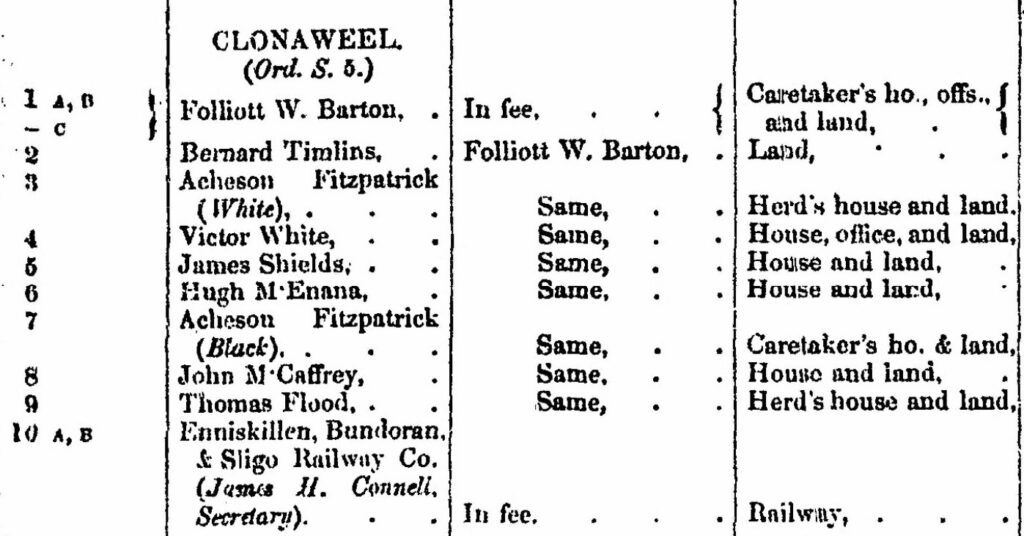
In Fermanagh, the surname Acheson became Acheson Fitzpatrick, and later Aitchison Fitzpatrick. The name was not used once and then forgotten. It appears repeatedly through the family and became so common within the local Fitzpatrick population that the Griffith’s Valuation records had to distinguish men of the same name by local bynames. Two Acheson Fitzpatricks were identified as “Black Fitzpatrick” and “White Fitzpatrick” in the valuation material, a remarkably vivid indication of how firmly the Acheson name had become established within this family. The labels were practical local identifiers used to distinguish men who otherwise bore the same name.
The same mechanism does not have to be assumed in every case, but the pattern is clear enough to be useful. These families repeatedly preserved the surnames of important maternal or allied families by turning them into Fitzpatrick given names. That makes the recurrence of Acheson in Drumkeeran much easier to understand as the memory of an older family relationship.
The Johnston marriages reinforce the same social pattern. Acheson Fitzpatrick married Sarah Johnston. John Fitzpatrick married Eliza Johnston. William Fitzpatrick married Elizabeth J. Johnston. The Johnstons were already numerous in seventeenth-century Fermanagh and Lurg, and by the nineteenth century they were marrying repeatedly into the Fitzpatrick family.
The recurrence of William should also be noted. It is too common to carry the same weight as Acheson, Hamner or Davis, but it persisted across both lines and formed part of the naming vocabulary of the family for generations.
Looking back at the older Virginia traditions from this perspective raises one question that may deserve to be reopened. The 2020 paper correctly found no contemporary record proving that William’s wife Sarah was a Breckenridge, and no documentary evidence that William travelled into Virginia with Alexander Breckenridge. Those conclusions still stand. Yet the Breckenridge name did recur among William’s descendants, and we can now see that this family repeatedly used maternal surnames as given names. That does not prove Sarah was a Breckenridge, but the tradition may have preserved something genuine that the surviving records no longer reveal. It is a question worth revisiting rather than dismissing.
The names do not prove the Atlantic connection. They reveal the kind of family culture in which old relationships were preserved.
The Davis evidence goes much farther.
Davis and Drumquin
William’s first secure Virginia land transaction was with Robert Davis.
Thomas Fitzpatrick’s same-day purchase was also from Robert Davis.
The Davis surname therefore belongs to William’s documented American environment from the beginning.
When the surname is followed back toward western Ulster, a series of records begins to converge on the country between Drumquin, Enniskillen, Pettigo and Lower Lough Erne.
A Davis family history published in 1912 placed Samuel Davis, born in 1669, near Drumquin, County Tyrone. His son James Davis, born in 1699, was likewise said to have been born near Drumquin. James’s son William was said to have been born there in 1730, and the family tradition placed their emigration to Pennsylvania in 1735.
That genealogy cannot be used to identify Robert Davis of Virginia as a descendant of Samuel or James.
Its value is independent of Robert. It preserves an old family tradition of Davis migration from the Drumquin district to colonial America during the exact generation in which William Fitzpatrick crossed the Atlantic.
The Irish records then add Thomas Davyes in Lurg in 1665 and Ferdinando Davies of Lisgoole in 1685, the latter intersecting through land litigation with the Nixon and Hassard families that soon became Acheson in-laws.
The Davis and Acheson worlds were therefore already overlapping in Fermanagh before William appeared in America.
Drumquin, Pettigo and the church network
Drumquin and Pettigo were not isolated communities.
Their Presbyterian congregations were eventually formally joined. In 1793 Drumquin was separated from Castlederg and united with Pettigo, and Thomas Anderson was ordained minister of the combined charge in 1794.
That formal union is too late to explain William’s migration. It demonstrates, however, that Drumquin and Pettigo belonged to a practical ecclesiastical corridor crossing modern county boundaries.
The earlier Presbyterian network was broader still. Enniskillen belonged to the Laggan Presbytery world, and men bearing the Pickins/Picking surname appear in the seventeenth-century Presbyterian and military community there.
That surname becomes particularly interesting in Virginia. In 1746 Andrew Pickens appears in an Augusta County road order under Robert Davis. The same order includes George Kill Patrick, while the adjoining road section contains Thomas Kill Patrick and John Davis.
None of those individuals can simply be assigned to the Fermanagh families on the strength of surname alone. Their appearance together nevertheless adds another layer to a pattern already established through land, church and migration records.
The later Drumquin church records show how persistent the regional network could be. On 6 January 1858, James Davis of Drummenny, son of Arthur Davis, married through Drumquin Presbyterian Church. The next recorded marriage, on 12 February, was Acheson Fitzpatrick of Killen, son of Samuel Fitzpatrick. The following entry involved a man from Drumkeeran, County Fermanagh.
Davis, Acheson Fitzpatrick and Drumkeeran were still intersecting in a single church register generations later.
The geographical corridor had endured.
The Killpatrick question
The Killpatrick surname adds another intriguing layer without carrying any part of the argument by itself.
The 1659 census records three Killpatricks in the combined Clones–Aghavea–Devenish grouping.
They may have been a separate Kilpatrick or Mac Giolla Phádraig family. They may also reflect the instability with which Pátraic surnames were being recorded in a region where clerks encountered several related-looking Gaelic and Scottish names. Later Kilpatrick households occur in Fermanagh, so continuity of the surname cannot simply be dismissed.
What catches the eye is the Virginia evidence. In 1746 George Kill Patrick was working on a road supervised by Robert Davis and alongside Andrew Pickens. Thomas Kill Patrick appears on the adjoining road section with John Davis.
The parallel is not genealogical proof. It is a surname cluster.
In Fermanagh and western Ulster we have Ó Maol Phádraig/Mullpatrick, Killpatrick, Acheson, Johnston, Davis/Davies and Pickins/Picking. On the Virginia frontier we encounter Fitzpatrick, Kill Patrick, Davis, Pickens and families drawn from the same larger Ulster migration world.
By this point the historical argument can stand without DNA.
A Fitzpatrick branch is rooted around Drumkeeran and Pettigo. That family preserves Acheson as a hereditary given name, repeatedly marries Johnstons, and sits within a landscape where Acheson, Johnston and Davyes were already present in the seventeenth century. Davies later intersects with the Nixon and Hassard families that married directly into the Achesons, while Ó Maol Phádraig can be followed moving out of Bréifne, into Fermanagh and progressively northward through the Erne country. On the American side, Davis is present at the beginning of William Fitzpatrick’s documented Virginia story, while Davis, Pickens and Killpatrick appear again within the same wider frontier network.
Taken together, those records produce a coherent historical reconstruction. They take us from William’s associates in Virginia back into a small western-Ulster landscape where the same family names, naming practices and migration routes had existed for generations. What they cannot do on their own is demonstrate that William Fitzpatrick of Albemarle was actually descended from the paternal Fitzpatrick family at Pettigo and Drumkeeran.
That requires a completely independent line of evidence.
The DNA connection
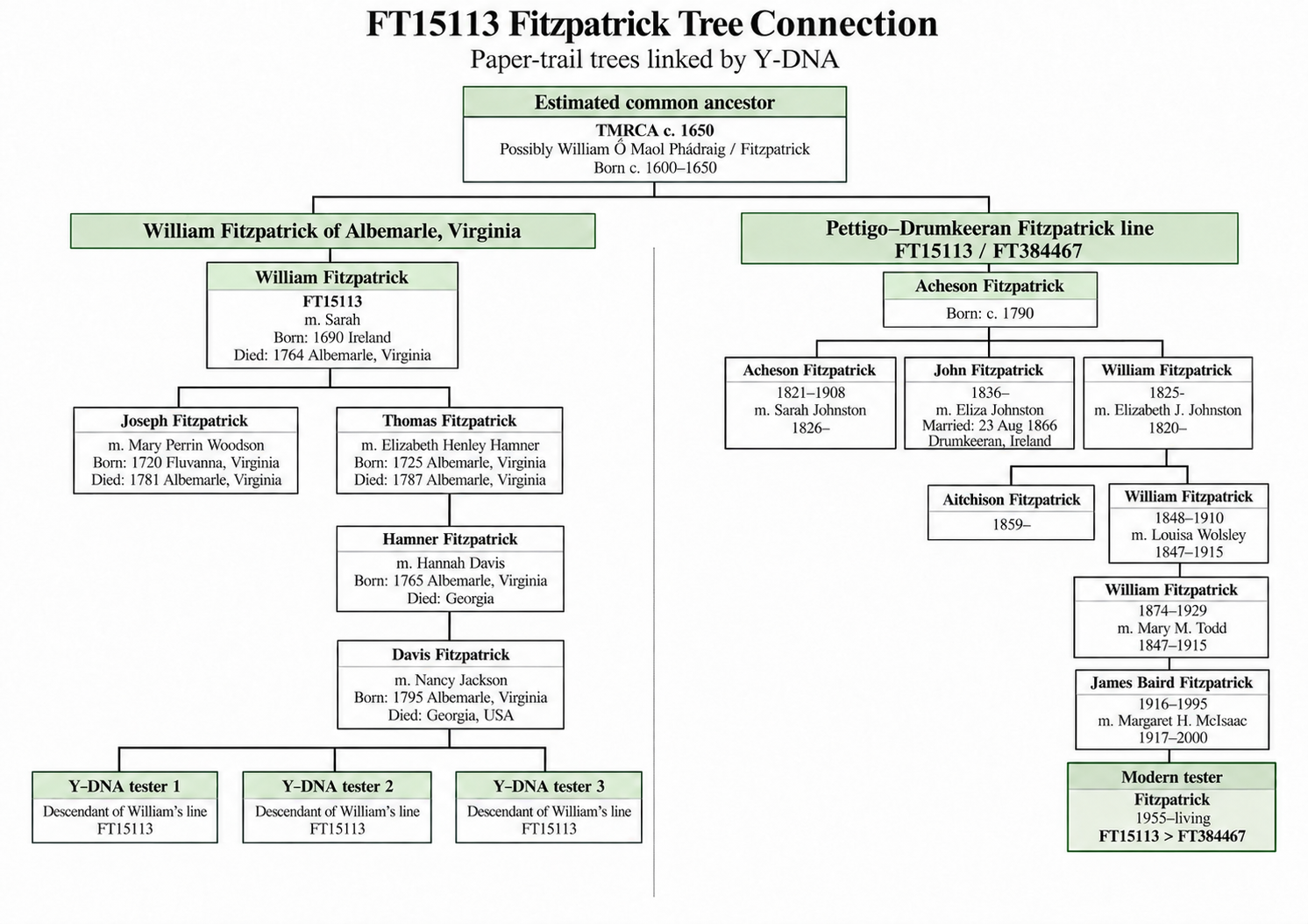
William’s Y-DNA line is FT15113, beneath the northern Ó Maol Phádraig branch BY12234. The 2020 study already established FT15113 in William’s Virginia descendants and demonstrated that his paternal ancestry belonged to this northern Fitzpatrick structure rather than to the Barons of Upper Ossory.
The Pettigo–Drumkeeran family now provides the missing Irish side of that comparison. A modern male descendant of the Acheson Fitzpatrick line carries FT15113 > FT384467, placing him directly within the same paternal branch as William’s Virginia descendants.
The connection is represented by three Big Y testers under FT15113, while FT384467 marks the surviving Pettigo–Drumkeeran line. The present estimate places the most recent common paternal ancestor of the two families at about 1650, with the usual uncertainty around Y-DNA dating. That ancestor could have been born at any point roughly between 1600 and 1650 and may still have been known as Ó Maol Phádraig, Mulpatrick or Fitzpatrick.
The name of that man is not known. William is an intriguing possibility because of the persistent use of the name in both later families, but it remains speculation. His lifetime nevertheless falls squarely within the period reconstructed from the historical evidence: after Ó Maol Phádraig had entered Fermanagh and while branches of the family were moving north toward the Lower Erne, Lurg, Drumkeeran and Pettigo.
The two families are therefore not connected merely by Acheson, Johnston, Davis, church associations or a plausible migration route. They share a recent paternal ancestor.
One branch remained in the Pettigo–Drumkeeran district and eventually produced the documented Acheson Fitzpatrick family and the modern FT384467 tester. The other produced the line of William Fitzpatrick of Albemarle, securely present in Virginia by 1738.
The surviving seventeenth-century records do not identify the exact generation at which those branches separated. The Y-DNA bridges that missing paper trail.
Finding William’s Irish homeland
For more than a century, William Fitzpatrick’s Irish ancestry was pushed toward Ossory because later genealogists understandably looked first to the best-known Fitzpatrick dynasty. Once a pedigree had been created, repetition carried it through thousands of family trees.
The evidence now points in the opposite direction.
William’s paternal ancestry belongs to the northern Ó Maol Phádraig genetic structure. The historical records place that family within Bréifne and then show it moving into Fermanagh. Ciarán Ó Scea’s work demonstrates that movement from outside septs into Fermanagh was an established feature of the Maguire lordship and that the county’s chronic underpopulation created a continuing demand for settlers, tenants, soldiers and specialist families. Sir John Davies’s observation that Maguire recruited soldiers from Bréifne provides a particularly direct connection between the two regions.
The Erne then provides the geographical continuity. Ó Maol Phádraig appears first in southern Fermanagh and later much farther north. By about 1659 O’Mullpatrick was established through the wider central and northern Fermanagh landscape. The later Fitzpatrick family takes root in the Lurg–Drumkeeran–Pettigo country where Achesons, Johnstons, Davises and other Plantation and Gaelic families were already living together.
The social history preserved in the later pedigrees fits that setting. Acheson becomes a repeated Fitzpatrick given name. Three closely related Fitzpatrick men marry Johnston women. William recurs from generation to generation. On the Virginia side, Hamner and Davis are preserved as given names in the same way, while the older Breckenridge tradition now deserves renewed consideration in light of that naming practice.
The Davis evidence provides the Atlantic connection. Robert Davis is present at the very beginning of William’s secure Virginia story. An independent Davis tradition leads back toward Drumquin and early eighteenth-century emigration. Thomas Davyes and Ferdinando Davies occur in the Fermanagh world before William’s departure, with the latter intersecting with families that married directly into the Achesons. Drumquin and Pettigo remained connected through Presbyterian networks, while Pickens and Killpatrick names recur in the Virginia records around Davis.
No single surname establishes William’s origin, and none needs to.
The geography, chronology and social connections independently led toward Pettigo and Drumkeeran before the modern DNA result was applied. The DNA then shows that the Fitzpatricks in that landscape and the descendants of William Fitzpatrick of Albemarle share the same recent paternal ancestry.
The old pedigree sent William south.
The evidence sends him north through Bréifne, Fermanagh and the Erne valley to the Pettigo–Drumkeeran border country.
We still cannot name every father between the seventeenth-century O’Mullpatricks and William Fitzpatrick of Albemarle. The records may never allow that degree of precision. What can now be reconstructed is much more substantial than a speculative pedigree: the paternal population from which he came, the path by which that family entered Fermanagh, the society into which it became integrated, the district in which a closely related branch survived, and the genetic relationship joining that branch to William’s descendants.
William Fitzpatrick was not a lost branch of the Barons of Upper Ossory.
His paternal story belongs to Ó Maol Phádraig of Bréifne, to the family’s movement north through Fermanagh, and ultimately to the small border country around Pettigo and Drumkeeran.
One branch remained there.
Another crossed the Atlantic and reached Virginia.
Three centuries later, their Y-DNA has brought the two histories back together.
Sources and Further Reading
Ian Fitzpatrick and Mike Fitzpatrick, Colonial American Fitzpatrick Settlers, Part I: Making Sense of One Line, The Journal of the Fitzpatrick Clan Society, 2020.
Ciarán Ó Scea, “Erenachs, erenachships and church landholding in Gaelic Fermanagh, 1270–1609,” Proceedings of the Royal Irish Academy, 112C.
Pádraig Ó Gallachair, “Hearth-Money Rolls: Co. Fermanagh,” Clogher Record, vol. 2, no. 1, 1957, pp. 207–214.
Séamus Pender, A Census of Ireland, circa 1659, Irish Manuscripts Commission, 1939.
Reba Fitzpatrick Lea, The “Belfield” Fitzpatricks and “Elim” Colemans: Their History and Genealogy, 1954.
Thomas Kirby Davis, The Davis Family, 1912.
W. Copeland Trimble, The History of Enniskillen.
Alexander Lecky, In the Days of the Laggan Presbytery.
Henry Biddall Swanzy, The Families of French of Belturbet and Nixon of Fermanagh.
National Library of Ireland Sources database, Pedigree of the Acheson family, Pettigoe, Co. Fermanagh, 1679–1904.
Virginia land, probate, court and road records relating to William Fitzpatrick, Thomas Fitzpatrick, Robert Davis, Davis/Davies, Pickens/Pickins and Killpatrick.
Fitzpatrick Y-DNA Project results for BY12234, FT15113 and FT384467.