
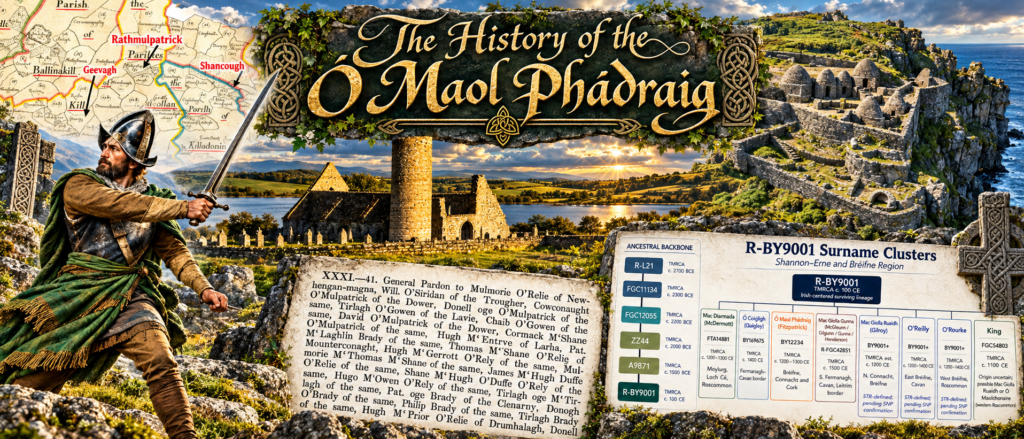
There comes a point in every historical investigation when the nature of the question changes, and for the Ó Maol Phádraig family we have now reached it. For most of the story reconstructed so far, it has been possible to follow something larger than isolated individuals. The surviving evidence repeatedly places Ó Maol Phádraig among the same kinds of people, within the same church landscapes and eventually within the same political networks. The family can be seen moving through a world of hereditary ecclesiastical service, church land, learned families, Gaelic lordship and long standing relationships between institutions stretching from Connacht into Bréifne and eventually much farther afield.
By the later seventeenth century that world had largely disappeared. The surname Ó Maol Phádraig itself was also beginning to fade from the records. Its descendants survived, many eventually appearing as Fitzpatrick and probably under several other Patrick derived surname forms, but the family can no longer be followed in quite the same way. The old connections had fragmented, branches had become separated geographically, and the church and landholding structures within which they had operated were being dismantled. The records increasingly describe households rather than a connected hereditary service family. This is therefore the right point to look back at the story as a whole before beginning the next phase of the research.
What has emerged is not the history of a great territorial clan ruling a compact Ó Maol Phádraig lordship. It is the history of what was probably once a much smaller Conmaicne family whose identity developed within the religious world of north Connacht. From a likely starting point around Rathmulpatrick in Tirerrill, that family appears to have grown through relationships with ecclesiastical and learned families. As those families entered new churches, lordships and religious institutions, branches of Ó Maol Phádraig seem to have moved with them. Their expansion was not based upon conquest. It appears instead to have depended upon service, reputation, trust and inherited relationships.
Before the surname: Conmaicne, saints and Tirerrill
The earliest part of the reconstruction begins long before anyone used the hereditary surname Ó Maol Phádraig. The Conmaicne were an old and widely dispersed population whose communities occupied parts of Connacht and the upper Shannon world. They never developed into a single enduring kingdom comparable with the great dynasties that later dominated Connacht and Bréifne. Their political independence gradually diminished as stronger dynasties expanded around and over them, but Conmaicne populations, churches and hereditary families remained embedded within the landscape.
The early Conmaicne church was strongly associated with particular saints. These were not parishes in the later medieval sense. A church community could develop around the cult of an individual saint, preserving traditions of that saint and maintaining relationships with other churches that claimed the same spiritual ancestry. Patrick was one of the most powerful of those religious identities. Later Patrician tradition associated Patrick with the Conmaicne and with a chain of churches running through Connacht and toward Bréifne. These traditions cannot simply be treated as a literal itinerary of the historical Patrick, but they show that communities in this region came to understand themselves as belonging within a Patrician religious world.
That provides an unusually appropriate setting for a family called Ó Maol Phádraig. The personal name Máel Pátraic meant a devotee or servant of Patrick. In the cultural setting in which it developed, it could express attachment to Patrick and to a religious community that identified itself through him. Rathmulpatrick preserves that personal name in the landscape. It is an early medieval rath bearing the name Máel Pátraic, while nearby Shancough was an old church with Patrician associations and evidence of a learned ecclesiastical tradition. The two places belonged to the same small geographical world of settlement, agriculture and church life.
No surviving document identifies the people of Rathmulpatrick as the ancestors of the later Ó Maol Phádraig family. That remains a reconstruction rather than a documented genealogy. Yet the combination is unusually compelling. We have the name Máel Pátraic attached to an early settlement, an ancient Patrician church nearby, a Conmaicne setting and later evidence of hereditary learned and ecclesiastical families operating throughout the same district. For a family whose name literally proclaimed devotion to Patrick, this is exactly the kind of environment in which its early identity could have formed.
The Book of Fenagh adds another remarkable element. It records Máel Pátraic son of Maolgeann as the ancestor “from whom are the Uí Maelpatraig.” Within the same genealogical material appears Máelmochéirghe, ancestor of the family later known as Ó Maolmochéirghe. Medieval genealogies must be handled cautiously because they often preserve political and institutional relationships as well as biological descent, but that may actually make this evidence more revealing rather than less. Ó Maolmochéirghe later became one of the major hereditary ecclesiastical families of Bréifne, while Ó Maol Phádraig repeatedly appears within the same wider church world. The genealogical tradition may therefore preserve a memory of connected Conmaicne church families whose relationships were already old when surnames began to become hereditary.
How a church service family could grow
A family such as Ó Maol Phádraig did not need to be numerous at the beginning. It may initially have consisted of only a few related households living close to a church or group of churches. Such people would leave almost no direct documentary trace unless one of them entered the level of society noticed by the annalists. Their value to the institutions around them could nevertheless have been considerable.
The early Irish church depended upon continuity. Land, custom and local rights were remembered through people as much as through documents, and a family that served an institution over several generations could become increasingly difficult to replace. Its knowledge was inherited, but so was its reputation. If a family had proved dependable over a long period, a new generation began with a degree of trust already established.
That inherited trust may have been one of the strongest assets available to Ó Maol Phádraig. Their position need not have depended upon a single formal office. What may have carried the family forward was the relationship itself. A church or lord that had relied upon one generation could continue to rely upon the next, while the family gained protection, standing and access to new opportunities in return.
This helps explain how a small kindred could expand without becoming a territorial dynasty. Younger members could be placed elsewhere within the same wider network, while the family still retained a sense of connection to its original patrons and relatives. Movement did not necessarily mean separation.
Ó Maolchonaire, Loch Cé and the opening of the network
The relationship with Ó Maolchonaire has become one of the most persistent patterns in the entire investigation. Again and again, when an early Ó Maol Phádraig record can be placed securely in its historical setting, an Ó Maolchonaire connection appears in the same landscape, institution or wider network. No surviving document tells us exactly what the relationship between the two families was, but the recurrence is difficult to treat as incidental.
Ó Maolchonaire emerged as one of the great learned families of Connacht and became closely associated with the Mac Diarmada world around Loch Cé. In the thirteenth century Clarus Mac Mailín Ó Maolchonaire transformed those relationships into a remarkable institutional network. From Holy Trinity on Loch Cé, Clarus established or developed houses and estates through Tirerrill and westward toward Killala. Áth Moighe was founded in 1232 and Kilross followed in 1233. Holy Trinity later possessed Shancough, Killadoon and Ummeryroe, placing its lands directly within the wider Rathmulpatrick landscape.
The significance of that connection becomes clearer when the later evidence is considered. The probable early Ó Maol Phádraig landscape around Rathmulpatrick and Shancough lay inside territory touched directly by Ó Maolchonaire institutions. When the network expanded eastward, it again created a route toward places where Ó Maol Phádraig later became strongly established. In 1237 Cathal Ó Raghallaigh granted Trinity Island in Lough Oughter for a Premonstratensian daughter house, and by about 1250 canons were being transferred from Loch Cé into the new establishment. Tirerrill, Loch Cé and East Bréifne were now joined within the same ecclesiastical system.
The southern evidence repeats the association even more clearly. By the later fourteenth century Ó Maol Phádraig men were established at St Michael’s Mount at Ballinskelligs in Kerry. Alan Ó Maol Phádraig became prior there, while Gilbert and Gillasenan Ó Maol Phádraig also appear in its records. Ó Maolchonaire men were present in the same religious community, and after Alan’s death in 1400 Thomas Ó Maolchonaire succeeded him as prior. Hundreds of kilometres from Tirerrill, the two families were again found within the same institution.
The pattern continues into the later networks examined throughout this project. Places and relationships associated with Ó Maol Phádraig repeatedly intersect with the learned and ecclesiastical world in which Ó Maolchonaire operated. The surviving records are too incomplete to define the relationship precisely, and there is no basis for assigning Ó Maol Phádraig a formal subordinate role to Ó Maolchonaire. What the evidence does show is a remarkable persistence of association across both time and geography.
Ó Maolchonaire therefore provides an unusually useful framework for understanding how Ó Maol Phádraig may have spread. A small hereditary service family did not need to create its own independent route across Ireland. It could move through relationships maintained by larger and more visible learned or ecclesiastical families. The Ó Maolchonaire network provides exactly such a route, beginning in the same Tirerrill landscape, extending through Loch Cé into Bréifne and reappearing beside Ó Maol Phádraig in Kerry.
Bréifne and the old Conmaicne church world
In Bréifne, the strongest parallel comes from Ó Maolmochéirghe. Their principal medieval base became centred on the Dowra and Cenél Luacháin district, especially around Drumreilly, Oughteragh and Ballinaglera. From there members of the family became deeply involved in the ecclesiastical life of the region. Their prominence within the medieval church demonstrates how an old Conmaicne church family could become established far from its earlier landscape while preserving its identity across centuries of political change.
The location is especially interesting because Dowra later became one of the strongest northern centres of Ó Maol Phádraig. The two families that appear close together in the older Conmaicne genealogical tradition therefore also occupied the same broad church landscape in western Bréifne. That does not prove that every later association between them was inherited from their earliest history, but it strengthens the impression that they belonged to a much older connected world.
The later history of Ó Maolmochéirghe adds another remarkable connection. After the dissolution of the medieval religious institutions, members of the family can again be found back in Tirerrill. Their history therefore runs from the older Conmaicne landscape into the Dowra and Cenél Luacháin church world and eventually back toward the district from which the earlier tradition appears to have emerged.
This creates a striking geographical circle. Rathmulpatrick, Shancough and Tirerrill form the probable early landscape in which Ó Maol Phádraig developed. Ó Maolmochéirghe was also rooted in that broader Conmaicne tradition, became strongly established around Dowra, and later returned to Tirerrill after the dissolution. Ó Maol Phádraig, meanwhile, appears prominently around Dowra by the beginning of the seventeenth century. The same two families are therefore repeatedly drawn back into the same landscapes at widely separated points in their histories.
Kings changed, territorial power shifted, and the influence of Ó Ruairc, Ó Raghallaigh and other ruling dynasties rose and fell, but these older family connections proved remarkably persistent. Ó Maol Phádraig did not leave the same visible succession of senior churchmen as Ó Maolmochéirghe, which may help explain why its medieval documentary footprint is so much thinner. The surviving geography nevertheless places both families within a connected corridor running from Tirerrill through the old Conmaicne church world into western Bréifne.
Lough Oughter then carried the wider Loch Cé network farther east, where Ó Raghallaigh power was growing and Sheridan and other hereditary ecclesiastical families became deeply embedded within the Church of Kilmore. The later Ó Maol Phádraig concentrations in Cavan and Leitrim therefore developed within a landscape whose connections back to Tirerrill were already centuries old. The movements of Ó Maolmochéirghe provide one of the clearest surviving examples of just how durable those connections could be.
South to Kerry and Cork
Another branch moved much farther south. In 1306 Robert Ó Maol Phádraig appeared in County Cork as a juror in a case involving Eustace le Poer and Philip de Barry. By the later fourteenth century members of the family had become established at St Michael’s Mount at Ballinskelligs in Kerry, where Alan Ó Maol Phádraig became prior of the Augustinian house and Gilbert and Gillasenan Ó Maol Phádraig also appear in its records.
The names around them are especially revealing. Ó Maolchonaire men were present in the same religious community, and after Alan’s death in 1400 Thomas Ó Maolchonaire succeeded him as prior. Here, hundreds of kilometres from Tirerrill, Ó Maol Phádraig and Ó Maolchonaire were again operating within the same ecclesiastical institution. It is one of the clearest examples of a pattern that appears repeatedly throughout the surviving evidence.
The southern Ó Maol Phádraig branch therefore need not have developed independently of the northern family. By 1300 and 1400, Ó Maol Phádraig had certainly become geographically divided, but the branches still appear to have belonged to an interconnected world of churches, learned families and patrons.
MacCarthy power in the south offered the kind of opportunities that Mac Diarmada and Ó Raghallaigh patronage offered farther north. Barry lands provided another setting into which a trusted service family could be absorbed. The details of the work may have changed, but the underlying relationships could remain remarkably durable.
Reputation as an inheritance
One of the most persistent features of the Ó Maol Phádraig evidence is that the family repeatedly appears beside powerful families without itself becoming a great ruling dynasty. That may tell us something essential about the way it survived.
Its strength may have rested less on office than on reputation. A family that had served reliably for generations could carry that standing with it, particularly when its patrons were themselves linked across regions. A younger branch did not necessarily arrive in a new place as a stranger. It could arrive already known through the family and network from which it came.
This provides a plausible mechanism for the spread of Ó Maol Phádraig without requiring a single mass migration. One branch could settle in Bréifne, another could move south, and others could occupy intermediate territories while still remaining part of a wider family world. Those relationships appear to have endured for centuries.
From church service into Gaelic lordship
After 1400 the surname becomes frustratingly difficult to follow in the northern records. For roughly 140 years it almost disappears from view, although the surrounding networks remain visible. Ó Maolmochéirghe continued to hold influence in Cenél Luacháin, Sheridans remained embedded in the Church of Kilmore, and Ó Raghallaigh power expanded across eastern Bréifne. The structures within which Ó Maol Phádraig had apparently operated were therefore still functioning.
When the family becomes clearly visible again in the sixteenth century, it appears in settings that fit the earlier reconstruction. In 1541 Nicholas and Charles Ó Maol Phádraig of Shancor were selected as jurors during the investigation of former Hospitaller property around Kilmainhamwood. Their inclusion points again to local standing and trusted knowledge.
In 1586 Cathal Bán Ó Maol Phádraig appears at Dunaree in eastern Cavan. He was described as a husbandman, but the location placed him within another old ecclesiastical landscape tied to Kilmore and Ó Raghallaigh influence. By then members of the family were also appearing within secular lordly followings. In 1593 Muircheartach Ó Maol Phádraig of Creeny was pardoned among the people of Philip Ó Raghallaigh of Bellanacargy.
The southern records tell a similar story. Domhnall mac Conchobhair Ó Maol Phádraig appears in 1577 among the followers of Donnchadha mac Cormaic Mac Donagh in Duhallow, while in 1585 Tadhg mac Conchobhair and Conchobhar Óg mac Conchobhair Ó Maol Phádraig appear at Rahanisky among a Barry associated population.
By this point the family was operating more visibly within secular lordship, but this need not represent a complete break with its earlier history. The patrons had changed, while the value of a family whose loyalty and usefulness were already established may have remained much the same.
The northern and southern branches were still connected
By the sixteenth century there were clearly distinct northern and southern Ó Maol Phádraig populations. It would be easy to assume that centuries of geographical separation had turned them into completely independent families, but the documentary evidence points in another direction.
The same kinds of associated families occur around both populations. Learned and medical surnames familiar from Connacht and Bréifne appear in the south, while MacCarthy, Barry and Mac Donagh networks intersect with families whose connections extended northward. Ó Maolchonaire remains especially notable because its connections repeatedly appear close to Ó Maol Phádraig records in both the earlier and later landscapes.
The Nine Years’ War brought these relationships into even clearer view as northern armies entered Munster and commanders such as Richard Tyrrell carried soldiers from the northern and midland world deep into the south. Ó Maol Phádraig appears repeatedly within this movement. The Cork pardons of 1601 contain several members of the family among MacCarthy, Barry and FitzGerald associated groups, while almost immediately afterward Ó Maol Phádraig men appear again within Tyrrell and Ó Raghallaigh networks farther north.
The simplest explanation is that the family still possessed a meaningful internal connection. The branches may have lived hundreds of kilometres apart, but they had not become strangers. They occupied overlapping networks of patrons and associated families, and those networks still linked north and south.
That continuity may also help explain why the old family identity survived so long. In June 1602 Conchobhar Ó Maol Phádraig appears in East Bréifne with the description “Chief of His Name.” The title does not imply an ancient Ó Maol Phádraig kingdom, for which there is no evidence, but it does show that at the very end of the Gaelic political order there was still enough collective identity for one man to be recognised as the senior representative of the name. After perhaps four centuries of geographical expansion, Ó Maol Phádraig was still understood as a family.
The last years of the old network
The records immediately following the Nine Years’ War provide one final concentrated view of that world. In November 1603 Ó Maol Phádraig yeomen appear at Abbeylara in the pardon of Richard Tyrrell. In April 1604 five Ó Maol Phádraig men appear in a major Cavan pardon, four of them associated with Dowra. Around them are Ó Raghallaigh, Sheridan, Brady, Mág Samhradháin and other families belonging to the old political and church landscape of Bréifne.
Dowra had by then become one of the clearest northern Ó Maol Phádraig concentrations. Its importance becomes even more striking when set beside the earlier history of Ó Maolmochéirghe, whose medieval heartland had also been centred upon the Dowra and Cenél Luacháin district. The appearance of Ó Maol Phádraig there cannot by itself prove a continuous relationship between the two families, but it places them once again within the same small historical landscape.
The description “yeoman” also appears repeatedly during these years. It would be too much to assign those men a specific hereditary office that the records never give them, but their social position fits comfortably within the longer history of a family whose standing depended upon service and trusted relationships. Their ability to adjust to a changing political world may have helped the family survive the destruction of the Gaelic order better than many families whose position depended entirely upon territorial power.
Plantation and one final expansion
The Plantation did not immediately destroy the family. New estates still depended upon people who could operate successfully within the local landscape, and Ó Maol Phádraig appears to have adapted once again.
By 1623 and 1624 members of the family were moving into Fermanagh as substantial tenants. At Dresternan and neighbouring holdings, Ó Maol Phádraig men occupied relatively large farms on the Butler estate. Another appears among Ó Raghallaigh tenants on neighbouring Balfour land. The movement appears to have come through the Cavan and Belturbet corridor, and once again the family was expanding through an existing landscape of relationships rather than appearing in isolation.
This Fermanagh movement may represent the last major expansion of Ó Maol Phádraig while the old surname and some part of the old family network were still intact. The upheavals beginning in 1641 changed that world decisively. Rebellion, Confederate warfare, Cromwellian conquest, confiscation and the restructuring of landownership broke many of the relationships that had allowed hereditary service families to maintain continuity across generations.
Ó Maol Phádraig survived, but increasingly as separate local families. Pender’s census of about 1659 records eleven principal Irish bearing Ó Maol Phádraig forms in Fermanagh and another eleven around Granard in County Longford. The Cavan returns are lost, so the largest northern population may be largely invisible in that source. Other records from the early 1660s show the surname continuing elsewhere. The people were still there, but the structure that had connected them was disappearing.
The surname fades and the families remain
By the later seventeenth century Ó Maol Phádraig and Mulpatrick forms were increasingly being replaced by Fitzpatrick and other Patrick derived forms. The previous post examined the mechanisms behind that transition in detail, and there is no need to repeat them here. The essential point is that the surname change coincided with the final breakup of the institutional world that had helped preserve the family’s older identity.
Once Ó Maol Phádraig families entered the records as Fitzpatrick, they became much harder to distinguish from completely separate Fitzpatrick populations elsewhere in Ireland. A surname that had once identified a particular historical kindred now placed its descendants among several unrelated paternal families using the same English form. At almost the same moment, the old service network itself was disappearing.
That combination brings the first part of the Ó Maol Phádraig story to an end.
What the DNA now adds
The documentary reconstruction can now be compared with a completely independent body of evidence. BY12234 is the second largest identified paternal DNA grouping among tested Fitzpatricks, and its internal structure is unusually deep. Its wider paternal background is also revealing. Upstream at BY9001 are connections with lineages bearing surnames such as McDermott, McGilroy, O’Reilly and O’Rourke, together with a possible Ó Maolchonaire connection. These are not random names in the context of the historical reconstruction. They belong to the same broad Connacht and Bréifne world in which Ó Maol Phádraig later appears so consistently.
One of the most striking features of the tree is what happens before its medieval expansion. From roughly 500 CE until about 1200 CE, no surviving paternal branches are visible in the modern BY12234 lineage. That long bottleneck suggests a deeply rooted and comparatively contained paternal population. For perhaps seven centuries, the surviving line shows no detectable expansion into multiple enduring branches. We cannot know how many sons or collateral lines actually existed during those generations, since only lineages that survived to the present can appear in the modern tree. Even so, the contrast with what happens after about 1200 is remarkable. The earlier lineage appears narrow and stable for centuries before suddenly beginning to diversify.
That pattern fits well with the kind of environment reconstructed around the early Conmaicne church landscape. A small hereditary family attached to a particular locality or religious community could remain rooted there for many generations, with its surviving paternal line passing through a prolonged bottleneck. Rathmulpatrick and the surrounding Tirerrill landscape provide a plausible setting for exactly that kind of long continuity. The DNA cannot prove that BY12234 was physically confined to Rathmulpatrick throughout those centuries, but it is consistent with a family that remained comparatively local and socially contained before its later expansion.
The older BY9001 connections reinforce that interpretation in another way. McDermott points back toward the Mac Diarmada world of north Connacht, while O’Rourke and O’Reilly belong to the political landscape of Bréifne into which the later Ó Maol Phádraig family became so deeply embedded. McGilroy also belongs within the northern network that repeatedly appears around later descendants of the line. The possible Ó Maolchonaire connection is particularly intriguing given the repeated documentary association between Ó Maol Phádraig and Ó Maolchonaire. None of these paternal connections can by itself identify the social relationship between the medieval families, but taken together they place the deeper genetic ancestry within a remarkably familiar historical environment.
Around 1200 the pattern changes dramatically. BY12234 begins to diversify, with numerous surviving branches forming during the following two centuries. That chronology fits closely with the period in which the ecclesiastical networks surrounding Tirerrill and Loch Cé were expanding into Bréifne and with the wider period in which Ó Maol Phádraig appears to have begun spreading beyond its probable early homeland.
For several hundred years after that expansion the lineage remains remarkably coherent. No other deeply rooted surname appears within the tree until the seventeenth century. When other surnames finally begin to appear, they are names strongly associated with Cavan and the surrounding Bréifne world. The modern DNA therefore preserves the appearance of a substantial medieval paternal family that first endured a very long period of limited surviving diversification and then expanded rapidly during the central Middle Ages.
Its later geography is equally revealing. Modern lineages with roots in Cork and the south do not form a single separate southern branch of BY12234. Nor do the northern families form one isolated northern cluster. Instead, northern and southern lines are mixed across the medieval branching structure.
That is difficult to reconcile with a single migration south followed by centuries of isolation. If one branch alone had moved into Cork or Kerry and simply remained there, its modern descendants would be expected to sit together more neatly on one part of the tree. They do not. The pattern points instead toward repeated movement between regions, continuing contact between branches, or both.
The DNA therefore suggests two quite different phases in the history of the paternal family. Before about 1200, the surviving lineage appears narrow, deeply rooted and comparatively contained within a wider paternal neighbourhood already associated with Connacht and Bréifne surnames. After about 1200, it expands rapidly and becomes geographically dispersed, while the later northern and southern descendants remain interwoven across the same paternal tree.
That transition fits remarkably well with the historical reconstruction. A small Conmaicne family may have remained rooted within its early church landscape for centuries before the expansion of ecclesiastical and patronage networks created opportunities for different branches to move outward. Geographical expansion did not immediately break the family apart. The later DNA suggests that north and south remained connected long after the first movements began.
The depth of BY12234 is also important when considering the later disappearance of the Ó Maol Phádraig surname. This is not a small Fitzpatrick line created by a recent surname adoption. It is one of the largest Fitzpatrick paternal groups yet identified, with a continuous genetic history reaching back many centuries before the surname begins disappearing from the written record. The modern descendants therefore preserve, genetically, a family that the documents increasingly conceal.
From one family history to many
The reconstruction now stretches across close to a thousand years. It begins within the Conmaicne world of north Connacht, where churches were closely identified with the cults of particular saints and where the name Máel Pátraic belonged naturally within a Patrician religious landscape. Rathmulpatrick remains the strongest candidate for the family’s early centre. Nearby Shancough and the wider ecclesiastical landscape provide the setting in which a small family devoted to Patrick could have developed into a hereditary church service kindred.
Its greatest asset may never have been land or military power. It may have been the reputation accumulated through generations of dependable service. That reputation could survive changes of rulers, carry younger branches into new regions and preserve relationships across considerable distances.
The two recurring family connections are particularly revealing. Ó Maolchonaire appears again and again close to Ó Maol Phádraig within the surviving ecclesiastical and learned networks, from the Tirerrill and Loch Cé landscape to St Michael’s Mount in Kerry and into the later connected world. Ó Maolmochéirghe links the same early Conmaicne environment with the Dowra and Cenél Luacháin district, before appearing again back in Tirerrill after the dissolution. Between them, these families help reveal a network that was neither local nor temporary.
By the fourteenth century Ó Maol Phádraig was already geographically dispersed, yet it was not disconnected. During the sixteenth century those relationships become visible again in Cork, Kerry, Cavan and the midlands. The Nine Years’ War brought men from those worlds into direct contact, while the later records continue to place Ó Maol Phádraig among many of the same families that recur throughout the earlier story. Even in 1602 there was a man called Chief of His Name.
The modern DNA adds another layer to that continuity. BY12234 preserves a deep medieval paternal structure, and the mixture of northern and southern descendants across its branches supports the same conclusion reached from the records. Movement between regions was not a single episode. The family remained connected across geography for a remarkably long period.
That long continuity is perhaps the most striking feature of the story. A small family that may have begun beside a Conmaicne Patrician church managed to expand across Ireland without acquiring a great territorial lordship of its own. It survived because its members remained useful to institutions and families larger than themselves, while their accumulated reputation and inherited relationships allowed different branches to remain connected long after they had become geographically separated.
For centuries, the system worked. During the seventeenth century, however, the institutions that held it together finally collapsed. The branches remained, but their common structure did not. The old surname began disappearing at precisely the same time. By the beginning of the eighteenth century we are no longer looking at Ó Maol Phádraig in quite the same historical sense. We are looking at descendant families.
Some remained in Cavan. Others were in Fermanagh, Longford and the midlands. Southern lines survived in Cork and Kerry. Some would later leave Ireland for Britain, North America, Australia and elsewhere. Many would be called Fitzpatrick, a name that by itself can no longer tell us which medieval family stood behind it.
That is where the research now has to change direction. Until this point we have largely been working forward, following the development of Ó Maol Phádraig from its probable Conmaicne beginnings through the medieval church and into the political world of the sixteenth and seventeenth centuries. From here we also have to work backward.
Documented Fitzpatrick families of the eighteenth and nineteenth centuries can be reconstructed generation by generation. Y DNA can separate paternal lines that the English surname brought together. Plantation records, leases, church registers, deeds, military records and later genealogies can be used to follow individual branches through the period when the old family disappears from direct historical view. Eventually those lines may meet the story reconstructed here.
The first stage of the investigation asked who the Ó Maol Phádraig were and how they spread. The next stage asks where they went.
Sources and Further Reading
The Book of Fenagh, ed. W. M. Hennessy and D. H. Kelly.
Annals of Ulster.
Annals of Loch Cé, ed. William M. Hennessy.
Annals of Connacht, ed. A. Martin Freeman.
Calendar of Entries in the Papal Registers Relating to Great Britain and Ireland.
Calendar of the Fiants of the Reign of Queen Elizabeth.
Calendar of Patent Rolls, James I.
Pender, Séamus, ed. A Census of Ireland, Circa 1659.
Fitzpatrick, Ian, and Mike Fitzpatrick. “Ó Maol Phádraig: The Name, the People, and the Clans. Part I.” Journal of the Fitzpatrick Clan Society 4, 2023.
Fitzpatrick, Mike, and Proinsias Mag Fhionnghaile. “Ó Maol Phádraig: The Name, the People, and the Clans. Part II.” Journal of the Fitzpatrick Clan Society 5, 2024.
Fitzpatrick, Matthew, and Mike Fitzpatrick. “Ó Maol Phádraig: The Name, the People, and the Clans. Part III.” Journal of the Fitzpatrick Clan Society 6, 2025.
Ó Scea, Ciarán. “Erenachs, Erenachships and Church Landholding in Gaelic Fermanagh, 1270 to 1609.” Proceedings of the Royal Irish Academy 112C, 2011.
FitzPatrick, Elizabeth. Landscapes of the Learned: The Gaelic Literati in Ireland and Scotland, 1200 to 1800.
Simms, Katharine. From Kings to Warlords: The Changing Political Structure of Gaelic Ireland in the Later Middle Ages.
Gwynn, Aubrey, and R. Neville Hadcock. Medieval Religious Houses: Ireland.
Earley, Joseph E., and Leonard E. Boyle. “Conflict over the Rectory of Cinel Luachain during the Fifteenth Century.” Breifne 9, no. 35, 1999.
1641 Depositions, Trinity College Dublin.
FamilyTreeDNA Discover, R BY12234.