
On 1 April 1654 Peter Rickebee, a smith of Belturbet, was questioned about events he said he had witnessed more than twelve years earlier. His examination returned to the killings associated with the occupation of the town in 1641–42 and named several Ó Maol Phádraig men already familiar from the earlier depositions. By the time Rickebee gave his evidence, however, the world in which those events had occurred had been dismantled by another decade of war.
Rory Maguire was dead. Owen Roe O’Neill had died in Cavan. The Ulster army that had won at Benburb had been destroyed. Philip mac Hugh O’Reilly had fought on for several more years before surrendering and leaving Ireland. Belturbet, which had been taken by the O’Reilly forces at the beginning of the rising and later occupied an important place within the Confederate military landscape, was now under Commonwealth control.
Rickebee’s examination belongs to that changed world. It was not simply another account of the disturbances of 1641. It was evidence being gathered after the conquest, when the new government had the power to return to old accusations and ask surviving witnesses to identify individuals who might be held responsible for killings committed at the beginning of the war.
The men around the Ó Maol Phádraig after 1641
The previous posts followed approximately thirty Ó Maol Phádraig men found in the Cavan and Fermanagh depositions. They were concentrated around Drumlane, Annagh, Belturbet, Quivvy, Kinawley and Knockninny and included gentlemen, yeomen, farmers and craftsmen. Several were connected with Rory Maguire in Fermanagh, while others were associated with Philip mac Hugh O’Reilly in Cavan. Bryan Óg Ó Maol Phádraig provides the clearest link between the two groups, appearing first with his father Domhnall Óg among Maguire’s followers and later around Belturbet as a commander associated with Philip O’Reilly.
After the depositions of the early 1640s, most of those individual Ó Maol Phádraig men become difficult to follow. There is no surviving record that allows us to place Bryan Óg, Hugh Reagh, Cormac, Philip Mothlach or the other named men in particular companies or battles during the following decade. Some may have remained in military service, others may have returned to farms or crafts, and some almost certainly died during years in which Cavan and Fermanagh were repeatedly crossed by armies. Their commanders are much easier to trace, and their careers show what was happening to the political and military world surrounding the surname community.
Rory Maguire became governor of Fermanagh and a colonel in the Ulster army commanded by Owen Roe O’Neill. He continued to campaign principally through Fermanagh and Monaghan, where Enniskillen and other Protestant garrisons remained beyond Confederate control. In 1645 Owen Roe sent Maguire with about five hundred men against British positions around Upper Lough Erne, bringing the war once again through the same waterway and border country in which the Kinawley Ó Maol Phádraig had been living.
Maguire was still with Owen Roe when the Ulster army met Robert Monro’s Scottish army at Benburb on 5 June 1646. He commanded the reserve and entered the battle against the collapsing Scottish flank. Benburb became the great military victory of Owen Roe’s career, but it did not end the war in Ulster. Garrisons remained in enemy hands, the Ulster army lacked the siege resources required to reduce all of them, and the political unity of the Confederate movement was beginning to fracture.
Maguire remained within Owen Roe’s orbit during the Confederate divisions that followed. In 1648, as fighting developed between Owen Roe and forces aligned with the Confederate leadership and Ormond, Maguire was active in the Midlands and captured Banagher. His career ended that November when he was killed during fighting near Jamestown. The Fermanagh commander with whom Bryan Óg and Domhnall Óg had been associated at the beginning of the rising therefore disappeared from the story six years before Rickebee gave his examination.
Philip mac Hugh O’Reilly survived much longer. He had been a central Cavan leader from the opening of the rebellion, became a colonel in Owen Roe’s army and fought in the major northern campaigns, including Benburb. When many Ulster landholders abandoned Owen Roe during the Confederate divisions, Philip remained with him. His connection with the Ó Maol Phádraig around Belturbet had therefore drawn them into the following of a man who would remain under arms almost until the end of organised resistance in Cavan.
Belturbet through the middle years of the war
Belturbet had been founded as a Plantation borough only a generation before the rebellion. Sir Stephen Butler had received land for the establishment of the town, which developed around British merchants and tradesmen and the strategically useful crossing of the River Erne. The earlier depositions show how quickly that Plantation arrangement broke apart after October 1641.
During the following years Belturbet ceased to function simply as the British town that had existed before the rising. Its position on the Erne placed it inside the military corridor joining Cavan and Fermanagh, while the surrounding country supplied cattle, grain, horses, labour and transport. By the middle of the decade Owen Roe was operating from the Cavan region and Belturbet formed part of the landscape supporting his Ulster army.
The town therefore passed through a longer transformation than the original depositions reveal. The houses and properties seized in 1641 were not simply returned to their former occupants a few months later. The war continued around them, and Cavan became one of the principal regions from which the Ulster Confederate forces drew support.
For the Ó Maol Phádraig families this meant that the events described in the depositions were only the beginning of a much longer disruption. A farmer or craftsman named in 1642 could spend the next decade living beside military garrisons, supplying armies, joining them, fleeing them or trying to retain a holding through repeated changes of authority. The records that once named these men with extraordinary precision become much less informative during this period, even while the country around them was becoming more militarised.
Cromwell changes the war
Oliver Cromwell entered the story in August 1649 when he landed near Dublin with a large Parliamentary army. He never personally campaigned in Cavan and never marched through Belturbet. His own operations were concentrated farther south and east, and he returned to England in May 1650.
His arrival nevertheless altered the future of Cavan. The Commonwealth possessed an army, financial resources and political determination far beyond anything previously directed against the remaining Confederate and Royalist forces. Victories at Drogheda, Wexford and elsewhere rapidly changed the strategic balance, while commanders such as Charles Coote, Robert Venables and Theophilus Jones continued the conquest in Ulster.
The effect can be seen in Owen Roe O’Neill’s final months. Earlier in 1649 Owen Roe had actually reached an accommodation with Parliamentary commanders and assisted Charles Coote at Derry. The arrival of Cromwell and the collapse of Ormond’s position after Rathmines persuaded Owen Roe that the Parliamentarians had become the greater danger. He finally reached terms with Ormond in late October 1649 and attempted to move his army south to join the wider resistance.
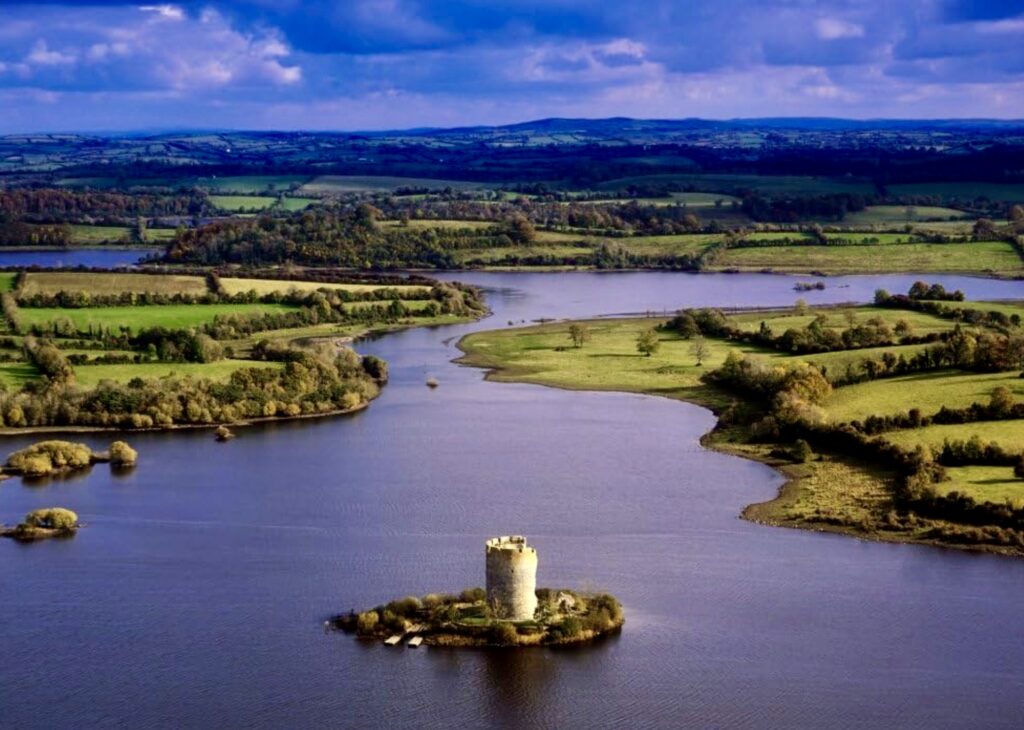
He was already seriously ill, and his progress stopped in the Cavan lake country. On 6 November 1649 Owen Roe died at or immediately beside Cloughoughter Castle in Lough Oughter. The fortress stood southwest of Belturbet amid the waterways and islands of central Cavan, terrain that had long provided refuge and defence for the O’Reillys.
His death removed the commander who had held the Ulster army together since 1642. It also placed the final days of his life directly inside the same Cavan landscape from which Philip O’Reilly and many of his followers had come.
The destruction of the Ulster army
After Owen Roe’s death, command of the Ulster army passed into less experienced hands. In June 1650 the army met Charles Coote’s forces at Scarrifholis near Letterkenny. The result was disastrous. The Ulster army was shattered, many senior officers were killed, and its ability to operate as a major field force effectively ended.
Philip mac Hugh O’Reilly survived.
What followed in Cavan was no longer the type of campaigning that had produced Benburb. Philip gathered surviving forces and continued resistance from the difficult country of Cavan, where lakes, woods, bogs and fortified positions allowed smaller bodies of men to avoid immediate destruction. Commonwealth commanders repeatedly attempted to clear these areas and establish garrisons within them.
One of the strongest positions still held by Philip was Bellanacargy, sometimes rendered Ballinacargy, near the River Annalee in eastern Cavan. This was not simply an ordinary residence being used temporarily by fugitives. Contemporary Commonwealth correspondence described it as the strong fort of Ballinacargy, while later descriptions identify the site as Philip O’Reilly’s castle and principal stronghold. It formed a substantial fortified position capable of resisting artillery and supporting a sizeable garrison.
In August 1651 the Commonwealth commissioners reported that Colonel Robert Venables had taken all available horse and about 1,300 foot into the field with the intention of capturing Ballinacargy and establishing garrisons deeper inside the remaining Irish-held territory. Belturbet was specifically named alongside Ballinacargy as one of the places where the Commonwealth wanted a permanent military presence. The two sites therefore formed part of the same strategy: break Philip O’Reilly’s remaining defensive network and occupy positions from which central and northern Cavan could be controlled.
Venables brought artillery against Ballinacargy in September. After two days of battering the castle he had consumed enough powder and ammunition that additional supplies had to be requested from Dublin. The defence remained formidable. Commonwealth reports later stated that about four hundred men were inside the fort, while another Irish force of approximately 2,300 foot and six or seven hundred horse was within a few miles.
Venables eventually abandoned the siege and withdrew toward Dundalk. The Commonwealth commissioners themselves explained that Ballinacargy was a considerable position, that Venables lacked provisions and ammunition, and that the large Irish force nearby made continued operations dangerous. The episode demonstrates that Philip’s resistance after Scarrifholis was much more substantial than a few scattered guerrilla bands hiding in the countryside. More than a year after the destruction of the Ulster field army, he still controlled a fortified base strong enough to withstand a serious Commonwealth attack.
Ballinacargy also creates a much older connection with the Ó Maol Phádraig story. A pardon from 1593 had been headed by an earlier Philip Ó Raghallaigh of Bellanacargy and included Moriertagh Ó Maol Phádraig of Creeny among the men associated with him. More than half a century later another Philip O’Reilly occupied the same stronghold while Bryan Óg Ó Maol Phádraig was described in the depositions as his follower. The documents do not allow the relationship between the two Philips, or the continuity of the OMP association, to be reconstructed securely, but Bellanacargy appears repeatedly within the same O’Reilly–Ó Maol Phádraig landscape.
For the individual Ó Maol Phádraig men there is again frustrating silence. Their earlier connection with Philip makes continued participation possible, but the surviving material does not allow us to place them among the defenders of Ballinacargy or the forces nearby. By 1654 some of the men Rickebee remembered may have been dead, some may have served through the final Cavan campaigns, and others may already have returned to civilian life.
Cloughoughter and the end of organised resistance
Ballinacargy did not end the struggle. Philip O’Reilly and other surviving forces withdrew deeper into the difficult country around Lough Oughter, where Cloughoughter Castle became one of the final strongholds of the northern resistance.
The castle stood on a small island and could not be approached like an ordinary land fortification. Its history during the war was already closely connected with the O’Reilly struggle. The O’Reillys had recovered control of the castle during the rising, Protestant prisoners including Bishop William Bedell had been held in the surrounding system of strongholds, and Owen Roe O’Neill had died in this same lake country in 1649.
By 1653 the Commonwealth was determined to finish the remaining resistance. Sir Theophilus Jones directed operations against Cloughoughter, and artillery was eventually brought against the island fortress from positions on the surrounding shore. Philip O’Reilly entered negotiations in April.
On 27 April 1653 terms were agreed for the surrender of the remaining forces associated with him. The articles allowed those accepting them to receive protection and provided opportunities for soldiers to enter foreign service, but they also contained exceptions relating to murder and robbery committed during the beginning of the rebellion.
Those exceptions carried the story directly back to Belturbet.
Philip himself left Ireland shortly afterwards. In May 1653 he sailed from Waterford with approximately one thousand soldiers bound for Spanish service. The man with whom Bryan Óg Ó Maol Phádraig had been associated around Belturbet was now gone from Ireland.
Within twelve months Peter Rickebee was giving evidence about events that had taken place when Philip’s forces first controlled the town.
Belturbet after the conquest
The Commonwealth campaign against Ballinacargy also helps explain what happened to Belturbet. As early as 1651 the Parliamentary commanders were discussing the establishment of garrisons at both places. They were not selecting Belturbet accidentally. The town controlled the River Erne route and stood close to the Cavan–Fermanagh border, making it an obvious base from which soldiers could penetrate the surrounding country and restrict movement between the surviving Irish forces.
Once Ballinacargy, Cloughoughter and the other centres of resistance had been neutralised, Belturbet could again function as an administrative and military centre rather than as a town embedded within the O’Reilly war effort. The Plantation borough had survived, but the balance of power around it had been completely reversed.
The change also altered the position of people such as Rickebee. During the occupation he had been a local smith living amid armed forces, captives and confiscated property. In 1654 he was a witness questioned under the authority of the government that had defeated those forces.
His examination took place less than a year after the surrender at Cloughoughter. The military struggle in Cavan had largely ended, and attention could now turn back to allegations that had remained unresolved while many of the accused or their patrons were still under arms.
The Commonwealth returns to the events of 1641
From 1652 the Commonwealth established commissions and High Courts of Justice to investigate accusations of murder associated with the rebellion. Earlier depositions could be revisited, witnesses sought out and new examinations taken. These later records differ from many of the original depositions because investigators were increasingly trying to identify particular individuals who might be prosecuted.
Rickebee was examined within that environment.
He identified Bryan Óg Ó Maol Phádraig, Cahir Óg Mór Ó Maol Phádraig, Conchobhar Óg Ó Maol Phádraig, Bryan Reagh Ó Maol Phádraig, Farrell mac Bryan Reagh Ó Maol Phádraig and another son of Bryan Reagh. He also named Danell O’Reilly, otherwise Danell Johnson, and other men who he said had been present.
Rickebee claimed that he saw James Carr and Timothy Dickenson being driven toward the gallows. He said that he witnessed their hanging and later watched a larger group of Protestant prisoners being taken toward the bridge and forced into the river. He estimated that approximately thirty-seven people were involved in the latter episode.
His description gives some indication of how he said he knew what had happened. Rickebee spoke of observing events from his own house and, during another part of the episode, from a nearby hill. He was presenting himself as an eyewitness rather than simply repeating a story circulating in the town.
Several of the names were already present in earlier testimony. Bryan Óg had appeared repeatedly and was described as a captain or commander. Conchobhar Óg was known from the Belturbet material. A Farrell Ó Maol Phádraig had previously been named with Hugh Reagh, Cormac and Philip Mothlach in allegations concerning the hangings and drownings.
Rickebee adds a particularly useful family detail by identifying Farrell as a son of Bryan Reagh and placing another unnamed son of Bryan Reagh with them. What had previously appeared as individual names therefore begins to resolve into another OMP household.
The examination also introduces or clarifies Cahir Óg Mór. An earlier Cahir Mór occurs in the deposition material, and the similarity raises the possibility that the two forms refer to the same man. The surviving evidence is not sufficient to make that identification certain.
Repeated forenames remain a problem throughout the material. Bryan, Hugh, Farrell, Philip, Domhnall and Conchobhar occur repeatedly in different households, and a resemblance between two names cannot by itself establish identity.
What happened to the other Ó Maol Phádraig men?
Very little can presently be said with confidence about the individual men followed through the earlier posts during the years between 1644 and 1654. That absence is better left visible than filled with assumptions.
Hugh Reagh, Cormac and Philip Mothlach had been named in earlier evidence concerning the Belturbet killings but do not appear in Rickebee’s surviving list. Domhnall Buí and his sons Thomas and Philip also disappear from the records currently assembled. Hugh mac Farrell, Bryan mac Farrell, Edmund of Quivvy, John Reagh and the craftsmen and tenants from the wider Kinawley and Drumlane groups similarly become difficult to trace.
Their disappearance from the record is not evidence that they had all died. The wars created several possible outcomes: death in military service, movement with an army, flight, imprisonment, settlement elsewhere, return to farming or simple survival beneath the level at which surviving government records identified individuals.
Rickebee’s examination gives us a small opening back into that population because several names surface again after the military struggle has ended. It does not tell us where those men had been during the intervening twelve years, and it does not establish that every man he named was alive in April 1654. He was identifying people whom he remembered from 1641–42.
That distinction is particularly important when trying to reconstruct the family. A name in a 1654 examination records what Rickebee said in 1654 about a person he remembered from an earlier period; it is not automatically evidence that the person was then living in Belturbet.
How should Rickebee’s evidence be read?
The twelve-year delay cannot be ignored. Memories change, stories are repeated and individuals who had lived through a traumatic event could have discussed it many times before finally being questioned formally. The investigators of 1654 were also seeking evidence concerning murder, so Rickebee was speaking within a very different political and legal setting from the witnesses examined during the first months of the rebellion.
At the same time, the passage of time does not make his evidence useless. Rickebee was a Belturbet resident identifying men from a relatively small local community. Several of those men had already appeared independently in earlier testimony, and the broad events he described had also been reported by other witnesses.
The strongest use of Rickebee is therefore comparative. Where his testimony overlaps with earlier witnesses, the records can be tested against one another. Where he supplies a patronymic or family relationship that the earlier evidence lacked, as with Farrell mac Bryan Reagh, he adds another piece to the reconstruction. Where his evidence stands alone, greater caution is required.
There is another limitation. No evidence yet found shows that Bryan Óg, Cahir Óg Mór, Conchobhar Óg, Bryan Reagh or Farrell mac Bryan Reagh was subsequently tried and convicted by the Commonwealth High Court. Trials were held and defendants were convicted for killings associated with the rebellion, but no identifiable Ó Maol Phádraig prosecution has yet emerged from the surviving material we have examined.
Some of those men may have died long before Rickebee spoke. Others may have gone abroad, remained beyond the reach of the authorities or simply never faced sufficient evidence for prosecution. The examination tells us what the Commonwealth was investigating; it does not by itself tell us the legal fate of the men Rickebee named.
Belturbet in 1654
Seen from Belturbet, the twelve years between the events and Rickebee’s examination had overturned almost every political relationship described in the original depositions.
Rory Maguire, under whom the Kinawley Ó Maol Phádraig first appear, had been killed in 1648. Owen Roe O’Neill had died in the Cavan lake country in 1649. His Ulster army had been destroyed at Scarrifholis in 1650. Philip mac Hugh O’Reilly had then continued resistance from strongholds such as Ballinacargy, where Venables failed to dislodge a garrison of several hundred men in 1651, before the remaining northern resistance contracted toward Cloughoughter and finally surrendered in April 1653.
The Commonwealth had meanwhile identified Belturbet itself as a place where a permanent garrison should be established. The town that had once formed part of Philip O’Reilly’s military world had become one of the positions from which that world was being dismantled.
Peter Rickebee gave his evidence in the aftermath of that sequence. The people asking the questions now had the authority to reopen allegations from 1641, compare witnesses and seek identifiable individuals who could be held accountable.
For the Ó Maol Phádraig story, his examination therefore provides something different from the earlier depositions. Those records revealed the family while its local society was being torn apart. Rickebee returns to several of the same men after the political and military structures surrounding them had collapsed.
What survives is fragmentary but unusually personal: Bryan Óg still being remembered as an identifiable figure; Bryan Reagh appearing with his sons; Farrell receiving a patronymic that helps reconstruct another family line; Cahir and Conchobhar reappearing among men connected with episodes described more than a decade earlier.
The records that follow belong to a different landscape. After conquest, the questions gradually become less about who joined the rebellion and more about who survived, where families were living, what land or property remained to them, who was displaced, and how the old surname began appearing increasingly in forms such as Mulpatrick and Fitzpatrick.
That is where the search now moves.
Sources and Further Reading
Trinity College Dublin. 1641 Depositions, TCD MS 833, examination of Peter Rickebee, 1 April 1654, fols. 295r–296v.
Trinity College Dublin. 1641 Depositions, Cavan and Fermanagh depositions relating to Belturbet, Drumlane, Annagh, Kinawley and Knockninny.
Fitzpatrick, Matthew and Fitzpatrick, Mike. 2025. “Ó Maol Phádraig: the Name, the People, and the Clans. Part III.” Journal of the Fitzpatrick Clan Society 6, 27–41.
Dunlop, Robert, ed. Ireland under the Commonwealth: Being a Selection of Documents Relating to the Government of Ireland from 1651 to 1659.
Breifny Antiquarian Society. “Cannon Ball from Ballinacargy Castle, Co. Cavan.” Breifny Antiquarian Society’s Journal, vol. II, no. III, 1925–26.
Davies, Oliver. “The Castles of County Cavan.”
Dictionary of Irish Biography. Entries for Owen Roe O’Neill, Rory Maguire, Philip mac Hugh O’Reilly, Robert Venables, Charles Coote and Sir Theophilus Jones.
Irish Manuscripts Commission. 1641 Depositions.
Cavan County Library. Archives of Belturbet Corporation.