
The Cavan Fitzpatricks in Owen Roe O’Neill’s Army
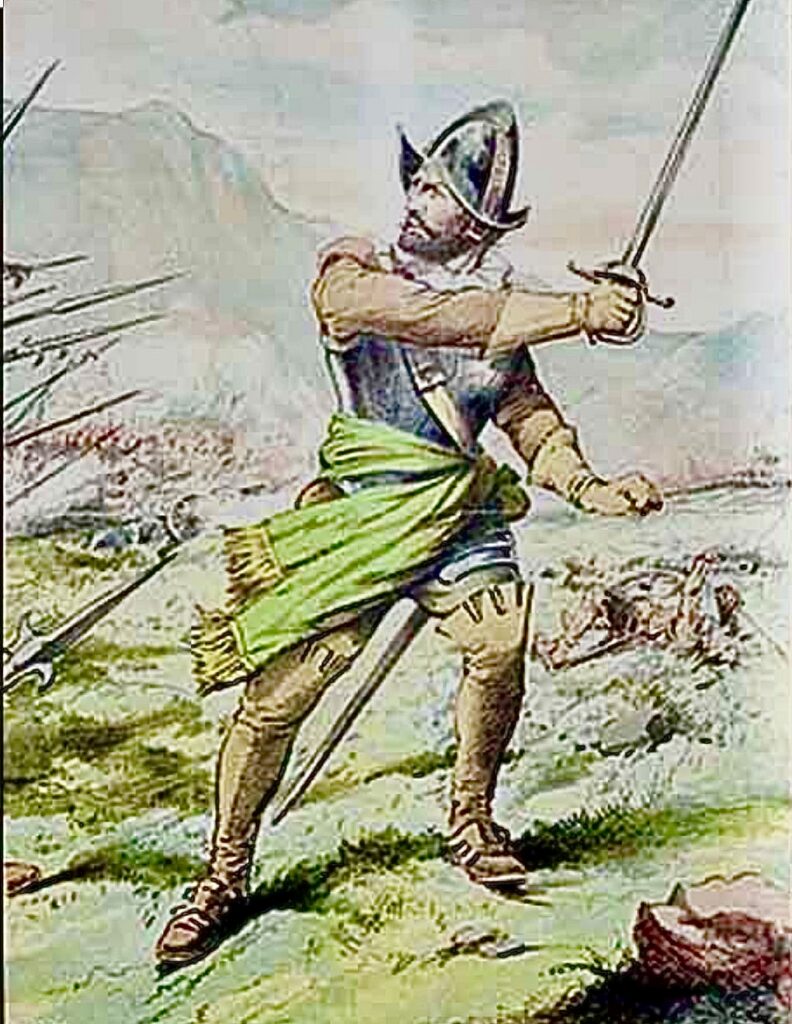
The previous post ended with Owen Roe O’Neill’s northern army preparing to leave Cavan in the spring of 1646. The men had spent the winter in a landscape already familiar from the preceding years of war: Belturbet, the O’Reilly country and the routes running north through Monaghan towards Armagh and Tyrone. Owen Roe had returned from Kilkenny with money and supplies, and by May he had assembled an army of roughly 5,000 infantry and several hundred horse.
Among the Cavan men who marched north were Fitzpatricks.
Thomas Davis, in his nineteenth-century account of the Battle of Benburb, named the principal regional elements of Owen Roe’s force. After identifying Colonel Philip O’Reilly of Ballynacargy and Maolmora O’Reilly, remembered as Miles the Slasher, he described the Cavan contingent in unusually specific terms:
“The O’Reillys brought 200 chosen men of their own name, and of the Mac Bradys, Mac Cabes, Mac Gowans, Fitzpatricks, and Fitzsimons, from Cavan.”
Davis then continued outward through the surrounding regions. Fighting men came with Mac Gauran of Templeport and Mac Ternan of Croghan; Connacht contributed O’Rourkes, MacDermots, O’Connors and O’Kellys; men also came from the O’Donnells and O’Dohertys of Donegal, Manus O’Cane of Derry, Sir Constantine Magennis of Down, the O’Hanlons of Armagh and the O’Hagans of Tyrone.
It is an extraordinary little description of Owen Roe’s army. Rather than presenting it simply as an Ulster force, Davis preserves something resembling a regional roll-call of the families and territories from which it had been assembled. For the Ó Maol Phádraig story, the position of Fitzpatrick within that list is especially revealing. The name appears not among strangers from another province, but among the O’Reilly-associated families of Cavan: Brady, McCabe, McGowan and Fitzsimons.
There is little reason to look elsewhere for the identity of these Fitzpatricks. The preceding records have already shown a substantial Ó Maol Phádraig population in precisely this part of Cavan and the adjoining Fermanagh borderland. During the rising they were repeatedly associated with the O’Reilly military network, and Bryan Óg Ó Maol Phádraig in particular was recorded as a follower of Philip mac Hugh O’Reilly. The depositions also described “a great number of the sept of the Mulpatricks” operating with O’Reilly forces around Belturbet.
Davis wrote almost two hundred years after Benburb, and the source behind his detailed Cavan roster has not yet been recovered. His terminology also belongs to his own century: contemporary records of the 1640s normally called this northern family Mulpatrick, Mollpatrick or related forms of Ó Maol Phádraig. Yet the later substitution of Fitzpatrick for Mulpatrick is independently demonstrated by the 1693 record of Edmund Fitzpatrick alias Mulpatrick. The simplest reading of Davis is therefore that he used the later surname for the same Cavan family already visible in the seventeenth-century records.
His reference takes the family story beyond Belturbet. The Ó Maol Phádraig were no longer merely participants in a local rising. By June 1646 men of the family were part of the Cavan contingent moving with Owen Roe O’Neill’s field army towards the Blackwater.
North from Cavan
The army that marched north in 1646 was the product of four difficult years. Owen Roe had arrived in Donegal in July 1642 after a long military career in Spanish service. Instead of immediately risking everything in a major battle, he spent much of the following years preserving his forces, improving their discipline and avoiding confrontation when Robert Monro’s Scottish army held the advantage.
The result was visible by 1646. Owen Roe now commanded an army capable of moving as a coordinated force rather than a loose collection of local companies. Rinuccini’s contemporary account records that the soldiers carried provisions for sixteen days, an indication of the planning required to move thousands of men through Ulster without depending entirely upon whatever could be taken from the countryside.
The regional character of the army had not disappeared. Philip mac Hugh O’Reilly still led men associated with Cavan, while Rory Maguire represented the Fermanagh element. Other commanders brought forces from Monaghan, Longford, Connacht and the northern counties. The difference was that these contingents were now being brought together under a single command.
For the 200 Cavan men described by Davis, the march north probably began through country they knew well before carrying them beyond their normal local world. Templeport, Croghan, Belturbet and the O’Reilly lands lay behind them as the army moved towards Monaghan and Armagh. Ahead was Robert Monro, whose Scottish army had dominated much of eastern Ulster since 1642.
Monro intended to prevent Owen Roe from consolidating his position. His brother George Monro was also moving south from the direction of Coleraine, and the possibility that the two Scottish forces might unite presented Owen Roe with a serious problem. He needed to block that junction while choosing ground upon which Monro’s advantages in artillery and numbers could be reduced.
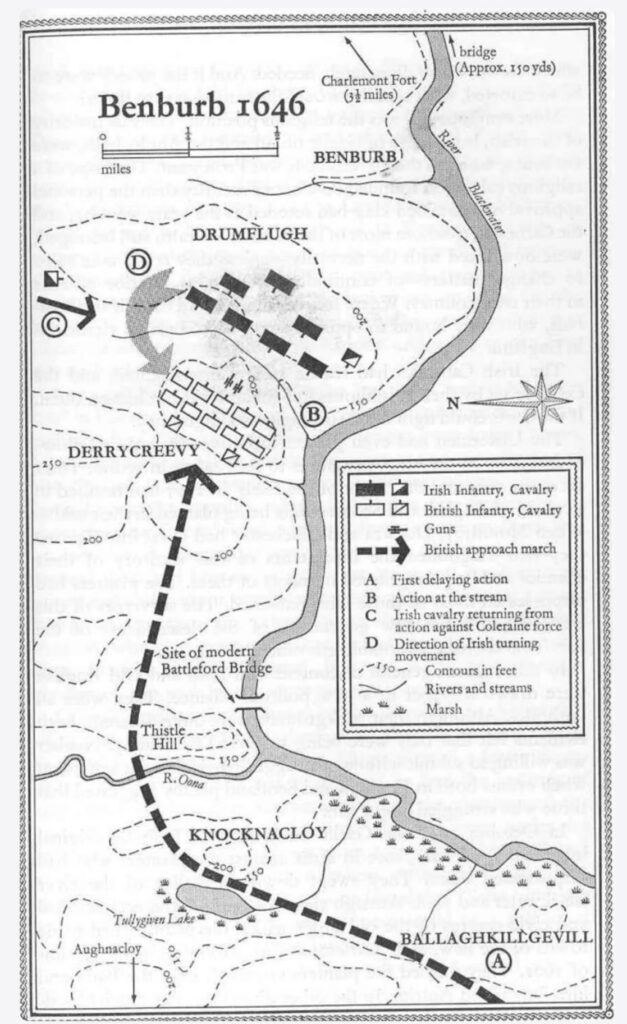
On 4 June Owen Roe moved from the Glasslough area towards Benburb and the River Blackwater.
5 June 1646
The battle developed slowly during the following day. Monro advanced through Armagh and towards the Blackwater, while Owen Roe repeatedly shifted his position and delayed a general engagement. Irish cavalry operating towards Dungannon interfered with George Monro’s approach, preventing the reinforcements from reaching the main Scottish army.
By the afternoon Robert Monro had crossed the Blackwater and was moving towards Owen Roe’s position. The ground around Benburb was broken by slopes, bog, streams and the river itself. Owen Roe used that landscape to restrict the space in which Monro could manoeuvre his infantry and cavalry.
The Scots possessed artillery and experienced soldiers, and for several hours their guns and musketeers pressed the Irish position. Owen Roe nevertheless refused to commit his entire force prematurely. His infantry remained formed while Monro’s men continued marching and manoeuvring over increasingly difficult ground.
At one stage cavalry appeared from the direction in which George Monro was expected. Robert Monro initially believed his brother’s force had finally arrived. Instead, the horsemen were Irish troops returning after helping to prevent George Monro’s advance.
The hoped-for Scottish junction had failed.
Owen Roe now ordered the general attack. His infantry moved forward through artillery and musket fire before the battle became a close struggle with pike and sword. Irish cavalry operated between and around the infantry formations, while Rory Maguire’s regiment remained available as a reserve until the fighting had developed.
The Scottish infantry resisted strongly, but by then many of Monro’s men had spent hours marching and repeatedly changing formation. The terrain left little room for recovering once units began to lose cohesion. When Owen Roe committed his remaining strength, the pressure became too great.
Monro’s line broke.
Retreat towards the Blackwater quickly became disastrous. Men were killed on the field, cut down during the flight or drowned attempting to cross the river. Robert Monro escaped, but his army abandoned artillery, weapons, colours, baggage, horses and provisions. Contemporary estimates of the Scottish dead vary considerably and some were undoubtedly exaggerated, but there is no doubt that the defeat was severe.
The Cavan Fitzpatricks disappear into the army at this point. Davis does not identify their company, officers or individual soldiers, and none of the named Ó Maol Phádraig from the earlier records can yet be placed personally on the battlefield. What survives is the collective identification: Fitzpatricks formed part of the 200 chosen Cavan men brought by the O’Reillys into Owen Roe’s army.
That is enough to carry the family onto the field without inventing names that the sources do not provide.
The company they kept
Davis’s complete list deserves attention beyond the single appearance of Fitzpatrick. Mac Brady, Mac Cabe and Mac Gowan repeatedly occur within the political and social world of the O’Reillys, while Mac Gauran of Templeport and Mac Ternan belonged to the wider Bréifne landscape. O’Rourke and MacDermot carry the list westwards towards Leitrim and north Connacht, while O’Donnell, O’Doherty, O’Cane, Magennis, O’Hanlon and O’Hagan extend it across Ulster.
The Fitzpatricks therefore appear exactly where the earlier Ó Maol Phádraig evidence would lead us to expect them: embedded among the families of Cavan and Bréifne rather than standing apart from them. Davis’s army list resembles in military form the network that has been emerging throughout this project from pardons, Plantation records, landholding, church connections and the 1641 Depositions.
The old relationships had survived the upheavals of the Plantation. They were now being expressed on a battlefield almost a hundred miles from Belturbet.
The identity of Davis’s source remains unresolved. He wrote before his death in 1845 and clearly drew his account from several kinds of material. Some of his battle narrative corresponds with contemporary military reporting, while other passages preserve local geography, family relationships and regional troop information unlikely to have come from a single official dispatch. His reference to “200 chosen men” and his careful naming of the Cavan families suggest access to more detailed information than a general history of the battle required.
The search for that source continues. Possibilities include Thomas Carte’s use of the Ormond papers, seventeenth-century Confederate narratives, material connected with the O’Reilly families of Cavan, and antiquarian manuscripts circulating in Dublin during Davis’s lifetime. Until the actual source is found, Davis’s statement must remain a nineteenth-century historical account rather than a contemporary muster. Its correspondence with the independently documented Cavan Ó Maol Phádraig population, however, gives the reference a context that Davis himself could not have reconstructed from the 1641 Depositions as they are available to us today.
After Benburb
Benburb was the greatest battlefield victory of Owen Roe O’Neill’s career, but it did not produce the political settlement that such a victory might have suggested. Confederate Ireland was already divided over peace negotiations with the royalists, and Owen Roe soon became entangled in the struggle between the nuncio’s supporters and those prepared to accept the proposed peace.
The northern army consequently did not remain in Ulster to exploit Monro’s defeat. Within weeks its direction was turning south again, drawing the soldiers who had marched from Cavan into a new stage of the Confederate wars.
For the Ó Maol Phádraig, Benburb marks a particularly clear point in a much longer transition. The family that had appeared beside the O’Reillys in pardons before 1600, entered Plantation tenancies after 1610 and emerged as a recognized northern sept during the events of 1641 was still moving within the same regional alliances in 1646. Davis’s account catches them at the moment when the surname familiar from the earlier records was beginning to disappear from view.
On the battlefield he called them Fitzpatricks.
Sources and Further Reading
Davis, Thomas. National and Historical Ballads, Songs, and Poems. Appendix: “The Battle of Benburb.” Published posthumously, 1846.
1641 Depositions, Trinity College Dublin. Cavan manuscripts MS 832, MS 833 and MS 834; Fermanagh manuscript MS 835.
Fitzpatrick, M. and Fitzpatrick, M. 2025. “Ó Maol Phádraig: the Name, the People, and the Clans. Part III.” Journal of the Fitzpatrick Clan Society 6, 27–41.
O’Neill, Henry. An Impartial Relation of the Most Memorable Transactions of General Owen O’Neill and His Party.
Rinuccini, Giovanni Battista. Contemporary correspondence and account of the Battle of Benburb, June 1646.
Monro, Robert. Contemporary report of the Battle of Benburb.
O’Mellan, Turlough. Contemporary Irish-language account of the Ulster war and the Battle of Benburb.
Hayes-McCoy, Gerard A. “The Weapons of Benburb”; “O’Mellan’s Account of the Battle of Benburb”; and “The Battle of Benburb, 1646.”
Hill, George, ed. The Montgomery Manuscripts. 1869. Hill reproduces Davis’s Cavan troop list and identifies Davis as his source.