One of the most difficult parts of working forward into the eighteenth and nineteenth centuries is that the surname Fitzpatrick begins to conceal rather than clarify family origins. By this point, people descended from different Gaelic Pátraic families could all appear in the records simply as Fitzpatrick. In Dublin especially, there were several apparently unrelated Fitzpatrick families living and working within a relatively small area, so the first task is not to connect Fitzpatricks but to separate them.
This particular investigation began with Hugh Fitzpatrick, the Dublin printer and bookseller who printed the 1795 political pamphlet An Appeal to Honest Men. Hugh caught my attention because he moved in the same Catholic political circles as Thomas Broughall, whose family has already become interesting in my own Fitzpatrick research. Hugh was involved with the Catholic Committee, later became printer and bookseller to Maynooth, and his premises became closely associated with the Catholic political movement. That was enough to make me look more closely at him.
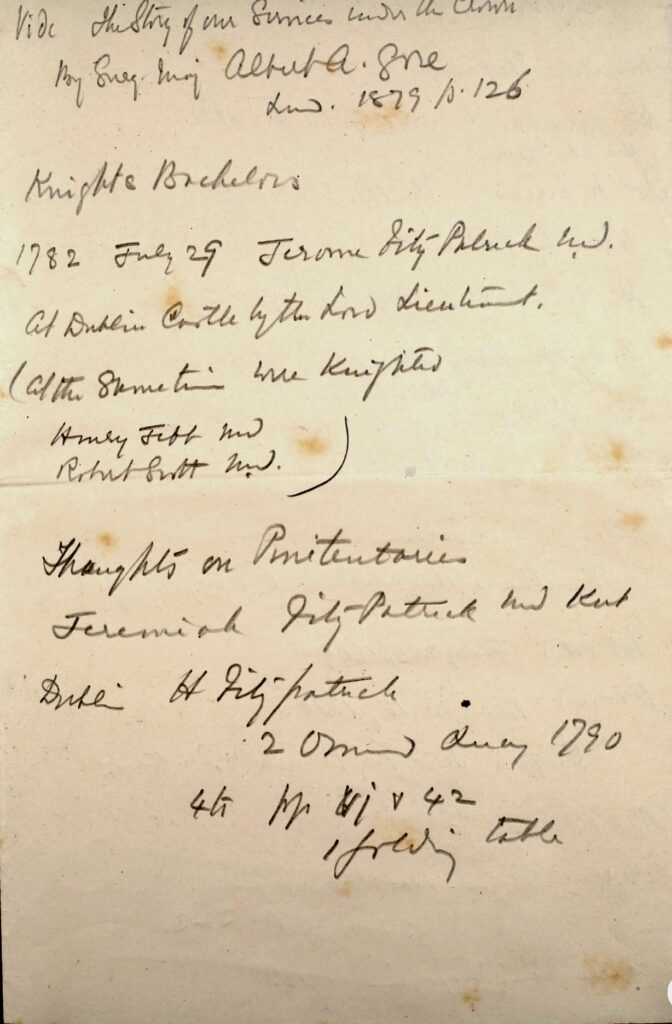
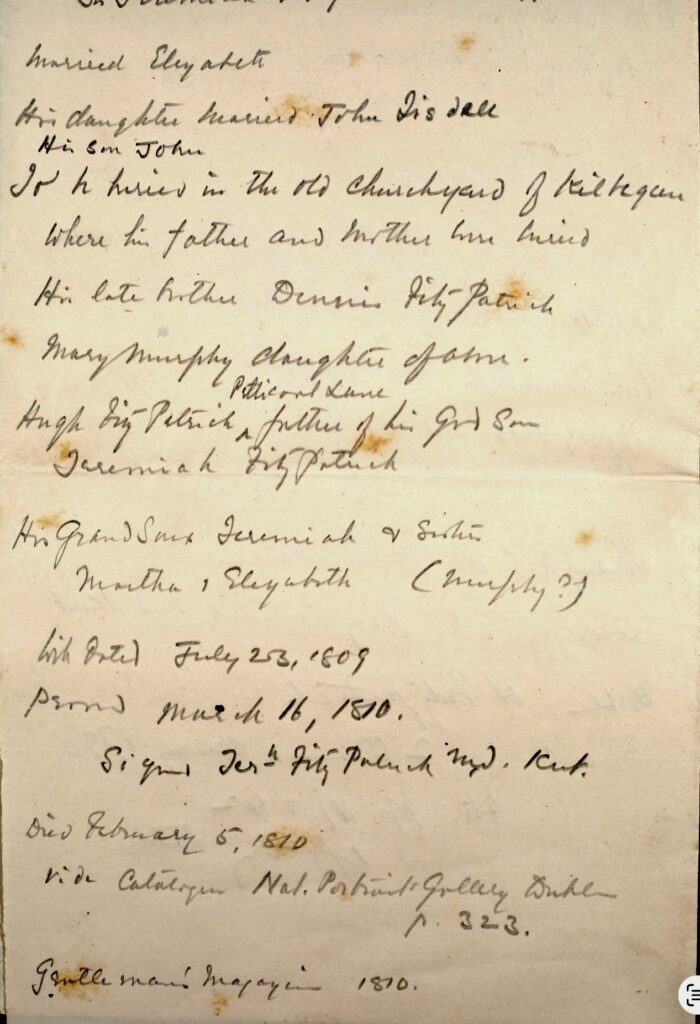
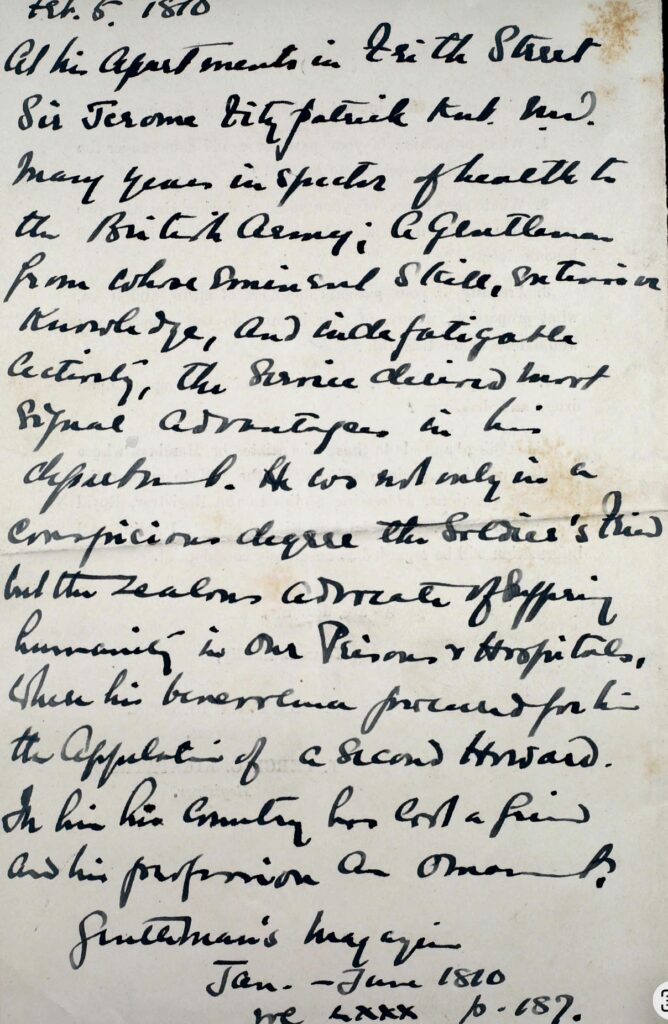
Very quickly the trail led to Sir Jeremiah Fitzpatrick, one of the more remarkable Irish reformers of the late eighteenth century. Jeremiah was a physician, prison inspector, military medical reformer and eventually inspector general of health to the British land forces. He was knighted in 1782, but his ancestry was never satisfactorily resolved. Oliver MacDonagh, who wrote the major biography of Jeremiah, was very clear about the problem. Jeremiah was born at Kilbeggan in County Westmeath, probably around 1740, and his own will records that his father and mother were buried in the old churchyard at Kilbeggan. MacDonagh believed the family was Catholic and probably of reasonably comfortable means, but he could trace Jeremiah’s ancestry no further.
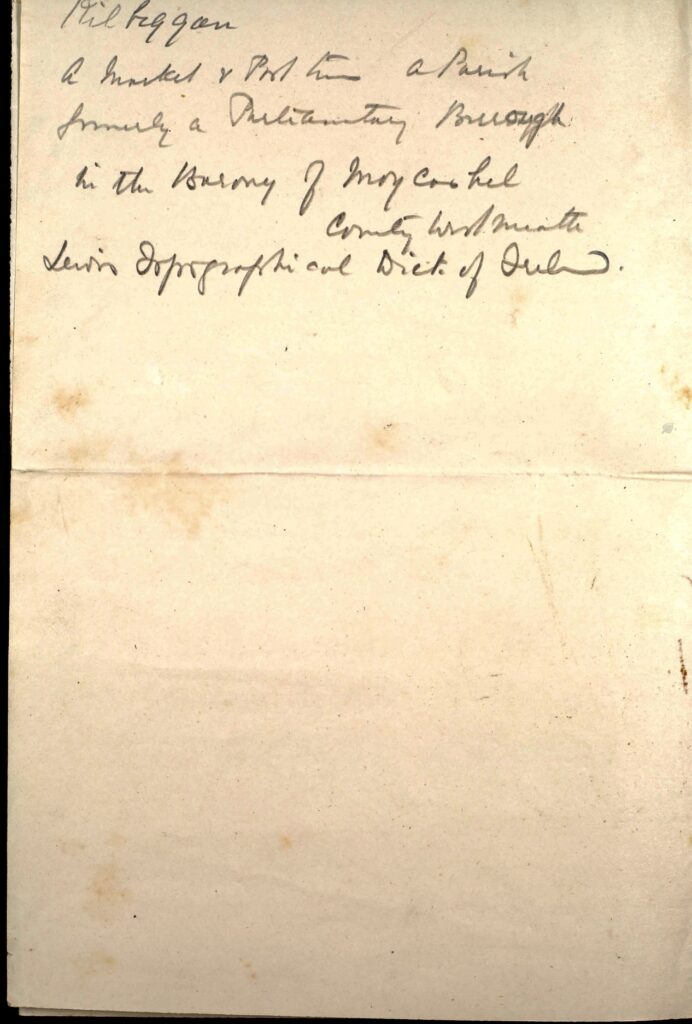
That burial detail is important because Kilbeggan was not simply a place Jeremiah became associated with later in life. His parents were already buried there, which strongly suggests that his own family had an established connection with the town before Jeremiah’s marriage and before the wealth that surrounded him later in life. Kilbeggan itself was an old ecclesiastical centre that developed into an important Midlands market town, and its ancient burial ground, locally known as the Relic, continued to be used by long-established Catholic families. Jeremiah’s parents being buried there therefore looks more like evidence of a settled family presence than a temporary residence.
Jeremiah married Elizabeth Fitzgerald in 1770, and the marriage appears to explain much of his later financial position. MacDonagh noted that Elizabeth’s prospective property lay close to Kilbeggan and that almost all of the trustees to the marriage settlement lived within about twenty miles of the town. He believed their shared Westmeath background probably explains how Jeremiah and Elizabeth came to know one another, and he also concluded that much of Jeremiah’s later landed income in Westmeath and King’s County probably came through his wife. Elizabeth Fitzgerald may therefore explain much of Jeremiah’s later wealth and property, but she does not explain why Jeremiah’s parents were already buried at Kilbeggan. The Fitzpatrick family was there first.
That raised an obvious question for me. Could this have been one of the Fitzpatrick families descended from Ó Maol Phádraig, rather than from the Mac Giolla Phádraig dynasty of Upper Ossory? We now know from the sixteenth- and early seventeenth-century records that Ó Maol Phádraig men were moving through the broader Longford-Westmeath-Midlands corridor, particularly in association with Richard Tyrrell and the political disturbances at the end of the Nine Years’ War. That does not create a bridge to Jeremiah nearly two centuries later, but it means that a Fitzpatrick family established in Westmeath cannot automatically be assigned to Upper Ossory simply because of the surname.
At first, that possibility made Hugh and Jeremiah particularly interesting. The more evidence that has accumulated, however, the more the balance has shifted toward Mac Giolla Phádraig of Upper Ossory.
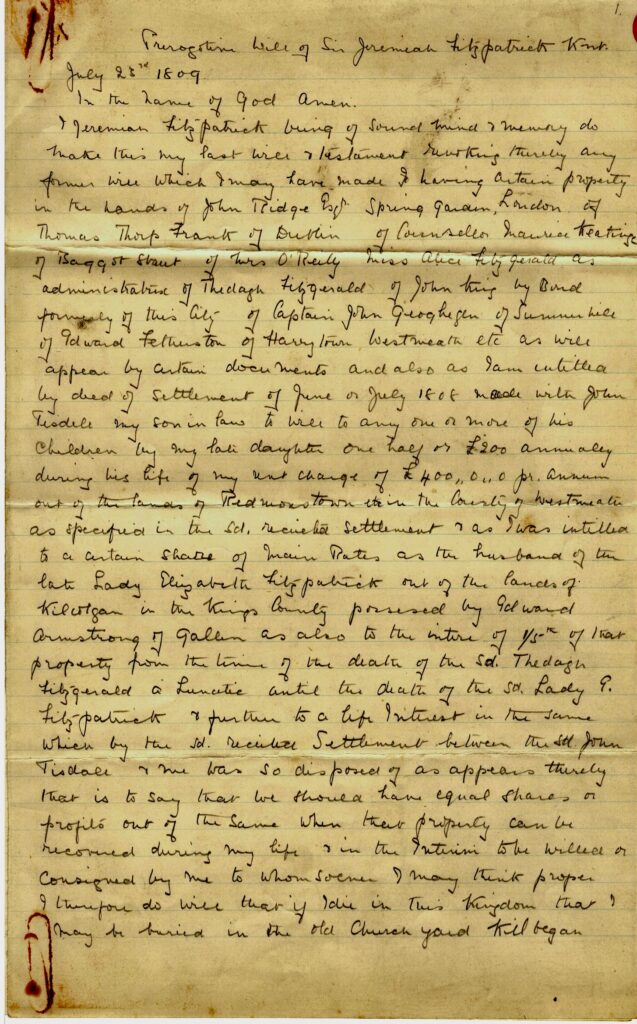
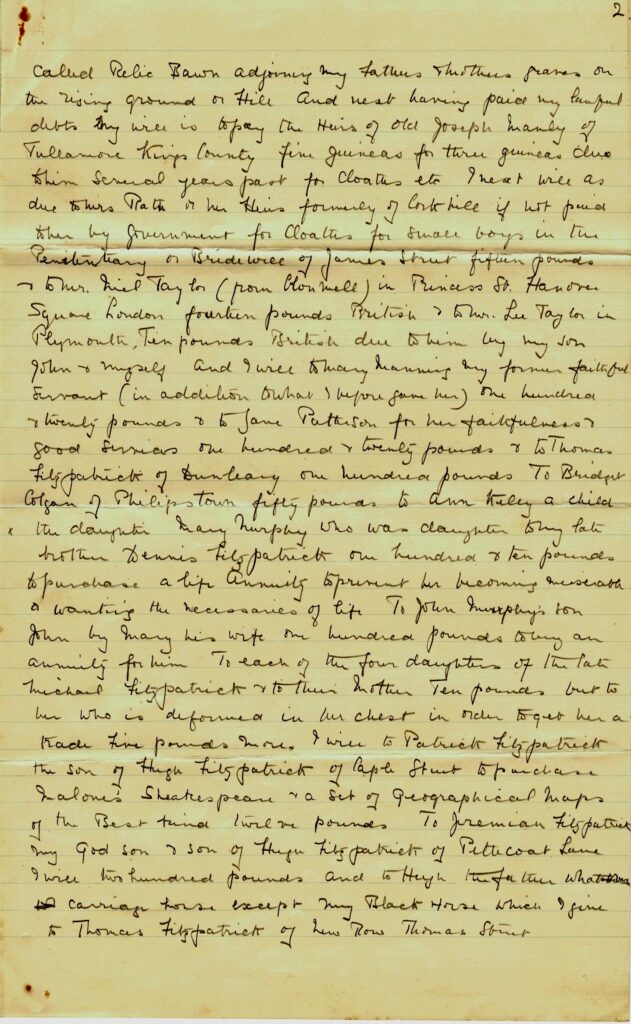
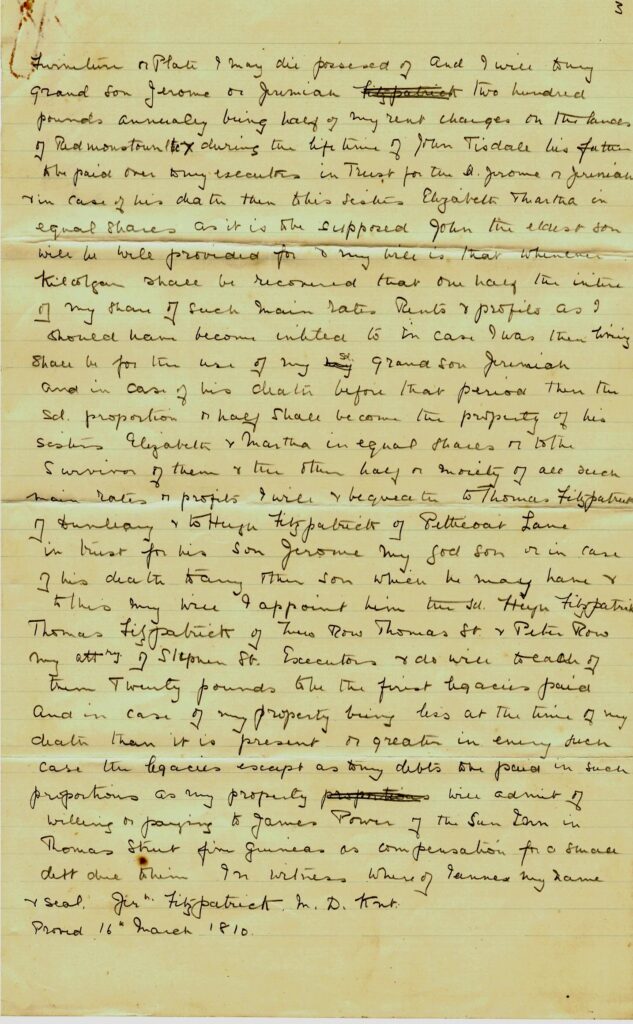
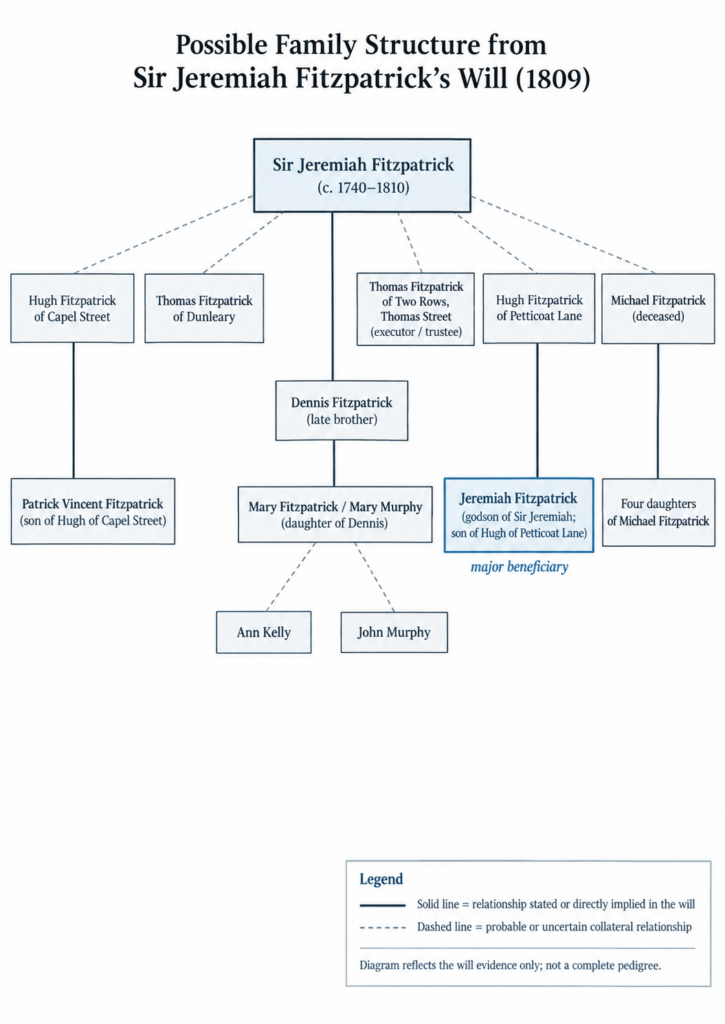
I am posting photographs of the handwritten copy or extract of Sir Jeremiah’s will with this article because the document is important in its own right. It reveals a much larger Fitzpatrick family than the published biographies make obvious. The will names Jeremiah’s late brother Dennis Fitzpatrick, giving us at least one confirmed sibling, and it also identifies several other Fitzpatricks around Dublin. Most importantly, it shows how dangerous it is to combine people simply because they share a name.
There were, for example, two different men named Hugh Fitzpatrick in Jeremiah’s immediate circle. One was Hugh Fitzpatrick of Capel Street, the printer and bookseller whose son was Patrick Vincent Fitzpatrick. The other was Hugh Fitzpatrick of Petticoat Lane, whose son Jeremiah Fitzpatrick was Sir Jeremiah’s godson and a major beneficiary of the will. The document also refers to Fitzpatricks associated with Thomas Street and Dunleary, together with the daughters of a deceased Michael Fitzpatrick. MacDonagh described Jeremiah as the successful member of a large, upwardly mobile and moderately respectable extended family involved in Dublin trade, and the will shows exactly what he meant.
Jeremiah’s ancestry puzzled MacDonagh for another reason. In 1782 Jeremiah received a knighthood from the Duke of Portland, and at the time Portland’s chief secretary in Ireland was Colonel Richard Fitzpatrick, younger brother of the Earl of Upper Ossory. MacDonagh openly considered whether Jeremiah might have been connected to the Upper Ossory Fitzpatricks. He rejected the idea that Jeremiah was simply an illegitimate offshoot of the aristocratic branch, but he left open the possibility that he belonged to a Catholic collateral branch of the Upper Ossory family. He admitted that this was conjecture, but clearly regarded it as one of the few plausible explanations for Jeremiah’s otherwise mysterious advancement.
The religious question does not work against that possibility. The Mac Giolla Phádraig family itself divided religiously after the Reformation. The titled and politically connected branches increasingly accommodated themselves to the Protestant establishment, but other branches remained Catholic. Some individual family members conformed for political or professional advantage while retaining strong Catholic family connections. That pattern is very close to what appears to have happened with Jeremiah. MacDonagh believed Jeremiah was born and raised Catholic, later conformed sufficiently to function within the Protestant establishment and hold high office, yet retained strong Catholic connections. By the end of his life he was again openly involved in Catholic political affairs, and his will reveals close ties to Hugh Fitzpatrick, Patrick Vincent Fitzpatrick and other Catholic relatives.
A Catholic Fitzpatrick family at Kilbeggan is therefore entirely compatible with descent from a collateral Mac Giolla Phádraig branch. In fact, the religious history of the family makes such a branch quite plausible. The better-known aristocratic line may have become Protestant, but that did not mean every branch of the wider Mac Giolla Phádraig family followed the same path.
There is another piece of evidence which considerably strengthens the Ossory interpretation. Sir Jeremiah was educated in continental Europe and received his medical degree at Rheims in 1767, but he was not the first Fitzpatrick associated with Ossory to follow that path. The Rheims medical records contain Patrick Fitzpatrick of Ossory, who received his M.D. there in 1681 and explicitly recorded that he was Roman Catholic. He was later associated with Dublin. The same records contain Kirenus Fitzpatrick of Ossory, who received his M.D. at Rheims in 1737. Then comes Jeremiah Fitzpatrick of Philipstown, M.D. Rheims, 1767, followed in 1780 by Gerard Valentine Fitzpatrick of Philipstown.
There is no documentary pedigree proving that Jeremiah descended from Patrick or Kirenus, and I do not want to turn a pattern into a family tree. Even so, the pattern is striking. Continental Catholic medical education at Rheims was already part of the world of Ossory Fitzpatricks generations before Jeremiah. Jeremiah’s religion, profession and educational route therefore fit an established Mac Giolla Phádraig pattern remarkably well.
The clearest evidence appears in the next generation. Hugh’s son Patrick Vincent Fitzpatrick, born in 1792, became closely associated with Daniel O’Connell and the Catholic political movement. By the nineteenth century Patrick Vincent was openly identifying himself with the Fitzpatricks of Upper Ossory. His residence was called Ossory Lodge, and contemporary antiquarian material records the belief that Patrick Vincent represented an elder branch of the Upper Ossory family.
Most strikingly, the monument erected for Patrick Vincent and his sister Honoria at Glasnevin carries the distinctive lion-and-dragon Fitzpatrick crest associated with the Upper Ossory Mac Giolla Phádraig family. That is very difficult to ignore. The crest does not provide a generation-by-generation pedigree, but it tells us clearly how Patrick Vincent and his immediate family understood their ancestry. This was not a modern genealogist attaching an Ossory story to them after the fact. The family itself was using the Upper Ossory heraldic identity.
When that is combined with MacDonagh’s independent suspicion that Jeremiah belonged to a Catholic Upper Ossory branch, the Rheims medical tradition, the religious history of the Mac Giolla Phádraig family and Patrick Vincent’s own Ossory identification, I think the weight of evidence is clear. Sir Jeremiah, Hugh the printer and Patrick Vincent should presently be treated as an Ossory Fitzpatrick family.
I would still leave one small question open. The lion-and-dragon crest proves an Upper Ossory identity, but heraldry by itself does not prove biological descent. By the eighteenth and nineteenth centuries, descendants of other Gaelic Pátraic families who had become Fitzpatrick could easily have forgotten the origin of the surname. A family that had been known as Fitzpatrick for several generations might naturally have assumed that it descended from the famous Mac Giolla Phádraig dynasty of Upper Ossory. That need not involve deliberate deception; it could simply be the result of the original surname history being lost.
This is where Jeremiah’s Westmeath background continues to give me a slight pause. His parents were already established at Kilbeggan before his marriage, and Kilbeggan lies within the wider Midlands region where we have found Ó Maol Phádraig activity in the early 1600s. That is not enough to seriously challenge the Ossory evidence, and I do not presently believe Jeremiah’s line was Ó Maol Phádraig. The Ossory evidence is substantially stronger. Until somebody finds the missing generations connecting Jeremiah’s parents at Kilbeggan to a documented branch of Mac Giolla Phádraig, however, I think it is reasonable to leave the smallest amount of room for the possibility that an older Fitzpatrick identity had been forgotten.
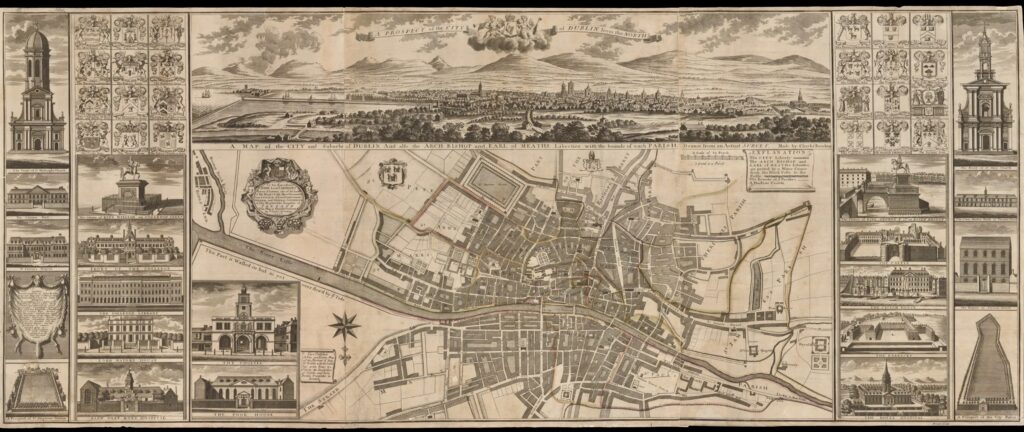
This investigation has also reinforced the need to keep different Dublin Fitzpatrick families separate. The 1783 Dublin directory contains several men named Fitzpatrick working in trades, among them John Fitzpatrick, flax dresser and weaver, of 23 North New Row. That entry is of particular interest to me because this John appears to be a strong possibility for the John Fitzpatrick in my own family tree, my fourth great-grandfather. I am not yet calling that identification proven, but he is a serious candidate.
That gives us another very different Fitzpatrick presence in eighteenth-century Dublin: a working family connected with the flax and weaving trades around North New Row. At the same time we have Jeremiah’s extended Fitzpatrick family appearing around Capel Street, Petticoat Lane, Thomas Street and elsewhere; older Catholic Ossory Fitzpatrick physicians in Dublin; Protestant Fitzpatrick families; and the better-known aristocratic descendants of the Upper Ossory line. There was clearly no single “Dublin Fitzpatrick family.”
That is the larger lesson from this exercise. The surname Fitzpatrick can hide several distinct paternal histories. Before trying to connect an eighteenth- or nineteenth-century Fitzpatrick to Ó Maol Phádraig, Mac Giolla Phádraig or any other earlier family, the Dublin lines have to be separated individually.
Hugh Fitzpatrick initially looked particularly interesting because of his Catholic political connections, his appearance in the same circles as Thomas Broughall and the uncertainty surrounding Sir Jeremiah’s ancestry. The Westmeath geography made the Ó Maol Phádraig possibility worth considering. After following the evidence further, however, I think Hugh, Sir Jeremiah and Patrick Vincent belong on the Mac Giolla Phádraig of Upper Ossory side of the ledger.
The parents buried at Kilbeggan remain an interesting unresolved piece of the story, but the family’s Catholic character does not conflict with an Ossory origin. Jeremiah’s continental medical education fits an existing Ossory Fitzpatrick tradition, MacDonagh independently suspected a Catholic Upper Ossory connection, and Patrick Vincent’s family ultimately placed the distinctive lion and dragon of Upper Ossory on his grave. For the moment, that is enough to keep this family separate from the Fitzpatrick line I am actually trying to follow, and that in itself is progress.
References
MacDonagh, Oliver. The Inspector General: Sir Jeremiah Fitzpatrick and Social Reform, 1783–1802. London: Croom Helm, 1981; reissued by Routledge, 2024.
Fitzpatrick, Sir Jeremiah. Will dated 23 July 1809, proved 16 March 1810. Kirkpatrick Bequest, Royal College of Physicians of Ireland, Dublin.
Dictionary of Irish Biography. “Fitzpatrick, Hugh.”
Dictionary of Irish Biography. “Fitzpatrick, Sir Jeremiah.”
Dictionary of Irish Biography. “Fitzpatrick, Patrick Vincent.”
Royal College of Physicians of Edinburgh. English-Speaking Medical Students at the University of Rheims. Entries for Patrick Fitzpatrick of Ossory, M.D. 1681; Kirenus Fitzpatrick of Ossory, M.D. 1737; Jeremiah Fitzpatrick of Philipstown, M.D. 1767; and Gerard Valentine Fitzpatrick of Philipstown, M.D. 1780.
Fitzpatrick Clan Society. Studies of Fitzpatrick heraldry and the Upper Ossory family, including the lion-and-dragon crest associated with the Mac Giolla Phádraig Fitzpatricks of Upper Ossory.
Fitzpatrick Clan Society. Fitzpatrick Multimedia Catalogue. Entry for the Patrick Vincent and Honoria Fitzpatrick monument at Glasnevin Cemetery, O’Connell Circle.
O’Donovan, John. The Tribes and Territories of Ancient Ossory. 1851.
Watson, John. The Gentleman’s and Citizen’s Almanack and Dublin directory material for 1783. Entry for John Fitzpatrick, flax dresser and weaver, 23 North New Row, Dublin.
Westmeath local historical material relating to Kilbeggan and the old burial ground known as the Relic.
Fitzpatrick, M. and Fitzpatrick, M. 2025. “Ó Maol Phádraig: the Name, the People, and the Clans. Part III.” Journal of the Fitzpatrick Clan Society 6, 27–41.
Note on the will images: The images reproduced here come from the biographical file on Sir Jeremiah Fitzpatrick compiled in the 1920s by Dr T. P. C. Kirkpatrick. The file was later digitised by Ancestry, but the transcript of Sir Jeremiah’s will was not included in that digitisation. A separate scan of the transcript has now been obtained and is reproduced here together with the other surviving items from Kirkpatrick’s file, several of which also contain references to Sir Jeremiah’s extended family.