
The published history of the Ó Maol Phádraig family has now essentially caught up with my current research. I have worked through the surviving evidence to about 1610, and the backlog of material that allowed me to post so frequently has now been cleared. From this point onward, the pace of new posts will probably slow considerably because I will once again be researching and writing at the same time.
I will try to continue following a chronological path, but there are no guarantees that the research will cooperate. Historical research rarely develops in a straight line. A seventeenth-century record can suddenly explain something that happened centuries earlier, DNA can point toward a new location, and one obscure reference can open an entirely new line of investigation. When significant new information appears, I will post updates as I uncover it, even if that means occasionally stepping outside the chronological sequence.
The next major phase of the project will cover approximately 1610 to 1820. This is one of the most difficult periods in Irish genealogy and family history. For many families it becomes a genuine brick wall. The records become thinner, less consistent and far more difficult to access, particularly for Gaelic families who were no longer major landholders. In the case of Ó Maol Phádraig there is an added complication: by this period the name is increasingly appearing in records as Fitzpatrick. From that point onward, finding a Fitzpatrick in the right county is no longer enough. We have to determine which Fitzpatrick paternal line that person belonged to and separate Ó Maol Phádraig descendants from Mac Giolla Phádraig and from other unrelated Fitzpatrick families. That makes the documentary research much more difficult, but it is also where the DNA work becomes increasingly valuable.
One of the great problems is that we lose much of the detailed information about who was actually living on individual pieces of land. The Gaelic landholding system had already been dismantled, and the people who remained beneath the new proprietors did not leave anything resembling a continuous genealogical record. In many cases records were never created, were deliberately avoided, were later destroyed, or survive only in scattered estate and archival collections. That means there may be generations of Ó Maol Phádraig families who remained in the same districts but are effectively invisible to us today.
The later seventeenth century offers some hope. The Williamite wars and the confiscations following the Jacobite cause produced another major redistribution of Irish land. Those events generated forfeiture records, claims, surveys, estate papers and other documentation that may allow us to identify where Ó Maol Phádraig and Fitzpatrick families were living at the time. The difficulty is that much of this material is not conveniently searchable online, and some of the most useful collections are difficult to access. I therefore need to develop a more systematic plan for working through these records and identifying the places where the family survived.
The immediate objective is not to produce another grand narrative. It is much simpler: find the people and pin them to places. If we can establish where Ó Maol Phádraig or related Fitzpatrick households were living during the seventeenth and eighteenth centuries, we may eventually be able to bridge the gap between the early modern family documented in the Fiants, Patents and other Crown records and the Fitzpatrick families who become visible again in parish records, valuations and nineteenth-century sources.
Looking back at where the project began, I think we have taken Ó Maol Phádraig from almost complete obscurity to one of the better documented Fitzpatrick paternal lines. Even the better-known Mac Giolla Phádraig line of Ossory still contains major gaps and uncertainties between roughly 1100 and 1500. With Ó Maol Phádraig we now have both a historical record and a Y-DNA record that fit together unusually well.
That does not mean the reconstruction is finished, and it certainly does not mean every part of it is proven. The narrative remains a work in progress. New evidence may change individual conclusions and could even force substantial parts of the reconstruction to be reconsidered. That is exactly how historical research should work.
What gives me confidence is that the record does not require us to invent improbable events to hold the story together. The geography, chronology, political relationships and DNA repeatedly fit the historical circumstances. Again and again, when one piece of evidence suggested that something else ought to exist, further research produced supporting material in approximately the place and context where we expected to find it. The result is a reconstruction that I believe is historically very plausible and increasingly difficult to dismiss simply as coincidence.
One question that deserves to be addressed is the apparent absence of Ó Maol Phádraig from surviving records in the Tirerrill region. I do not find that absence particularly troubling. During the period when the family appears to have been living in or around that area, it was probably very small. The wider region was also repeatedly affected by conflict and political change between roughly 900 and 1200, making it exactly the sort of place from which a small family could disappear from the documentary record.
If Ó Maol Phádraig found patronage through families such as Ó Maolchonaire and Ó Maolmochéirghe, movement away from the original area may also have begun quite early. That movement may have been complete, or any branch that remained behind may simply have failed to survive in the male line. The absence of later surname records in Tirerrill therefore does not require a complicated explanation.
The survival of Rathmulpatrick is particularly important in that respect. Without that placename, reconstructing the earliest stage of the family’s history would have been much more difficult. Its location beside the early Ó Maolchonaire and Ó Maolmochéirghe landscape provides what I still believe is the best explanation for the family’s earliest setting. Nothing I have found so far contradicts that interpretation. In fact, the later history consistently develops in ways that make the proposed early relationship more plausible rather than less.
There is still a great deal of historical detail missing, but the difference now is that we increasingly know where to look for it. The broad framework is in place. Future research can concentrate on strengthening, refining or challenging specific parts of it rather than trying to construct the family history from scratch.
Alongside the next phase of archival research, I also intend to improve the interactive map and reorganize parts of the website so that the growing amount of material is easier to navigate. I also want to begin working systematically through the modern genealogies of known Ó Maol Phádraig-descended Fitzpatrick lines. Working backward from documented nineteenth-century families while continuing to work forward from the seventeenth century may eventually allow those two sides of the research to meet.
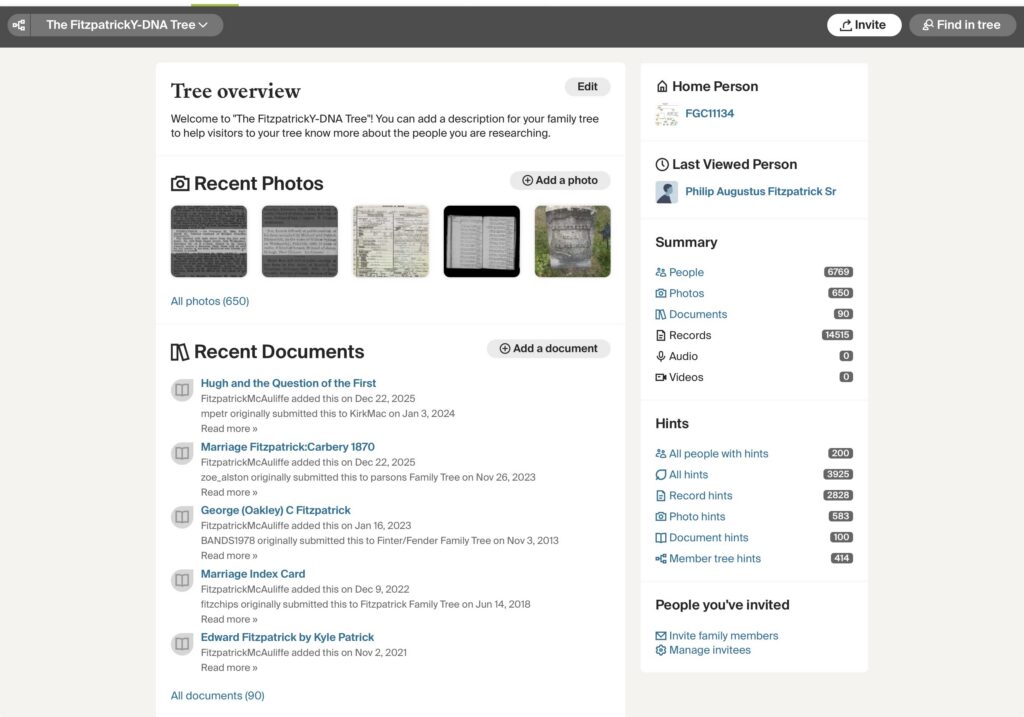
I already have a very large Fitzpatrick Y-DNA genealogy tree on Ancestry that has been growing for several years. It contains more than 4,000 Fitzpatrick individuals, grouped where possible according to known Y-DNA haplotypes and paternal lines. It has become an extremely useful research tool, but it has also become something of a mess as the number of families, records and DNA connections has grown. One of my projects for this winter will be to reorganize that tree, clean up the structure and make the different paternal lines easier to follow. Once I am satisfied that it is in a form that will be genuinely useful rather than confusing, I intend to make it public.
That work should become increasingly important as we move into the eighteenth and nineteenth centuries. The documentary record alone may not always tell us whether a particular Fitzpatrick family descends from Ó Maol Phádraig, but a combination of location, genealogy and Y-DNA may allow us to separate families that the written record has merged under the same surname. The goal is eventually to work backward from these known modern lines while continuing to work forward from the seventeenth-century Ó Maol Phádraig records, and see where the two approaches begin to meet.
I welcome challenges to the reconstruction. If a record contradicts something I have written, I want to know about it. If an identification is wrong, it should be corrected. If another interpretation explains the evidence better, it deserves to be considered. Confidence in a historical reconstruction should never mean protecting it from criticism.
Please feel free to use the comments beneath individual posts or contact me directly if you have records, family histories, DNA information, corrections, questions or alternative interpretations.
The rapid run of new articles may be coming to an end for now because the research backlog has finally been cleared. The project itself is not slowing down. It is simply moving into a much more difficult period of the record.