
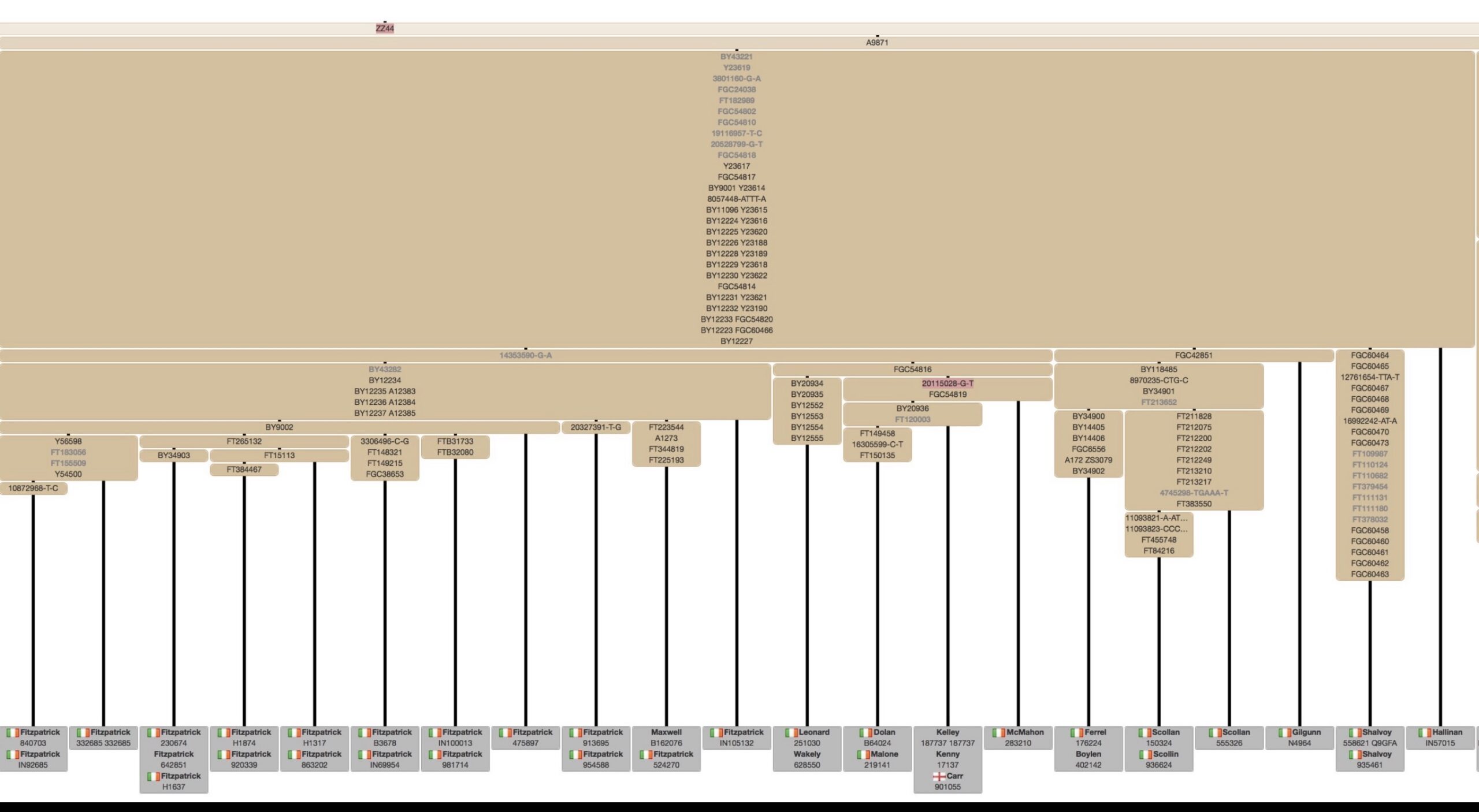
The preceding study followed BY9001 across a much deeper timescale. BY9001 belongs to the old paternal landscape of the Shannon–Erne corridor and the wider northwestern Irish world, long before the emergence of the Ó Maol Phádraig surname. Within that ancient regional lineage, however, one much younger branch begins to look very different. BY12234 is where the genetic story starts to align remarkably closely with the historical reconstruction of the Ó Maol Phádraig family.
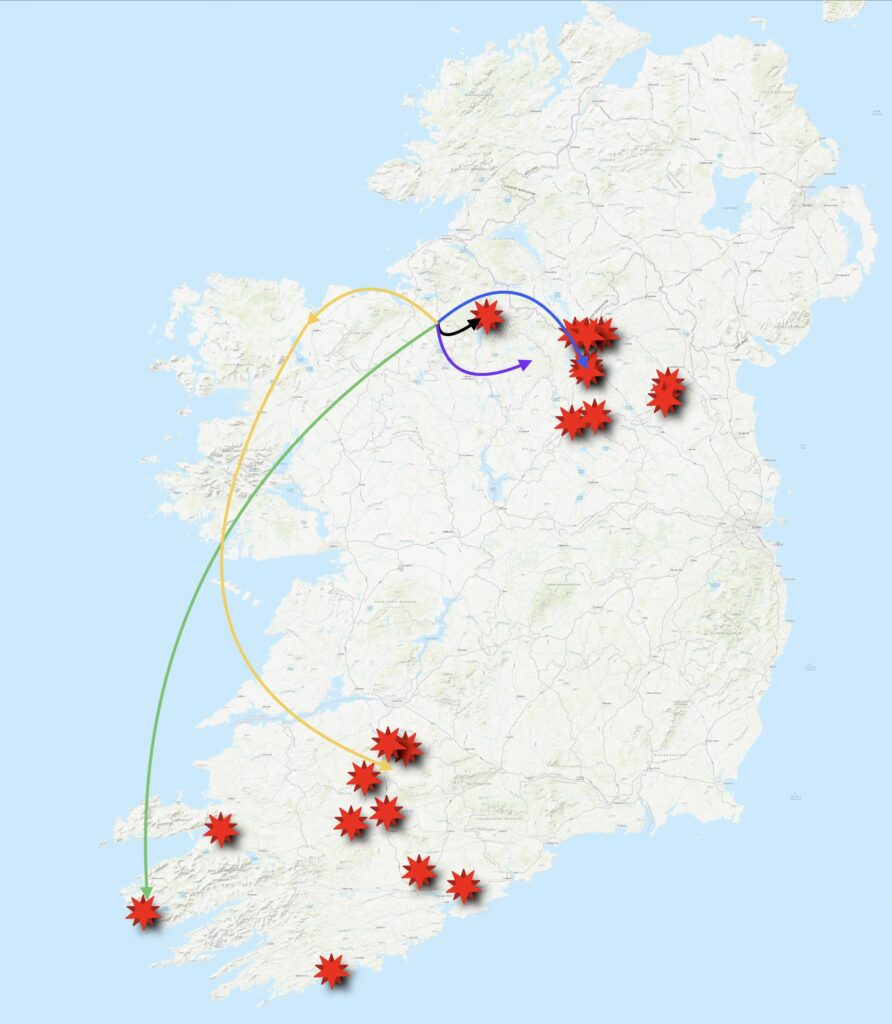
The genealogical tradition places Maol Phádraig son of Maoilgeann, “from whom are Uí Mhaoil Phádraig,” within Cenél Luacháin and the wider Conmaicne world. The historical reconstruction developed through the earlier articles has suggested that the family’s deeper setting lay farther west than its later concentration in Cavan, within the Tirerrill–Moytura–Loch Cé landscape and the connected northwestern interior. From there, members of the family appear to have begun moving outward into the developing worlds of Bréifne, Cavan and, eventually, Cork.
The structure of BY12234 fits that chronology unusually well.
From the old regional lineage to a medieval family
One of the most striking features of the paternal tree before BY12234 is not its branching but its lack of branching. From approximately ca. 500 to ca. 1200, the surviving paternal line passes through a prolonged bottleneck. No substantial surviving diversification is presently visible across those centuries. That does not mean only one male descendant existed at any particular time. Other lines may simply have died out or remain unsampled. What the present tree shows is that only one paternal path survives into the tested population from that long interval.
At approximately ca. 1200, the pattern changes sharply. BY12234 begins producing multiple surviving paternal lines, with four major branches emerging around the beginning of this expansion. By approximately ca. 1400, at least thirteen separate surviving branches had formed.
That timing falls directly across the period in which the historical reconstruction suggests that Ó Maol Phádraig was beginning to spread beyond its older western landscape. Instead of a paternal line remaining compressed within one locality, the genetic tree begins to broaden almost exactly when the historical family may have been moving into new geographical and social environments.
This is one of the reasons BY12234 is so important. The tree is not being forced to fit the history after the fact. The branching structure comes from the Y-chromosome, while the historical model has been assembled independently from genealogies, church records, later fiants, patents and associated family networks. Yet the two begin changing at almost the same point in time.
The expansion from ca. 1200 to ca. 1400
The rapid diversification between ca. 1200 and ca. 1400 also helps explain something that has repeatedly emerged from the historical evidence: Ó Maol Phádraig does not behave like a family confined to one compact territorial block.
If the surviving paternal family had remained highly concentrated within one restricted locality, we might expect a more prolonged bottleneck, particularly if marriage and reproduction continued primarily within one narrow local population. BY12234 instead produces a remarkable number of independent surviving lines over approximately two centuries. That pattern is much easier to understand if different sons and grandsons were becoming established in different places.
Geographical dispersal creates paternal diversity. Once brothers, cousins or more distant relatives established households in different regions, their descendants began accumulating their own mutations. Over several generations those families became genetically distinct branches of the same paternal tree, even though the men themselves may still have understood one another as members of the same wider Ó Maol Phádraig family.
This offers a much better model for the evidence we have been finding. One branch could remain nearer the older Conmaicne landscape. Another might move toward Cenél Luacháin and the eastern Bréifne world. Others could become associated with Cavan, while at least one line may already have been moving toward Cork. Learned service, ecclesiastical connections, fosterage, military service and relationships with powerful dynasties could all have helped create that spread.
The expanding BY12234 tree therefore looks less like the genetic history of a territorially isolated sept and more like the history of a geographically dispersed but still connected paternal family.
A family spread across the geography
This model helps resolve one of the persistent problems encountered throughout the documentary research. Ó Maol Phádraig appears in too many different political and institutional environments to fit comfortably into the conventional search for one small ancestral territory.
Members of the family occur among Ó Raghallaigh, Ó Maolmochéirghe, Ó Maolchonaire, Mac Diarmada, Mac Cárthaigh, Tyrrell and other networks. By the sixteenth century the records place Ó Maol Phádraig men across a surprisingly broad geography, yet the same associated families and social relationships recur repeatedly.
This distinction between family and territory is becoming increasingly important. Ó Maol Phádraig could remain a coherent family without every member living beside one another. Indeed, the DNA increasingly suggests that geographical mobility was part of the family’s medieval development.
Cork and Bréifne
The clearest example is Cork.
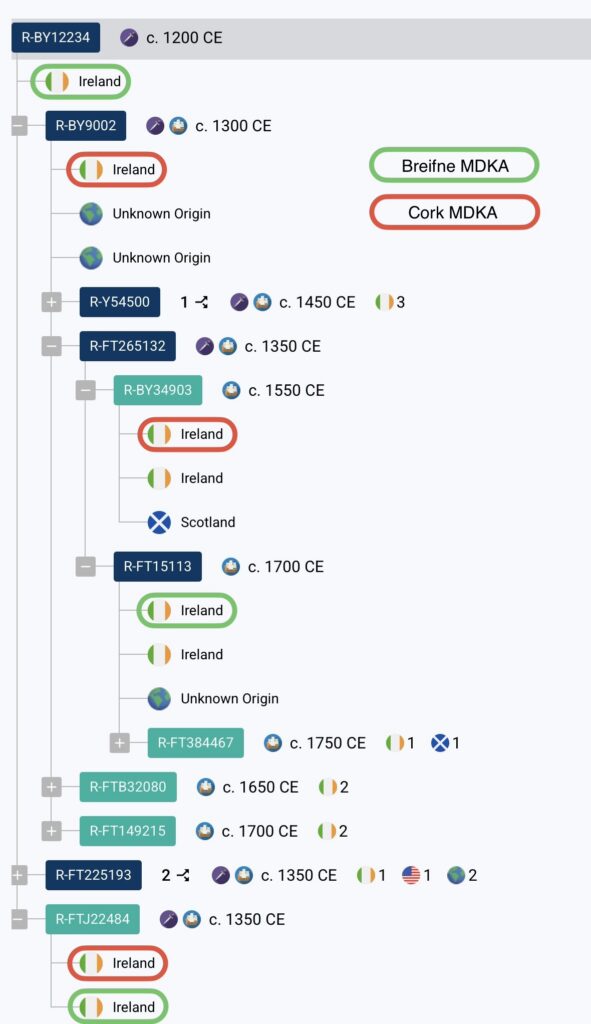
The Cork ancestry presently reported among BY12234 testers does not occur beneath one single young downstream branch. Instead, Cork-associated most distant known paternal ancestors appear on substantially separated parts of the tree. One is associated with the early FTJ22484 line, another occurs within the BY9002 side, and another is found beneath FT265132 through BY34903. There is also an additional Fitzpatrick with a Cork paternal ancestry whose STR results appear to fit best beneath BY9002, although only a Big Y test could determine his correct position.
This pattern is revealing because it makes a single late migration into Cork an unnecessarily complicated explanation. If one Fitzpatrick family had arrived in Cork during the sixteenth or seventeenth century and produced the later Cork population, those descendants should normally cluster beneath one comparatively recent paternal branch. Instead, Cork appears on lines whose common ancestry reaches much farther back toward the beginning of BY12234 itself.
The simpler explanation is that an Ó Maol Phádraig presence became established in Cork relatively early and that other related branches continued to move there afterward.
That interpretation fits particularly well with the documentary evidence, because the Ó Maol Phádraig surname is already recorded in Cork in 1306. The genetic expansion of BY12234 was therefore already underway when a historically identifiable Ó Maol Phádraig was present in Cork. If the first movement south had occurred during the earlier part of the BY12234 expansion, later related families could have followed established social or service connections into the same region.
Cork may therefore not represent one isolated “Cork branch.” It may preserve several different arrivals from the wider Ó Maol Phádraig family.
This also raises an important possibility regarding the later Tyrrell records. If Ó Maol Phádraig families continued moving into Cork while maintaining relationships with relatives elsewhere, then movement could also occur in the opposite direction. The possibility that men connected with the Cork population later travelled northward with Richard Tyrrell toward the Midlands and Cavan would no longer be an exceptional event requiring a separate explanation. It would represent the continuation of the same long-established pattern of family mobility.
The documentary evidence does not yet allow us to identify a particular BY12234 branch with an individual Ó Maol Phádraig named in a medieval or Tudor record, but the genetic structure shows that such movements are entirely compatible with the history of the paternal family.
A necessary caution about the MDKAs
The geographical information on the tree must be treated carefully.
A reported most distant known ancestor is not a direct observation of where a medieval SNP formed. Modern genealogies can contain mistaken parentage, undocumented adoptions, surname changes and assumptions that become repeated as fact. Even well-researched paternal trees normally extend only a few centuries and do not reach the men living when BY12234 and its earliest branches actually formed.
The Cork associations should therefore be treated as evidence rather than certainty.
Each line will need to be examined separately in later posts: who the tester’s earliest documented ancestor was, where that man lived, whether the paternal genealogy is secure, what other testers share the branch and whether their histories support or contradict the stated origin. The STR-only Cork line requires particular caution until a Big Y test establishes its actual SNP position.
Even with those qualifications, the repeated appearance of Cork ancestry on widely separated BY12234 lines remains striking. The significance lies not in any one MDKA but in the cumulative pattern.
What the surnames beneath BY12234 show
Another revealing feature of the tree is the remarkable surname continuity within its older branches.
No clearly unrelated surname currently appears deeply within the medieval structure of BY12234. The early surviving branches are overwhelmingly Fitzpatrick. Other surnames do occur farther downstream, including names such as Crayton and Maxwell and surnames associated with later Scottish or planter populations, but those appearances belong to paternal lines formed after approximately 1600.
The chronology is significant. If BY12234 were simply an old regional paternal lineage shared by numerous medieval families, we should expect some unrelated surnames to appear beside Fitzpatrick among branches formed in ca. 1200–1400. At present they do not.
Instead, the tree appears remarkably surname-specific throughout its medieval expansion.
The simplest explanation is that BY12234 had become closely associated with the Ó Maol Phádraig paternal family by the time its major surviving branches began to form. Later surname changes, incorporations or paternal events appear after the medieval family structure had already existed for several centuries.
This fits surprisingly well with the historical picture emerging from the documentary research. Ó Maol Phádraig repeatedly appears within church-connected families and environments in which religious identity remained important. The evidence does not permit us to describe every member as clerical, nor would such a claim be justified, but the cumulative record increasingly presents a family closely associated with the Church and strongly attached to the Catholic world in which it operated.
Such a family could maintain a powerful internal identity even while geographically dispersed.
The great disruption comes later. After 1600, conquest, confiscation, plantation, military service, migration, religious pressure and the gradual disappearance of the Ó Maol Phádraig surname created entirely different conditions. It is precisely after this period that the tree begins showing other surnames beneath branches ultimately descending from the medieval paternal family.
Possible Inlow and Ó Raghallaigh connections
There may, however, be hints of one or two much earlier exceptions.
The Inlow STR results indicate a particularly close relationship to the BY12234 population, potentially reaching back toward the medieval expansion of the tree. An Ó Raghallaigh line also appears unusually close by STR comparison. Neither can presently be placed securely on the SNP tree without the appropriate Big Y testing, and neither should be treated as proven.
If one of these lines eventually proves to branch with BY12234 around ca. 1200–1400, however, fosterage immediately becomes an important historical possibility.
Medieval Irish fosterage was far more than temporary childcare. Foster relationships created enduring obligations between families and could bind households politically, emotionally and socially for life. A foster-son could become deeply associated with the household in which he was raised, while the relationship created reciprocal obligations between both biological and foster families.
Most importantly for genetic genealogy, fosterage worked in both directions.
An Ó Maol Phádraig boy could be fostered into an Ó Raghallaigh, Mac an Leagha or another allied household. Equally, a boy born into one of those families could be raised among Ó Maol Phádraig.
The paternal Y-chromosome would remain that of the biological father regardless of the child’s social identity. Over generations, however, a descendant strongly incorporated into another family could conceivably become associated with that family’s surname or identity. Such a process provides one historically plausible mechanism for an unusual surname appearing within an otherwise highly surname-specific paternal line.
The possibility becomes particularly interesting because the historical records repeatedly place Ó Maol Phádraig beside precisely the kinds of families with whom such relationships could have existed.
Other Fitzpatrick and Ó Maol Phádraig haplotypes
The same reasoning has to be applied in the opposite direction.
BY12234 is not the only paternal haplotype found today among men carrying Fitzpatrick, Mulpatrick or names historically associated with Ó Maol Phádraig. Other genetically unrelated paternal lines exist, including lines whose most distant known ancestors also occur within the wider Bréifne region.
At present, however, I have found no historical evidence demonstrating that several unrelated Ó Maol Phádraig septs or paternal families existed in Bréifne.
For that reason, the existence of several modern Fitzpatrick haplotypes cannot simply be converted into a historical claim that several separate medieval Ó Maol Phádraig families existed. The documentary evidence presently does not support such a conclusion.
Those other paternal lines require explanation, but more than one explanation remains possible. Fosterage or another form of incorporation into an Ó Maol Phádraig household is one. Later surname adoption is another. A paternal event followed by continuation of the family surname is another. Some could theoretically represent Mac Giolla Phádraig-derived Fitzpatrick lines that later moved into the region, although at present this appears a more remote possibility in the cases under consideration.
What will now be especially interesting is whether those other haplotypes can be connected genetically or historically to families that were repeatedly associated with Ó Maol Phádraig.
If one of these apparently unrelated Fitzpatrick paternal lines points instead toward Ó Raghallaigh, Mac an Leagha, Brady, Sheridan, Ó Maolmochéirghe or another family appearing repeatedly beside Ó Maol Phádraig in the records, the historical possibilities become considerably more specific. Fosterage would no longer be merely a general explanation available for any unexplained paternal discrepancy. It could potentially be tested against the actual families surrounding Ó Maol Phádraig.
That will be one of the more interesting directions for the next stage of the research.
A paternal tree that follows the historical model
BY12234 cannot tell us the name used by a man living in 1250. It cannot tell us where he lived, whom he served, whether he was fostered or why one of his descendants moved from one part of Ireland to another. TMRCA estimates are approximate, the current testing population is incomplete, and the tree will change as additional Big Y results create new branches or divide existing ones.
Yet the overall structure is difficult to dismiss.
From approximately ca. 500 to ca. 1200, the surviving paternal lineage remains bottlenecked. At approximately ca. 1200, at almost exactly the period in which the historical Ó Maol Phádraig family begins to become meaningful within the medieval evidence, BY12234 rapidly begins to diversify. Four major surviving lines emerge near the beginning of that expansion, and by approximately ca. 1400 at least thirteen branches had formed.
This occurs across the same centuries in which the historical model places members of the family spreading beyond the older Conmaicne and Tirerrill-connected landscape toward Bréifne, Cavan and Cork. Rather than remaining trapped within one territorial bottleneck, the paternal family becomes increasingly diverse, exactly as would be expected if different branches were establishing themselves across a wider geography.
The later tree preserves both Cork and Bréifne-associated lines. Cork appears repeatedly rather than beneath one single recent branch, suggesting continued movement into an established Cork population. The medieval portion of the tree remains overwhelmingly Fitzpatrick, while clearly different surnames become apparent mainly on branches formed after 1600. Possible Inlow and Ó Raghallaigh connections may eventually allow fosterage to be investigated genetically, while the unrelated Fitzpatrick haplotypes found elsewhere in Bréifne raise the reverse question: whether men from neighbouring families may at some point have been incorporated into Ó Maol Phádraig.
None of those individual questions is resolved yet.
But the broad structure is remarkably consistent.
BY9001 gave us the old regional paternal landscape from which this family emerged. BY12234 appears to capture the point at which that old lineage became a rapidly expanding medieval paternal family and began spreading across precisely the geography in which the historical Ó Maol Phádraig later appears.
The next task is to take those branches apart one by one and see whether their individual histories continue to follow the same pattern.
References
Earley, Joseph E., Sr., and Leonard E. Boyle. 1999. “Conflict over the Rectory of Cinel Luachain during the Fifteenth Century.” Breifne, vol. IX, no. 35, pp. 103–113.
Fitzpatrick, Ian, and Mike Fitzpatrick. 2023. “Ó Maol Phádraig: the name, the people, and the clans. Part I.” Journal of the Fitzpatrick Clan Society, vol. 4, pp. 1–10.
Fitzpatrick, Mike, and Proinsias Mag Fhionnghaile. 2024. “Ó Maol Phádraig: the name, the people, and the clans. Part II.” Journal of the Fitzpatrick Clan Society, vol. 5, pp. 25–42.
Fitzpatrick, Matthew, and Mike Fitzpatrick. 2025. “Ó Maol Phádraig: the name, the people, and the clans. Part III.” Journal of the Fitzpatrick Clan Society, vol. 6, pp. 27–41.
O’Donnell, Thomas Charles. 2016. The Affect of Fosterage in Medieval Ireland. PhD thesis, University College London.
Ó Scea, Ciaran. 2011. “Erenachs, Erenachships and Church Landholding in Gaelic Fermanagh, 1270–1609.” Proceedings of the Royal Irish Academy, vol. 112C, pp. 271–300.
FamilyTreeDNA. BY12234 Discover paternal tree and associated Big Y branch estimates. Branch dates and reported paternal origins as displayed in the current BY12234 tree. Accessed 2026.