
When the Old Professions Disappeared: Ó Maolmochéirghe, Ó Maolchonaire and Ó Maol Phádraig after the Gaelic Order
By the opening years of the seventeenth century, the world in which Ó Maolmochéirghe, Ó Maolchonaire and Ó Maol Phádraig had developed was breaking apart. The Nine Years’ War had ended, Crown authority was advancing into regions that had long operated through Gaelic lordship, and the political, ecclesiastical and economic structures that had supported hereditary learned and clerical families were being dismantled or transformed.
The effects were not the same for every family. Ó Maolchonaire and Ó Maolmochéirghe had occupied positions of remarkable importance in medieval Ireland, but much of that importance depended upon highly specialised professions and institutions. Ó Maolchonaire belonged to the highest learned order of Connacht. Ó Maolmochéirghe belonged to a hereditary ecclesiastical world centred upon church office and church land. Ó Maol Phádraig, by contrast, appears in the surviving late records in a broader range of practical roles, including husbandmen, yeomen, retainers and men attached to military and landed households.
That difference may help explain what happened to the three families when the old order disappeared.
A family built around learning
Ó Maolchonaire was one of the great hereditary learned families of medieval Connacht. The family was deeply associated with the intellectual world around Loch Cé and with the Uí Chonchobhair and Mac Diarmada political sphere. In 1231 Duinnín Ó Maolchonaire died as ollamh of Síl Muireadaigh, and by 1270 Tanaide Mór Ó Maolchonaire had succeeded to the Ollamh’s Chair of Connacht. Later generations continued to produce historians, poets, manuscript workers, legal specialists and clerics of high standing.
Their influence extended far beyond one school or lordship. Ó Maolchonaire men appear in ecclesiastical and learned settings around Loch Cé, Elphin, Fenagh, Loch Oughter, Thomond and even St Michael’s at Ballinskelligs in Kerry. Members of the family were active in the production and preservation of manuscripts, and in 1516 Muirgheas Ó Maolchonaire revised the manuscript remembered as the Old Book of St Caillín at Fenagh. Other branches operated learned schools, worked as scribes and legal notaries, and continued to serve Gaelic patrons well into the sixteenth century.
This was an extraordinarily successful system, but it required much more than possession of a surname and a parcel of land. Producing an Ó Maolchonaire historian, poet or legal specialist required years of education, access to teachers and manuscripts, mastery of a specialist intellectual tradition and, at the end of that education, a patron capable of maintaining the learned man and his household.
That system could reproduce itself while Gaelic kings and lords continued to require hereditary historians, genealogists, poets and legal specialists. Once the political order supporting those offices began to contract, the difficulty was not that Ó Maolchonaire people suddenly disappeared. The problem was that there were fewer positions capable of sustaining highly trained Ó Maolchonaire professionals.
The very specialisation that had elevated the family for centuries was becoming increasingly difficult to maintain.
The clerical world of Ó Maolmochéirghe
Ó Maolmochéirghe faced a related problem, although the family’s inherited profession was different.
Their strongest medieval centre was the Drumreilly–Oughteragh–Cenél Luacháin church-land system. The family held the hereditary coarbship and rectory associated with Drumreilly alias Cenél Luacháin, while another line was associated with the erenaghship of Ballinagleragh. The surviving record reaches back at least to Muirchertach Ua Maelmoicheirge, bishop of Bréifne, who died in 1149, and continues through generations of abbots, canons, papal officials, notaries and other senior clerics.
During the fifteenth century the family appears repeatedly in papal records concerning the rectory of Cenél Luacháin. Members became canons of Kilmore and Ardagh, acted within the papal administrative system, and John Ó Maolmochéirghe ultimately became Dean of Kilmore. The repeated succession of members of the family to the same ecclesiastical positions shows how strongly blood, office and church land remained connected even when appointments were being processed through the formal machinery of the medieval Church.
Their position depended upon land as well as clerical office. Medieval coarb and erenagh families were not simply collections of priests. Church estates supported households, dependants, hospitality and the economic obligations attached to ecclesiastical office. Ó Maolmochéirghe therefore possessed something far more substantial than a series of church appointments. They stood at the centre of a hereditary church-land system that had survived for centuries.
As long as that institution remained intact, it could sustain the family’s social position from generation to generation. Once hereditary Catholic church office and the old church-land structure were broken apart, however, descent from generations of coarbs, rectors and canons no longer guaranteed a son an equivalent position.
The late Tudor records show that the family adapted, but they also show how dramatically the conditions of that survival had changed.
The family after the institution
Fiant 4786 provides the clearest late snapshot of Ó Maolmochéirghe in the old ecclesiastical heartland. Members of the family appear at Drumreilly, Ballinagleragh and Lisbonan or Lisbouan, almost exactly where the older church-land structure would lead us to expect them. A 1603 pardon again finds an Ó Maolmochéirghe at Ballinagleragh. The family therefore remained physically attached to the centre from which much of its medieval authority had developed.
Other records reveal a much broader footprint. Fiant 5441 places the family at Dromard; Fiant 5597 at Behy; Fiant 5603 at Ballyneglogh; and Fiant 5815 at Killagown or Kyllagowne. These appearances extend the late Ó Maolmochéirghe geography from the Drumreilly–Ballinagleragh core through south Leitrim, into Tirerrill in south Sligo, and eastward toward the northeastern Cavan–south Monaghan frontier.
Behy and Killagown are particularly interesting because they place members of Ó Maolmochéirghe back in the Tirerrill region. The family was therefore not simply retreating into a shrinking pocket around Drumreilly. Its members were moving through, or continuing to inhabit, a much wider landscape.
This adds another dimension to the older evidence connecting the family with the western world around Loch Cé, Moylurg and Tirerrill. The movement of learned and ecclesiastical families between Connacht and Bréifne was evidently not a simple one-way migration in which an earlier homeland was abandoned forever. Branches could remain behind, move back, marry into neighbouring families or continue circulating through the same network of lordships and church lands for generations.
The late geography is therefore better understood as dispersal than disappearance. Ó Maolmochéirghe survived as a family, but the institution that had once concentrated its power around hereditary clerical office could no longer support the family in the same way.
The problem of educating the next generation
There was another difficulty hidden within hereditary learned and clerical professions: the education required to reproduce them.
Large families were valuable in Gaelic society, but highly specialised professions could not absorb unlimited numbers of sons. A farming household could put another son to work with cattle, crops, livestock management and the ordinary labour of the holding. A son who did not inherit the principal farm could become a tenant elsewhere, work for another landholder or marry into another agricultural household. Much of the knowledge required for that life could be transmitted within the family itself.
A hereditary learned family faced a different problem. Producing a professional historian, poet or legal specialist required prolonged education, and the same was true of men intended for the higher reaches of the Church. Not every household could provide every part of that education itself.
Fosterage offered one mechanism by which children could be placed into another household for upbringing, education and social formation. Medieval Irish evidence makes clear that fosterage involved far more than simply feeding another family’s child. Education formed part of the relationship, and children could acquire skills and knowledge in the household in which they were fostered. In a society containing hereditary learned and professional families, this created a way of distributing children through networks of expertise as well as networks of kinship and political alliance.
This may help us understand why the same learned, clerical and ruling families repeatedly appear around one another. A boy did not necessarily have to be educated entirely within the house in which he had been born. Fosterage could place him in another environment where specialist knowledge, useful connections and future patrons were available.
Such a system worked particularly well while there were many households able to receive and educate children and many offices in which those educated sons could later find a place. As Gaelic lordship contracted, however, so did the number of courts, learned schools, ecclesiastical estates and hereditary offices capable of supporting them.
The problem was therefore not simply that learned or clerical families had too many children. Their difficulty was that maintaining their traditional social position required considerable educational investment in their sons at the same time that the number of positions capable of rewarding that education was shrinking. A large learned family might produce several capable sons, but there was only one ollamhship. A clerical family might educate several sons, but there were only so many rectories, canonries and hereditary church offices. When those positions themselves began disappearing, the imbalance became even greater.
For centuries the system had allowed these families to turn education into influence. By the seventeenth century, the same investment could no longer guarantee a comparable place for the next generation.
Ó Maol Phádraig was differently placed
Ó Maol Phádraig entered this changing world from a different position.
The late records do not reveal a single Ó Maol Phádraig hereditary profession equivalent to the Connacht ollamhship of Ó Maolchonaire or the Drumreilly coarbship of Ó Maolmochéirghe. Instead, the family appears scattered through the practical working world of late Gaelic and early Crown society.
Cathal Bán Ó Maol Phádraig appears as a husbandman. Other members of the family are found as yeomen, military followers, retainers and men attached to powerful households. Some travelled with figures such as Richard Tyrrell. Others appear in the company of Ó Raghallaigh, Brady, Sheridan, Mac an Leagha, Ó Maolmochéirghe and families belonging to the same wider Bréifne world of church land, learned service, estate administration and military allegiance.
For much of this research the apparent absence of a great hereditary Ó Maol Phádraig office has seemed like something missing from the record. We could find the great offices of neighbouring families, but nothing comparable for Ó Maol Phádraig.
It may instead have been one of the reasons the family was able to adapt.
A son did not require years of specialist manuscript training to become a capable farmer, cattle manager, yeoman or estate servant. He did not need a papal appointment to continue cultivating land, nor did his livelihood depend upon a Gaelic king maintaining an ollamh’s household. The skills visible among Ó Maol Phádraig men in the late records were useful under more than one political system.
A man accustomed to managing livestock or agricultural land could continue doing so when the identity of the landowner changed. A yeoman or estate servant could take his experience into another household. Military followers could move with patrons, as the Tyrrell records appear to demonstrate. Families accustomed to operating across several kinds of practical service were not bound to the survival of a single institution.
This did not protect Ó Maol Phádraig from dispossession, religious pressure, war or poverty. The seventeenth century would be devastating for Gaelic families generally, and the eventual disappearance of Ó Maol Phádraig as an everyday surname shows that the family did not pass through the period untouched. What appears different is that its continued economic existence did not depend upon preserving one highly specialised medieval profession.
What the later population may tell us
The later population pattern provides an interesting test of this idea.
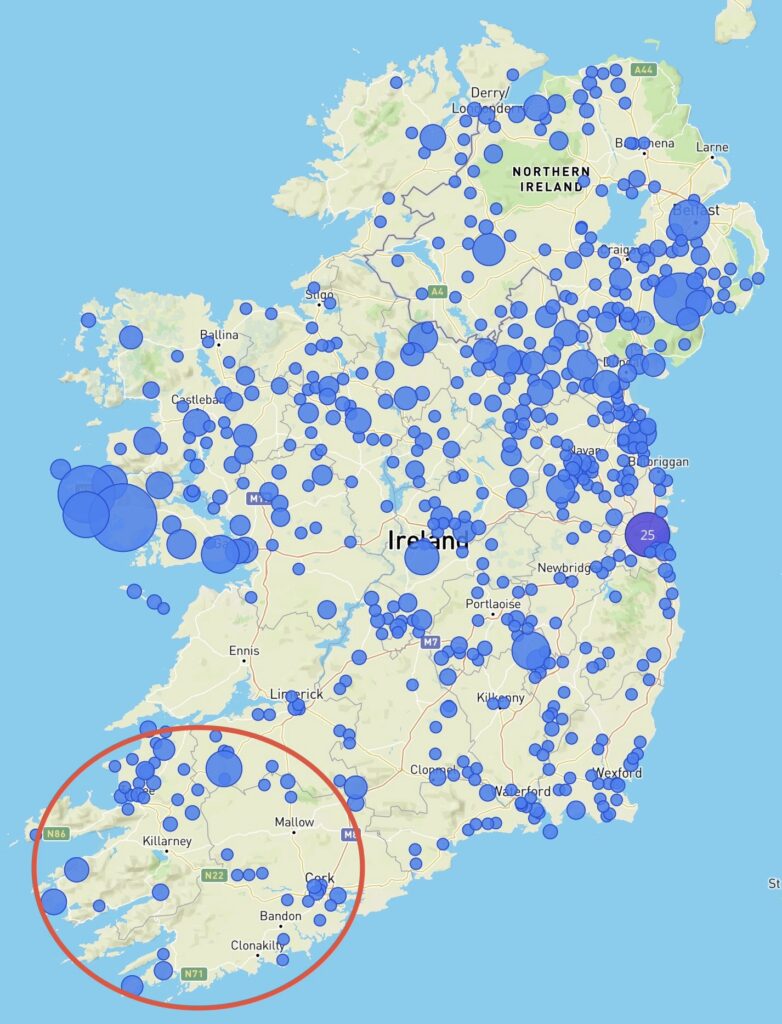
By the 1901 census, Fitzpatrick had become an exceptionally numerous surname in Cavan. There were approximately 1,215 Fitzpatricks living in the county, making Fitzpatrick the eleventh most common surname in Cavan. The county-of-birth figures are even slightly higher, with about 1,273 people recorded as Fitzpatricks who had been born in Cavan. Cork, the other major region in which Ó Maol Phádraig appears repeatedly in the early modern record, also retained a substantial Fitzpatrick population, with approximately 645 Fitzpatricks resident there in 1901.
Those figures cannot tell us that every Cavan or Cork Fitzpatrick descended from the particular Ó Maol Phádraig families found in the fiants and patents. Fitzpatrick had more than one origin in Ireland, and individual lines still have to be resolved genealogically and genetically. The geographical persistence is nevertheless striking. Two of the strongest early modern centres of Ó Maol Phádraig still contained large Fitzpatrick populations three centuries later.
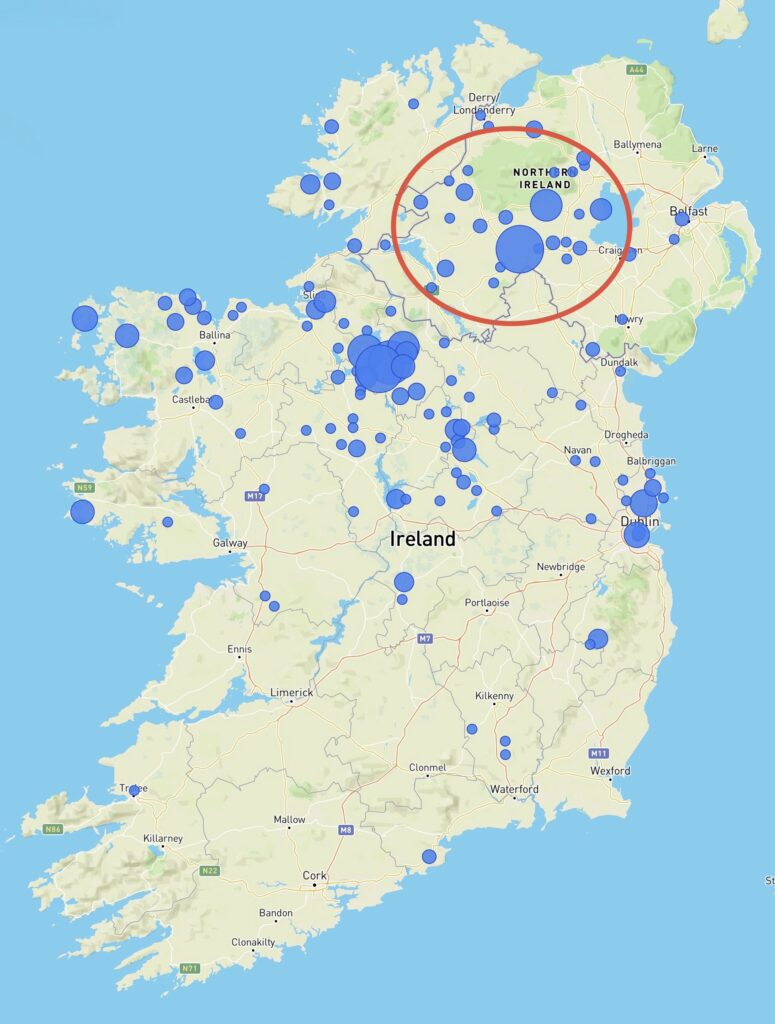
The surviving forms of Ó Maolmochéirghe present a noticeably different scale. Early, the principal surname associated with Ó Maolmochéirghe, numbered about 1,169 people in the whole of Ireland in 1901, of whom approximately 268 were in Leitrim. The Leitrim concentration is important because it preserves the surname close to the old Drumreilly and Ballinagleragh centre, but the total population is modest when compared with the number of Fitzpatricks found in Cavan alone. Cavan also contained Early families, although Leitrim remained the much clearer centre of the surname.
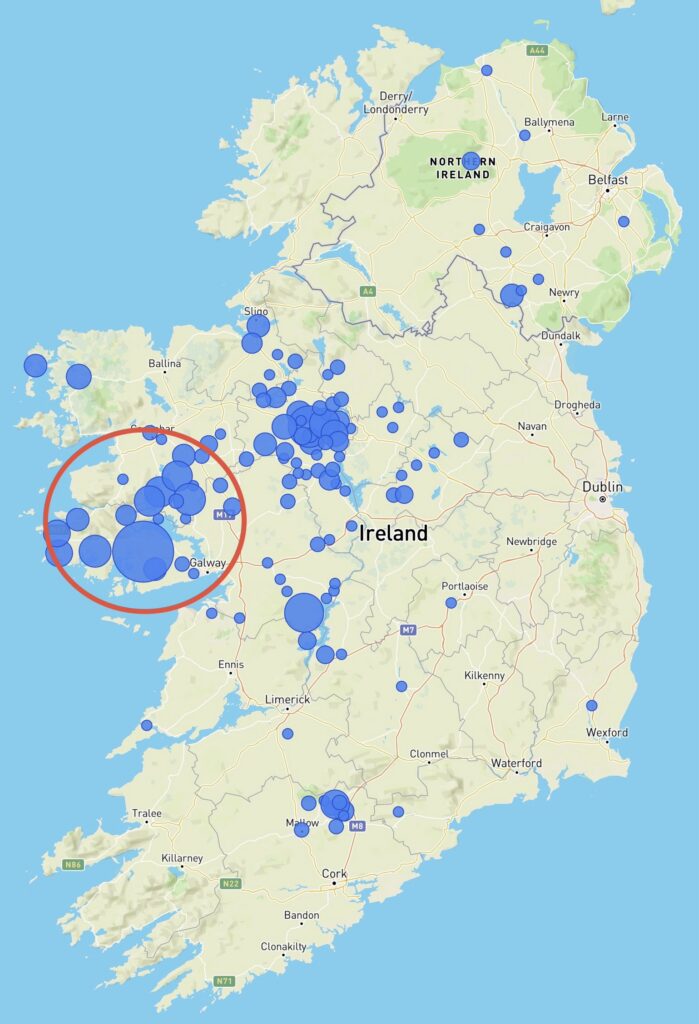
Ó Maolchonaire is more difficult to measure because its descendants became concealed within several surname forms. Conry, however, provides the clearest surviving form associated with the old learned family. There were only about 634 Conrys in Ireland in 1901, with approximately 271 in Roscommon. That concentration is remarkable in itself: nearly half of the Irish Conry population remained in the county most closely associated with the principal Ó Maolchonaire learned family.
The wider surname Conroy was considerably more numerous, numbering several thousand nationally and strongly concentrated in Connacht, particularly Galway. It cannot simply be counted as Ó Maolchonaire, however, because Conroy developed from several different Gaelic surnames. The same problem applies to King, another surname that can derive from Conroy-type Gaelic forms but has several independent origins. Some Ó Maolchonaire descendants may therefore be hidden among the much larger Conroy and King populations, particularly in Connacht, Thomond and possibly around Ballinskelligs, but those populations cannot be added wholesale to the Ó Maolchonaire total.
Even with those qualifications, the contrast is suggestive. The medieval record gives greater prominence to Ó Maolchonaire and Ó Maolmochéirghe because their hereditary professions placed them among the intellectual and ecclesiastical elite. The later population record looks almost reversed. Their descendant populations became smaller, more geographically fragmented and, in the case of Ó Maolchonaire, divided among surname forms that can be difficult to separate from unrelated families.
Ó Maol Phádraig appears to have followed another path. The family had less institutional prestige to preserve, but perhaps also fewer barriers to forming additional households. Farming, livestock management, estate service and other practical occupations could absorb sons who would never have found places within the restricted professional world of an ollamhship or hereditary church office. Over generations, that difference could have produced exactly the pattern visible centuries later: the once-powerful learned and clerical families still surviving, but in relatively modest or fragmented populations, while Fitzpatrick had become numerous in both Cavan and Cork.
The population figures cannot prove that this occupational difference caused the later demographic pattern, but they fit the mechanism remarkably well. The families that had once depended most heavily upon specialised institutions had the greatest adjustment to make when those institutions disappeared. Ó Maol Phádraig, already functioning across a broader economic world, may simply have been better placed to keep producing ordinary households in the society that replaced them.
References
Earley, Joseph E., Sr., and Leonard E. Boyle, O.P. “Conflict over the Rectory of Cinel Luachain during the Fifteenth Century.” Breifne, vol. IX, no. 35, 1999, pp. 103–113.
Farrell, Gerard. “Class Divisions and the ‘Mere Irish’ of Colonial Ulster.” Journal of Postgraduate Research, Trinity College Dublin, 2014.
Farrell, Gerard. The ‘Mere Irish’ and the Colonisation of Ulster, 1570–1641. Palgrave Macmillan, 2017.
Fitzpatrick, Ian, and Mike Fitzpatrick. “Ó Maol Phádraig: the Name, the People, and the Clans. Part I.” Journal of the Fitzpatrick Clan Society, vol. 4, 2023.
Fitzpatrick, Mike, and Proinsias Mag Fhionnghaile. “Ó Maol Phádraig: the Name, the People, and the Clans. Part II.” Journal of the Fitzpatrick Clan Society, vol. 5, 2024.
Fitzpatrick, Matthew, and Mike Fitzpatrick. “Ó Maol Phádraig: the Name, the People, and the Clans. Part III.” Journal of the Fitzpatrick Clan Society, vol. 6, 2025.
O’Donnell, Thomas Charles. The Affect of Fosterage in Medieval Ireland. PhD thesis, University College London, 2016.
Ó Scea, Ciaran. “Erenachs, Erenachships and Church Landholding in Gaelic Fermanagh, 1270–1609.” Proceedings of the Royal Irish Academy, vol. 112C, 2011, pp. 271–300.
Annals of Connacht.
Annals of Loch Cé.
Calendar of Entries in the Papal Registers Relating to Great Britain and Ireland.
Fiants of the Reign of Queen Elizabeth.
Patent Rolls of James I.
Census of Ireland, 1901, surname distribution data for Fitzpatrick, Early, Conry, Conroy and King.
Map source note: The surname distribution maps used in this post are from John Grenham’s Irish Ancestors website. Permission to reproduce them was sought directly by asking what conditions applied and what was required for their use, but no reply was received. They are included here for research and illustrative purposes with full acknowledgement to John Grenham and Irish Ancestors.