
Mac an Leagha, the Inlow Line and an Older Learned-Family Network
Part I followed Richard Tyrrell through Cork and the final years of the Nine Years’ War, ending with the four Ó Maol Phádraig yeomen recorded at Mainistir Leathrátha, modern Abbeylara, in his pardon of 5 November 1603. The same patent contains another group at Abbeylara that deserves to be followed much further back.
Beside Hugh, William, Conchobhar and Glaisne Ó Maol Phádraig were Donnell McInlowe, Brian McInlowe and Farrall McInlewe. A fourth man, Brien McInlewe of Dromramyn, occurs elsewhere in the pardon. The spellings shift, but McInlowe, McInlewe and the modern surname Inlow belong to the same surname stream. The remarkable part is that this surname had already appeared within a very familiar northern network almost twenty years earlier.
Before Abbeylara: Fiant 4786 and the Fenagh World
Fiant 4786, dated 18 November 1585, was headed by Brian Ó Ruairc of Dromahair, knight. Reading the people in it together gives the record an importance that is easy to miss when individual names are extracted from the list.
Two men appear as:
Tirtelagh McAnlewe of Coulley
Cormock McEnlewe of the same
Nearby is one of the strongest concentrations of Ó Maolmochéirghe yet encountered in the Tudor records:
Gilledowe Ó Maolmochéirghe of Drumreilly
Tirtelagh Ó Maolmochéirghe of Drumreilly
Morish Ó Maolmochéirghe of Ballinaglera
John Ó Maolmochéirghe of Ballinaglera
James Ó Maolmochéirghe of Ballinaglera
Tirtelagh Ó Maolmochéirghe of Lisbouan
Gerald Ó Maolmochéirghe of Lisbouan
Seven men of the family are concentrated within the Drumreilly–Ballinaglera–Lisbouan landscape. The same pardon contains an Ó Roddy group centred upon Fenagh, including Gerald Ó Roddy of Fenagh, while Ó Raghallaigh is represented as well. Over the entire record stands Brian Ó Ruairc.
Taken as a group, these are some of the most persistent names in the old Fenagh–Cenél Luacháin–West Bréifne landscape: Ó Ruairc, Ó Maolmochéirghe, Ó Roddy, Ó Raghallaigh and McAnlewe/McEnlewe. The two Inlow-form men were therefore already embedded in this world in 1585, long before the three McInlowe men appear beside Ó Maol Phádraig at Abbeylara.
The geography is particularly suggestive. Ballinaglera was a major Ó Maolmochéirghe centre, while the later Ó Maol Phádraig records place men at nearby Dowra/An Damhshraith. On the modern map Dowra stands noticeably apart from the dense eastern Cavan clusters and instead looks back toward the Ballinaglera and Lough Allen landscape. The 1585 fiant strengthens the possibility that the Dowra Ó Maol Phádraig belonged primarily within this older Ballinaglera–Cenél Luacháin society rather than simply representing an outlying extension of East Bréifne.
The appearance of McAnlewe beside Ó Maolmochéirghe in 1585 consequently provides an important prehistory to the McInlowe–Ó Maol Phádraig association of 1603.
The Mac an Leagha Medical Family
Following the name further backward leads into the hereditary medical orders of Gaelic Ireland.
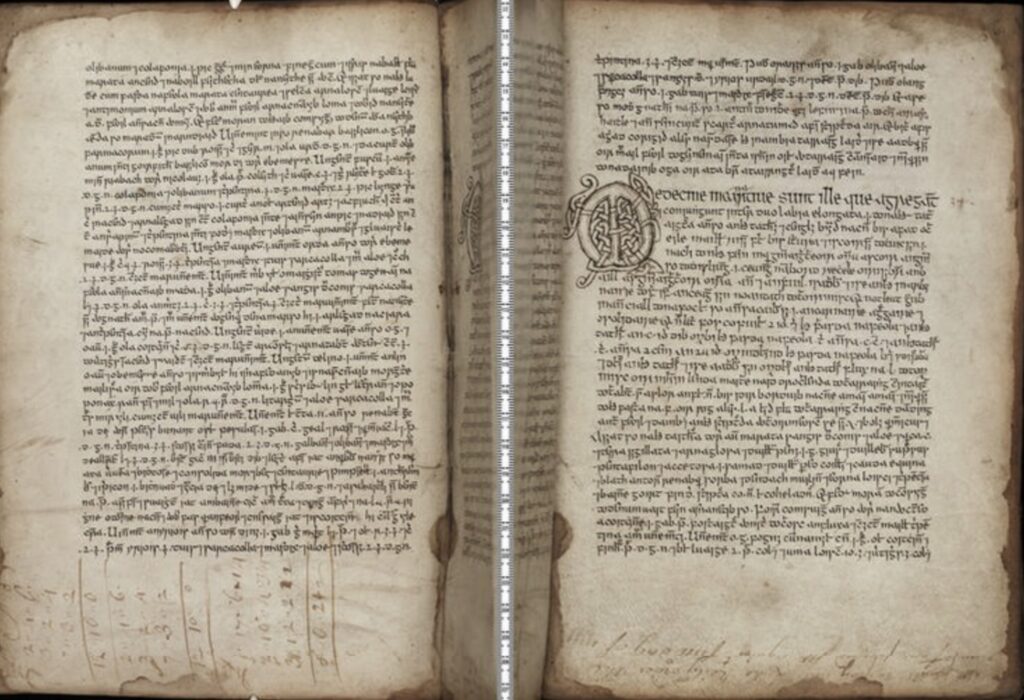
The Mac an Leagha were a learned medical family. Their surviving manuscripts show physicians who were not simply practising local remedies but participating in the wider European medical tradition available through Latin learning, translated and adapted into Irish. One of the richest surviving witnesses is King’s Inns MS 15, largely associated with Maelechlainn Mac an Leagha and dated in part to 1512.
Maelechlainn identifies himself repeatedly in the manuscript and says that he wrote material in Tír Oilella, Tirerrill. He was physician to the Mac Donnchadha lords there. In one extraordinary note he thanks Conaire mac Torna Ó Maolchonaire for supplying him with the exemplar from which he was working. Mac an Leagha and Ó Maolchonaire were therefore not merely neighbouring learned families; here one was actively assisting the manuscript work of the other.
The same note becomes unexpectedly personal. Maelechlainn complains of being separated from people close to him. His mother was far away in Munster, as was his brother Eóghan. He then speaks anxiously of another brother, Connla Mac an Leagha, who was in Magh Luirg, fearing that the host of the Earl of Kildare might harm him.
That single gloss takes the family across a remarkable geography. Maelechlainn is writing in Tirerrill, serving Mac Donnchadha and receiving assistance from Ó Maolchonaire; his brother Connla is in Magh Luirg/Moylurg, the territory of Mac Diarmada; his mother and another brother are in Munster. The Mac an Leagha family itself was therefore geographically mobile within the same western and southern worlds that recur repeatedly in the Ó Maol Phádraig research.
Connla was a physician in his own right. Modern study of his surviving medical compilation places him in the service of the Mac Diarmada lords of Moylurg. His medical collection, now divided principally between RIA MSS 24 B 3 and 23 N 29, contains a large body of remedies, charms and learned medicine. He was treating real patients: one entry records his treatment in 1509 of a man suffering from a dangerous foot wound, while the wider manuscript demonstrates familiarity with the standard learned medical tradition of the period.
The Mac an Leagha therefore occupied the intersection between Tirerrill, Moylurg, Mac Donnchadha, Mac Diarmada and Ó Maolchonaire. This is very close to the western landscape already under investigation for the earlier history of Ó Maol Phádraig.
Another manuscript strengthens the connection. Leabhar Uí Maolconaire, compiled for the Ó Maolchonaire learned family, contains work in several hands, one of them Uilliam Mac an Leagha. The collection includes saints’ Lives, genealogical material and other learned texts. Mac an Leagha participation in an Ó Maolchonaire manuscript was therefore part of a broader intellectual relationship between these families.
Fosterage Written into the Manuscript
The most intriguing part of King’s Inns MS 15 may not be medical at all. It is a few words Maelechlainn wrote about Cormac Mac an Leagha.
He calls Cormac:
“mo dalta ⁊ mo comdalta”
The terms dalta and comdalta occupy the overlapping world of pupilage and fosterage: a pupil or fosterling, and a fellow-pupil or co-fosterling. In the same informal passage in which Maelechlainn worries about his brothers and describes the people from whom he is separated, he explicitly describes another Mac an Leagha through the vocabulary of fosterage and shared education.
This gives us something much stronger than a general statement that fosterage existed in Gaelic Ireland. The fosterage language occurs inside the working manuscript of the medical family we are investigating.
Katherine O’Donnell’s study of medieval Irish fosterage shows how closely education and fosterage could overlap. Children might be raised and educated outside their natal household, while educational relationships could generate bonds expressed through fosterage terminology. Monastic and learned environments borrowed heavily from the same institution: instruction, protection, upbringing and affection could all be understood through the foster relationship.
A hereditary learned family therefore should not be imagined as a sealed biological unit in which every physician was simply the son of the previous physician. Its household could include sons, brothers, collateral relatives, fosterlings and pupils. A talented boy from another family might be educated there and become deeply integrated into the household and profession. Shared training could create relationships regarded socially as kinship even where the paternal ancestry was different.
This has potentially large implications for the Ó Maol Phádraig problem.
If OMP participated in the same ecclesiastical and learned environments, different paternal families could become associated with the Ó Maol Phádraig name through fosterage, service or incorporation, while men of an Ó Maol Phádraig paternal line could similarly enter another household and emerge in later generations under a different family identity. Gaelic society provided several mechanisms through which social family and paternal genealogy could diverge.
That possibility is particularly relevant to the Inlow evidence. A paternal line related to Ó Maol Phádraig could have entered a medical household generations before the first surviving McAnlewe spelling. Equally, the process need not have happened only once. It would therefore not be surprising if the documentary surname Ó Maol Phádraig ultimately proves to include men belonging to more than one immediate paternal family, especially in a society where fosterage and learned service were central institutions.
The Manuscript Itself Travels into the Ó Raghallaigh World
The later history of King’s Inns MS 15 is almost as revealing as its original contents.
The manuscript did not disappear into an institutional library after Maelechlainn finished writing it. Its margins accumulated notes for centuries. At one point it was associated with members of the Mac Parthaláin family; later still it was being used in County Cavan.
By the eighteenth century the margins contain the names of Conor Reilly of Culage and Luke Reilly of Rosene, together with Andrew Brady. They were not merely signing a blank leaf. The manuscript was being used to record promises to pay, debts and transactions. One entry has Conor Reilly of Culage promising payment to Luke Reilly. Other entries repeatedly name Luke Reilly of Rosene. Andrew Brady witnesses or participates in several of these transactions, including a promise by Brady to pay Luke Reilly three pounds. The notes are dated around 1759, and one even explicitly identifies the setting as County Cavan.
The modern catalogue draws an important conclusion from these marginalia: the surnames and place-names indicate that the manuscript remained reasonably close to its region of origin for more than two centuries.
Its journey is remarkable when placed beside the historical network.
A manuscript written by Mac an Leagha, physician to Mac Donnchadha in Tirerrill, with assistance from Ó Maolchonaire, and containing references to a Mac an Leagha brother in Mac Diarmada’s Moylurg, eventually surfaces in the everyday possession and use of Ó Raghallaigh and Brady people in Cavan. Add to this the fact that members of the McAnlewe/McEnlewe family are found in Fiant 4786 alongside the Ó Maolmochéirghe of Drumreilly, Ballinaglera and Lisbouan, with Ó Roddy of Fenagh, Ó Raghallaigh and Brian Ó Ruairc all appearing within the same pardon, and the continuity of the wider social landscape becomes difficult to overlook.
Those are not unfamiliar surnames in the Ó Maol Phádraig record. Ó Raghallaigh and Brady appear repeatedly around OMP in the Tudor and Jacobean pardons. The manuscript itself therefore followed, over centuries, a geographical and social route through some of the same worlds that we have reconstructed independently from the pardons.
There is no need to manufacture a continuous chain of named owners between 1512 and 1759. The surviving marginalia cannot provide one. What they preserve is almost more interesting: a physical object created inside the western Mac an Leagha–Ó Maolchonaire learned world remained in circulation until it could be found in an Ó Raghallaigh–Brady Cavan environment more than two centuries later.
Physicians on the Move in Fiant 6569
There is another piece of evidence between the 1585 and 1603 records.
Fiant 6569, from the great mobilisation of 1601, contains a conspicuous group of men whose names or descriptions contain leigh, Leaghe or related forms. Among them were Awly O Leyne, explicitly described as a chirurgeon, together with Donogh mac Muircheartaigh leigh, Diarmaid leigh O Reighly, Deirmod mac Gillecanne Leaghe, and John mac Donogh I Leaghe.
The concentration is too strong to regard the medical language as incidental. At least some of these men were physicians or surgeons.
Two Ó Flaithbheartaigh men, William and Shane, occur in the same huge pardon. That is especially interesting because the Ó Laoidhigh, later O’Lee or Lee, were the hereditary physicians of the Ó Flaithbheartaigh in west Connacht. Their surviving medical tradition is represented by the celebrated Book of the O’Lees.
The Leaghe forms in Fiant 6569 should not all be assigned automatically to one surname. Some may be occupational descriptions, and the Ó Laoidhigh association with the Ó Flaithbheartaigh provides a strong explanation for at least part of the medical element. At the same time, possible Mac Diarmada-type names occur elsewhere in the record, while the documented Mac an Leagha physicians belonged to precisely the Mac Diarmada–Mac Donnchadha patronage world.
The fiant may therefore be preserving more than one hereditary medical tradition within the same wartime gathering.
That fits what we learned from Tyrrell in Part I. These great military movements were not simply columns of armed men. Ruling families travelled with households, clients, clerics and specialists. Physicians were essential to such a society, treating wounds and illness but also serving as learned members of the lordly household. In Fiant 6569 we appear to be seeing some of those specialists inside the mobilisation itself.
An Ó Maol Phádraig man also occurs in Fiant 6569. His presence does not identify him with the medical group, but it puts OMP inside the same enormous southern wartime movement in which physicians and Leaghe-named men were present.
By 1603, the relationship becomes much more direct: McInlowe men and Ó Maol Phádraig men are actually living together at Abbeylara.
The Inlow DNA Result
Modern Y-DNA changes the character of the question.
A modern Inlow tester can be placed under BY12234 from his 111-marker STR comparison. His personal estimated TMRCA with the comparison Fitzpatrick line is approximately AD 1300, with a range of roughly ±150 years.
A Big Y test would still be extremely valuable. It should identify the precise SNP-defined position of the Inlow line below BY12234 and greatly improve the chronology of the branching event. The present 111-marker evidence is nevertheless sufficient to place him within BY12234 rather than merely somewhere in the older FGC11134 or BY9001 environment.
The paternal relationship is therefore medieval.
That chronology is striking beside the historical evidence. The common paternal ancestry lies around AD 1300 ±150 years; Mac an Leagha is documented within the Tirerrill–Moylurg learned world by the late medieval period; McAnlewe/McEnlewe occurs among the Fenagh and Ballinaglera families in 1585; and McInlowe/McInlewe occurs directly beside OMP at Abbeylara in 1603.
The problem is no longer whether the modern Inlow paternal line belongs to the BY12234 story. It does. The difficult question is how descendants of the same medieval paternal lineage came to be represented by the Ó Maol Phádraig/Fitzpatrick and Inlow names.
The learned-family evidence offers a plausible answer without requiring a simple father-to-son surname change at some identifiable date. A BY12234 boy could have entered a Mac an Leagha household through fosterage and education, become part of its professional world and left male descendants identified with that family. Movement in the opposite direction, or more complicated incorporation between related households, is also conceivable. The phrase mo dalta ⁊ mo comdalta shows that these were not theoretical social arrangements invented to explain the DNA: fosterage and educational kinship were part of the language used by Mac an Leagha themselves.
It may also help explain why OMP cannot automatically be treated as a single closed paternal population in every historical record. A family involved for centuries in church, learned and service networks could absorb men from other paternal lines while losing some of its own paternal descendants into other surnames. The surname history and the Y-chromosome history need not be identical at every point.
What the Inlow Evidence Adds
The McInlowe men at Abbeylara initially looked like an interesting group beside the four Ó Maol Phádraig. Following them backward has produced a much larger story.
The surname was already present as McAnlewe/McEnlewe in the 1585 pardon of Brian Ó Ruairc, among the Ó Maolmochéirghe of Drumreilly and Ballinaglera, Ó Roddy of Fenagh and Ó Raghallaigh. Behind that lies the documented Mac an Leagha medical world of Tirerrill and Moylurg, where Mac Donnchadha, Mac Diarmada and Ó Maolchonaire intersect. The surviving manuscript gives us not only their medicine but their own words about brothers, pupils and foster relationships. Centuries later that same manuscript was still circulating in Cavan among Ó Raghallaigh and Brady people.
Fiant 6569 shows the learned medical world on the move during the Nine Years’ War, with surgeons and Leaghe-named men appearing among the great southern mobilisation. Patent XVI–15 then brings McInlowe and Ó Maol Phádraig together physically at Abbeylara in 1603.
The DNA reaches beneath all of those records. A modern Inlow line sits within BY12234 with an estimated shared paternal ancestry around the medieval period. Fosterage and incorporation into learned households offer a historically documented way in which one paternal lineage could later emerge under different surnames.
Seen from that perspective, the Inlow result is not an isolated genetic curiosity attached to an unusual name. It may preserve a surviving paternal trace of the learned, ecclesiastical and fosterage networks that connected Tirerrill, Moylurg, Fenagh, Ballinaglera, Bréifne and eventually Abbeylara.
We still lack the one test capable of sharpening the genetic side dramatically: a Big Y from the Inlow line. If that is eventually obtained, its exact position below BY12234 may tell us whether the documentary history we have been reconstructing is approaching the period in which the two surname histories separated.
For now, Patent XVI–15 has given us something valuable enough. The McInlowe men beside Ó Maol Phádraig were not appearing from nowhere. Their name can already be followed backward into the Fenagh–Ballinaglera world, while the wider Mac an Leagha history reaches further west into the same learned Connacht landscape that repeatedly appears in the earliest reconstruction of the Ó Maol Phádraig family.
References
Fitzpatrick, M. and Fitzpatrick, M. 2025. Ó Maol Phádraig: the Name, the People, and the Clans, Part III. The Journal of the Fitzpatrick Clan Society, 6, 27–41.
Hayden, Deborah. 2019. “A Versified Cure for Headache and Some Lexicographical Notes.” Keltische Forschungen 8, 7–22.
Ireland Public Record Office. Calendar of the Fiants of the Reign of Elizabeth. Fiant 4786, 18 November 1585.
Ireland Public Record Office. Calendar of the Fiants of the Reign of Elizabeth. Fiant 6569.
Ireland Public Record Office. Calendar of the Patent Rolls of the Chancery of Ireland, James I. Patent XVI–15, 5 November 1603.
Irish Script on Screen. King’s Inns MS 15. Dublin Institute for Advanced Studies.
O’Donnell, Katherine. The Affect of Fosterage in Medieval Ireland. Doctoral thesis.
Ó Con Cheanainn, Tomás. 2002. “Seanchas ar Mhuintir Laidhe.” Éigse 33, 179–225.
Royal Irish Academy. MS 23 P 10 (ii), The Book of the O’Lees.
Royal Irish Academy. MSS 24 B 3 and 23 N 29, medical manuscripts associated with Connla Mac an Leagha.
Selvage, Courtney M. 2023. Three Saints’ Lives from the Northwest of Ireland: A Study from within the Context of the Columban Tradition. PhD thesis, Ulster University.
Walsh, Paul. 1947. “An Irish Medical Family—Mac an Leagha.” In Irish Men of Learning, edited by Colm Ó Lochlainn, 206–218.
Woulfe, Patrick. 1923. Sloinnte Gaedheal is Gall: Irish Names and Surnames.
Wulff, Winifred. 1926. “De Febre Efemera nó an Liagh i n-Éirinn i n-allod.” Lia Fáil 1.