
Richard Tyrrell, Cork and the Ó Maol Phádraig Men of Abbeylara
On 5 November 1603, only months after the formal end of the Nine Years’ War, James I granted a general pardon to Richard Tyrrell of Ballybrack, County Westmeath, gentleman, his wife Dorothy, and a very large company of relatives, associates and followers. Among them were five men named Ó Maol Phádraig.
Four were together at Mainistir Leathrátha, modern Abbeylara in County Longford: Hugh, William, Conchobhar and Glaisne Ó Maol Phádraig, all described as yeomen. A second Hugh Ó Maol Phádraig, styled a gentleman, was recorded separately at Corr na gCléireach in County Cavan.
The patent is remarkable for the mixture of people within it. Tyrrells, Tuites, Daltons and other long-established Old English Midlands families appear beside Ó Fearghail, Ó Raghallaigh, Ó Ruairc, Mac Geoghegan and numerous other Gaelic families. Its geography stretches through Westmeath and Longford and deep into Cavan. Abbeylara sits close to the centre of that world, near the meeting point of the Midlands and Bréifne.
Richard Tyrrell makes the record more significant still. He had spent the preceding years moving through exactly the political and military networks that joined these regions to Munster. After the war he would establish himself in Cavan, purchasing lands from native proprietors and eventually receiving a substantial Plantation grant there. The people surrounding him in 1603 therefore belong not only to his wartime past but, in important respects, to the Cavan world into which he was about to move.
Richard Tyrrell’s Road Through Munster
Tyrrell came from the Old English Tyrrell family of Westmeath, but by the later 1590s he had become one of the more formidable commanders fighting in alliance with Aodh Mór Ó Néill. His career illustrates how thoroughly the Nine Years’ War crossed the older division between Gaelic Irish and Old English Catholic society.
His involvement in Munster began before the Spanish landing at Kinsale. Philip O’Sullivan Beare places Tyrrell with forces entering Munster under Owny Ó Mórdha, accompanied by figures including Raymond Burke and Dermot O’Connor. Their campaign brought them into the Mallow and north Cork region, where President Thomas Norris was attempting to contain the spread of the rebellion. Fighting and pursuit continued around Mallow, Ardskeagh and Buttevant, bringing Tyrrell directly into the Cork theatre well before the climactic events of 1601.
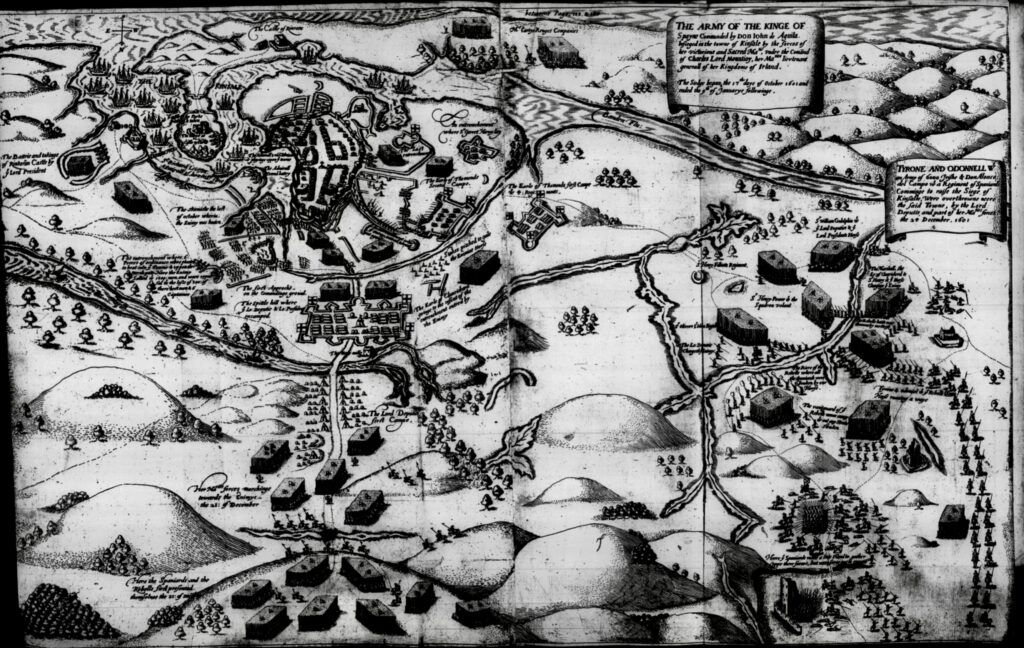
The great southward movement came in 1601. After the Spanish expedition landed at Kinsale, Aodh Mór Ó Néill and Aodh Ruadh Ó Domhnaill undertook the long march south to relieve the Spaniards. Tyrrell was among the commanders accompanying Ó Néill.
The confederate forces assembled west of Cork city and established themselves in Kinalmeaky, the territory extending through the Bandon country. From there they moved toward Coolcarron Wood, close to Kinsale and the English siege lines. Tyrrell commanded a substantial body of experienced troops within the army. He was not simply one man among thousands passing through Cork, but a commander with his own following and a recognised place within the confederate military structure.
His southern movements can therefore be followed through several distinct phases:
1598-99: campaigning in Munster, including the Mallow–Buttevant region.
1601: the march south with Ó Néill toward the Spanish forces at Kinsale.
1601: operations in Kinalmeaky and the Bandon country.
1601: movement to Coolcarron Wood and Kinsale.
1602: continued resistance in Beara and Bantry after the defeat at Kinsale.
1602: eventual withdrawal with his own troops toward Connacht.
Tyrrell’s connection with Cork was therefore neither brief nor confined to a single battle. He had operated in the county before Kinsale, returned as one of the commanders of the great southern expedition, and remained in Munster after the confederate defeat.
The Annals of the Four Masters record that when the principal northern leaders withdrew following Kinsale, Captain Tyrrell remained in Munster with other confederates. Domhnall Cam Ó Súilleabháin Bhéarra became the leading figure in the remaining resistance, and O’Sullivan Beare records Tyrrell and William Burke among the commanders retained in his service.
During 1602, Tyrrell continued to operate in the southwest as the struggle shifted toward Beara and Bantry. The surviving accounts place the confederates around the approaches to Beara and in continuing operations in that region before Tyrrell eventually left Munster with the troops under his own command and moved toward Connacht.
When he appears at the head of Patent XVI–15 in November 1603, Tyrrell was therefore a man whose recent path had run from the Midlands through Munster, repeatedly through Cork, onward to Kinsale and Beara, and then northward again as organised resistance collapsed.
Three Names That Appear Twice
This becomes particularly interesting when the Ó Maol Phádraig names are compared with the Cork records of 1601.
Among the southern Ó Maol Phádraig recorded that year were William, Conchobhar Beg and Glaisne Ó Maol Phádraig. Two years later, William, Conchobhar and Glaisne Ó Maol Phádraig occur together again, this time among the yeomen at Abbeylara in Tyrrell’s pardon.
Fitzpatrick and Fitzpatrick had already noticed the resemblance. In Ó Maol Phádraig: the Name, the People, and the Clans, Part III, they drew attention to the recurrence of Glaisne together with Conchobhar and William and suggested that the Cork and Abbeylara records may refer to the same people.
The observation is particularly valuable because Glaisne is a much more distinctive name than William or Conchobhar. Either of the latter could readily recur independently. Finding all three together in records separated by only two years makes the comparison considerably more compelling.
Tyrrell’s movements add historical context to that earlier observation. The first combination occurs in Cork in 1601. During the period between that record and the 1603 pardon, Tyrrell himself was moving through Cork, fighting there and remaining in the southwest well into 1602. The same unusual combination of Ó Maol Phádraig names then appears among the people included in his own pardon.
The exact relationship between the three men and Tyrrell remains unknown. They may have served within his military following, belonged to the entourage of another confederate leader, become associated with him during the war, or entered his circle through political, local or personal relationships afterward. What survives is an unusually suggestive sequence of names, places and movements.
The next question is perhaps the most interesting of all: which way were these men travelling?
South to North, or North and Back Again?
It would be easy to describe William, Conchobhar and Glaisne as Cork Ó Maol Phádraig men who subsequently moved north to Abbeylara. That is one possible explanation. There was a genuine southern Ó Maol Phádraig presence in Cork and Kerry before and during this period, so they could have belonged to that southern population and become attached to one of the political or military networks created by the war.
The opposite direction is equally plausible.
The growing body of records from Bréifne and the Midlands shows that Ó Maol Phádraig was also well established in the north. William, Conchobhar and Glaisne might instead have travelled south during the enormous movement of men created by the Kinsale campaign, appeared in the Cork records of 1601, and then returned toward the Midlands after the confederate collapse.
The contemporary description of what happened after Kinsale makes such a journey entirely credible. The Annals of the Four Masters describe the surviving leaders abandoning the idea of remaining together and instead setting out separately for their own territories:
“each lord and chieftain apart, with his own friends and faithful people following him.”
The annal continues with an account of the dangers and attacks encountered on the roads before many of these bodies eventually reached their home territories. This is important evidence for the movement of more than the famous commanders. A lord travelled with his friends and faithful people. The dispersal after Kinsale involved whole followings attempting to make their way back across Ireland.
Tyrrell himself followed a different course. Rather than immediately returning north, he remained in Munster and continued the struggle in the southwest before eventually moving with his troops toward Connacht.
There is also a third possibility. The distinction between a purely “northern” and purely “southern” Ó Maol Phádraig may be too rigid. Families could possess relationships in several regions through marriage, fosterage, church associations, tenancy, military service and patronage. The surviving documents tell us where particular men were recorded at particular moments. They do not give us their birthplaces or a complete account of the connections that brought them there.
For now, the Cork and Abbeylara records may preserve the same group of men moving within the upheaval of 1601–1603, while their original home and precise route remain unresolved.
Ó Domhnaill, Flaithrí Ó Maolchonaire and the Travelling Gaelic World
The forces moving south toward Kinsale were not composed solely of soldiers. Political advisers, clerics, learned men and members of important families travelled with the Gaelic leadership.
One particularly important figure was Flaithrí Ó Maolchonaire, Franciscan, confessor and trusted adviser to Aodh Ruadh Ó Domhnaill. Flaithrí occupied a position close to the confederate leadership and subsequently accompanied Ó Domhnaill to Spain after Kinsale.
His presence is noteworthy in the longer Ó Maol Phádraig story because Ó Maolchonaire and Ó Maol Phádraig had appeared together centuries earlier in the ecclesiastical world associated with St Michael’s in Kerry. No surviving record places Flaithrí personally beside William, Conchobhar or Glaisne in Cork, but his presence tells us something important about what actually travelled with these armies.
Ó Néill and Ó Domhnaill did not arrive in Cork at the head of anonymous masses of fighting men. They brought the political, religious and learned networks of Gaelic Ireland with them. Clerics, advisers, clients, dependants and family connections accompanied the military movement.
For a brief period the Kinsale campaign brought people from Ulster, Bréifne, Connacht, Leinster, the Midlands and Munster into the same relatively confined landscape of southern Ireland. The possible movement of Ó Maol Phádraig men between Cork and the Midlands belongs within that much larger human movement.
What Did “Yeoman” Mean?
The description attached to the Abbeylara men deserves closer attention. Hugh, William, Conchobhar and Glaisne Ó Maol Phádraig were all styled yeomen.
A modern reader can easily interpret yeoman as simply another word for farmer, but in the late sixteenth and early seventeenth centuries it carried a stronger social meaning. A yeoman generally occupied a position below a gentleman but above the poorer ranks of rural society. The designation might be applied to a substantial tenant, small landholder, prosperous farmer or a man responsible for managing land, livestock and agricultural production.
A yeoman could possess livestock, equipment and a valuable tenancy. He might employ servants or labourers and have enough independence to participate meaningfully in local economic and political affairs. The term therefore said something about status and substance, rather than defining a single occupation.
The Irish context makes the designation more complicated. Crown administrators were applying English social categories to a Gaelic society organised according to its own traditions of lordship, kinship, landholding and service. A Gaelic man called a yeoman by an English clerk may have understood his own position in quite different terms. The word gives us the administration’s classification, not a complete description of his social identity.
The distinction was nevertheless real. The same 1603 patent describes the other Hugh Ó Maol Phádraig, at Corr na gCléireach in Cavan, as a gentleman. The clerk was clearly distinguishing between recognised ranks.
The four Abbeylara men should therefore not be imagined as impoverished agricultural labourers. They belonged to a substantial middle layer of rural society: men with resources, standing or independence sufficient to separate them from ordinary husbandmen, labourers and cottiers.
Agricultural status and military activity were not mutually exclusive. A substantial tenant or landholder could normally make his living from land and livestock while also bearing arms, accompanying a lord, participating in a hosting or serving within a military following when circumstances required it. The armies of the period drew heavily upon precisely these layers of society.
The designation yeoman therefore fits men capable of the sort of mobility we are considering. If William, Conchobhar and Glaisne moved between Cork and Abbeylara, they belonged to a social level with the resources and connections to make such movement possible.
Abbeylara at the Crossroads
Abbeylara itself provides an appropriate setting.
Mainistir Leathrátha had been founded as a Cistercian monastery by the Tuite family in the early thirteenth century. Over succeeding centuries the surrounding area became deeply embedded in the Ó Fearghail political landscape of Annaly. By 1603 Abbeylara stood near the meeting point of Longford, Westmeath and Cavan, and the names in Tyrrell’s pardon reflect exactly that position.
Old English Midlands families appear beside Gaelic families associated with Annaly and Bréifne. Tyrrells, Tuites, Daltons and others share the record with Ó Fearghail, Ó Raghallaigh, Ó Ruairc, Mac Geoghegan and many more.
The Ó Maol Phádraig men therefore appear at a genuine crossroads between several political and cultural worlds.
What happened to Richard Tyrrell himself after 1603 makes this even more significant.
From Rebel Commander to Cavan Landholder
The pardon was not the end of Tyrrell’s relationship with the Gaelic networks represented in the document. Within only a few years he and his brother William Tyrrell were purchasing lands in County Cavan, much of it through agreements with native proprietors.
By about 1606, the Tyrrell brothers had begun acquiring property in several parts of Cavan. Richard became involved in landholding in Tullyhaw, including lands in the Ballyconnell area associated with the Mág Samhradháin lordship. William was making comparable purchases elsewhere, including lands obtained from Ó Raghallaigh proprietors. These were transactions made during the unsettled years between the end of the Nine Years’ War and the full implementation of the Plantation of Ulster.
The circumstances of some of William Tyrrell’s purchases are particularly revealing. When the Plantation commissioners later investigated existing claims in Cavan, they found that he had already held some of his lands for approximately four years. The arrangements were described as having been made with the native proprietors and were associated with the provision of protection.
That is significant. The Tyrrells were not simply arriving after confiscation to receive lands from the Crown. They had already begun establishing relationships with Gaelic landholders and acquiring property directly from them before the Plantation settlement was imposed.
By 1608, Crown officials were openly discussing Richard Tyrrell’s position. Tyrrell, Captain Garrett Fleming and Walter Talbot were identified among men who had purchased land from the native inhabitants of Cavan. Rather than condemning those transactions outright, officials noted favourably that these purchasers had already begun what was described as a “civil plantation”, which was considered to have benefited the county.
It was an extraordinary reversal for a man who only a few years earlier had been one of Ó Néill’s most effective military commanders.
The Crown’s subsequent Plantation of Cavan altered many of the earlier arrangements. Existing purchases had to be examined, surrendered, exchanged or incorporated into the new system of royal grants. Tyrrell nevertheless emerged from the process as a substantial proprietor rather than losing his position entirely.
Richard and his brother William were ultimately associated with a large estate in Tullygarvey, one of the baronies at the heart of East Bréifne. Their Plantation allocation was nominally 2,000 acres. Contemporary Plantation surveys later recorded substantial building work on the estate, including a stone-and-lime bawn approximately eighty feet square, twelve feet high and provided with four flankers.
A royal patent in 1612 confirmed Richard and William Tyrrell in their Cavan holding.
The transformation is striking. Within little more than a decade Richard Tyrrell had moved from commanding confederate troops against the Crown in Cork to possessing a fortified landed estate in Cavan under royal title.
Yet this was not simply a clean break with his earlier associations. His entry into Cavan had involved agreements with Ó Raghallaigh and Mág Samhradháin interests, and his political relationships remained intertwined with the native Catholic population. During the bitterly disputed Cavan parliamentary election of 1613, Tyrrell stood with Walter Talbot on the Catholic side against the government-backed candidates.
His later life therefore helps explain the composition of the 1603 pardon. The large Ó Raghallaigh and Cavan element around Tyrrell was not merely the residue of a defeated wartime alliance. Within a few years he himself would be living in that society, negotiating with its landholders, acquiring estates and participating in its politics.
Patent XVI–15 consequently catches Tyrrell at a genuine point of transition between wartime commander and post-war Cavan proprietor.
For the Ó Maol Phádraig men at Abbeylara, this is particularly interesting. They appear beside Tyrrell at precisely the moment when his own centre of gravity was beginning to shift from the Westmeath world of his birth toward Cavan and the Ó Raghallaigh landscape in which Ó Maol Phádraig becomes increasingly visible in the records that follow.
What Patent XVI–15 May Be Showing Us
The importance of Patent XVI–15 is not simply that Richard Tyrrell was pardoned, or that several Ó Maol Phádraig men happened to appear in the same document. Its value lies in the way several strands come together at one moment.
Tyrrell had spent years moving through the war from the Midlands into Munster and Cork. The same period places William, Conchobhar and Glaisne Ó Maol Phádraig in the south. By 1603 those three names appear together again at Abbeylara, inside Tyrrell’s pardon, while Tyrrell himself was on the verge of building a new life in Cavan among the very families already prominent in the record.
That makes the patent feel less like an ending than a transfer point. The military geography of the Nine Years’ War was beginning to become the social and landed geography of the early Jacobean period.
For the Ó Maol Phádraig family, the central question is therefore no longer simply whether the Cork and Abbeylara men were the same individuals. It is what their recurrence may reveal about how members of the family moved through these overlapping networks at the end of the war.
Part II will stay with the same patent and examine another piece of that network: the Mac an Leagha men recorded at Abbeylara alongside the Ó Maol Phádraig group. Their later appearance beside Ó Maol Phádraig in Cavan makes that association worth following on its own.
References
Fitzpatrick, M. and Fitzpatrick, M. 2025. Ó Maol Phádraig: the Name, the People, and the Clans, Part III. The Journal of the Fitzpatrick Clan Society, 6, 27–41.
Griffith, M. 1966. Irish Patent Rolls of James I. Dublin: Irish Manuscripts Commission.
Ireland Public Record Office. 1885. The Seventeenth Report of the Deputy Keeper of the Public Records in Ireland. Dublin: Her Majesty’s Printing Office.
O’Clery, M., O’Clery, C., O’Mulconry, F. and O’Duigenan, C. Annals of the Kingdom of Ireland by the Four Masters, ed. and trans. John O’Donovan.
O’Sullivan Beare, Philip. Chapters towards a History of Ireland in the Reign of Elizabeth, trans. Matthew J. Byrne.
Pynnar, Nicholas. A Survey of the Escheated Counties of Ulster.
Russell, C. W. and Prendergast, J. P., eds. 1874. Calendar of the State Papers Relating to Ireland, of the Reign of James I, 1608–1610. London.