
Fiant 6569, dated 25 August 1601, becomes more remarkable the less it is treated as a simple pardon list. At its head stood Edmund FitzMaurice, brother of the late Lord FitzMaurice of Kerry, and beneath him were hundreds of men scattered through Kerry. Among them, at Callinafercy near Milltown and Castlemaine, was Diarmaid Ó Maol Phádraig.
The pardon was intended as an act of pacification. The Crown had spent years trying to break the alliances that sustained rebellion in Munster, alternating military pressure with pardons designed to detach individual lords and their followers from the wider resistance. Edmund’s submission on 25 August appears to belong to that effort. It did not last.
Edmund was no minor local gentleman. He was a son of Thomas FitzMaurice, Lord Kerry, whose family had ruled from Lixnaw for centuries, and through his mother, Margaret FitzGerald, he was closely connected to the earls of Desmond. His father was remembered by the Four Masters not simply as a warrior but as an exceptional purchaser of wine, horses and literary works, a revealing glimpse of the Gaelicised culture of the FitzMaurice household. The family also produced an extraordinary series of educated clerics. During the fourteenth and fifteenth centuries FitzMaurice men held senior church positions in Ardfert and Limerick, some after years of university study in canon and civil law. Their lordship belonged simultaneously to the worlds of warfare, aristocratic patronage, church office and learned culture.
Edmund himself had already experienced rebellion. During the Desmond war he and his elder brother Patrick were captured and imprisoned at Limerick, escaping in 1581. Patrick became Lord Kerry and remained under Crown suspicion until his death in 1600. Edmund therefore entered the crisis of 1601 carrying twenty years of family experience of rebellion, imprisonment, submission and renewed resistance.
His pardon in August was not the end of that story. Edmund was killed during the Kinsale campaign. The man at the head of Fiant 6569, supposedly pacified in August, was dead within months fighting in the struggle the pardon was intended to prevent.
This changes the way the hundreds of men beneath his name should be read. They were not simply residents of Kerry appearing before an administrative machine. Many belonged to communities already being drawn into a war that was moving steadily south.
Before Kinsale was Kinsale
The date is crucial. 25 August 1601 was before the Spanish army landed at Kinsale. None of the men in this pardon could yet have known that Kinsale would become the battlefield on which the war would turn.
But they did know that something much larger was underway.
Hugh O’Neill and his allies had been seeking substantial Spanish intervention for years. England and Spain were already at war, and the Irish rebellion had increasingly acquired a European and religious dimension. For Philip III, Ireland offered a western front against Protestant England; for O’Neill and the confederate lords, Spain offered trained soldiers, weapons, money and the possibility that a war which had begun largely in Ulster might finally overturn English power throughout Ireland.
When the Spanish expedition eventually entered Kinsale harbour in September 1601, it transformed the strategic situation. O’Neill and O’Donnell now had to bring their northern armies the length of Ireland to relieve the Spanish garrison. Munster suddenly became the meeting ground of forces that had previously fought in very different parts of the country.
Fiant 6569 belongs to the weeks immediately before that transformation, but the movement south had already begun. Contemporary Crown correspondence shows concern about Ulster and Connacht forces entering Munster, and Munster lords were already maintaining hired soldiers and military followers. The Spanish landing did not create these networks; it suddenly gave them a common destination.
This is why some of the names in Edmund FitzMaurice’s pardon look so unusual in Kerry.
How were these men living in Kerry?
There is no reason to expect a northern force arriving in Munster to appear in one enormous camp.
An important institution in Gaelic military society was buannacht. Gerard Farrell describes it as military billeting: the subjects of a lord could be required to feed and lodge his soldiers. Katharine Simms and C. A. Empey have shown how this belonged to the wider system of military maintenance, hospitality, coign and lordship. Soldiers could therefore be distributed across the lands controlled by an allied ruler, with individual communities providing accommodation, food and fodder.
This was not simply a military inconvenience imposed upon an otherwise separate civilian society. Gaelic lordship revolved around reciprocal obligations. A lord drew tribute, hospitality and military support from those beneath him and in return provided protection, redistributed resources and maintained armed followers. Farrell places military retainers alongside hereditary learned specialists — poets, lawyers and physicians — within the social structure surrounding a Gaelic lord. The mobile pastoral economy described by Simms also made armies more sustainable than a modern map might suggest: cattle could be moved with people and constituted wealth, food and logistical support at the same time.
The geography of Fiant 6569 fits such a system remarkably well. Men with northern or Connacht associations are not concentrated in one Kerry location. They appear in small pockets among local communities.
At Callinafercy, Diarmaid Ó Maol Phádraig appears in the same local grouping as Tadhg Mac Kenna and John mac Domhnaill Mac Kenna. At Coolclieve, Cathal Ó Ruairc and Tadhg Ó Ruairc occur together. Elsewhere in the pardon appear an apparent Ó Raghallaigh, Brady, O’Flaherty and Mac Suibhne names, along with several men whose descriptions bring an entirely different part of Gaelic society into view.
They are physicians.
The doctors travelled with the war
Among the hundreds of names is Awly O Leyne, explicitly described as a chirurgeon — a surgeon. There is also Donogh mac Muircheartaigh leigh, where leigh almost certainly denotes a physician; Diarmaid leigh O Reighly; and men recorded in forms such as Deirmod mac Gillecanne Leaghe and John mac Donogh I Leaghe.
These forms have to be handled cautiously. Leaghe, Leigh and similar spellings can represent more than one Irish medical surname, and not every one can presently be assigned to a specific family. But the concentration of medical language in the pardon is unmistakable.
A Gaelic army did not consist only of fighting men. Physicians belonged to hereditary learned families trained within sophisticated medical traditions. They copied and translated medical works, compiled collections of remedies, treated wounds and disease, and served particular ruling families over generations. Their learning drew on both Irish tradition and the European Latin medical corpus.
Two families are especially relevant to the names in this pardon.
The Ó Laoidhigh, or O’Lees, were a west Connacht family known as hereditary physicians to the O’Flahertys. They were also associated with ecclesiastical office at Annaghdown. A fifteenth-century medical manuscript, the famous Book of the O’Lees, preserves something of the learning maintained within that family.
The Mac an Leagha were another hereditary medical family of north Connacht. Around the turn of the sixteenth century, Connla Mac an Leagha compiled a large medical collection while probably practising under the patronage of Mac Diarmada of Moylurg. His probable brother Maeleachlainn Mac an Leagha served as an ollamh in medicine to the Mac Donnchadha lords of the Ballymote and Tirerrill region.
So when O’Flaherty names, possible Mac Diarmada forms and several leigh/leaghe names occur in the same 1601 Kerry pardon, we should notice the old relationships without pretending that every individual can be identified. If some of these men were Ó Laoidhigh or Mac an Leagha, they belonged to families whose professional histories were rooted in exactly the Connacht lordships represented by other surnames in the record.
The presence of surgeons and hereditary physicians also tells us something human about these travelling groups. An army expecting serious fighting needed men who could set bones, dress wounds, control bleeding, treat infection and illness, and care for important members of a lord’s household. Learned families could therefore move with political and military networks just as soldiers did.
This will become important again in later records. The names are not merely clues to where men came from; they show what kinds of people travelled with a Gaelic lordship when it went to war.
Callinafercy was not an empty corner of Kerry
Diarmaid’s location deserves the same treatment.
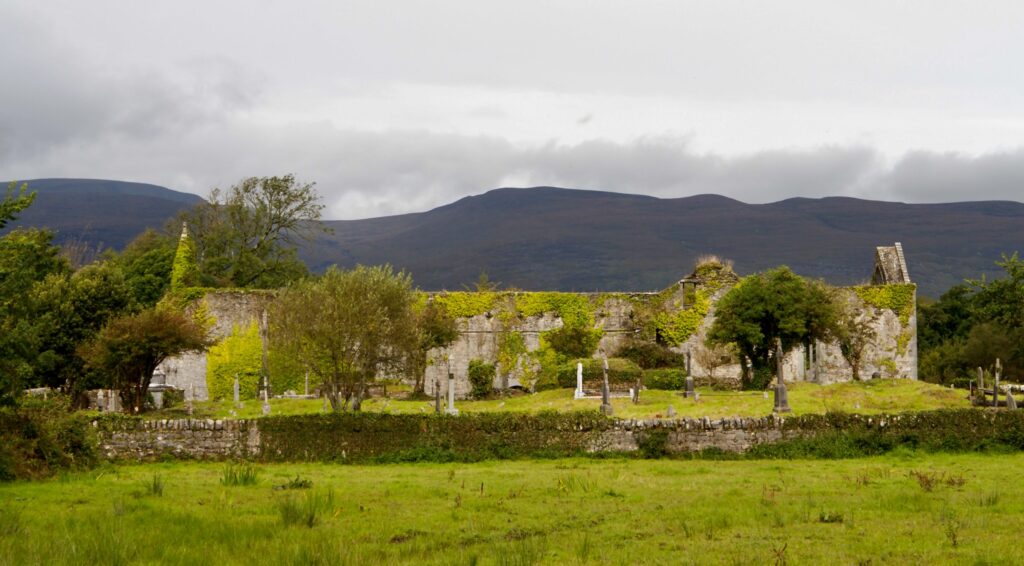
Callinafercy lies beside Milltown and Castlemaine, only a few kilometres from Killagha Abbey, one of the important medieval Augustinian houses of the diocese of Ardfert. Farther west in Iveragh stood Ballinskelligs Priory, another Augustinian foundation and one whose history brings Ó Maolchonaire directly into the story.
Killagha itself rested upon an older Gaelic ecclesiastical landscape. The Augustinian house of St Mary de Bello Loco was founded around 1215–1216 on the earlier church site of Cell Achaid Coinchinn, which had served the country around the Maine valley, Milltown and Killorglin. By the early fourteenth century Killagha was a substantial institution, and its interests eventually extended through churches and benefices at Killorglin, Dingle, Kilcrohane and other parts of western Kerry.
The house had begun within the Anglo-Norman reorganisation of Kerry, and its foundation tradition even preserves an attempt to exclude native Irish canons. The policy did not survive the centuries. By the late fourteenth and fifteenth centuries Killagha had become thoroughly entangled with Gaelic clerics and Gaelic political families.
In 1396, papal business involving Killagha also involved Gilbert Ó Súilleabháin, archdeacon of Aghadoe. In 1401, the prior was instructed to provide Cornelius son of Thomas Ó Súilleabháin to a benefice vacated by another Ó Súilleabháin. In 1411, Alan Ó Loingsigh became prior. The possibility that Alan belonged to the important Bréifne Ó Loingsigh family was investigated because of the separate BY9001 Lynch question, but the surviving evidence currently favours a Munster or Thomond background: Lynch clerics were active around Scattery and Kilrush immediately before his appointment. The northern possibility remains unproved.
By the later fifteenth century, Killagha had become valuable enough to provoke a violent contest. Mac Cárthaigh claimants, FitzGerald interests and Ó Muircheartaigh clerics fought over the priorship. During the 1480s and 1490s, Odo Ó Muircheartaigh eventually secured possession, apparently with the support of the Earl of Desmond. By 1573–1574, Donnchadh Ó Muircheartaigh was prior.
The political character of the house became unmistakable during the Desmond crisis. When Castlemaine was recovered by Desmond supporters on Christmas Eve 1573, the prior of Killagha went to the castle the following day to give thanks. The Crown suppressed the monastery in 1576.
Only twenty-five years separate that suppression from the appearance of Diarmaid Ó Maol Phádraig at Callinafercy.
The buildings could be confiscated, but the old institution did not instantly disappear from the society surrounding it. In 1602, after Kinsale, a Diarmaid Mac Callaghan was still styled prior of Killagha while accompanying a papal and Spanish-supported mission into Kerry. The mission was helping sustain the remaining Catholic resistance, including substantial numbers of Connacht men.
The proximity is striking. In August 1601 an Ó Maol Phádraig man appears beside Killagha in a pardon containing conspicuous northern and Connacht names. Within the following year the surviving Catholic prior of Killagha was participating directly in the Spanish-backed resistance alongside forces containing Connacht soldiers.
There is still no evidence that Diarmaid belonged to Killagha. The surrounding history nevertheless makes Callinafercy a very different place from the isolated Kerry townland it first appeared to be.
Killagha and Ballinskelligs
By the beginning of the fifteenth century, Ó Maolchonaire was deeply embedded at Ballinskelligs.
Members of the family repeatedly held the priorship and served among the canons. Alan Ó Maolchonaire was prior in 1411. Maurice Ó Maolchonaire was sent to Oxford to study canon law in 1455. John Ó Maolchonaire held the priorship by 1470, and Tadhg Ó Maolchonaire became prior in 1506. The surviving archaeological and documentary histories describe the family as essentially dynastic priors for much of the fifteenth century.
These were not Kerry people who happened to have the same name as a Connacht learned family. Ó Maolchonaire belonged to the great hereditary learned tradition of Connacht, and the family’s establishment at Ballinskelligs demonstrates how far such a kindred could move while retaining its identity and professional standing.
Then comes one of the most revealing records discovered during this investigation.
On 13 March 1463, Pope Pius II appointed the prior of Killagha and the prior of Ballinskelligs together as papal executors in the case of Matthew Ó Falvey, treasurer of Ardfert. A third executor was the dean of Antwerp. The two Kerry priors were being trusted jointly to carry out papal business.
Ballinskelligs was by then well inside the long Ó Maolchonaire period.
So more than a century before Diarmaid Ó Maol Phádraig appears at Callinafercy, the monastery beside his later location was formally cooperating with a religious house dominated by Ó Maolchonaire.
The connection is institutional, dated and documented.
Mac Cárthaigh, Ó Súilleabháin — and a road from Connacht already travelled
The church network did not exist separately from the political world.
Ballinskelligs lay in Iveragh, within the wider lordship of Mac Cárthaigh Mór. Ó Súilleabháin power occupied much of the surrounding southwest. Killagha was already administering benefices involving Ó Súilleabháin clerics by 1396–1401, while in 1470 Diarmaid Ó Súilleabháin directly challenged John Ó Maolchonaire over his conduct as prior of Ballinskelligs.
Mac Cárthaigh connections reach through the same landscape. Mac Cárthaigh interests competed for Killagha’s priorship in the later fifteenth century, and Mac Cárthaigh Mór exercised substantial secular authority in Iveragh. In the later sixteenth-century records, Ó Maol Phádraig repeatedly appears among Mac Cárthaigh-associated groups in Cork and Carbery.
Seen geographically, the southern evidence forms a broad belt rather than a single settlement: Cork through Carbery and Ross, into the Mac Cárthaigh and Ó Súilleabháin country of southwest Munster, and onward into Kerry and Ballinskelligs. Callinafercy sits near the eastern entrance to that Kerry world.
There is a useful historical comparison in Ó Cruadhlaoich — Crowley.
The Cork Crowleys were traditionally and genealogically traced back to the Mac Diarmada of Moylurg in Connacht. Medieval evidence places an Ó Cruadhlaoich in Cork by the thirteenth century, and by the later Middle Ages the family was firmly established in Carbery. Whatever qualifications are placed around individual pedigree details, the broader migration is well established in the historical tradition: a family rooted in the Mac Diarmada world of north Connacht became a powerful west Cork family and eventually operated within the Mac Cárthaigh Riabhach sphere.
The Crowleys are useful precisely because there is no need to invent a hypothetical mechanism. Connacht-to-Cork movement really happened, and it could happen early enough for the descendants to become thoroughly Cork while still retaining a genealogical memory of their older origin.
Ó Maolchonaire provides another version of the same phenomenon: Connacht learned men becoming entrenched in Kerry church office.
So when old Connacht names appear in the Cork and Kerry records, distance alone is a poor guide to ancestry. Some men may have arrived during the Nine Years’ War. Others belonged to families whose ancestors had travelled south centuries earlier.
The familiar names in Fiant 6569
This is why the mixture in Edmund FitzMaurice’s pardon is so intriguing.
Mac Kenna beside Diarmaid at Callinafercy naturally raises the north. Ó Ruairc brings West Bréifne immediately to mind. An apparent Ó Raghallaigh recalls East Bréifne. Brady has deep associations with the diocese of Kilmore. O’Flaherty belongs to west Connacht. The possible Mac Diarmada forms point toward Moylurg. The leigh and Leaghe entries may include members of hereditary medical families connected with those same lordships.
None should be forced. Mac Suibhne, for example, had branches established in Munster long before 1601. McDermody can be either a hereditary surname or merely a patronymic. Leigh-type spellings can conceal several different Irish names.
The significance lies in the accumulation, not in making every ambiguous man northern.
It begins to resemble fragments of an older Connacht and Bréifne social world appearing inside a Kerry mobilisation: ruling-family names, military families, physicians and learned specialists. And this occurs beside church institutions where Connacht learned families had already been moving for generations.
Was Diarmaid from the north?
The answer remains deliberately unresolved.
There is good evidence for an established southern Ó Maol Phádraig population before 1601, particularly in Cork. In another pardon from the same year, Fiant 6505, Tadhg mac Diarmaid Ó Maol Phádraig of Bruff in County Limerick appears among the followers of Sir John Bourke of Brittas. The shared father’s name is intriguing. No evidence proves that Tadhg’s father was the Diarmaid recorded at Callinafercy, but the coincidence of surname, name, year and broad Munster setting deserves to remain in the research notes.
No securely identifiable northern Diarmaid Ó Maol Phádraig has yet been found. Nor does Fiant 6569 call him a Connachtman, an Ulsterman or a hired soldier.
On the other hand, no continuous Ó Maol Phádraig family has yet been demonstrated at Callinafercy before or after 1601. Later Kerry records in the anglicised form Fitzpatrick cannot settle the question either, because Fitzpatrick could represent both Ó Maol Phádraig and Mac Giolla Phádraig.
The present balance therefore still leans toward Diarmaid being a southern Ó Maol Phádraig, perhaps from the wider Cork–Limerick–Kerry world rather than necessarily a long-established Callinafercy family.
Fiant 6569 leaves open the possibility that he had come from farther north. More interestingly, if he was southern, it places a southern Ó Maol Phádraig directly among people and institutions carrying very old Connacht connections.
The older connection underneath the surnames
Ó Maolchonaire keeps reappearing in this story for a reason.
The family was part of the hereditary learned world in which genealogy and history were not hobbies but professions. Members served major rulers, preserved manuscripts, maintained pedigrees and moved between patrons and religious institutions. Their history demonstrates that family identity could survive enormous geographical movement.
The remembered relationship between Ó Maol Phádraig and Ó Maolchonaire may itself reach back before either hereditary surname had fully formed. That memory cannot automatically be turned into a literal modern pedigree. Medieval genealogies were capable of political reconstruction and later synthesis. Yet those traditions should not be dismissed simply because they are old.
Kinship in Gaelic society carried practical consequences. It influenced marriage, fosterage, political allegiance, patronage, inherited office and social status. The people responsible for preserving such relationships were precisely the learned families whose names keep appearing in this investigation.
What we are seeing in Munster may therefore be more complicated than one family following another south.
The older connections could have travelled independently.
Ó Cruadhlaoich moved from the Mac Diarmada world into Cork and became a Carbery family. Ó Maolchonaire moved from Connacht into the Kerry church world and became entrenched at Ballinskelligs. Ó Maol Phádraig appears repeatedly through the same Mac Cárthaigh-connected southern landscape. Then, as the Nine Years’ War draws men south, Mac Kenna, Ó Ruairc, O’Flaherty and other familiar names appear in the same Kerry pardon.
Some of those movements were separated by centuries.
The relationships survived them.
What Spain changed
The Spanish landing brought all of these strands together with extraordinary speed.
Until September 1601, the war could still be imagined as a series of connected regional conflicts: O’Neill and O’Donnell dominating resistance in the north, Munster families struggling with the aftermath of the Desmond wars and the plantation, and Connacht lordships choosing sides under intense pressure from both the Crown and the confederacy.
Spain turned Munster into the centre of the war.
When Spanish troops landed at Kinsale, the northern confederates could not leave them isolated. O’Neill and O’Donnell marched south. Connacht allies and military followers moved with or around them. Munster families now had to decide whether a real Spanish army offered the opportunity to overturn the settlement imposed after the Desmond rebellions.
For Catholic families, the Spanish presence carried another meaning. This was not simply foreign military assistance. The rebellion had increasingly become bound to the defence of Catholic worship and clerical authority against a Protestant Crown. The appearance of Spanish soldiers therefore gave the conflict a religious and international legitimacy that local rebellion alone could not provide.
The old church networks were not spectators. In 1602, the continuing Catholic prior of Killagha was participating in the papal-Spanish effort to sustain resistance in Kerry. Physicians, clergy and learned families travelled within the same society as soldiers. The institutional world that had linked Killagha, Ballinskelligs, Ó Maolchonaire, Ó Súilleabháin and the great Munster lordships was being pulled directly into the military crisis.
Fiant 6569 therefore sits at a remarkable threshold.
On 25 August 1601, the Crown was still trying to pacify Edmund FitzMaurice and hundreds of men associated with him.
Within weeks, Spain arrived.
The pardon failed.
Edmund returned to the struggle and was killed at Kinsale.
The scattered northern and Connacht names in his August pardon suddenly make much more sense when viewed against what followed. They represent a countryside already filling with men, families and professional retainers before the place of the final confrontation was even known.
And among them was Diarmaid Ó Maol Phádraig of Callinafercy, only a few kilometres from a recently suppressed monastery whose Catholic prior would soon be involved in the same Spanish-backed war.
We still cannot say whether Diarmaid came from Kerry or from farther north.
What can now be seen much more clearly is the world into which he belonged.
From Connacht and Bréifne to Cork, from Ross through Carbery and onward to Ballinskelligs, families travelled along political, ecclesiastical, learned and military networks that were already centuries old. Mac Cárthaigh, Ó Súilleabháin and FitzMaurice provided southern lordly frameworks. Ó Maolchonaire carried a learned tradition from Connacht into Kerry. Ó Cruadhlaoich demonstrates that even a Mac Diarmada-derived family could become thoroughly rooted in Cork. The physicians in Fiant 6569 show that the travelling community included far more than fighting men.
By August 1601 these old strands were being pulled together by war.
The names look scattered only when each record is viewed by itself.
Seen together, the connections run across the land.
And some of them may have been remembered long before the surnames themselves existed.
References
Ireland Public Record Office. Eighteenth Report of the Deputy Keeper of the Public Records in Ireland. Dublin, 1886. Fiant 6569, pp. 34–36.
Ireland Public Record Office. Seventeenth Report of the Deputy Keeper of the Public Records in Ireland. Dublin, 1885. Fiant 6505, pp. 193–196.
Fitzpatrick, M. and Fitzpatrick, M. 2025. “Ó Maol Phádraig: the Name, the People, and the Clans. Part III.” Journal of the Fitzpatrick Clan Society 6, 27–41.
O’Sullivan, A. and Sheehan, J. 1996. The Iveragh Peninsula: An Archaeological Survey of South Kerry. Cork University Press.
Calendar of Papal Registers Relating to Great Britain and Ireland. Fifteenth-century entries for the dioceses of Ardfert and Aghadoe, including the papal mandate of 13 March 1463 involving the priors of Killagha and Ballinskelligs.
Farrell, Gerard. 2014. “Class Divisions and the ‘Mere Irish’ of Colonial Ulster.” Journal of Postgraduate Research, Trinity College Dublin.
Simms, Katharine. 1987. From Kings to Warlords: The Changing Political Structure of Gaelic Ireland in the Later Middle Ages. Woodbridge: Boydell Press.
Simms, Katharine. 1986. “Nomadry in Medieval Ireland: The Origins of the Creaght or Caoraigheacht.” Peritia 5.
Empey, C. A. and Katharine Simms. 1975. “The Ordinances of the White Earl and the Problem of Coign in the Later Middle Ages.” Proceedings of the Royal Irish Academy 75C, 161–187.
Hayden, Deborah. 2021. “Medieval Irish Medical Verse in the Nineteenth Century.”
Royal Irish Academy. The Book of the O’Lees, MS 23 P 10 (ii).
Ó Con Cheanainn, Tomás. 2002. Discussion of Ó Laoidhigh and the west Connacht medical family in Éigse 33.
Fitzpatrick, M. 2021. “Mac Giolla Phádraig Clerics 1394–1534 AD: Part I.” Journal of the Fitzpatrick Clan Society 2, 42–65.
Nicholls, K. W. 1970. “The FitzMaurices of Kerry.” Journal of the Kerry Archaeological and Historical Society.
Dunlop, Robert. 1889. “Thomas Fitzmaurice.” Dictionary of National Biography.
Mac Fhirbhisigh, Dubhaltach. Leabhar Mór na nGenealach. Edited by Nollaig Ó Muraíle. Dublin: De Búrca, 2003.
Woulfe, Patrick. 1923. Sloinnte Gaedheal is Gall: Irish Names and Surnames.
Ó Murchadha, Diarmuid. The O’Crowleys of Co. Cork.
Morgan, Hiram, ed. 2006. The Battle of Kinsale. Bray: Wordwell.
Silke, John J. 1963. “Why Aguila Landed at Kinsale.” Irish Historical Studies.
Silke, John J. 1965. “Spain and the Invasion of Ireland, 1601–2.” Irish Historical Studies.