
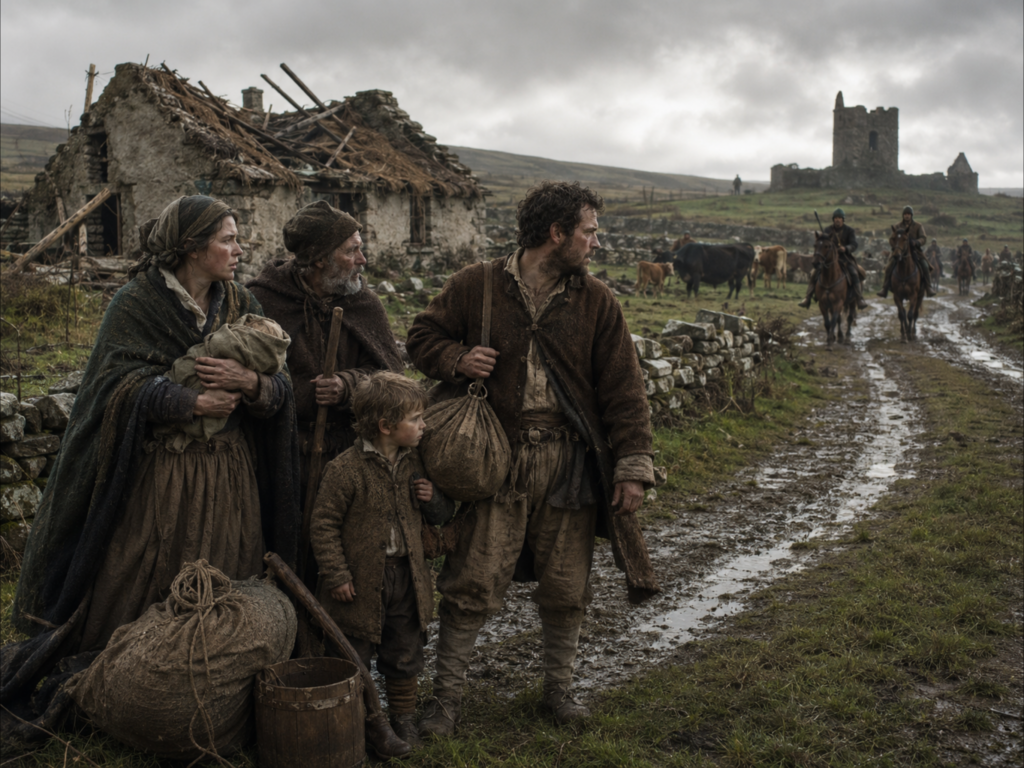
On 29 May 1601, Callaghan mac Teige Mac Cárthaigh of Carrignamuck received a pardon with an enormous company of men and women from across County Cork. Among them were six Ó Maol Phádraig. Only a few weeks later, another great pardon, Fiant 6558, included Mathghamhain Beag Ó Maol Phádraig of Cloghanughera in north Cork.
Read simply as administrative records, these are long lists of names. Read against the history of 1601, they are something else. They are records of people trying to survive the final phase of a struggle that had been tearing Irish society apart for decades.
The six Ó Maol Phádraig in Fiant 6539 do not form one obvious household. William Neale Ó Maol Phádraig is recorded at Kilmore, followed by Guylline Ó Maol Phádraig and Conoghor Beg Ó Maol Phádraig “of the same.” The best present identification is Kilmore in Kilbolane parish in north Cork, although it should remain probable rather than certain. Elsewhere in the pardon is a second grouping: Shane Ó Maol Phádraig Conoghor of Killeagh, followed by Teige mac Shane Ó Maol Phádraig and Shane mac Teige Ó Maol Phádraig. Their Killeagh cannot yet be identified securely.
The distinction is important because Fiant 6539 is not arranged geographically. Places from north Cork, Muskerry, east Cork, the south coast and the far west are mixed together. The names cannot simply be read as though everyone standing beside an Ó Maol Phádraig on the page was his neighbour or companion.
What does hold the document together is politics.
At its head stood Callaghan mac Teige Mac Cárthaigh of Carrignamuck, a man from one of the ruling families of Múscraí. Around him were people from the great and lesser families of Cork who had spent generations living within a political order dominated by houses such as Mac Cárthaigh and Barry. Ó Maol Phádraig were among them.
By 1601 that order had been battered almost beyond recognition.
The Desmond rebellions had devastated Munster during the previous generation. Great estates had been forfeited, confiscated land had been planted with new settlers, and old relationships between lord and follower had been weakened or deliberately broken. Warfare had not ended when the Desmond rising ended. Armed companies, local feuds, Crown garrisons and renewed rebellion continued to make life uncertain. Then the Nine Years’ War drew Munster once again into a struggle that had begun far to the north.
For ordinary people, these political changes were experienced at ground level. Armies needed cattle, grain, horses, lodging and labour. A family living on land claimed by a rebel lord could find itself treated as suspect regardless of how much choice it had in the matter. Cattle could be driven away, crops ruined, houses burned and rents demanded by whichever authority controlled the district that month. A man could submit to the Crown, accept a pardon and still find himself caught between obligations to his neighbours, his lord and his kin.
That is the world behind these lists.
The Gaelic social order had never rested on landownership alone. Land connected a family to neighbours, patrons, church, inherited obligations and local memory. Political authority was personal as well as territorial. Fosterage could create bonds almost as powerful as blood. A military follower might also be a tenant, cousin, client or foster-brother. Learned families, church families and local landholders existed within the same network of reciprocal obligations.
The Tudor state did not understand many of those relationships in the same way. It wanted loyalties that ran upward to the Crown, lands held under titles it recognised, disputes settled in royal courts and military power exercised only under royal authority. What one side regarded as customary obligation could be described by the other as unlawful exaction. What one side regarded as legitimate lordship could be treated by the other as private power standing in the way of government.
The transformation was therefore much greater than a change in who sat at the top.
People were being asked to live differently.
An inherited right to land increasingly needed to be translated into a patent, lease or other written title. A lord whose authority had rested partly on generations of allegiance now had to negotiate with officials who could recognise or deny that authority. Families that had supported churches for centuries saw ecclesiastical property and patronage altered by the Reformation and by Crown intervention. Catholic practice persisted throughout much of the population, while the official church and many of the lands once connected with older religious institutions were being reorganised around them.
None of this happened overnight, and neither Gaelic nor Anglo-Irish society simply disappeared in 1601. People adapted. They used the new courts when it suited them, sought grants, negotiated pardons and tried to protect what they could. But adaptation did not mean that the change was painless.
A pardon was itself part of that process.
To us it can look like a straightforward legal transaction: a person had rebelled and was forgiven. In practice it could be far more complicated. Accepting a pardon might mean that a man had decided the rebellion was lost. It might mean his lord had submitted and he had little choice but to follow. It might simply mean that he wanted to protect his family and land while waiting to see what happened next.
Men could be pardoned and later rebel again. Others could serve the Crown while maintaining close ties with people in rebellion. Families divided. Old allies chose different sides. Survival did not always allow for ideological consistency.
That ambiguity is especially visible among the Barrys.
Different Barry branches made different choices during the Nine Years’ War. David Barry of Barryscourt resisted Ó Néill, and Dunbulloge was plundered in 1600. Yet other Barry families appear repeatedly among the people being pardoned, negotiated with or drawn into the conflict. They were not one political unit moving together.
Ó Maol Phádraig had already appeared inside this complicated Barry–Mac Cárthaigh world long before 1601. In 1577, Domhnall mac Conchobhair Ó Maol Phádraig was pardoned among the followers of Donnchadha mac Cormaic Mac Donagh Mac Cárthaigh. In 1585, Teige mac Conchobhair Ó Maol Phádraig and Conchobhar Óg Ó Maol Phádraig appeared in the pardon headed by Honora Barry, wife of Patrick Condon.
Now six more appeared with Callaghan Mac Cárthaigh of Carrignamuck.
And then came Fiant 6558.
Its importance is not that it repeats the same six men. It does not. Instead it introduces another Ó Maol Phádraig: Mathghamhain Beag Ó Maol Phádraig of Cloghanughera in Shandrum parish, in the north Cork barony of Orrery and Kilmore.
Cloghanughera lies in the country between the great Barry centres around Liscarroll, Churchtown and Buttevant. Fiant 6558 also contains David fitz Edmund Roe Barry of Annagh and James fitz Nicholas Barry of Annagh. Another pardon from the same period, Fiant 6465, shows the Annagh Barrys much more clearly and names Nicholas Barry alias MacJames of Annagh with a substantial group of his family. James fitz Nicholas Barry of Annagh in 6558 fits directly into that family world.
The record does not tell us that Mathghamhain Beag served the Barrys of Annagh, and it would be wrong to say that it does. What it gives us instead is something perhaps more important: another Ó Maol Phádraig living inside a landscape dominated by families with whom the surname had already appeared repeatedly.
The pattern is becoming difficult to dismiss as accidental.
Across almost a quarter of a century, different Ó Maol Phádraig men appear in records involving Mac Cárthaigh, Barry and Condon families. They are not all living in one townland, and they are not necessarily one small Cork household moving from place to place. The evidence increasingly suggests something broader: Ó Maol Phádraig were woven into the same regional society in which these families exercised power.
That makes the date of these two pardons particularly striking.
Fiant 6539 was issued on 29 May 1601. The Lord Deputy’s warrant behind Fiant 6558 was dated 5 July. In September, a Spanish force landed at Kinsale.
The people taking pardons in May and July could not know how the war would end. Ó Néill had already shown that Crown armies could be defeated. Spain had long been expected to intervene. Munster families had to decide whether the safer future lay with the Crown, with the northern alliance, or simply in keeping their heads down until it became clear who would prevail.
Imagine the choice from the perspective of a family living in one of these districts.
A father might remember the Desmond wars and what happened to communities caught on the losing side. His sons had grown up in a province filled with confiscated estates, soldiers and new landowners. Old stories of who possessed a place and by what right still mattered locally, but increasingly there were patents, surveys and officials carrying a very different version of ownership. The local priest might belong to the old faith while the law recognised another church. The lord to whom a family had owed allegiance for generations might himself be bargaining for survival.
Then word came that another army was moving, another lord had submitted, another had rebelled, or another pardon was available.
For people living through it, the great political transformation of Ireland was not experienced as a chapter in a history book. It arrived as uncertainty about next year’s harvest, whether cattle would still be in the field tomorrow, whether a son would be called into a fighting company, whether a neighbour could still be trusted, whether the family’s title to its land would be recognised and whether choosing the wrong patron would destroy everything accumulated over generations.
That human uncertainty is present in these pardons even though the clerks who wrote them never describe it.
William Neale, Guylline and Conoghor Beg at Kilmore were living through it. So were Shane, Teige and Shane at Killeagh. So was Mathghamhain Beag at Cloghanughera.
They appear only briefly in the surviving record, but the world around them is becoming clearer.
These were people whose lives were rooted in a society in which family, place, faith and political allegiance were closely connected. By 1601 each of those things was under pressure. Some of the old structures would survive in altered form. Others would be broken after Kinsale and the subsequent consolidation of Crown power.
The Ó Maol Phádraig records do not yet tell us precisely what place the family occupied within the Mac Cárthaigh and Barry worlds. They may have served in several capacities and probably did not all occupy the same social position. What the accumulating evidence does show is continued presence.
From the Desmond rebellions to the eve of Kinsale, Ó Maol Phádraig kept appearing among the same interconnected Cork families.
They were not watching the end of this world from a distance.
They were living inside it.
Sources and Further Reading
Fiant 6539, 29 May 1601.
Fiant 6558, 1601; Lord Deputy’s warrant dated 5 July 1601.
Fiant 6465, 1600–1601.
Fitzpatrick, Matthew and Mike Fitzpatrick. “Ó Maol Phádraig: the name, the people, and the clans. Part III.” Journal of the Fitzpatrick Clan Society 6 (2025), 27–41.
Farrell, Gerard. The ‘Mere Irish’ and the Colonisation of Ulster, 1570–1641.
Farrell, Gerard. “Class divisions and the ‘mere Irish’ of colonial Ulster.” Journal of Postgraduate Research, Trinity College Dublin (2014).