
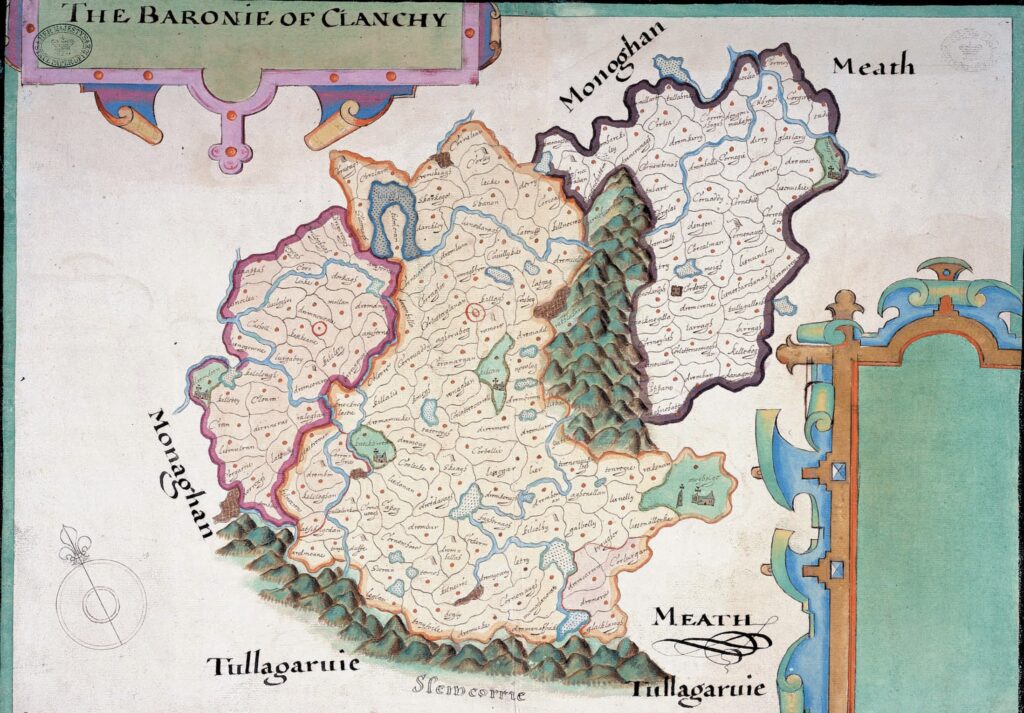
After the recent records in the south, the Ó Maol Phádraig story now returns north to Cavan, and to a political landscape that was moving steadily toward the Nine Years’ War.
It is tempting to divide the late sixteenth century neatly into rebellions: the Desmond Rebellions ended in the early 1580s, the Nine Years’ War began in the 1590s, and between them there was peace. The records tell a different story. Ireland was never really settled in the intervening years. Pardons continued to be issued, rival Gaelic factions competed for power, the Crown pushed surrender and regrant, English law and shiring into territories it had never effectively controlled, and older Gaelic lordships struggled to accommodate, manipulate or resist the new order. The mechanisms that would produce the Nine Years’ War were already turning on both sides.
For the Ó Maol Phádraig family, Fiant 5792, dated 6 March 1593, brings us directly into that world. The man named in the record is Moriertagh O Mullphadrick, Muircheartach Ó Maol Phádraig, described as being “of the Crynan.” An Críonach can be identified with considerably more confidence with Creeny in Annagh parish, in the barony of Loughtee, although another Creeny in neighbouring Drumlane has also been proposed. The precise identification remains slightly uncertain.
But this time the location may not be the most important part of the record. The important man may be the one at the top.
Philip O’Reilly
Fiant 5792 begins:
“Pardon to Philip OReighly, of Ballincarg, esq.”
What follows is a long list of O’Reillys and other men from across Cavan. At first sight Muircheartach Ó Maol Phádraig appears simply to be one name among many. A closer examination of Philip O’Reilly changes that completely.
This was Pilib Ó Raghallaigh, second son of Aodh Conallach Ó Raghallaigh, lord of East Bréifne from 1565 until his death in 1583. Philip’s elder brother John had spent part of his youth as a ward of the English administration. He learned English, became familiar with English law and developed an increasingly anglicised political outlook.
Philip followed a very different course. During John’s absence he effectively occupied the position of heir-apparent and cultivated the attributes expected of a traditional Gaelic lord. Marc Caball’s detailed study of the bardic poetry composed for Philip shows that this was not incidental. Philip became a major patron of the Gaelic learned order, and at least twenty-one poems written for him survive. He apparently possessed his own duanaire, or collection of poems, and his household included poets, bards, harpers and other performers.
The contrast between the brothers became political as well as cultural. In 1583 John agreed with the Crown to abandon several features of traditional Gaelic government, including Brehon law, Gaelic rents and customary assemblies. Significantly, he also agreed not to maintain a bard, carrogh or rhymer in his household.
Philip surrounded himself with precisely that world. His poets repeatedly presented him as possessing the qualities of a proper Gaelic lord and treated him as a potential alternative to his anglicised elder brother. Caball concludes that Philip’s political ambition centred upon attaining the lordship of his name — becoming O’Reilly in the traditional sense. That ambition would eventually place him directly in the path of the Nine Years’ War.
The Division of Bréifne
The most important discovery for understanding Fiant 5792 comes from what happened after the death of Aodh Conallach.
During the Crown restructuring of East Bréifne in 1584, the old O’Reilly lordship was effectively divided among the principal members of the dynasty. Sir John accepted a settlement intended to replace the traditional system of lordship and succession with a territorial structure operating under English law.
Philip was granted the barony of Clankee.
That one fact explains an extraordinary amount of Fiant 5792. When the locations of the men in the pardon are reconstructed, a very large proportion fall in eastern Cavan, especially in and around Clankee, Enniskeen, Shercock and Bailieborough. The repeated M’Echey surname in the record can be identified as Mac an Chaoich, the O’Reilly cadet kindred from which Clann Chaoich — Clankee — took its name.
These were not simply random O’Reilly-associated men scattered across Cavan. A large part of the pardon appears to represent Philip O’Reilly’s own territorial constituency, and within that population is a remarkable collection of names.
At Shercock are Fear Dorcha Ó Dálaigh and Conchobhar Ó Dálaigh, members of one of Ireland’s great hereditary learned families. At a place called “the Derry”, an older denomination in Enniskeen parish, we find Cathal O’Sheridan, Conla Carragh Mac Diarmada, and Neill mac James Mac an Chaoich.
That is worth dwelling on. Sheridan and Mac Diarmada are not merely names appearing somewhere in the same enormous pardon. They are recorded at the same place, inside a landscape heavily populated by the Mac an Chaoich O’Reillys. Other Mac an Chaoich households occur at Cabra, Corratober, Corraweelis, Laragh, Drumcrin and neighbouring places around Enniskeen. Mac Cléirigh also appears within the broader Clankee population.
This was a real community, and we have seen it before.
Back to Dunaree
Seven years earlier, in Fiant 4908 of 18 July 1586, Cathal Bán Ó Maol Phádraig had appeared at Dunaree, also in Clankee.
At the time, Dunaree was important because it placed an Ó Maol Phádraig man within the eastern O’Reilly world and only a few miles from the earlier Ó Maol Phádraig presence around Shancor. Fiant 5792 now allows that earlier record to be seen differently.
Cathal Bán was not simply an isolated Ó Maol Phádraig husbandman living somewhere in eastern Cavan. He was living within the same small Clankee landscape in which, only a few years later, we can actually see Mac an Chaoich, Sheridan and Mac Diarmada living together, with Ó Dálaigh and Mac Cléirigh nearby.
That is a much stronger connection than the appearance of several surnames in the same list. It demonstrates that these families were physically embedded in the same local society.
It does not prove that they were still performing the hereditary ecclesiastical or learned functions associated with some of their families in earlier centuries. Nor does it establish some formal surviving church organization. But it does establish something that is perhaps more useful: they really were living together inside the same O’Reilly political landscape.
Cathal Bán Ó Maol Phádraig was already part of that landscape in 1586. Fiant 5792 now exposes the network around him.
Seven Years in Dublin Castle
Philip himself had almost disappeared from that landscape. In 1585 he and his uncle Edmund represented Cavan in the Dublin parliament. Philip’s conduct brought him into conflict with the government, and he was imprisoned in Dublin Castle, where he remained for approximately seven years.
Caball records the consequences. In Philip’s absence his lands deteriorated, tenants abandoned their holdings and his own family fell into poverty. There is something revealing here about the actual nature of Gaelic lordship. Removing the lord did not simply remove an individual politician; it disrupted the web of tenants, dependants, freeholders, household officers and followers attached to him.
Philip was finally released in 1592, after entering into recognizance and agreeing to observe the Crown settlement of Bréifne. Then, only months later, comes Fiant 5792: Philip O’Reilly and a large body of his people are pardoned on 6 March 1593.
The fiant itself does not tell us that these men had all committed one particular offence together. Its provisions exclude murder and persons already imprisoned or on bail, indicating the broader character of the pardon. But placed against Philip’s history, the timing is difficult to ignore. A man whose lands and following had been disrupted during seven years of imprisonment had returned to Cavan, and now the Crown was pardoning him together with a substantial body of men connected with the society over which he exercised influence.
Fiant 5792 begins to look very much like a record of Philip’s re-emergence into the political life of Bréifne.
The Man Who Does Not Fit
That makes Muircheartach Ó Maol Phádraig particularly interesting.
Most of the eastern population can now be explained. The Mac an Chaoich men belong naturally in Clankee. The Ó Dálaighs are at Shercock. Sheridan and Mac Diarmada are together at the Derry in Enniskeen. At least one Mac Cléirigh can also be placed firmly within Clankee.
Muircheartach is different. If the Crynan is Creeny in Annagh parish, as the historical forms presently suggest, he is not part of that tight Clankee concentration at all. He lies considerably farther west, in Loughtee.
Yet his name appears remarkably high in Philip’s pardon. After Philip himself come his brother Owen, his sister Evelin, and a small number of named O’Reillys. Then appears “Moriertagh O Mullphadrick, of the Crynan.” Only after him come Cormac Óg Mac Cléirigh and the two Ó Dálaighs of Shercock, followed by the much larger population.
His geographic isolation may therefore be telling us something. Rather than trying to force Muircheartach into the Clankee group, it may be more useful to recognize that he does not belong to it geographically. The connection may instead have been to Philip himself.
We do not know the nature of that relationship. Muircheartach could have been a personal follower, household servant or officer, administrator, military adherent, surety, client, or connected through marriage, fosterage or some older relationship between their families. There is presently no evidence allowing one of those possibilities to be selected.
But the structure and geography of the pardon make a personal association increasingly plausible. The large Clankee population can be explained by Philip’s territorial lordship; Muircheartach cannot. Something else appears to have brought him into Philip O’Reilly’s circle.
Another Circle Around Philip
The Bradys in the pardon may provide a hint that Philip’s following was not arranged purely by territory.
Six Brady men appear. One is from Cavan, two have locations that remain unresolved, but three are recorded at Bealenecarg/Bealanecarg/Bealinecarg — apparently variant forms associated with the Bellanacargy from which Philip himself is styled.
If that identification is correct, half of the Brady contingent was associated with Philip’s own seat rather than the eastern Clankee concentration. The pardon may therefore preserve overlapping circles around him: a large territorial following from Clankee and a smaller personal or household network whose members need not have lived within that barony.
Muircheartach Ó Maol Phádraig may belong to the second.
It is an important distinction because the Ó Maol Phádraig appearances are beginning to show more than one way in which the family interacted with the O’Reilly political world. Cathal Bán in 1586 appears territorially embedded at Dunaree within Clankee; Muircheartach in 1593 may instead have been attached directly to one of the most ambitious O’Reilly lords of his generation.
Toward War
By 1593 the political machinery that would produce the Nine Years’ War was already in motion.
The Crown was attempting to replace traditional lordship, succession and law with a territorial order dependent upon English government. Gaelic lords were simultaneously accepting Crown titles, resisting sheriffs and officials, competing with one another for traditional authority, building alliances and maintaining the older learned and cultural institutions that legitimised their rule.
Philip embodied those contradictions. He had accepted a Crown-created territorial grant in Clankee, represented Cavan in an English parliament, spent seven years imprisoned by the same government, and after his release agreed to observe the settlement. Yet his poets continued to present him as the proper Gaelic lord of Bréifne.
Within a few years that tension would break. After the death of his brother John in 1596, Hugh O’Neill supported Philip for the traditional title of O’Reilly. Philip finally achieved the position his poets had spent years predicting for him and aligned himself with O’Neill in defiance of the Crown settlement.
His triumph lasted only months. Philip was killed in 1596 in obscure circumstances involving men from O’Neill’s following.
The pardon of 1593 therefore catches Philip at an extraordinary moment. He had just returned from seven years in Dublin Castle, and his political network was being reassembled. Around him stood the Mac an Chaoich population of Clankee, O’Reilly kinsmen, learned families and other dependants. Among them, but apparently coming from outside the territorial centre of the group, stood Muircheartach Ó Maol Phádraig of the Crynan.
Behind this record stands Cathal Bán at Dunaree seven years earlier, already living among the same Clankee society that Fiant 5792 now allows us to see in far greater detail. The Ó Maol Phádraig story has returned north, and this time it is standing very close to the political fault line that was about to become the Nine Years’ War.
References
Caball, Marc. “Aspects of Sixteenth-Century Élite Gaelic Mentalities: A Case-Study.” Études Celtiques, vol. 32, 1996, pp. 203–216.
Ireland Public Record Office. Sixteenth Report of the Deputy Keeper of the Public Records in Ireland. Dublin, 1884. Fiant 5792, p. 222.
Fitzpatrick, Mike and Mike Fitzpatrick. “Ó Maol Phádraig: the name, the people, and the clans. Part III.” The Journal of the Fitzpatrick Clan Society, vol. 6, 2025, pp. 27–41.