
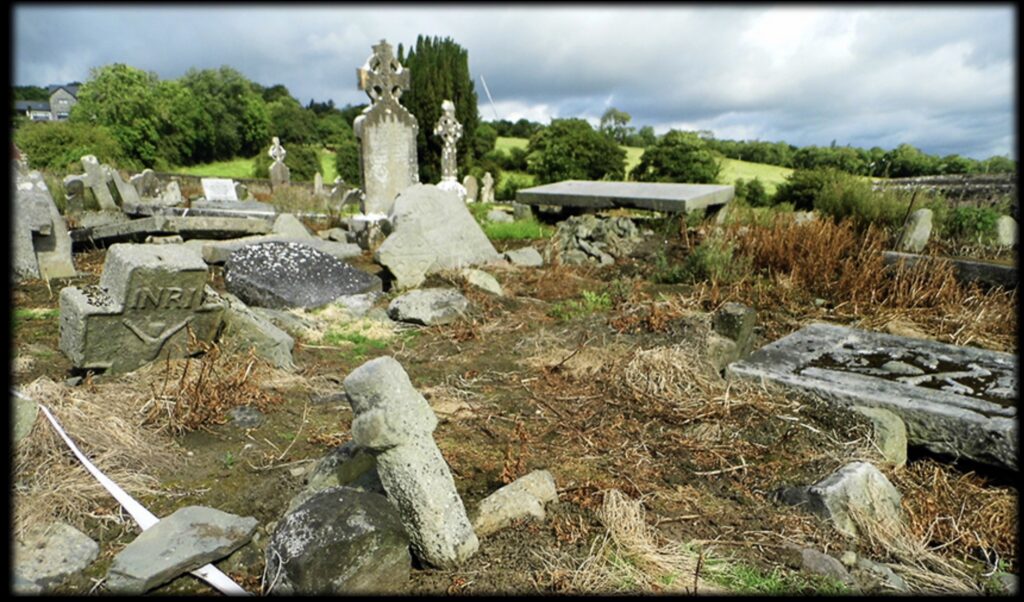
The journey through the Elizabethan fiants does not follow a neat geographical path. The previous Ó Maol Phádraig record carried the investigation deep into the south of Ireland; Fiant 4908 now brings it abruptly back to the eastern reaches of County Cavan.
That movement is deliberate. The fiants are being followed chronologically rather than geographically, which means moving with the surviving records wherever they lead. In the later sixteenth century, events that appear very different when viewed locally were often parts of the same much larger transformation taking place across Ireland.
From Cork and Kerry to Meath and Bréifne, the Crown was steadily dismantling political and landed structures that had existed for centuries. The suppression of the monasteries had transferred enormous amounts of Catholic Church property to the Crown in law, but legal ownership did not automatically produce possession on the ground. Former monastic lands still contained tenants, hereditary families and local interests whose relationships with those estates long predated the Tudor state. Gaelic and Old English lords continued to exercise influence over church property, while new Crown lessees and grantees attempted to take their place.
The result was not a single organised Irish resistance stretching from one end of the island to the other. It was something more complicated and persistent: local families pushing back against the same Crown process in different places at roughly the same time. Political lordship was being reduced, ecclesiastical property redistributed and the older Catholic institutional landscape progressively dismantled. Pardons became one of the mechanisms by which the government attempted to bring the people caught in that upheaval back under Crown authority.
Following the fiants chronologically therefore means watching that process unfold simultaneously in different parts of Ireland. The names and alliances change from one region to another, but some of the underlying pressures remain remarkably similar.
Fiant 4908 is a particularly good example.
Dated 18 July 1586, it contains a long list of men from eastern Cavan, among them Cahill bane O Mulpatrick of Donerye, husbandman — Cathal Bán Ó Maol Phádraig of Dunaree near Kingscourt.
After the 1541 record at Kilmainhamwood, the description seemed almost ordinary. Nicholas and Charles Ó Maol Phádraig had appeared there as sworn jurors during the investigation of a dissolved religious estate, trusted to give evidence concerning land, rents, tenure and value. What makes Cathal Bán immediately more interesting is the geography: Dunaree lay only a few miles away, little more than a short walk from the world of Shancor and Kilmainhamwood. Forty-five years later, another Ó Maol Phádraig was still present in almost the same borderland, this time described simply as a husbandman receiving a royal pardon.
The natural question was what he had done. The fiant gives no specific offence, however, and the Tudor pardon rolls are often more revealing when read as groups rather than as isolated names. Once the people around Cathal were examined, the character of the record changed completely.
Fiant 4908 begins with Domhnall mac Seáin Ó Raghallaigh and Fearghal mac Seáin Ó Raghallaigh of Lough Sillan, both gentlemen. They are followed by men from Tullagalkhork, Cabra, Enniskeen, Dunaree, Cormey and neighbouring places. Most striking is the number belonging to Mac an Chaoich, the Ó Raghallaigh branch whose name survives in the territory of Clankee, Clann Chaoich.
The occupations make clear that this was not simply a military company. Gentlemen appear beside husbandmen, cottiers, servants, tradesmen, a horseman, a priest and clerks. What the fiant preserves is closer to a cross-section of a local lordship: people of different rank and occupation connected by territory, kinship and political allegiance.
The date places them in a particularly unsettled moment. Aodh Conallach Ó Raghallaigh had died in 1583, leaving East Bréifne divided by a succession struggle just as the Crown was accelerating its attempt to dismantle the old lordship. Sir John Ó Raghallaigh received Crown support, while rival members of the dynasty resisted the new settlement. Under Sir John Perrot, East Bréifne was being transformed into County Cavan and older territorial relationships were increasingly being replaced by Crown grants, administrative divisions and English law.
Clankee stood directly in the path of that change. Philip Ó Raghallaigh was closely associated with the territory and opposed aspects of the Crown settlement; by late 1585 he was imprisoned in Dublin Castle. Fiant 4908 followed only months later. A mass pardon of men belonging to this country therefore fits naturally within a programme of pacification, but the geography around Cathal Bán reveals that the conflict was about more than succession within the Ó Raghallaigh dynasty.
Dunaree and the old church lands
Dunaree formed one of the principal divisions of the parish of Enniskeen. An inquisition of 1609 describes Enniskeen as containing five ballybetaghs, among them Ballydonrie, Dunaree, and Ballincabragh, Cabra. The same inquiry reveals that this was an unusually layered ecclesiastical landscape.
The Bishop of Meath was described as both parson and vicar of Enniskeen, receiving the tithes in kind and maintaining a curate. The wording is explicit: “the bishop of Meath is both parson and vicar.” Yet the Bishop of Kilmore continued to receive an annual rent from two polls at Enniskeen, part of an older termon or hospital estate. The printed commentary on the inquisition also identifies the church as “a dependency of Kells.”
These were not mutually exclusive claims. They were surviving layers of a much older arrangement.
The same structure becomes clearer in neighbouring churches. At Moybolge, much of the rectorial income belonged to St Mary’s Abbey at Kells while Kilmore retained rights in the termon lands. At Killann, the parsonage and vicarage were likewise appropriated to Kells while an older Kilmore interest remained. Knockbride and Drumgoon belonged to the same wider group of old church estates.
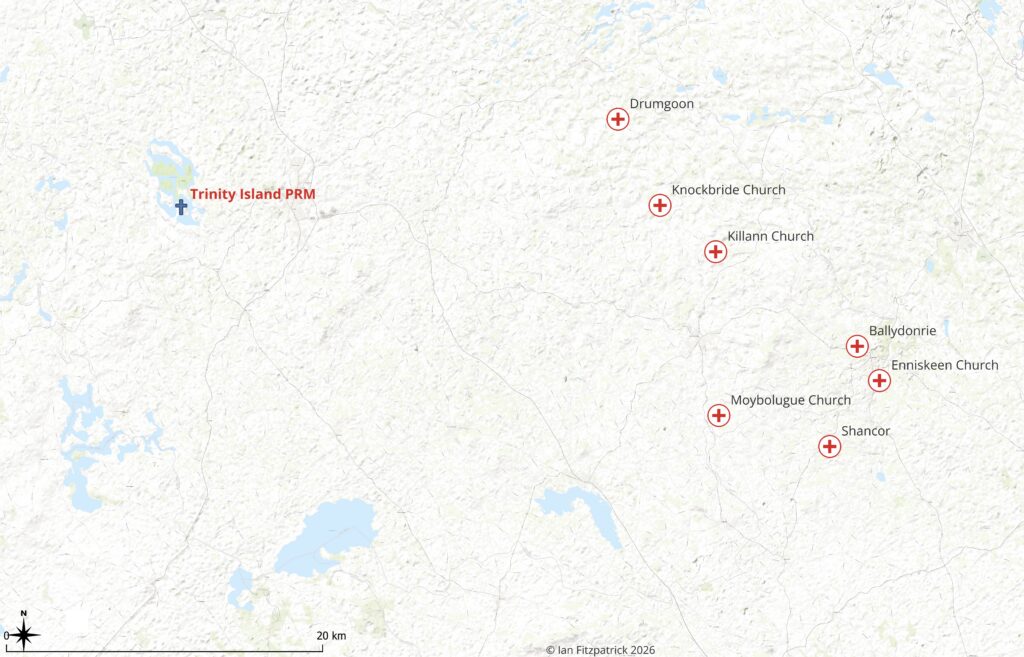
Enniskeen, Moybolge, Killann, Knockbride and Drumgoon were remembered as the Hospitals of Clankee. Their precise arrangements differed, but together they formed a network in which Kells, Meath and Kilmore possessed ecclesiastical interests inside a territory politically dominated by the Ó Raghallaigh.
Cathal Bán was therefore not simply farming near an old parish church. He was living within a landscape whose ownership and obligations had been shaped for centuries by ecclesiastical institutions.
That immediately changed the significance of his occupation. A husbandman could be part of a church-land economy just as readily as he could farm secular land. Gaelic ecclesiastical estates were populated by hereditary church families and ordinary tenants who cultivated the land, paid customary dues and lived under the authority of local church officials. The title recorded beside one man in a Tudor pardon tells us what he was doing at that moment; it does not tell us how his family first acquired its place in the landscape.
Church authority and Ó Raghallaigh power
The next question was who actually controlled these church estates on the ground.
Ciarán Ó Scea’s study of Gaelic church landholding shows that the formal rights of bishops and churches coexisted with very real secular intervention. In Kilmore the tension is documented by 1428, when exactions imposed by Owen Ó Raghallaigh upon erenach lands were associated with the concealment of tithes.
By the later sixteenth century the relationship was even more obvious. O. Davies states that Brian mac Phelim Ó Raghallaigh held Aghleere and “all the bishop’s lands” before his attainder. The precise legal nature of that possession is difficult to reconstruct, but the broader reality is clear: ecclesiastical title did not prevent an Ó Raghallaigh lord from exercising practical authority over church property.
That distinction is central to understanding Cathal’s world. Land could remain ecclesiastical in origin while the people occupying it lived politically under Ó Raghallaigh authority. A family could therefore owe its position to an older church-land arrangement while simultaneously belonging to an Ó Raghallaigh following.
That may be the most useful way of thinking about the Ó Maol Phádraig presence at Dunaree. The surviving evidence does not tell us whether the family was originally placed there by Kilmore, entered through an older Kells-associated arrangement, or was settled or maintained by the Ó Raghallaigh. In this kind of system those possibilities need not be alternatives. Ecclesiastical tenure and secular patronage could reinforce one another.
The men surrounding Cathal in Fiant 4908 fit that world remarkably well. Donnell Ó Deoráin of Tullagalkhork is explicitly described as a priest. A later study of the Hospitals of Clankee, noting Tullagalkhork’s position between Muff and Enniskeen, considered him likely to have served the church at Enniskeen. Nearby, Philip Roe Mac Gargáin of Carriga appears as a clerk in the Moybolge landscape.
Then there are Thomas mac Rory Ó Cearbhalláin and Rory Ó Cearbhalláin. Their surname had a much older ecclesiastical history in the same border country. In 1366 Archbishop Milo Sweteman commissioned Peter Ó Cearbhalláin, Chancellor of Armagh, to conduct the metropolitan visitation of Kilmore, bringing him directly into the world of Bishop Richard Ó Raghallaigh and the clergy gathered around Kilmainhamwood. By 1550 another member of the family, Terence or Toirdhealbhach Ó Cearbhalláin, was rector of Knogh in County Meath.
Yet Thomas mac Rory appears in 1586 simply as a cottier.
That is a useful warning against reading Tudor occupational labels too narrowly. A family which had produced senior clergy could also contain a cottier. Likewise, Cathal Bán being a husbandman tells us nothing certain about the historical function of earlier generations of Ó Maol Phádraig.
Shancor returns to the story
At that point the 1541 record from Shancor became difficult to ignore.
Nicholas and Charles Ó Maol Phádraig had been selected as jurors during the survey of the former Hospitaller estate at Kilmainhamwood and associated ecclesiastical property. They were local men trusted to speak about land, rents, tenure and value. Shancor lies only a short distance south of the Enniskeen–Dunaree landscape.
There is no evidence that Nicholas, Charles and Cathal held the same hereditary office, nor is there any need to invent one. What is striking is the setting in which the surname appears.
In 1541, Ó Maol Phádraig is found beside a dissolved religious estate on the Meath edge of Bréifne. In 1586, another Ó Maol Phádraig appears immediately to the north within another landscape of old church estates under Ó Raghallaigh authority.
The family repeatedly turns up among the people who knew, occupied and worked land tied to ecclesiastical institutions.
The investigation then widened beyond Clankee, because the Enniskeen termon was only one small part of a much larger Kilmore church-land system.
At Drumlane, the Bishop of Kilmore possessed a remarkable thirty-two polls of termon land. Drumlane also had a separate Augustinian abbey estate, while nearby Trinity Island on Lough Oughter possessed its own monastic lands. These properties became particularly revealing after the Dissolution because the Crown discovered that confiscating an abbey on paper was one thing and taking possession of its estates was another.
In 1569, custody of Drumlane and Trinity Island was granted to Turlough McCabe. Later records show continued difficulty establishing effective control, and arrangements eventually involved Sir Hugh Ó Raghallaigh himself. The Crown claimed legal ownership of the former religious estates, but the Ó Raghallaigh still possessed the local power capable of determining who actually occupied them.
Davies regarded 1586, when Sir Luke Dillon was granted and apparently succeeded in occupying the properties, as the point at which a Crown holder finally established effective possession against Ó Raghallaigh opposition.
The coincidence with Fiant 4908 is striking. It does not prove that Cathal Bán or the men pardoned with him were resisting Dillon, and there is no reason to force such a connection. It does show, however, that in the very year of Cathal’s pardon the Crown was still struggling to convert its theoretical ownership of former ecclesiastical estates into real authority on the ground.
The resistance at Drumlane and Trinity Island is especially revealing because it shows how incomplete the Dissolution remained decades after the monasteries had legally been suppressed. These estates represented land, rents, tenants, grazing, patronage and authority. For the Ó Raghallaigh, they also lay inside a political and ecclesiastical world in which their family had exercised influence for generations. A Crown lease did not erase those inherited relationships.
That wider resistance gives Fiant 4908 a sharper edge. The men in the pardon were living through a period when Irish families across the country were being forced to decide whether to accommodate the new order, resist it, or find some uneasy position between the two. For families whose identity and livelihood were bound up with the old Catholic church-land system, the pressure could be particularly intense.
The Flemings and the incoming order
Fiant 4908 also contains men who point toward the future. Flemings appear among the Tullagalkhork group, and their presence is significant because the family would soon become closely associated with former Kells ecclesiastical interests and with new landholding in the Enniskeen district.
Gerald Fleming of Cabragh belonged to the kind of incoming landed interest created by the redistribution of former church property and the Crown’s restructuring of eastern Cavan. His rise gives the pardon an added dimension. The same record that preserves Mac an Chaoich men, local clergy, Ó Cearbhalláin and Cathal Bán Ó Maol Phádraig also contains members of a family whose future position would increasingly depend upon the new Crown-backed property order.
Fiant 4908 therefore catches the two worlds meeting. The older population remained tied to Ó Raghallaigh relationships and to an ecclesiastical landscape whose institutions had developed over centuries, while new families were beginning to acquire rights through Crown grants, leases and the redistribution of Catholic Church property.
Fiona Fitzsimons has shown that Tudor pardon schedules can preserve groups of followers within a lordship, while James Leduc has demonstrated how pardon and mercy formed part of the machinery of pacification. Read in that light, the gentlemen, farmers, clerics, servants and cottiers of Fiant 4908 look less like unrelated offenders than a community being brought to terms as the political order around them was dismantled.
For Ó Maol Phádraig, another theme is now beginning to emerge. The surviving Tudor records increasingly present the family as a troublesome and resistant lot, and the Church repeatedly lies somewhere close to the centre of the story. Nicholas and Charles Ó Maol Phádraig had appeared beside dissolved religious property at Shancor in 1541. Cathal Bán now appears only a few miles away among an Ó Raghallaigh population living across old Kells and Kilmore church lands, at a time when resistance to Crown possession of former ecclesiastical estates was still occurring elsewhere in the diocese.
Fiant 4908 does not tell us that Cathal personally fought for the Catholic Church, and no specific religious offence is attached to his name. The broader sequence nevertheless begins to suggest a family whose loyalties remained with the older Catholic and Gaelic order and which was not always inclined to accept quietly the Crown’s dismantling of it. As the later Ó Maol Phádraig records appear, that combination of resistance, older lordship and attachment to the Church becomes increasingly difficult to dismiss as coincidence.
That is the pattern worth carrying forward into the next fiants.
What Fiant 4908 finally reveals
The investigation began with a husbandman in a pardon and ended with a much larger picture.
The names around Cathal led to the Mac an Chaoich and the politics of Clankee. Dunaree led to Enniskeen and its two Kilmore church polls. Enniskeen opened the older relationship with Kells and Meath, while neighbouring Moybolge and Killann showed that these overlapping ecclesiastical interests formed part of a wider system. The Kilmore termon lands then revealed how thoroughly Ó Raghallaigh political authority could penetrate church property, and Drumlane and Trinity Island showed that the Crown was still encountering resistance when it tried to place new holders in possession of former religious estates.
At the same time, the Flemings appearing in Fiant 4908 foreshadow the new landed order that would increasingly replace the old one.
Cathal Bán therefore occupies a remarkably revealing position. He was a husbandman at Dunaree, but Dunaree lay within a Kells-shaped ecclesiastical landscape containing surviving Kilmore rights and governed politically through the Ó Raghallaigh world.
Whether the Ó Maol Phádraig family first entered that landscape through the Church, through Ó Raghallaigh patronage, or through a combination of both cannot yet be demonstrated. The last possibility fits the society revealed by the records particularly well.
A family could have obtained its place through ecclesiastical tenure and remained there because an Ó Raghallaigh lord protected or incorporated it. When the Crown began dismantling both the old religious estates and the political authority surrounding them, those same families would naturally appear among the populations being pardoned, pacified and drawn into the new system.
Seen that way, Cathal Bán is no longer an incidental farmer buried in a Tudor list.
He is a surviving glimpse of the world that Fiant 4908 was helping the Crown bring to an end.
References
Calendar of the Fiants of the Reign of Queen Elizabeth, Fiant 4908, 18 July 1586.
Fitzpatrick, Mike et al., Ó Maol Phádraig — the Name, the People, and the Clans, Part III.
Breifny Antiquarian Society Journal, 1931–33, 1609 Inquisition of County Cavan, particularly the entries for Enniskeen and the Hospitals of Clankee.
Davies, Oliver, “The Castles of County Cavan.”
Ó Scea, Ciarán, “Erenachs, Erenachships and Church Landholding in Gaelic Fermanagh, 1270–1609.”
Lawlor, H. J., A Calendar of the Register of Archbishop Milo Sweteman.
Earley, Brendan and Boyle, Michael, “Conflict over the Rectory of Cinél Luacháin.”
Calendar of Patent Rolls, James I, records relating to the termon and hospital lands of the Diocese of Kilmore.
Scott, Brendan, study of the suppression and later custody of Irish religious houses, including Drumlane and Trinity Island.
Fitzsimons, Fiona, studies of Tudor fiants and pardon schedules.
Leduc, James, studies of pardon, mercy and pacification in Tudor Ireland