
Every so often a record that has been sitting in plain sight suddenly demands another look.
In this case it came from the excellent three-part study of the Ó Maol Phádraig name by Dr Mike Fitzpatrick and his co-authors. I had passed over the record months earlier while concentrating on other parts of the family history. Then I returned to it and realised that I had never actually read it properly.
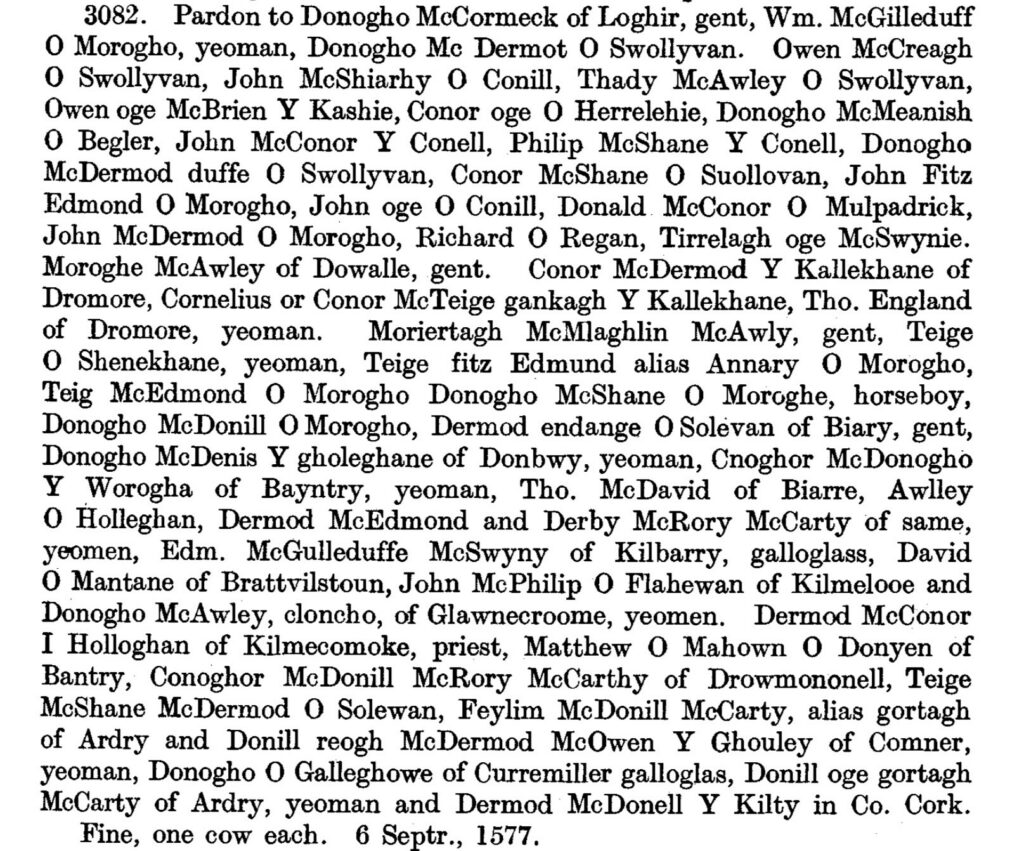
It was Fiant 3082, dated 6 September 1577.
It was also the first Ó Maol Phádraig record in the Elizabethan fiants that I had reached in this investigation, and it was in County Cork.
That immediately produced an uncomfortable feeling. By this stage of the research, a fairly detailed picture had developed around Ó Maol Phádraig in Bréifne, the ecclesiastical families associated with Cenél Luacháin, and the much earlier records from Ballinskelligs. A previously overlooked record from Cork had every possibility of upsetting that picture.
That is part of historical research. A new record does not have to support what has already been written. If it points somewhere else, the interpretation has to move with it.
So Fiant 3082 needed more than a quick reading. The whole record had to be examined: the man who headed the pardon, the people named with him, their families, their occupations, the geography of the group and the political world in which they lived.
The result was considerably more rewarding than expected
Reading a fiant
The Tudor fiants are easy records to underestimate.
A researcher looking for one surname can work through hundreds of entries, find the person being sought, record the date and spelling, and move on. Used that way, Fiant 3082 gives us one straightforward piece of information: in September 1577 a man recorded as Donald m’Conor O Mulpadrick received a royal pardon in County Cork.
Rendered into Irish, he was Domhnall mac Conchobhair Ó Maol Phádraig.
But the record does not consist of one line.
Fiants were warrants authorising the issue of letters patent under the Great Seal and survive for grants, appointments, leases, pardons and other Crown business. Their value became even greater after the destruction of the Irish Public Record Office in 1922, because the nineteenth-century calendars preserve information drawn from original records that no longer survive.
The pardon fiants can be particularly revealing because the people named in them were often presented in groups.
Fiona Fitzsimons has drawn attention to the way large Elizabethan pardon lists could be compiled from schedules of followers submitted to the Irish council. This makes the names surrounding an individual potentially important evidence. When examined carefully, they can reveal elements of a lord’s following, military retinue or wider faction.
Dr Mike Fitzpatrick has used a similar approach in his own work on Pátraic surnames in the fiants and patent rolls. Rather than treating each surname occurrence as an isolated entry, he has examined the people standing around it and the political and social setting in which the group appears. That work demonstrates how much can disappear when a fiant is treated merely as a surname index.
This does not mean that every person in a pardon was related, lived in the same place or served directly in the household of the man heading the list. Nor does a shared pardon prove that everyone committed the same offence.
It does mean that the rest of the names cannot simply be discarded.
Fiant 3082 contains almost fifty men. Among them are gentlemen, yeomen, a priest, a horseboy and galloglass. The surnames include MacCarthy, O’Sullivan, O’Mahony, O’Callaghan, MacAuliffe and MacSweeney, families deeply rooted in the political world of south-west Munster.
The men were dealt with collectively, each paying a fine of one cow. That common treatment raises the question the bare fiant does not answer: what had brought Donnchadha mac Cormac and this body of followers before the Crown in September 1577?
Why were they being pardoned?
The date of Fiant 3082 is important.
The pardon was issued only a few years after the end of the First Desmond Rebellion. Between 1569 and 1573 much of Munster had been drawn into conflict involving the Crown, the FitzGerald earls of Desmond and the network of Gaelic and Old English lords whose rivalries and alliances shaped the province.
Donnchadha mac Cormac had himself become involved in that wider struggle.
By 1577 the principal fighting of the first rebellion had ended, but Munster was far from politically settled. Crown government faced a problem larger than defeating individual rebels. Much of the province still operated through powerful regional lords who could summon substantial followings and whose authority over local society was often more immediate than that of Dublin.
William Drury had become President of Munster in 1576 and began an energetic effort to impose greater Crown control throughout the province. He travelled through Munster holding sessions, dealing with offenders and attempting to force local lords and their followers into a more regular relationship with the government.
Punishment was part of that process, but so was accommodation.
Pardons allowed men who had been implicated in rebellion, disorder or resistance to return formally to the Queen’s peace. Security could be demanded for their future conduct, fines could be imposed, and a lord could be dealt with together with the people attached to his political following.
Fiant 3082 belongs within that environment.
It was not an isolated pardon issued to a single group on an otherwise quiet day. The first days of September 1577 saw a succession of substantial Cork pardon groups being processed. MacCarthy-led pardons occur immediately around Fiant 3082, and similar settlements continued over the following days. The repeated use of the one-cow fine across these groups suggests a standardised effort to settle large numbers of men rather than a collection of unrelated criminal cases.
Fiant 3082 therefore looks less like the resolution of one specific offence and more like part of a broader attempt to pacify and reorganise the political landscape of Cork after rebellion.
The record does not tell us what Domhnall mac Conchobhair Ó Maol Phádraig personally had done, and it would be wrong to invent an offence for him. His inclusion tells us something different. When Donnchadha mac Cormac and this substantial body of men were brought into a settlement with the Crown, Domhnall was one of the people included with them.
The Crown was not simply pardoning Donnchadha.
It was dealing with a political following.
And Donnchadha’s following was worth dealing with because of who he was.
Donnchadha mac Cormac
Dr Mike Fitzpatrick’s Part III identifies Donnchadha as belonging to the MacCarthy family known in English records as the “Carties of Dowally,” the Mac Donagh MacCarthys of Duhallow.
Donnchadha was therefore not simply an otherwise unknown Cork gentleman. He belonged to the ruling Mac Donagh branch of the MacCarthy dynasty in Duhallow.
The name attached to him in the fiant, Loghir, appears to point toward Lohort, one of the places associated with the Mac Donagh lordship.
Following Donnchadha backwards reveals a family whose position in Duhallow had been built over generations and whose succession had become violently contested by the sixteenth century. Donnchadha was remembered as the son of Cormac Óg, son of Cormac Mac Donagh, and his branch competed with another Mac Donagh line for control of the lordship.
The dispute involved more than rival claims to precedence. Members of the competing branches had killed one another across successive generations, and those killings were still being invoked in arguments over the Duhallow succession later in the century.
Donnchadha inherited that struggle.
His father, Cormac Óg, belonged to a line already exercising military and territorial authority in Duhallow. Earlier generations of the family appear in warfare with neighbouring dynasties and in the wider conflicts of the MacCarthy world. By 1577 Donnchadha stood at the head of a substantial body of followers entering a formal accommodation with the Crown.
Domhnall Ó Maol Phádraig was one of those men.
The older Mac Donagh line
Tracing the Mac Donagh pedigree farther back leads well beyond Tudor Cork.
The Duhallow branch descended from Diarmaid Ruadh MacCarthy, a son of Cormac Fionn MacCarthy. The senior MacCarthy Mór line and the Duhallow Mac Donaghs therefore came from the same medieval ruling dynasty.
This is one of the most useful discoveries to come out of Fiant 3082.
Duhallow was not an unrelated Cork lordship that happened to carry the MacCarthy name. Its rulers formed one branch of the same wider dynasty whose senior line dominated much of south Kerry.
The Duhallow pedigree is also supported by the wider medieval record. By the early fourteenth century descendants of Diarmaid were already operating as substantial regional powers, and later annalistic material records their descendants as lords of Ealla, the Gaelic territory associated with Duhallow.
By the end of the fifteenth century the family was firmly established as one of the principal powers of north-west Cork.
So the man heading the 1577 pardon stood at the end of a political lineage extending back into the thirteenth century.
That immediately brought another place back into view.
Ballinskelligs.
Back to Ballinskelligs
Earlier in this series we encountered Alan, Gilbert and Gillasenan Ó Maol Phádraig in the records of St Michael’s at Ballinskelligs.
By 1390 Alan Ó Maol Phádraig was at the centre of the leadership of the religious house, while Gilbert Ó Maol Phádraig was among the canons. Several members of the Ó Maolchonaire family were serving there at the same time.
That association became much more important when the archaeological survey of Ballinskelligs Abbey and graveyard was examined closely.
The survey records that the O’Mulchronys of Connacht had been brought south as bards for the MacCarthys. By 1411 Alan O’Mulchrony was prior, and the family subsequently occupied the priorship for much of the fifteenth century.
The surviving papal evidence pushes their presence there earlier still. By 1390 multiple Ó Maolchonaire men were already serving in the same religious community as the Ó Maol Phádraig clerics.
The date at which the Ó Maolchonaire first entered the MacCarthy sphere is unknown. The movement could have begun during the fourteenth century or earlier. A thirteenth-century beginning cannot presently be excluded.
What can be established is the mechanism.
A learned Connacht family was brought into the south-west under MacCarthy patronage and became sufficiently established to occupy major ecclesiastical positions in Kerry.
That provides an important context for the Ó Maol Phádraig presence beside them.
It does not prove that Ó Maolchonaire brought Ó Maol Phádraig south. Nor does it prove that the two families travelled together. But it demonstrates that movement of this kind actually occurred within the MacCarthy world.
The simplest working possibility is that a western learned and ecclesiastical network already linking these families was extended southward through MacCarthy patronage. Once established in Kerry, members of both families could have entered St Michael’s through local patronage, ecclesiastical appointment, papal provision or some combination of those routes.
By 1390, whatever the earlier sequence had been, both families were there.
The graveyard
There is another detail at Ballinskelligs that gives the place unusual continuity.
The archaeological survey recorded more than two hundred named headstones and a much larger number of other burial markers in the abbey graveyard. Among the surviving surnames are McCarthy, Barry, O’Sullivan, Sullivan, King and Sweeney.
Those are not medieval identifications and should not be treated as evidence that the exact families surrounding Alan Ó Maol Phádraig in 1390 occupied those surviving graves. The visible memorials are much later.
But the names are difficult to ignore.
The burial landscape continued to contain families central to the political history of the same south-western world: MacCarthy, Barry, O’Sullivan and MacSweeney among them.
That gives Ballinskelligs a remarkable continuity as a place where the ecclesiastical and political relationships encountered in the medieval records remained reflected in the later local population.
The Ó Maol Phádraig connection therefore belongs within a real social landscape, not an isolated papal entry.
Remember Robert?
There is also an earlier Cork record that has already appeared in this series.
Robert Ó Maol Phádraig.
When we first encountered Robert, he appeared in 1306 as a juror in County Cork in litigation involving Eustace le Poer and Philip de Barry. At the time it was an intriguing but isolated early southern occurrence.
Fiant 3082 gives that old record a different background.
Robert still cannot be connected genealogically to Alan, Gilbert, Gillasenan or Domhnall. His exact home in Cork remains unknown.
But we now know that an Ó Maol Phádraig was already present in Cork by 1306, that members of the family were established at St Michael’s by the end of that century, and that they were serving there alongside Ó Maolchonaire men in a MacCarthy environment.
The southern appearance of the surname was therefore not a late Tudor development.
It was already centuries old when Domhnall entered Fiant 3082.
Returning to 1577
The record now looks very different from the one that first appeared on the page. At first it seemed to say simply that an Ó Maol Phádraig had received a pardon in Cork. Read as a complete record, it places Domhnall mac Conchobhair Ó Maol Phádraig inside the following of Donnchadha mac Cormac Mac Donagh, a member of the ruling Duhallow branch of the MacCarthy dynasty. It also places both men within the unsettled aftermath of rebellion in Munster, when the Crown was attempting to bring regional lords and the men attached to them back into the Queen’s peace.
Tracing Donnchadha’s family backwards leads into the same wider dynasty whose senior branch dominated the world around Ballinskelligs. Almost two centuries earlier, Ó Maol Phádraig and Ó Maolchonaire had already been serving together at St Michael’s, and one of those families is explicitly remembered as having entered the south through MacCarthy patronage.
The evidence cannot yet connect the individuals genealogically. It cannot prove that Domhnall descended from the Ballinskelligs Ó Maol Phádraig, nor can it prove that a MacCarthy first brought Ó Maol Phádraig into Cork or Kerry. But it does show that the association visible in 1577 was not occurring in an entirely new political environment. Ó Maol Phádraig had already been present in the Cork and Kerry world for centuries, and the MacCarthy connection was already part of that older landscape.
Fiant 3082 may therefore preserve a much later expression of a relationship whose beginnings lie somewhere in the medieval period. When I first returned to this record, I wondered whether it might force a complete change in direction. It could have. Instead, the names surrounding Domhnall led backwards through the lords of Duhallow, into the medieval MacCarthy pedigree and eventually back toward Ballinskelligs.
None of those connections appeared by reading the Ó Maol Phádraig line alone. They appeared because the entire fiant was read. That may be the most useful lesson contained in Fiant 3082: a name in a Tudor pardon can tell us something, but the company it keeps can tell us much more.
References
Fitzpatrick, Dr Mike, and co-authors. “Ó Maol Phádraig: the Name, the People, and the Clans, Part III.” Journal of the Fitzpatrick Clan Society.
Fitzsimons, Fiona. “Tudor Fiants.” History Ireland.
Ireland Public Record Office. Calendar of the Fiants of the Reign of Queen Elizabeth.
Brewer, J. S., and William Bullen, eds. Calendar of the Carew Manuscripts Preserved in the Archiepiscopal Library at Lambeth.
MacCarthy, Samuel Trant. Studies of the MacCarthy pedigrees and the Mac Donagh line of Duhallow.
MacCotter, Paul. “Lordship and Colony in Anglo-Norman Kerry.”
Archaeological Survey of Ballinskelligs Church and Graveyard, Ballinskelligs, County Kerry. Kerry County Council, 2012.
Calendar of Entries in the Papal Registers Relating to Great Britain and Ireland: Papal Letters.