
One of the difficulties in reconstructing the history of the Ó Maol Phádraig family is that the surviving medieval records rarely tell us what members of the family actually did. They appear in ecclesiastical settings, around important churches and later among the dependants and associates of powerful ruling families, but no surviving document describes a hereditary Ó Maol Phádraig occupation.
That absence has encouraged the search for a territorial homeland, on the assumption that a medieval family should eventually be identifiable with a particular district. Another possibility deserves consideration. The unusual geographical spread of the Ó Maol Phádraig may reflect not the expansion of a territorial family, but the distribution of a family whose usefulness required its members to live in different places.
The people who performed much of the practical work beneath medieval Irish lordship are poorly recorded. Kings, bishops, rectors, erenachs, poets, historians, lawyers and physicians appear because their offices generated records. The people who kept estates functioning from year to year are much harder to see.
It is in this largely hidden part of the system that the role of the Ó Maol Phádraig may have developed.
Families Placed Where They Were Needed
Elizabeth FitzPatrick’s study of the Gaelic learned professions provides an important model for understanding how hereditary service families could be distributed through a lordship.
Her work concerns poets, historians, lawyers, physicians and other members of the Gaelic literati. There is no evidence that the Ó Maol Phádraig belonged to that same professional class. What FitzPatrick demonstrates, however, is a broader feature of Gaelic society: specialist families could be deliberately established where their services were required.
Their estates did not necessarily mark their place of origin. Branches of learned families moved into new lordships, acquired lands from ruling dynasties and sometimes became tenants on ecclesiastical estates. Land could form part of the compensation for service, and the relationship between a family and a particular estate might continue for generations.
The location of these families could also be politically important. FitzPatrick draws particular attention to learned families established on church lands and in borderland environments. In Fir Manach, specialist families were concentrated on ecclesiastical land around Enniskillen, a distribution she connects with the policies of successive Mag Uidhir rulers.
A borderland was not simply an unimportant fringe. It could be one of the most sensitive parts of a lordship. Roads entered and left there, neighbouring powers met there, cattle raids crossed it and military forces moved through it. Placing a dependable family in such a district extended the reach of the ruling house and put trusted people where local knowledge and loyalty mattered most.
Patrick Duffy’s work on the Mac Mathghamhna lordship of Airgialla similarly shows that Gaelic political relationships had a geographical expression. Katharine Simms, approaching the problem from political structure, describes a world of rulers, subordinate lords, dependants, retainers and professional families rather than a chief dealing directly with every household beneath him.
That provides an important context for Ó Maol Phádraig. Different branches may have been established in different places because their services were required there.
The Scale of the Ecclesiastical Economy
The scale of the problem becomes clearer when the church lands themselves are considered.
Drumreilly and Oughteragh, within the ecclesiastical landscape associated with Cenél Luacháin, together amounted to more than 4,000 acres. That is approximately 16.2 square kilometres, or 6.25 square miles. If compressed into a perfect square, each side would measure about 4 kilometres, or roughly 2.5 miles.
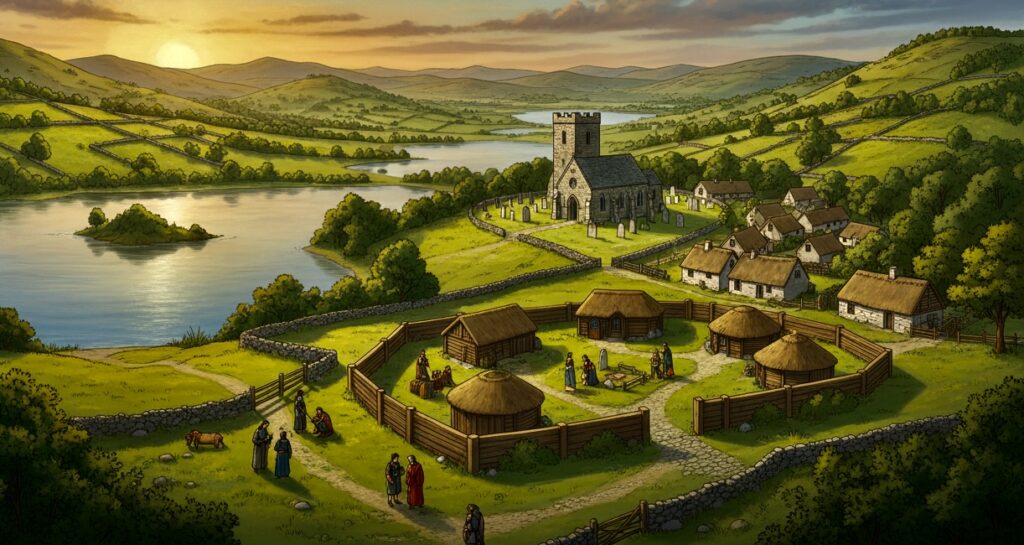
The real landscape was far less orderly. It contained hills, bogs, streams, roads, pasture, cultivated ground and scattered settlement.
Nor was Cenél Luacháin an isolated estate. Across the Diocese of Kilmore lay episcopal lands, erenachships, coarb lands, parish lands, monastic properties and other ecclesiastical holdings. Together they formed a substantial landed economy spread across much of Bréifne.
Ciaran Ó Scea’s study of erenachships in Gaelic Fermanagh is especially useful because he examines them as economic units rather than merely ecclesiastical offices. Church land contained hereditary landholders, lesser tenants, customary obligations, livestock and rents. The senior officeholder possessed the formal right, but a system of that size could not have depended upon him personally supervising every holding.
The internal complexity of Gaelic estates can be seen in the professional estates studied by FitzPatrick. At Ballaghdacker, an early fifteenth-century description of Ó Cuindlis lands recorded fields, roads, ditches, bog, woodland, arable areas and boundaries. At Cahermacnaghten the Ó Duibhdbábhoireann estate contained residences, gardens, roads, wells, grazing areas, milking places and subdivided holdings.
An estate was not simply acreage. It was a working arrangement of land, people, rights and resources.
The Missing Middle
The surviving evidence points toward a hierarchy beneath the senior officeholder.
At the top stood bishops, abbots, coarbs, erenachs, rectors and ruling lords. Beneath them must have been substantial hereditary families, local officers and landholders through whom those rights were made effective. Below them were tenants and agricultural workers.
The documentary record naturally favours the top. The working middle is much less visible.
Yet this was the level at which information had to move upward and demands had to move downward. Paul MacCotter’s reconstruction of medieval Irish territorial and economic divisions helps explain how this could operate. Units such as the baile biataigh, quarters and smaller subdivisions formed part of the structure through which land, settlement and obligations were organized.
If the Ó Maol Phádraig occupied part of this middle layer, the family itself was probably hierarchical. Some branches may have held substantial land and dealt directly with powerful patrons. Others may have worked much closer to individual estates and tenants. Over generations, one line could rise in standing while another remained embedded in the practical work of the estate.
That would help explain why later Ó Maol Phádraig records do not show every man at the same social level.
A Family That Had to Be Trusted
A family in this position would have required more than useful skills.
It would have required an exceptional reputation for reliability.
Estate administration meant access to the wealth of the institution: rents, livestock, food supplies, landholding arrangements and obligations owed by tenants. In a distant district, a trusted intermediary might operate with little direct supervision. If he concealed resources, favoured particular tenants, misrepresented what had been collected or shifted his loyalty to a rival lord, the consequences could be serious.
Trust therefore mattered as much as literacy or practical ability.
A family repeatedly entrusted with church land and local administration over generations would almost certainly have built its standing upon dependable service. In the case of Ó Maol Phádraig, the early clerical associations make it reasonable to ask whether devotion to the church formed part of that reputation.
The name itself does not prove piety, and neither does one clerical record prove the character of an entire family. But a family serving ecclesiastical institutions over generations would have needed to be regarded as safe, loyal and dependable.
For a ruling family such as the Ó Raghallaigh, that reliability would have been essential. For an ecclesiastical family such as the Ó Maolmochéirghe, it would have been equally important. Both depended upon people beneath them who could be trusted with valuable land, income and local knowledge.
Knowing What the Land Could Produce
Elizabeth FitzPatrick is careful about the limits of the surviving evidence. She describes knowledge of farming in Ireland between 1200 and 1600 as “remarkably poor” and notes the difficulty of determining whether evidence from learned estates was distinctive or representative of the wider population of service providers occupying lordly and church land.
What can be seen is the variety of resources involved.
Gaelic estates supported cattle, sheep and horses. They produced grain and dairy products. They contained pasture, gardens, woodland, rough grazing and cultivated land. Some included mills, cereal-drying kilns or specialised enclosures.
Practical administration therefore depended upon local knowledge as much as written records.
The useful intermediary needed to understand what different lands could support, how holdings were divided and who carried particular obligations. Literacy and numeracy would have helped with accounts, quantities and written agreements, but those skills were most valuable when combined with intimate knowledge of the district itself.
Horses, Cattle and Lordship
That knowledge mattered beyond ordinary agriculture.
FitzPatrick identifies horse grazing on professional estates and records horses being given in return for service. For ruling dynasties such as the Ó Raghallaigh, horses were essential for travel, communication, hunting and warfare.
Cattle were still more important. They represented food, movable wealth, tribute and reward. They could be transferred between families, driven with military forces or taken in raids.
Control of land therefore meant control of resources.
A ruling dynasty needed confidence that those resources could be identified and mobilized when required.
When the Lord Called a Hosting
Warfare shows the organizational demands of the system particularly clearly.
A Gaelic lord preparing for battle did not simply summon armed men. Men had to be fed. Horses required grazing and fodder. Cattle and provisions had to be assembled. Grain, meal, butter, meat and drink could have to be drawn from numerous holdings. Messages had to move between districts and supplies had to reach a gathering point at the correct time.
John Dymmok’s late-sixteenth-century description of Irish military obligations shows that provisioning was built into the system. A general rising-out required horsemen and kern together with victuals for a prescribed period. Bonaght similarly involved contributions toward the maintenance of military forces.
This was a logistical system, not an improvised scramble.
A demand could not be imposed efficiently unless somebody knew what a district contained and who was responsible for supplying it. The chief needed a dependable structure beneath him that could turn orders into men, animals and provisions.
That also helps explain why trusted families were valuable in border districts. Those families were close to the routes, livestock, settlements and communities from which resources might have to be mobilized quickly. In politically sensitive areas, competence without loyalty would not have been enough.
From Clerical Service to Landed Service?
The earliest surviving Ó Maol Phádraig records provide a possible starting point for understanding how such a role might have developed.
Some of the early evidence belongs to clerical settings. Those positions required literacy and familiarity with ecclesiastical institutions. Whatever the precise level of learning involved, such men possessed skills that were not universally distributed through medieval society.
The strongest early clerical line, however, belongs to the south of Ireland.
What happened to the northern lines may have been different.
In Bréifne, a family already accustomed to ecclesiastical service could have adapted those skills to the practical needs of church landholding. Literacy and some ability with numbers were useful not only to priests and clerks. They were equally useful when dealing with rents, divisions of land, quantities of produce and obligations spread across large estates.
If this occurred, it did not represent an abandonment of church service.
It was another form of it.
The northern Ó Maol Phádraig may increasingly have served the church by helping maintain the economic structure upon which its senior offices depended.
The family may also have developed its own internal hierarchy. Senior branches could become substantial landholders or trusted intermediaries dealing directly with major patrons. Other lines may have worked much closer to the everyday operation of individual estates. The same inherited tradition of service could therefore produce different levels of status several generations later.
Keeping the Structure Together
Families such as the Ó Raghallaigh and Ó Maolmochéirghe stood close to the upper levels of political and ecclesiastical authority in Bréifne.
Their position depended upon a structure beneath them that worked.
The value of a trusted service family was that those at the top did not need to know every field, payment or tenant themselves. They needed to know that someone reliable did.
That may have been where the northern Ó Maol Phádraig found their place.
There is no surviving document stating that estate administration was the hereditary function of the family, and the argument should remain a reconstruction. But the surrounding evidence creates a coherent model: specialist families could be placed where they were needed, borderlands were especially important, church estates were economically complex, and literacy combined with local knowledge had obvious practical value.
The early clerical evidence may preserve one part of the story. In the north, some branches may have evolved from clerical service into the practical administration of church and lordly land while retaining the trust and ecclesiastical loyalty that made such service possible.
That possibility becomes especially important as the story moves into the Tudor records.
Those records will show Ó Maol Phádraig men much more clearly, but in a world whose older institutions were already under pressure and changing rapidly. Their titles and associations in the sixteenth century may describe where they stood at that moment without explaining how their families had acquired that position.
Understanding the older service structure may therefore be essential to interpreting what appears next.
The Tudor records do not simply introduce a new chapter in the family’s history.
They may begin to reveal what remained after the older system had started to come apart.
References
Duffy, Patrick J. Studies of Gaelic territorial and social organisation, including the Mac Mathghamhna lordship of Airgialla, in Gaelic Ireland: Land, Lordship and Settlement, c.1250–c.1650.
Dymmok, John. A Treatise of Ireland.
Edwards, David, Elizabeth FitzPatrick and Patrick J. Duffy, eds. Gaelic Ireland: Land, Lordship and Settlement, c.1250–c.1650.
FitzPatrick, Elizabeth. Landscapes of the Learned: The Gaelic Literati in Ireland and Scotland, 1200–1800.
MacCotter, Paul. Medieval Ireland: Territorial, Political and Economic Divisions.
Ó Scea, Ciaran. “Erenachs, Erenachships and Church Landholding in Gaelic Fermanagh, 1270–1609.” Proceedings of the Royal Irish Academy.
Simms, Katharine. From Kings to Warlords: The Changing Political Structure of Gaelic Ireland in the Later Middle Ages.