
Down the Research Rabbit Hole
One of the greatest challenges in historical research is keeping the work on track.
A question may begin with one person or one place. Then an unfamiliar surname appears in a footnote. A document mentions an institution that was not part of the original investigation. Before long, the research has moved into a completely different century or crossed from one side of Ireland to the other.
That is not always wasted time. Some of the most revealing discoveries begin as distractions.
This particular journey began while I was writing about St Michael’s Mount at Ballinskelligs. I had collected an archaeological survey of the abbey and graveyard some time ago, but had never examined it closely. While reading through the list of burials, I began checking the surnames and the number of surviving memorials.
The names included Fitzpatrick, King, Barry, McCarthy, O’Sullivan and Fitzgerald.
Fitzpatrick immediately attracted attention because Alan, Gilbert and Gillasenan Ó Maol Phádraig had been connected with St Michael’s Mount around 1400. King was interesting because some surname sources associate it with names also rendered Conry or Conroy. The Barry name opened another trail entirely.
Robert Ó Maol Phádraig and the de Barrys
The Barry burials brought to mind the earliest securely dated southern record of the Ó Maol Phádraig surname.
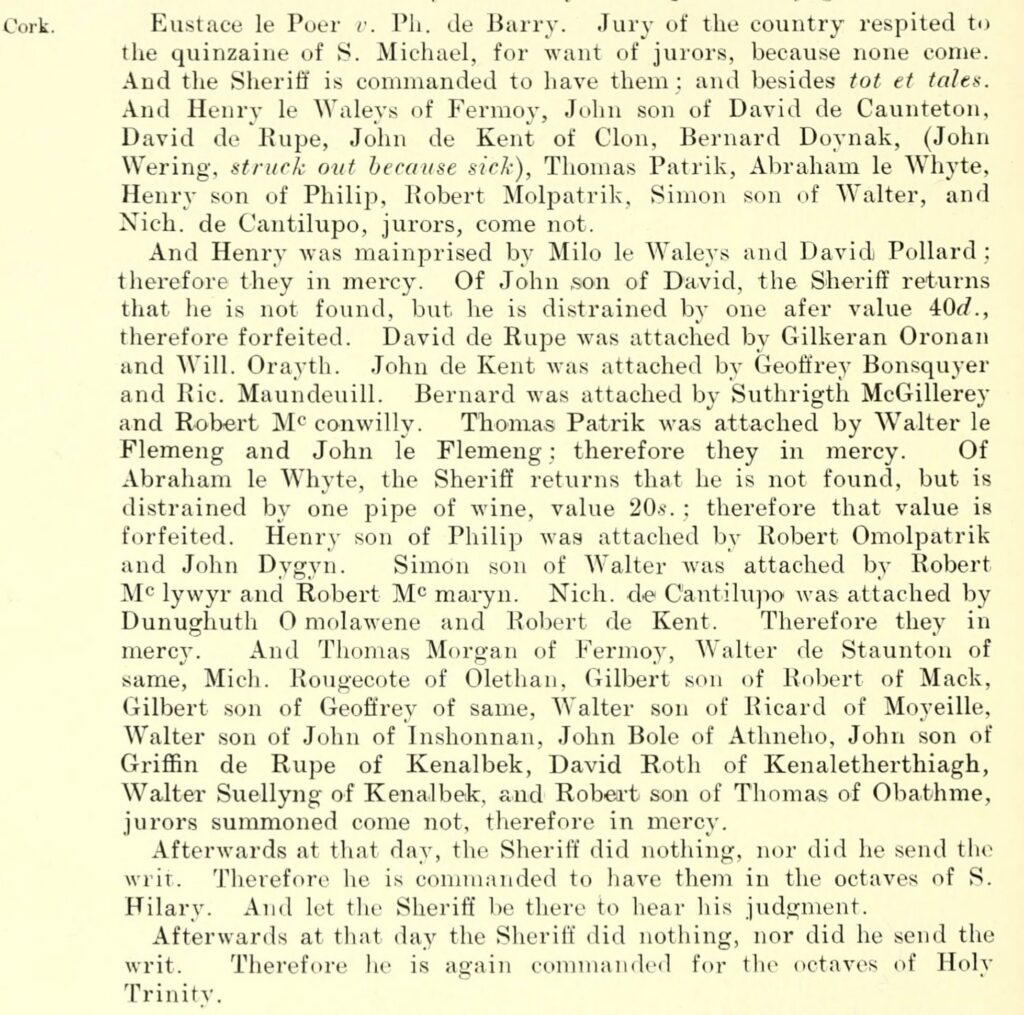
In 1306, Robert Ó Maol Phádraig appeared among the jurors summoned in a County Cork case between Eustace le Poer and Philip de Barry. He was written once as Robert Molpatrik and later as Robert Omolpatrik.
The brief entry does not identify his home or occupation. It does not explain the original dispute. It records only the failure of the jury to appear and the legal measures used to secure their attendance.
Robert appears twice. He was one of the absent jurors, but he had also acted with John Dygyn as a pledge for Henry son of Philip. This placed him within the machinery through which the sheriff attempted to compel attendance.
That deserves more attention than a passing reference to “Robert the juror.”
Medieval jurors were not chosen randomly from the entire population. They were selected from recognised local men who were expected to possess knowledge of the district and its inhabitants. The jury list included men connected with Fermoy and Olethan. It also contained members of established Anglo-Norman families and men bearing Gaelic surnames.
Robert was functioning within that mixed society.
The record does not call him a lawyer or cleric. His selection nevertheless suggests that he was considered suitable for county jury service. His additional role as a pledge shows that he was already trusted to participate in the enforcement of legal obligations.
The investigation could easily have ended there. Instead, the de Barry name raised another question.
Who were they, and what institutions did they support?
Ballybeg and the Augustinian connection
The de Barry family founded and endowed Ballybeg Priory near Buttevant for the Canons Regular of St Augustine. The foundation is traditionally dated to 1229 and associated with Philip de Barry, although later members of the family contributed to its development.
The Philip involved in Robert’s case was not the original founder. He belonged to a later generation of the same dynasty.
That distinction does not weaken the institutional connection. Robert appeared within the legal world of a family that had maintained a large Augustinian priory for generations.
Ballybeg required canons and administrators. It controlled property and dependent churches. Its patrons could recommend men and create opportunities for families already associated with religious service.
Then another unexpected fact emerged.
Ballybeg possessed a dependent Augustinian cell at Crossmolina in County Mayo.
John Ryan’s study of the two houses concluded that Crossmolina had been founded from Ballybeg and remained dependent upon it until the dissolution. Crossmolina existed by 1306. Papal records later describe it as belonging to the prior and convent of Ballybeg, while members of the Barrett family exercised local patronage.
This was not merely a distant piece of property listed in an estate account. Personnel moved through the connection. John Barrett served at Crossmolina, became a canon and prior of Ballybeg, and later held offices at Killala. Other Barretts repeatedly obtained positions at the cell.
A functioning ecclesiastical route therefore linked north Cork with north Mayo.
Crossmolina and the older northern landscape
Crossmolina stood only a short distance from Killala. Its Irish name, Crois Uí Mhaoilfhíona, preserved the name of the Ó Maoilfhiona family that had dominated the area before the Anglo-Norman consolidation.
Flaithbheartach Ó Maoilfhiona was killed in 1269. Ryan believed effective Anglo-Norman occupation followed after about 1270, with the Augustinian foundation probably being established toward the end of the century. This date is a historical reconstruction rather than the date of a surviving foundation charter.
The place-name suggests that a sacred centre already existed before Ballybeg established its Augustinian cell. The later priory may have reorganised an older church rather than founded religious life on an unused site.
The Ó Maoilfhiona and the Ó Maolchonaire were distinct families, but the Hy Fiachrach genealogies placed them within the same wider Uí Amhalghadha ancestry. They occupied neighbouring parts of the north-Mayo landscape.
Ó Maolchonaire was associated with Caille Conaill near the Killala coast. Ó Maoilfhiona was associated with the Crossmolina district farther inland. The distance between these areas presents no real difficulty for hereditary learned or ecclesiastical families, whose members could operate beyond a principal family centre.
Ballybeg was therefore entering a northern landscape already occupied by older ruling, learned and church families. It may have acquired access to their personnel and relationships along with the church itself.
No surviving record names an Ó Maolchonaire at Crossmolina. It would be wrong to insert the family into the house without documentary evidence. Yet Ballybeg had gained a permanent institutional foothold close to the region from which the Ó Maolchonaire tradition emerged.
The timing is remarkable.
Ballybeg was established in the de Barry world during the thirteenth century. Its northern dependency existed by 1306. In that same year, Robert Ó Maol Phádraig appeared in a de Barry case in Cork. Less than a century later, members of the Ó Maol Phádraig and Ó Maolchonaire families were serving together at St Michael’s Mount in Kerry.
Robert may never have visited Crossmolina. He may not have served at Ballybeg. He could have come through another religious house or belonged to an older southern branch. None of those possibilities can presently be chosen with confidence.
What can be identified is the network through which such movement was possible.
Writing a record dry
This is what I mean by writing a record dry.
The words preserved in the 1306 court entry are only the beginning. The other jurors must be examined. The families behind the dispute must be identified. The legal procedure has to be understood. The institutions patronised by those families may then reveal relationships that the original record never explains.
The de Barry name led to Ballybeg. Ballybeg led to Crossmolina. Crossmolina led back toward Killala and the older north-Mayo church landscape. That in turn returned the investigation to the Ó Maolchonaire and to the later community at St Michael’s Mount.
The original court entry still does not tell us where Robert came from. Yet it can no longer be treated as the isolated appearance of an Ó Maol Phádraig man who happened to be in Cork.
He was participating in the legal world of a major Catholic dynasty whose Augustinian patronage reached from Cork into north Mayo. He was sufficiently established to be selected as a juror and to serve as a pledge for another man.
Was his family placed in Cork through that religious network?
We may never know. Another record may still be waiting in a papal calendar, an estate document or a forgotten local history. Even without that missing document, the investigation has identified a practical route through which an educated northern church family could have entered the de Barry sphere.
The Norman and Irish families involved did not belong to opposing religions. They were Catholics who lived under the same canon law and recognised papal authority. Their political interests often conflicted, but the Church gave them common institutions through which education and patronage could cross ethnic boundaries.
Once again, an Ó Maol Phádraig record appears only one or two steps away from an Ó Maolchonaire connection.
AI: a blessing and a curse
Artificial intelligence has become part of this research, and my experience with it has been both extremely productive and deeply frustrating.
At times, it is an extraordinary tool. It can help organise hundreds of notes, compare spellings and suggest connections between records gathered months apart. It can search for unfamiliar names and explain the structure of difficult legal documents. More than once it has noticed a relationship that I had overlooked.
At other times, it is the worst research assistant imaginable.
It can misunderstand a source and then defend the misunderstanding with complete confidence. It can combine two unrelated people into one life. It can invent books, records and quotations that do not exist. A plausible sentence may conceal an entirely imaginary fact.
There have been several occasions when I became convinced that the tool would never be useful. I discarded large amounts of work and considered abandoning it altogether. Then a carefully directed search produced a major advance, and the research moved forward again.
Learning to use it has required developing a system.
Important facts must be preserved in written summaries because its working memory is limited. Those summaries need to be corrected and updated as the research develops. Clear rules must be repeated. Every important statement must still be checked against the original source.
The tool becomes more useful as the research becomes better organised, but it never becomes safe to trust without verification.
That places responsibility firmly with the researcher. Artificial intelligence can suggest a route, but it cannot be allowed to decide whether the route is real. It may identify a name in a graveyard or bring together several distant records. The documents must still be opened and read. Dates must be checked. People with similar names must be separated.
Used carelessly, it can pollute an entire body of research.
Used critically, it can make connections that would once have required months of searching.
It is both a blessing and a curse. It is also an amazing research tool, provided the researcher survives the temptation to smash the computer first.
One more name in the graveyard
There is another possible connection hidden among the Ballinskelligs burials.
The archaeological survey records ten King memorials. Nineteenth-century records show that King was not represented by one recently arrived household. It had become a substantial local surname in Prior parish, while Fitzpatrick was also concentrated there.
Some modern surname references include King among names associated with Conry, Conroy or O’Mulconry. That has led to the possibility that at least some King families may descend from an Ó Maolchonaire line. However, the evidence is not as clear as it first appears.
Patrick Woulfe’s authoritative entry for Ó Maolchonaire gives the later forms O’Mulconry, Mulconry, Conry and Conroy. It does not list King.
Woulfe does list King as a translation of the separate surname Mac Conraoi. The similarity of the later forms Conry and Conroy allowed several originally different Gaelic surnames to become confused during anglicisation. Modern surname compilations sometimes place Mulconry and King together, but they do not usually explain whether this is a documented Ó Maolchonaire transition or the result of later Conry and Conroy names being grouped together.
The possibility cannot be dismissed, but neither can it be stated as fact.
The Ballinskelligs Kings may have had an entirely different origin. King could represent Mac Conraoi, another Gaelic surname or an English surname already present in Ireland. No document has yet been found showing a Ballinskelligs family changing its name from Ó Maolchonaire to King.
Yet the location demands further investigation.
The medieval Ó Maolchonaire became deeply established at St Michael’s Mount. Members of the family repeatedly held authority there, and their influence continued for generations. Centuries later, a large Catholic King population lived in the parish and buried its dead at the old priory.
That may be another coincidence.
It may also be the next rabbit hole.
References
Bliss, W. H., and J. A. Twemlow, eds. Calendar of Entries in the Papal Registers Relating to Great Britain and Ireland: Papal Letters, Vols. IV–V. London: His Majesty’s Stationery Office, 1902–1904.
Mac Fhirbhisigh, Dubhaltach. The Genealogies, Tribes and Customs of Hy-Fiachrach. Edited and translated by John O’Donovan. Dublin: Irish Archaeological Society, 1844.
Mills, James, ed. Calendar of the Justiciary Rolls or Proceedings in the Court of the Justiciar of Ireland, 1305–1307. Dublin: His Majesty’s Stationery Office, 1914.
Ryan, John. “Augustinian Religious Houses at Buttevant and Crossmolina.” Journal of the Cork Historical and Archaeological Society 46, no. 163 (1941): 76–79.
Woulfe, Patrick. Irish Names and Surnames. Dublin: M. H. Gill & Son, 1923.
Archaeological Survey of Ballinskelligs Church and Graveyard, Ballinskelligs, County Kerry. Kerry County Council, 2012.