
Killala and the Survival of an Older Conmaicne Church Network
The early history of Ó Maolchonaire leads back to the country around Killala, where the family appears among the hereditary peoples of Caille Conaill. This western placement is important because Killala was not simply a later centre of Uí Fhiachrach authority. It stood within one of the oldest recorded Patrician church landscapes in Connacht, extending through Tír Amhalgaidh, the lower Moy, the Wood of Fochloth and the neighbouring districts of north Mayo and west Sligo.
The evidence placing Ó Maolchonaire in this region comes directly from the genealogical and territorial traditions published by John O’Donovan in The Genealogies, Tribes and Customs of Hy-Fiachrach. O’Donovan prepared the work from the genealogical manuscript compiled by Dubhaltach Mac Fhirbhisigh, whose account closely followed material preserved in the Book of Lecan while adding information from other authorities. The record therefore belongs to the learned tradition of the hereditary historians of north Connacht rather than to a later attempt to locate the family from its better-known history elsewhere.
In the passage describing the descendants of Amhalgaidh, the text states that Fergus son of Amhalgaidh had two sons, Conaing and Muireadhach. From Conaing came the population occupying Caille Conaill in the north, a district described as extending from Trá Murbhaigh to Fearsad Tresi. The text then names the hereditary families of Caille: Ó Deirg, Ó hAodha of Ard Ó nAodha, Ó Maolchonaire, Ó Flannabhra and Ó Tegha.
Ó Maolchonaire is therefore placed by name within a formal territorial roster of the peoples of Caille Conaill. The family stands beside other hereditary kindreds of the district and appears within the same regional survey that describes Breudach, Uí Eachach Muaidhe, Tír Fhiachrach and the neighbouring territories of the lower Moy.
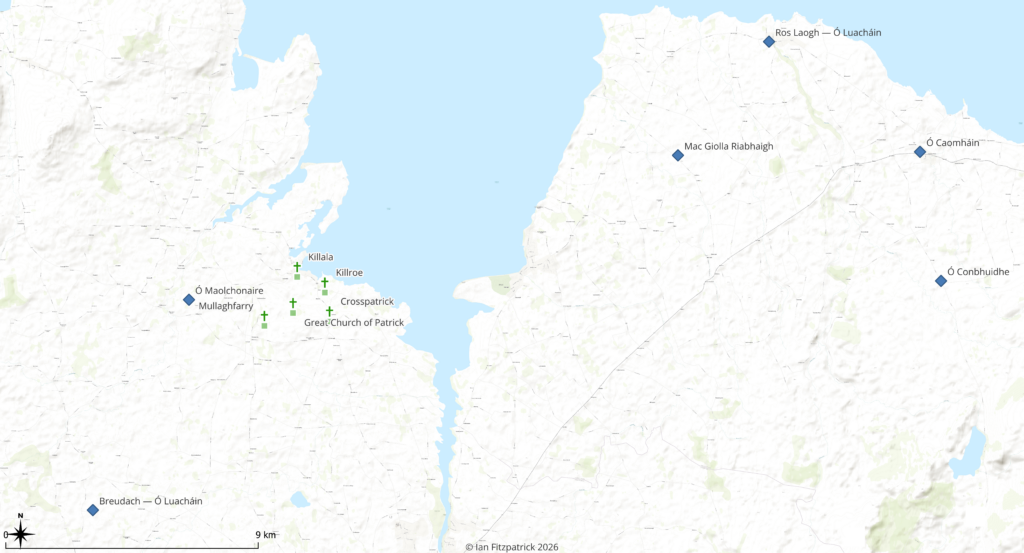
Caille Conaill lay south-west of Killala Bay, approximately around Crosspatrick, Killroe, Mullaghfarry and Foghill. This was also the country associated with the Wood of Fochloth and the Great Church of Patrick described in the Patrician material preserved in the Book of Armagh.
The close geographical relationship between Caille Conaill and the Wood of Fochloth is striking. Ó Maolchonaire was remembered among the hereditary families of the district in which one of the principal western Patrician church organisations had been located.
The Great Church of Patrick appears to have represented more than a single building. The church landscape around Killala, Crosspatrick, Killroe and Mullaghfarry formed part of a regional Patrician organisation in which churches, territories and clerical families were bound together. The relationships created through this system extended beyond individual settlements and across later political boundaries.
Over the centuries these churches acquired lands, tenants, legal privileges and hereditary officers. Families became attached to particular foundations as clerics, coarbs, erenaghs, administrators and custodians of church property. Their relationship with a church could endure through political change because the lands, local cults and hereditary offices often remained in place after the ruling dynasty had changed.
The genealogy places the peoples of Caille Conaill beneath Conaing son of Fergus son of Amhalgaidh and ultimately within the ancestry of the Uí Fhiachrach. Yet it does not provide a continuous historical pedigree leading from a recognizable member of Ó Maolchonaire back through those remote generations. Its method is collective. A number of territorial families are identified and the entire population is then incorporated into a single ancestral structure.
Medieval Irish genealogy often expressed territorial membership, service, alliance, fosterage and ecclesiastical dependence as paternal descent. A family could become fully accepted within a regional order without having originated as a biological branch of the dynasty that later claimed it.
The Caille Conaill record may therefore preserve two layers of history. The geographical memory firmly associates Ó Maolchonaire with the Killala region, while the remote descent records the family’s incorporation into the Uí Fhiachrach political and genealogical structure.
The possibility of an older population beneath that structure becomes much stronger when the other hereditary families of Killala, Tirawley and Tireragh are compared with the Cenél Luacháin genealogy.
Mike Fitzpatrick and Proinsias Mag Fhionnghaile reproduced the relevant genealogical material in Ó Maol Phádraig: the Name, the People, and the Clans, Part II. Their appendix contains a long list of collateral families attached to the wider Conmhaicne Fhinnir and Cenél Luacháin descent structure. It is not another pedigree of Ó Maol Phádraig. It is a roster of parallel families placed beneath Luachán and Máelgenn, with Ó Maol Phádraig forming only one branch among many.
Most of those names later disappear from the surviving historical record. Ó Maol Phádraig and Ó Maolmochéirghe remained visible, but many collateral families have no securely identified modern equivalent. Their apparent disappearance may reflect surname change, translation, replacement, the ending of hereditary office or their descent into an ordinary social position that left few written records.
Uí Chailti provides a valuable example of how one of these apparently lost families could survive beyond the genealogy.
The Book of Fenagh places Uí Chailti immediately beside Uí Máelpatraig. Cailti and Máel Pátraic are presented as brothers, sons of Máelgenn, and their descendants as parallel branches within the same wider kindred. The editor associated Uí Chailti with the later forms O’Keelty or Keelty, but for many years the family appeared to be known only from the genealogy.
A Tudor Fiant of 1585 records Brien son of Shane O Kiltie and Brian son of Nele O Kiltie, both husbandmen of Ballintober in County Roscommon. The presence of two men carrying the same uncommon surname in one locality shows that O Kiltie was an established hereditary family rather than an isolated personal designation.
The surrounding names place them within the native Gaelic society of the O’Conor Don lordship. The Fiant includes O’Conors, O’Flynns, O’Hanlys, O’Mulrenans, O’Lavines, MacDermotts, MacSweeneys and other families belonging to the political and social world of central Connacht.
The name also survived in the local landscape. Keely, later written Keily and Keelty, appears in the parish of Ballintober and formed part of the O’Conor Don estate around Ballintober Castle. Later records show Keelty and Kielty families concentrated in the Roscommon and south Sligo borderlands, particularly around Drumrat and Boyle.
A complete line between the medieval Uí Chailti and the O Kilties of Ballintober has not yet been recovered. Even so, the documentary sequence demonstrates that a rare surname corresponding closely with one of the Cenél Luacháin branches remained alive within the wider western Connacht world centuries after the genealogy had been preserved.
Uí Chailti also changes the way the disappeared names should be viewed. Some collateral branches may survive beneath altered forms that have not yet been recognised. Others may remain hidden in land records, fiants, papal registers or local placenames. The long family list probably preserves more historical reality than its later silence initially suggests.
The Killala and Tireragh evidence is especially significant because several names from that list reappear together within the Uí Fhiachrach territorial tradition.
Ó Luacháin is the clearest example. The Uí Fhiachrach material records Ó Luacháin on the western side of Breudach and also names Ó Luacháin of Ros Laogh. O’Donovan identified Ros Laogh with Rosslee near Easkey in Tireragh. Another tradition places Ó Luacháin inside the household world of the Ó Dubhda through the fostering of Taithleach Muaidhe.
The Luachán name was therefore carried by an established hereditary family within Uí Fhiachrach territory. Its presence near Easkey and in Breudach places the central ancestral name of the Cenél Luacháin genealogy inside the north-western Connacht landscape.
Mac Giolla Riabhaigh supplies another direct connection. This family appears in the long collateral list reproduced in the Ó Maol Phádraig study. It belongs within the wider Cenél Luacháin block as a parallel branch rather than as a descendant of Ó Maol Phádraig.
The Uí Fhiachrach material independently records Mac Giolla Riabhaigh of Criochan. O’Donovan identified Criochan with Creaghaun in the parish of Skreen, barony of Tireragh. Another family preserved within the Cenél Luacháin genealogical structure was therefore established inside Uí Fhiachrach territory on the western side of Sligo.
Ó Caomháin presents a similarly strong case. Meic Caomháin appear in the Cenél Luacháin family list, while the Uí Fhiachrach tradition assigns Ó Caomháin a territory extending from Tuaim dá Bhodhar toward Gleoir. In modern geographical terms, this ran approximately from the Toomore and Dromore West area through Templeboy toward the Easkey River.
The family also held ceremonial privileges connected with the inauguration of Ó Dubhda. Their role demonstrates a high level of integration within the Uí Fhiachrach political system. A family preserved among the collateral branches of Cenél Luacháin had become part of the ceremonial order through which Uí Fhiachrach authority was publicly expressed.
Mac Cobhthaigh appears in the same broader genealogical group. The Uí Fhiachrach landscape preserves Dún Uí Chobhthaigh, identified with Doonycoy in Templeboy parish. The survival of the family name in a territorial designation inside the same Tireragh district adds another element to the pattern.
Ó Duinchinn is listed among the wider Cenél Luacháin families and appears in the Uí Fhiachrach material as Ó Duinchinn of Doire na nAth. Ó Conbhuidhe is also represented in the wider genealogical block and was associated with territory extending toward Dún Néill and Muirisg.
Several additional names from the list later remained heavily concentrated in Mayo or the neighbouring north Connacht counties. These include families represented by the later surnames Lavelle, Hoban, Cloonan or Cluvane, Sloyan, Duane or Devane, Tully and Tormey. Their later distribution carries less weight than an explicit medieval territorial placement, but it adds to the broader western concentration.
The pattern is not dependent upon one surname. Ó Luacháin, Mac Giolla Riabhaigh, Ó Caomháin, Mac Cobhthaigh, Ó Duinchinn and Ó Conbhuidhe all belong to, or correspond closely with, the wider family group attached to Cenél Luacháin. They also appear within the Uí Fhiachrach world of Killala, Tirawley and Tireragh.
Ó Maolchonaire stands at the centre of this pattern because its western placement is direct and specific. The Mac Fhirbhisigh text names the family as one of the hereditary peoples of Caille Conaill. That district lay beside the Great Church of Patrick in the Wood of Fochloth. Ó Maolchonaire was therefore remembered within both a Uí Fhiachrach territorial order and an ancient Patrician ecclesiastical landscape.
The concentration of related names suggests that these families may not all have travelled westward from the later Cenél Luacháin territory. An older population may already have been distributed across western and north-central Connacht before the later dynastic map took its familiar form.
In that model, the expansion of Uí Fhiachrach authority did not replace the existing church population. Older families remained attached to their churches and lands, accepted the authority of new rulers and gradually became incorporated into the genealogical structure of the dominant dynasty. Their political identity became Uí Fhiachrach while traces of an earlier Conmaicne or Cenél Luacháin connection survived in their surnames and inherited church relationships.
The Mac Céile family provides the clearest institutional bridge between Killala and Fenagh.
The Annals of the Four Masters record that Máel Pátraic Mac Kele, erenagh of Killala, was slain in 1257. The Uí Fhiachrach genealogical tradition traces the Mac Céiles of Cill Ealaidh from Mo Céile Ó Máelfhoghmair and preserves a succession of ecclesiastical figures from the family. Their repeated association with Killala identifies them as a hereditary church dynasty rather than an ordinary territorial sept.
O’Donovan connected the Mac Céile name with the later Mac Hale surname. Patrick Woulfe later described the family as hereditary erenaghs of Killala and as coarbs of St Caillín at Fenagh.
The Fenagh connection is supported by a separate historical record. Katharine Simms, in her study of the Donegal poems preserved in the Book of Fenagh, identified Giolla na Naomh Mac Céile, who died in 1331, as coarb of Fenagh. Woulfe’s description therefore brings together two documented offices held by members of the same ecclesiastical kindred: the erenaghship of Killala and the coarbship of Fenagh.
The sequence is important. Máel Pátraic Mac Céile was recorded as erenagh of Killala in 1257. Less than a century later Giolla na Naomh Mac Céile appears as coarb of Fenagh. The family’s institutional connection between the two churches is therefore supported by annalistic and scholarly evidence rather than by surname tradition alone.
A hereditary church family rooted in the Patrician landscape of Killala had established a recognised place at Caillín’s principal foundation in the Conmaicne world.
The personal name Máel Pátraic adds another layer to the connection. A man bearing the devotional name from which Ó Maol Phádraig arose belonged to the Killala branch of the same family that later supplied a coarb of Fenagh. His name does not make him an ancestor of the later Ó Maol Phádraig surname, but it places the Máel Pátraic tradition within the ecclesiastical kindred that connected Killala and Fenagh.
The hereditary families of these churches would have shared knowledge through the church structure. They were not isolated households confined to their own townlands. Clerics travelled between foundations, learned families copied texts, coarbs and erenaghs managed lands, and churchmen acted as negotiators, witnesses and legal representatives. Kinship, fosterage, patronage and education carried information across diocesan and political boundaries.
A family in Caille Conaill could know the traditions and personnel of churches around the lower Moy, Tireragh, Fenagh and Lough Cé. A hereditary officer at Killala could maintain a recognised relationship with the coarbship of Caillín. Genealogies preserved one expression of those connections, while church offices and annalistic records preserved another.
Later medieval evidence shows Irish hereditary church families communicating directly with the papal administration, presenting disputes, pursuing benefices and using Roman legal procedure with considerable confidence. Such knowledge rested on established lines of communication. Earlier generations may already have possessed connections reaching far beyond Connacht, perhaps ultimately to Rome itself, even though the records naming them have not survived.
The surviving papal registers begin to illuminate relationships that were probably older than the documents in which they first appear. Institutional knowledge usually develops over generations. By the time hereditary church families are found navigating papal law, they were drawing upon a church culture and network of contacts that had already matured.
Killala may therefore preserve part of a much wider ecclesiastical system. Its Patrician foundations, hereditary families and links with Fenagh belonged to a world in which knowledge and relationships travelled farther than the surviving political histories suggest.
This offers a plausible explanation for an early connection between Ó Maolchonaire and Ó Maol Phádraig.
Ó Maolchonaire was remembered among the hereditary peoples of Caille Conaill, beside the Great Church of Patrick in the Wood of Fochloth. Ó Maol Phádraig was preserved within the Cenél Luacháin genealogical tradition. Several collateral families from the same genealogy also appear inside the Uí Fhiachrach landscape, while the Mac Céile dynasty connected the erenaghship of Killala with the coarbship of Caillín at Fenagh.
The worlds represented by those records were therefore not separate. An older Conmaicne-based church network may already have linked the Patrician communities around Killala with Fenagh and the central Connacht church landscape. Families later classified as Uí Fhiachrach could have inherited relationships formed before that political identity became dominant.
Under this interpretation, Ó Maolchonaire and Ó Maol Phádraig may have shared knowledge of one another long before their later documentary histories become visible. Their association could have arisen through hereditary churches, learned families, patronage and the circulation of genealogical and ecclesiastical knowledge across western Connacht.
The later history of Ó Maolchonaire will reveal how much farther these connections extended. That evidence belongs to the posts that follow. For now, the Killala material establishes the foundation of the theory: Ó Maolchonaire was remembered as a hereditary family of Caille Conaill within the oldest Patrician church landscape of western Connacht, while a notable cluster of Cenél Luacháin names survived inside the surrounding Uí Fhiachrach structure.
Beneath the later dynastic map, the outline of an older Conmaicne ecclesiastical world may still be visible.
References
Etchingham, Colmán, and Catherine Swift. “Early Irish Church Organisation: The Case of Drumlease and the Book of Armagh.” Breifne 10, no. 37, 2001.
Fitzpatrick, Ian, and Mike Fitzpatrick. “Ó Maol Phádraig: The Name, the People, and the Clans. Part I.” Journal of the Fitzpatrick Clan Society 4, 2023, 1–10.
Fitzpatrick, Mike, and Proinsias Mag Fhionnghaile. “Ó Maol Phádraig: The Name, the People, and the Clans. Part II.” Journal of the Fitzpatrick Clan Society 5, 2024, 25–42.
Mac Fhirbhisigh, Dubhaltach. The Genealogies, Tribes, and Customs of Hy-Fiachrach, Commonly Called O’Dowda’s Country. Edited and translated by John O’Donovan. Dublin: Irish Archaeological Society, 1844.
O’Donovan, John, ed. and trans. Annals of the Kingdom of Ireland by the Four Masters. Dublin: Hodges, Smith and Company, 1856.
Simms, Katharine. “The Donegal Poems in the Book of Fenagh.”
Stokes, Whitley, ed. and trans. The Book of Fenagh. Dublin: Alexander Thom, 1875.
Woulfe, Patrick. Sloinnte Gaedheal is Gall: Irish Names and Surnames. Dublin: M. H. Gill and Son, 1923.